
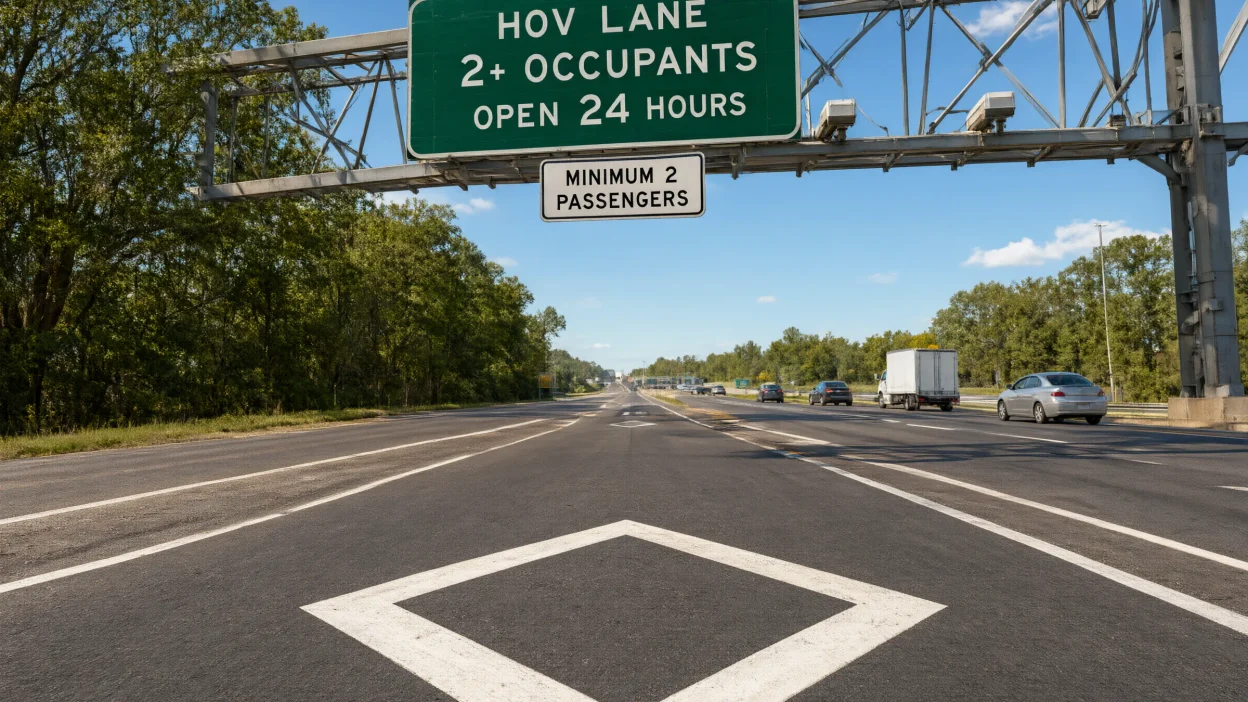
HOV means High-Occupancy Vehicle. The term describes a car, van, bus, or other vehicle that carries a required number of people.
On US roads, the term is most often used when talking about HOV lanes. These are special traffic lanes set aside for vehicles that meet the posted occupancy rules.
For example, imagine a highway sign that says “HOV 2+.” This usually means a vehicle must have at least two people inside, including the driver, to use that lane during the hours when the restriction applies.
If a sign says “HOV 3+,” the vehicle generally needs at least three people, including the driver.
The exact rules depend on the road, state, and posted signs.
What Does HOV Stand for in Driving?
In driving, HOV stands for High-Occupancy Vehicle. It is a traffic term used to identify vehicles that carry multiple people.
You may see the term on:
- Highway signs
- Road maps and navigation apps
- Traffic reports
- Carpool lane signs
- State transportation websites
HOV is not a type of car or a special car brand. It describes how many people are traveling in a vehicle under the rules for a specific lane.
What Is an HOV Lane?
An HOV lane is a highway lane reserved for vehicles that meet certain passenger requirements.
It is designed to encourage carpooling and help move more people using fewer vehicles.
For example, if three coworkers travel to work in one car, they may be allowed to use an HOV lane that requires two or more people.
A driver traveling alone may not qualify during restricted hours.
HOV lanes may be located on the left side of a highway, but their location can vary.
They are often marked with a diamond symbol and signs showing the number of people required.
How Do HOV Lanes Work?
HOV lanes work by giving eligible vehicles access to a special lane under posted traffic rules.
The rules may apply all day or only during certain hours.
The main goal is to encourage people to share rides. When more people travel together, fewer cars may be needed to move the same number of people.
Here is a simple example.
Suppose three people are traveling to the same office. Instead of taking three separate cars, they ride together in one vehicle.
If the highway has an HOV lane that allows vehicles with two or more occupants, their car may qualify.
A driver traveling alone may need to stay in the regular lanes during the restricted period.
How Many People Do You Need for an HOV Lane?
The number of people required depends on the posted sign.
Common examples include:
- HOV 2+: Two or more people in the vehicle.
- HOV 3+: Three or more people in the vehicle.
- HOV 4+: Four or more people, where such a rule is posted.
The driver usually counts as one person. For example, a driver and one passenger generally meet a two-person requirement.
Always check the sign at the entrance to the lane. Do not assume every HOV lane has the same rules.
When Can You Use an HOV Lane?
Some HOV lanes operate only during rush hour. Others have restrictions throughout the day or at all times.
A sign might show that the lane is restricted from 6 a.m. to 9 a.m. and again from 3 p.m. to 7 p.m. If so, the occupancy rule applies during those hours as shown on the sign.
Outside the restricted hours, the lane may be open to other vehicles, depending on the local rules.
Some roads also have separate rules for motorcycles, buses, or eligible clean-air vehicles. These exceptions vary by location and may require special permits or stickers.
Never rely only on the time of day or the type of vehicle you drive. Read the posted signs before entering the lane.
Who Can Use HOV Lanes?
Who Can Use HOV Lanes?
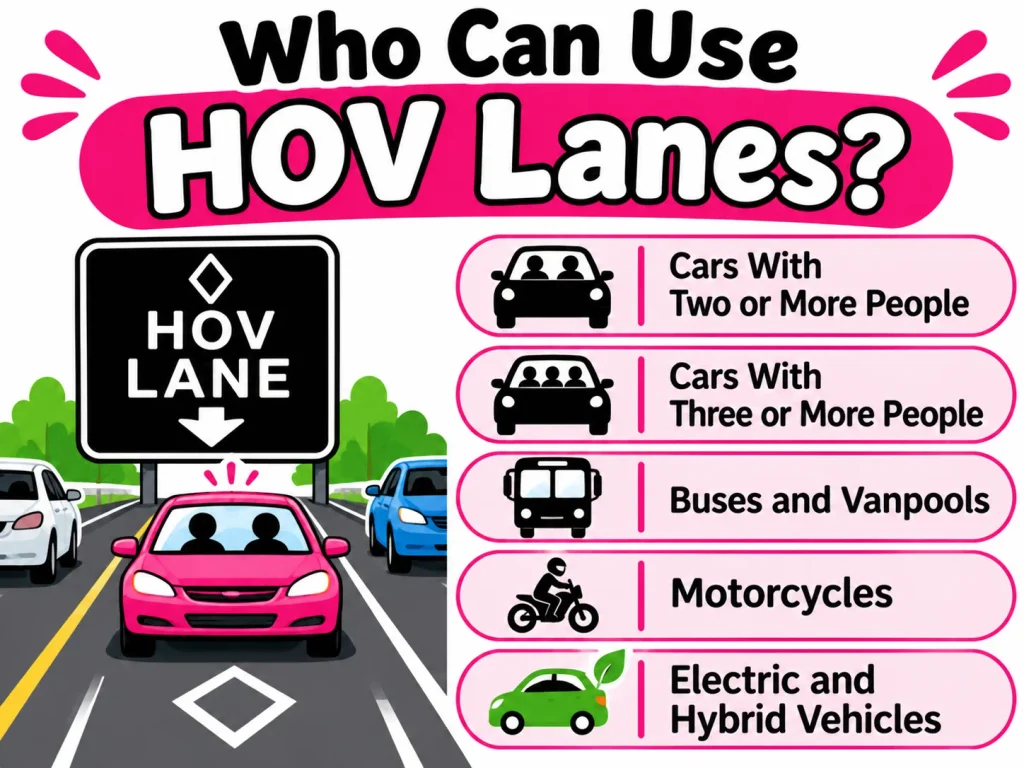
Not every vehicle can use an HOV lane at every time. Access depends on the number of people inside the vehicle and the rules for that road.
Cars With Two or More People
Many HOV lanes allow cars with at least two people, including the driver. These people may be family members, friends, coworkers, or other passengers.
For example, a parent driving with a child may meet a two-person rule if the local lane rules count both people.
Cars With Three or More People
Some lanes require three or more people. A driver with two passengers would meet this requirement.
Always check the sign because a car that qualifies for an HOV 2+ lane may not qualify for an HOV 3+ lane.
Buses and Vanpools
Public buses and eligible vanpools can often use HOV lanes. These vehicles carry many people and help reduce the number of cars on the road.
Some roads have special rules for buses, so check the posted signs.
Motorcycles
Motorcycles may be allowed to use HOV lanes even when carrying only one person. However, you should check the rules for the road you are using.
Electric and Hybrid Vehicles
Owning an electric or hybrid car does not automatically give you permission to use an HOV lane alone.
Special access rules have changed over time. For example, the federal clean-vehicle exemption expired on September 30, 2025.
Drivers should check current federal and state rules before relying on a vehicle’s fuel type for HOV access. <Cite refs={“turn127565search5″,”turn127565search6″”turn127565search5″,”turn127565search6”}/>
What Do HOV Road Signs Mean?
HOV signs tell drivers who can use a lane and when the rules apply. Reading these signs helps you avoid entering a lane you are not allowed to use.
Here are some common signs and their meanings.
| HOV sign | What it means |
| HOV 2+ | At least two people must be in the vehicle. |
| HOV 3+ | At least three people must be in the vehicle. |
| HOV Only | The lane is reserved for vehicles that meet its posted rules. |
| HOV 2+ 6–9 AM | The two-person rule applies during the listed morning hours. |
| Diamond symbol | Often marks a lane reserved for HOV traffic. |
| HOV/Express | May identify a managed lane with special access or toll rules. |
The Federal Highway Administration explains that HOV lanes are often marked with signs and diamond symbols painted on the road. <Cite refs={“turn127565search0″,”turn127565search10″”turn127565search0″,”turn127565search10”}/>
What Does HOV 2+ Mean?
HOV 2+ means that a vehicle must carry at least two people to qualify for the lane during restricted periods.
For example:
- One driver and one passenger: two people.
- One driver and two passengers: three people.
- One driver alone: one person.
If the sign says HOV 2+, a driver and one passenger generally meet the occupancy requirement.
What Does HOV 3+ Mean?
HOV 3+ means that at least three people must be inside the vehicle.
A driver with two passengers meets the three-person requirement. A driver with only one passenger does not.
This rule is common on some busy roads where transportation agencies want to encourage more people to share rides.
What Does a Diamond on the Road Mean?
A white diamond painted on a highway lane often indicates an HOV lane. It helps drivers recognize that the lane has special use rules.
However, the diamond alone does not tell you every rule. Look for signs showing the minimum number of people, restricted hours, and any special conditions.
What Is the Difference Between HOV and HOT Lanes?
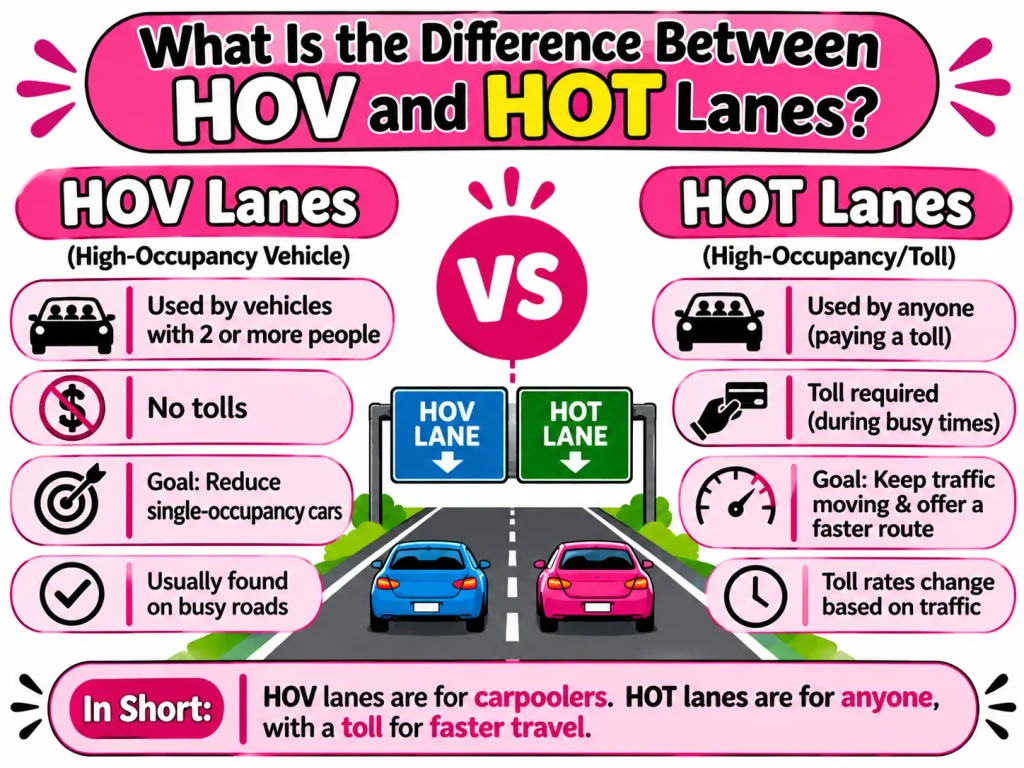
HOV and HOT lanes are related, but they do not mean the same thing.
An HOV lane is mainly designed for vehicles that meet a minimum passenger requirement.
A HOT lane is a High-Occupancy Toll lane. It may allow drivers who do not meet the passenger requirement to use the lane by paying a toll.
Here is a simple comparison:
| Feature | HOV lane | HOT lane |
| Main purpose | Encourage carpooling | Manage traffic and offer paid access |
| Carpool vehicles | Usually allowed if they meet the rules | Often allowed, sometimes at a discount or no charge |
| Solo drivers | Usually restricted during operating hours | May be allowed to pay a toll |
| Payment | Usually no separate lane toll | Tolls may apply |
| Rules | Depend on the road | Depend on the road and toll system |
For example, a highway might have an HOV 2+ lane that requires two people in a vehicle. A nearby HOT lane might let a solo driver enter by paying a fee.
Not every express lane is a HOT lane, and not every HOV lane has the same payment rules.
Check the signs before entering. <Cite refs={“turn127565search0″,”turn127565search7″”turn127565search0″,”turn127565search7”}/>
What Is the Difference Between HOV and Carpool?
HOV and carpool are closely related terms, but they describe different things.
HOV stands for High-Occupancy Vehicle. It is the formal transportation term used on highway signs and in traffic rules.
Carpooling means that two or more people share a vehicle for a trip, such as going to work, school, or an event.
For example, if three coworkers drive to the office together, they are carpooling. Their vehicle may qualify for an HOV lane if it meets the lane’s requirements.
People often use the terms “HOV lane” and “carpool lane” to mean the same thing.
The Federal Highway Administration also uses both terms when explaining these lanes. <Cite refs={“turn127565search0″,”turn127565search2″”turn127565search0″,”turn127565search2”}/>
Why Do Highways Have HOV Lanes?
HOV lanes are designed to move more people using fewer vehicles. They can offer several benefits to drivers and communities.
They Can Help Reduce Traffic
When people share a ride, fewer cars may be needed to carry them. This can help reduce traffic pressure on busy roads.
For example, four coworkers who travel in one car use fewer vehicles than four coworkers who drive separately.
They Can Save Travel Time
HOV lanes may allow qualifying vehicles to bypass some of the traffic in regular lanes.
This can make travel more predictable, especially during busy commuting hours. However, an HOV lane is not guaranteed to be faster on every trip.
They Encourage Ride-Sharing
Some people may choose to share a ride because they can use an HOV lane during restricted hours.
Carpooling can also help people share driving duties and, depending on the trip, reduce fuel and parking costs.
They Can Support Cleaner Travel
When carpooling replaces separate trips, it may reduce the number of vehicles on the road and lower total fuel use and emissions.
The results depend on factors such as the vehicles used, trip length, and whether the shared ride replaces trips that would otherwise happen separately.
What Happens If You Drive in an HOV Lane Alone?
Driving alone in a restricted HOV lane when you do not qualify can lead to a traffic citation or fine.
The exact penalty depends on the state, road, and local rules. Some places may also apply extra penalties for repeat violations.
Before entering an HOV lane, check:
- The minimum number of people required.
- The hours when restrictions apply.
- Whether your vehicle qualifies for an exception.
- Whether the lane requires a toll or special pass.
- Where you may safely enter or exit the lane.
Do not assume you can use the lane just because traffic is moving slowly in the regular lanes.
How Can You Enter and Exit an HOV Lane?
HOV lane entry and exit rules vary by highway.
Some lanes allow drivers to move in and out at certain points. Others use solid lines, barriers, or marked access areas to control where vehicles can enter or leave.
Follow these basic safety tips:
- Read the signs before entering the lane.
- Check your mirrors and blind spots.
- Use your turn signal before changing lanes.
- Cross lane markings only where permitted.
- Leave enough space between your vehicle and others.
- Follow any signs showing restricted entry or exit points.
Never cross a solid line or barrier just to reach an HOV lane. If you miss an entrance, stay in your current lane and look for the next legal access point.
Common Examples of HOV Lane Use
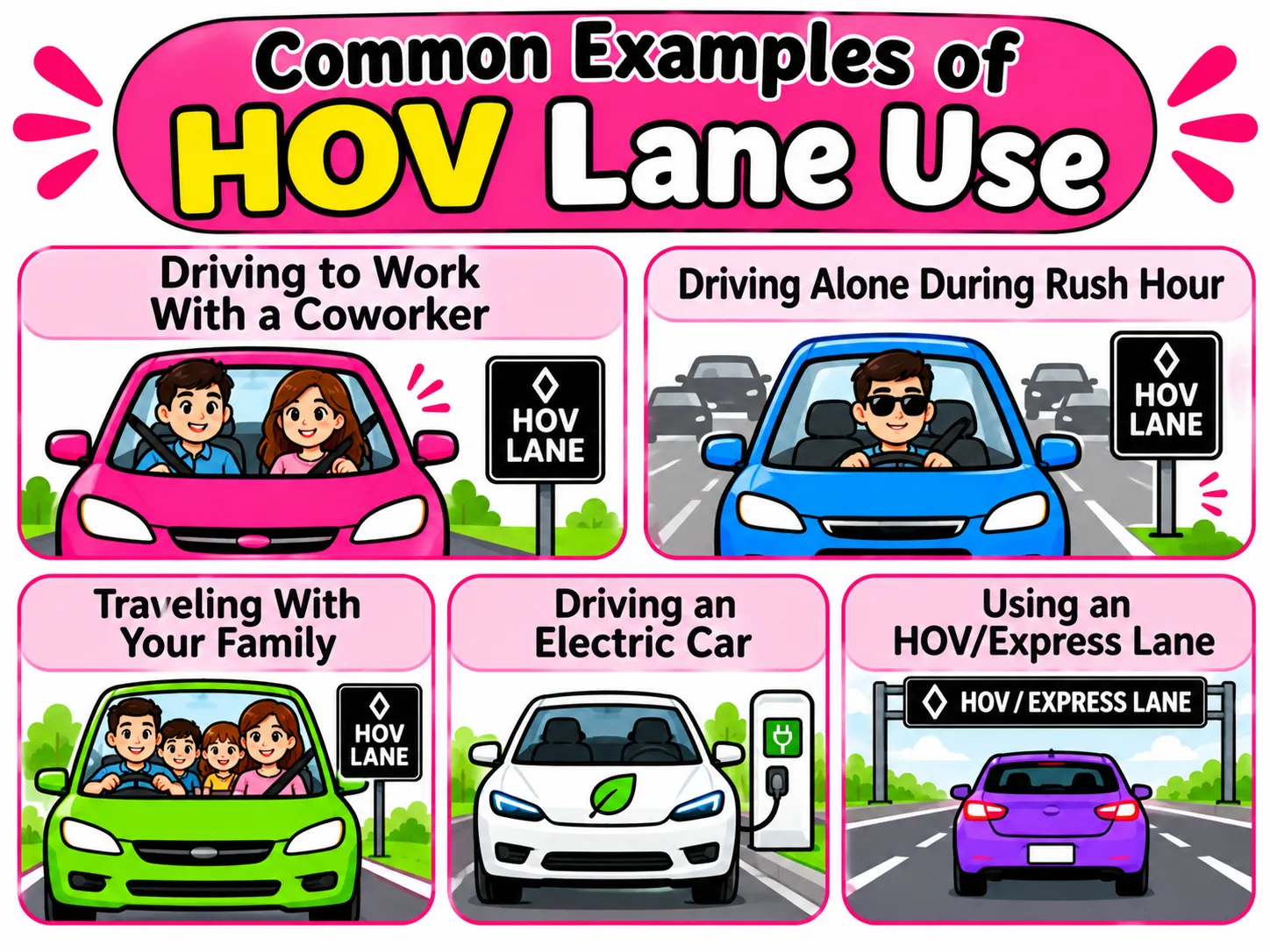
These examples can help you understand how HOV rules work in everyday driving.
Driving to Work With a Coworker
You and a coworker travel to the same office in one car. The highway sign says HOV 2+.
There are two people in your car, so you generally meet the occupancy rule during restricted hours.
Driving Alone During Rush Hour
You are driving alone and see an HOV 3+ sign. The lane is restricted during the morning rush hour.
You do not meet the passenger requirement. You should use a regular lane unless the road’s rules provide another valid way to enter.
Traveling With Your Family
You are driving with two family members, so there are three people in the vehicle, including you.
If the lane requires HOV 3+, you generally meet the occupancy requirement. Other posted restrictions still apply.
Driving an Electric Car
You drive an electric car but have no passengers. You see a sign for an HOV 2+ lane.
Do not assume that your electric car qualifies. Check the current rules and any required permits or exceptions for that specific highway.
Using an HOV/Express Lane
You are driving alone and see a sign for a lane that allows eligible carpools and toll-paying vehicles.
The lane may be a HOT lane. Check the toll signs and payment requirements before entering.
FAQS
Is HOV the Same as a Carpool Lane?
Yes, the terms often refer to the same type of highway lane. HOV is the formal abbreviation for High-Occupancy Vehicle, while carpool lane is the common name.
Does HOV Mean Two People in a Car?
Not always. HOV refers to a High-Occupancy Vehicle, but the required number of people depends on the posted sign. HOV 2+ generally requires two people, while HOV 3+ requires three.
Does the Driver Count as an Occupant?
Yes. Under common HOV rules, the driver counts as one person. A driver and one passenger usually meet an HOV 2+ requirement.
Can You Use an HOV Lane With a Baby?
A baby may count as a passenger under the applicable occupancy rules.
However, drivers should check local requirements and make sure the child is secured in an appropriate car seat.
Can You Use an HOV Lane on Weekends?
It depends on the highway. Some HOV lanes have restrictions only during weekday rush hours, while others have rules that apply at different times or throughout the week.
Read the posted signs to find out when the lane is restricted.
Are HOV Lanes Free?
Many HOV lanes do not charge a separate toll for vehicles that qualify.
However, some managed roads combine HOV access with toll facilities, and HOT lanes may charge drivers who do not meet the occupancy rules.
Check the signs for the specific road.
Can You Use an HOV Lane With Two People?
You can generally use an HOV 2+ lane with two people, including the driver, if you meet the other posted conditions. Two people may not be enough for a lane that requires HOV 3+.
What Is an HOV Violation?
An HOV violation occurs when a driver uses a restricted HOV lane without meeting its requirements or breaks another rule governing the lane. Penalties vary by location.
Article Summary
HOV stands for High-Occupancy Vehicle. HOV lanes are special highway lanes designed to encourage carpooling and help move more people through busy roads.
The main points to remember are:
- HOV means High-Occupancy Vehicle.
- HOV lanes are also called carpool lanes.
- HOV 2+ generally means at least two people, including the driver.
- HOV 3+ generally means at least three people, including the driver.
- Some buses and motorcycles may qualify under special rules.
- Electric and hybrid vehicles do not automatically qualify when traveling alone.
- HOT lanes may let drivers who do not meet HOV requirements pay a toll.
- Signs and local rules determine when and how you can use each lane.
Conclusion
Understanding what HOV means can make driving on US highways easier and safer.
HOV stands for High-Occupancy Vehicle, and HOV lanes are designed to encourage people to share rides and help traffic move more efficiently.
Remember that HOV 2+ usually requires two people, while HOV 3+ usually requires three. The driver counts toward the total, but the exact rules depend on the road and the time of day.
HOT lanes may also offer paid access to drivers who do not meet the passenger requirement.
Before entering an HOV lane, read the signs, check the operating hours, and follow the local traffic rules.
A few seconds of checking can help you avoid a ticket and make your trip safer.