RPM has several meanings, but two of the most common are revolutions per minute and revenue per mille.
The correct meaning depends on the topic.
- Revolutions per minute: Measures how many full turns a rotating object makes in one minute.
- Revenue per mille: Measures earnings for every 1,000 views, impressions, or other defined units, depending on the platform or report.
For example, a car engine running at 3,000 RPM makes 3,000 revolutions each minute.
In digital publishing, an RPM of $5 may mean $5 earned per 1,000 views under the metric being used.
The first meaning is about speed. The second is about money.
What Does RPM Mean in Cars?
In cars, RPM stands for revolutions per minute. It tells you how fast the engine’s crankshaft is turning.
Your car’s engine has moving parts that work together to create power.
RPM measures how many times the crankshaft completes a full turn in one minute.
How to Read RPM on a Car Dashboard
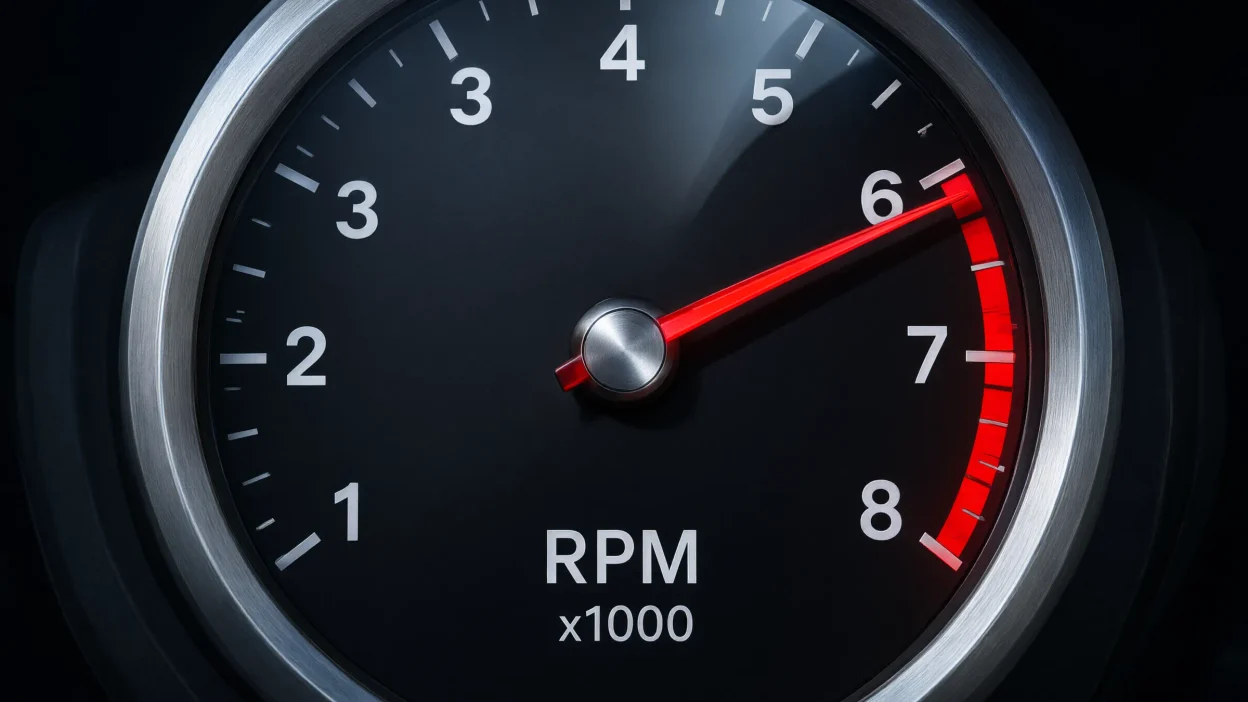
Many cars have a gauge called a tachometer. It shows engine speed in RPM.
You may see numbers such as 1, 2, 3, and 4 on the gauge. On many dashboards, these numbers represent thousands of revolutions per minute.
For example:
- 1 means about 1,000 RPM.
- 2 means about 2,000 RPM.
- 3 means about 3,000 RPM.
- 4 means about 4,000 RPM.
Some cars show RPM as a digital number instead.
What Is a Normal RPM for a Car?
There is no single normal RPM for every car. Engine type, gear, speed, and driving conditions all matter.
Here are some general examples:
- At idle: Many warm passenger-car engines run around 600–1,000 RPM.
- During calm driving: The engine may run at roughly 1,500–3,000 RPM, depending on the car and gear.
- During hard acceleration: RPM may rise much higher as the engine produces more power.
These are general ranges, not strict rules. Check your owner’s manual for information about your vehicle.
What Does High RPM Mean?
High RPM means the engine is turning quickly. This often happens when you press the gas pedal hard or drive in a lower gear.
High RPM is not always a problem. Some engines are designed to operate at high speeds.
However, staying near the engine’s redline can cause damage if the vehicle is not designed for that use.
What Does Low RPM Mean?
Low RPM means the engine is turning slowly.
This is normal when your car is stopped and the engine is idling. It can also happen during relaxed driving in a higher gear.
However, if the RPM drops too low and the engine shakes, struggles, or stalls, there may be an issue with the engine or its systems.
What Does RPM Mean on YouTube?
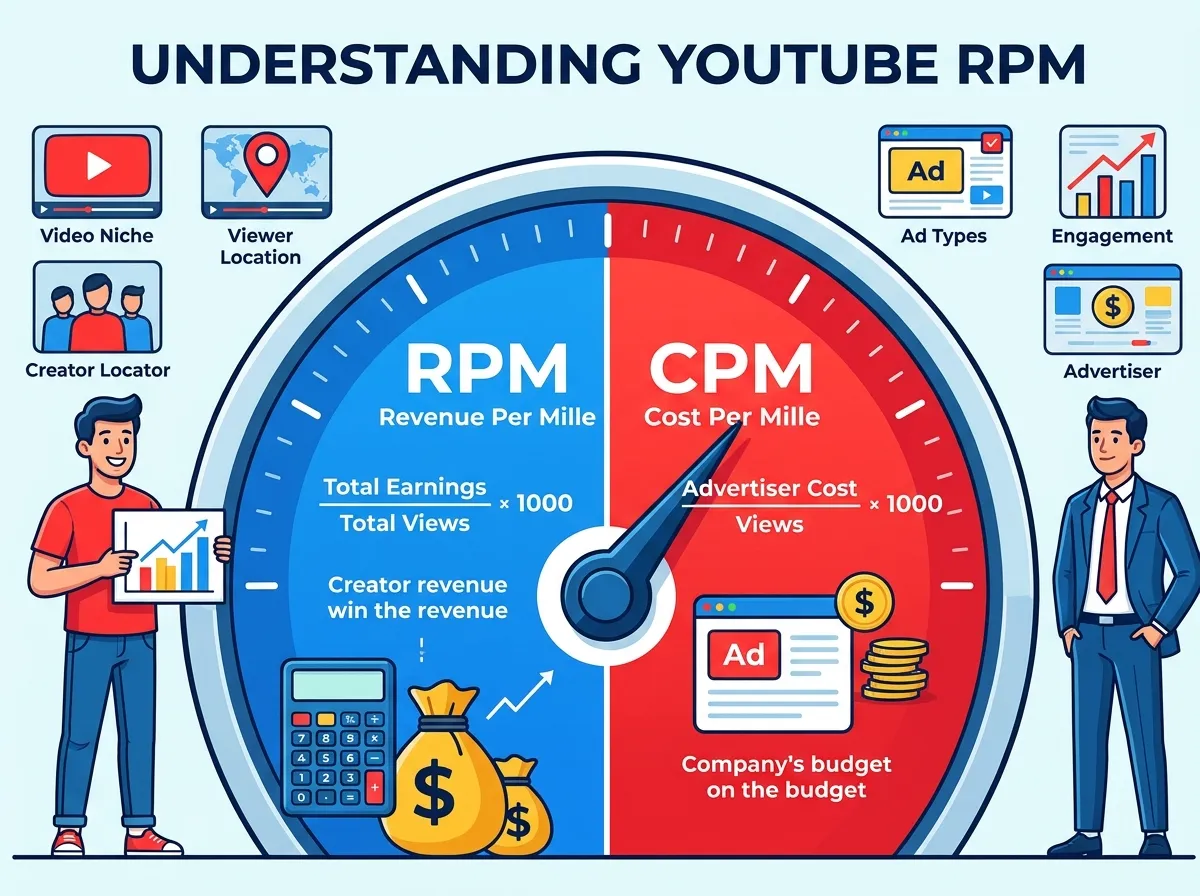
On YouTube, RPM usually stands for revenue per mille. The word mille means one thousand.
YouTube RPM helps creators understand how much revenue they earn for every 1,000 video views.
It can include several revenue sources reported by YouTube, such as advertising revenue,
YouTube Premium revenue, channel memberships, and Super Chat or Super Stickers where applicable.
RPM is useful because it looks at earnings in relation to views, rather than showing only the amount earned.
How Is YouTube RPM Calculated?
A simple way to understand RPM is:
RPM = Total revenue ÷ Total views × 1,000
For example, suppose a creator earns $120 from 30,000 video views.
$120 ÷ 30,000 × 1,000 = $4
The creator’s RPM is $4 per 1,000 views.
This example uses total revenue and views to show how the calculation works.
YouTube’s own Analytics definition may include specific revenue categories and adjustments, so use the platform’s reported figure when reviewing your channel.
What Is a Good RPM on YouTube?
There is no single RPM that is good for every channel.
A creator’s RPM can change based on factors such as:
- The topic of the channel.
- The country where viewers live.
- The type and length of the video.
- The time of year.
- Viewer engagement and ad availability.
- The share of views that generate revenue.
- Other eligible revenue sources.
For example, two channels may each receive 100,000 views but earn different amounts.
Their viewers, content, and revenue sources may not be the same.
Instead of comparing your RPM with a random number online, track your own results over time. Look at your RPM alongside views, watch time, and total revenue.
RPM vs. CPM on YouTube
RPM and CPM are related, but they do not mean the same thing.
RPM shows creator revenue per 1,000 video views. CPM, or cost per mille, generally shows how much advertisers pay per 1,000 ad impressions before YouTube’s revenue share and other factors are considered.
For example, a video may have a CPM of $10 but an RPM of $4.
These numbers can differ because not every view includes an ad, and the creator does not receive the full advertiser payment.
Remember: CPM focuses on advertiser spending, while RPM focuses on creator earnings relative to views.
What Does RPM Mean in Digital Marketing?
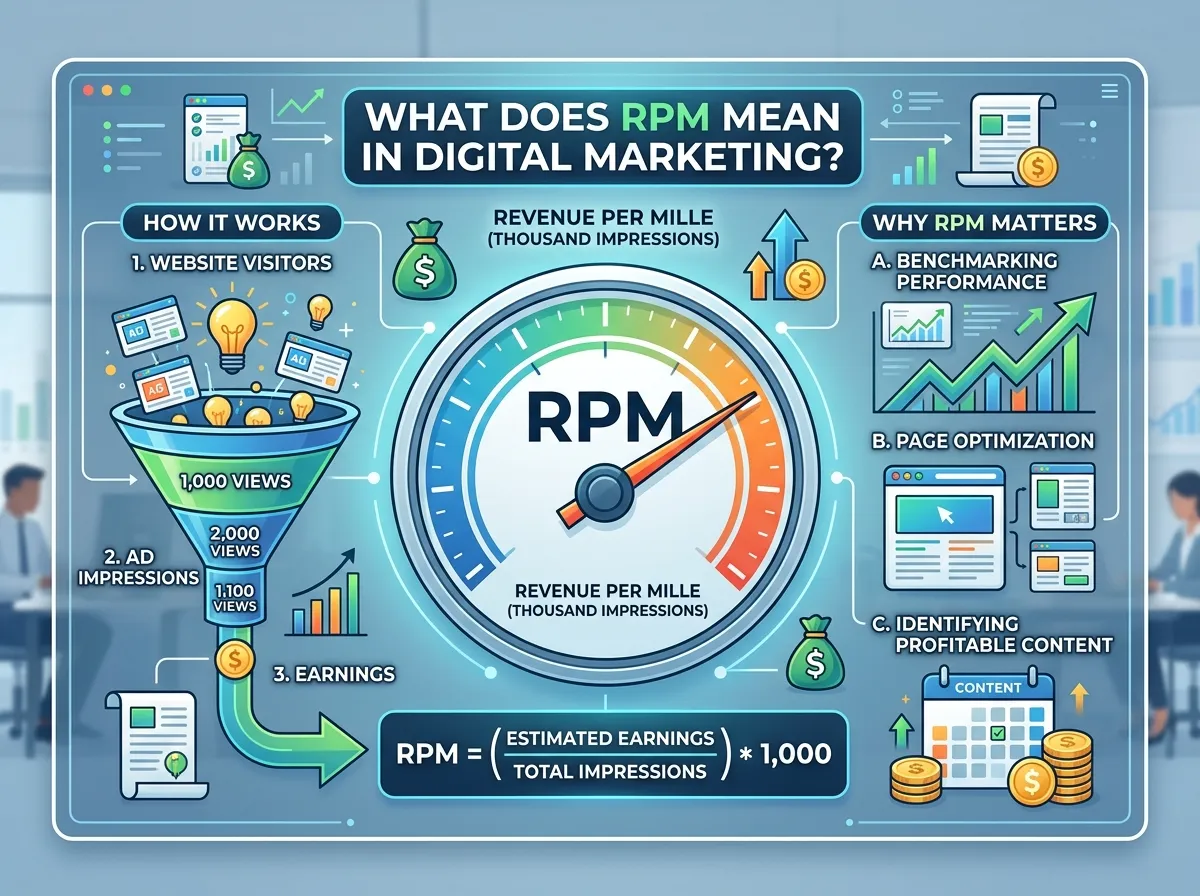
In digital marketing, RPM often stands for revenue per mille. It is a way to measure how much money a website, ad placement, or other digital property earns per 1,000 units.
The exact unit depends on the metric. A website may report revenue per 1,000 page views, while an advertising report may use impressions.
What Is Page RPM?
Page RPM measures estimated earnings for every 1,000 page views.
A common calculation is:
Page RPM = Estimated earnings ÷ Page views × 1,000
For example, imagine a blog earns $75 from 25,000 page views.
$75 ÷ 25,000 × 1,000 = $3
The blog’s page RPM is $3.
This means the site earns an average of $3 for every 1,000 page views under that reporting method. It does not mean every visitor brings in exactly the same amount.
Why Is RPM Important for Bloggers?
RPM helps bloggers understand how well their content earns money.
A blog owner can use RPM to:
- Compare earnings across different pages.
- Find topics that bring in more revenue.
- Measure changes after updating content.
- Estimate possible earnings from future traffic.
- Review how ad placement or audience changes affect revenue.
For example, if two blog posts receive similar traffic but one has a much higher RPM, the owner may study the topics, audience, and page layout to understand the difference.
A higher RPM does not always mean a page is better.
It is also important to consider search traffic, reader satisfaction, conversions, and the purpose of the content.
RPM vs. CPM in Digital Marketing
In advertising, CPM usually refers to the cost an advertiser pays per 1,000 ad impressions.
RPM usually refers to the revenue earned per 1,000 views or another defined unit.
The two metrics may use different units and perspectives.
For example, an advertiser may pay for 10,000 ad impressions, while a publisher may measure revenue against 8,000 page views.
The numbers will not be directly comparable unless the reporting methods are understood.
Always check whether a report measures impressions, page views, sessions, or video views.
What Does RPM Mean in Machines and Tools?
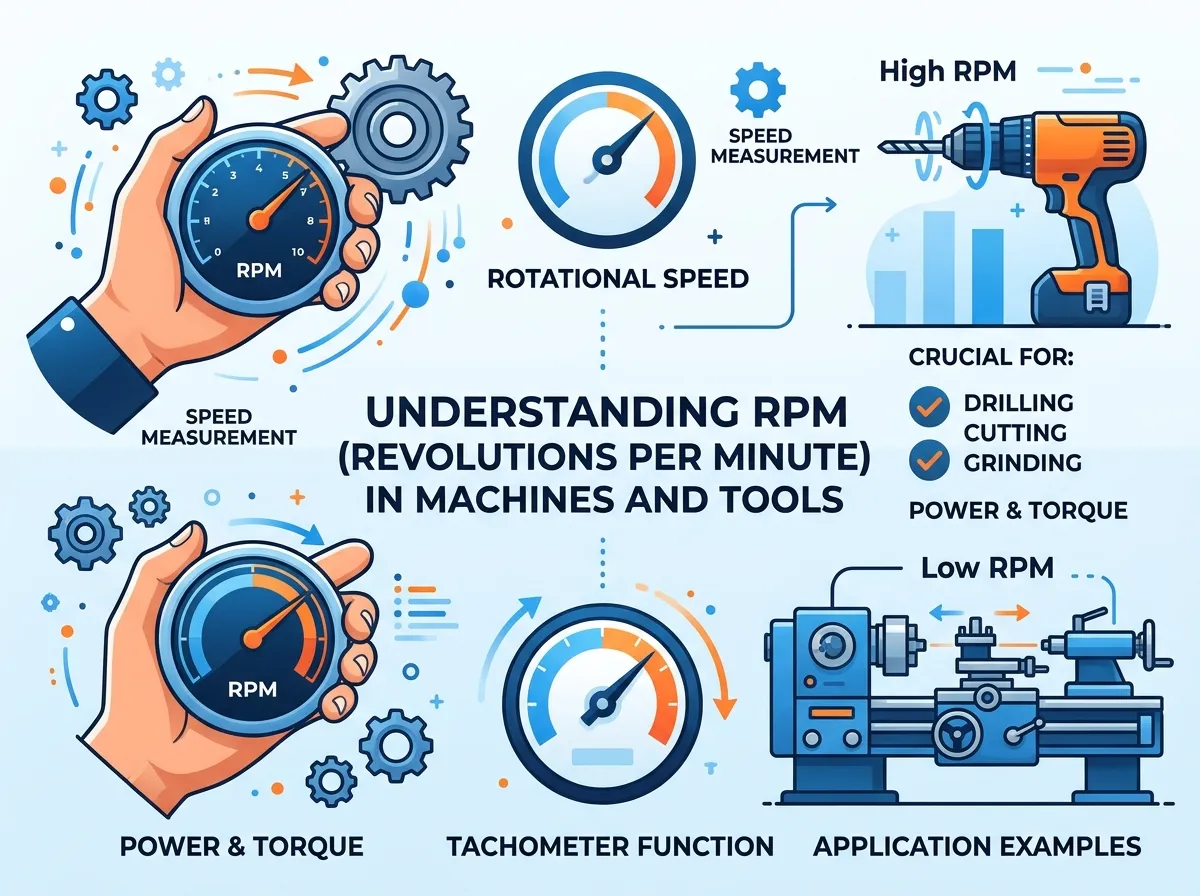
RPM is also used to measure the speed of rotating machines.
A rotating object may be a fan, drill, motor, washing machine, or industrial tool. In these cases, RPM tells you how many complete turns the rotating part makes each minute.
RPM in Electric Motors
An electric motor converts electrical energy into motion. Its RPM describes how quickly its rotating part spins.
A motor rated at 1,800 RPM, for example, is designed to operate at a speed around that rating under specified conditions.
Its actual speed can vary with the motor design and load.
Motor speed matters because it affects how a machine performs.
RPM in Fans and Drills
A fan’s RPM affects how quickly its blades rotate. A drill’s RPM describes how fast its bit turns.
Higher RPM may help with some tasks, but it is not always better. The right speed depends on the material, tool, and job.
For example, drilling into metal often requires a different speed from drilling into wood. Always follow the tool maker’s instructions and use the correct speed for the task.
What Does RPM Mean in Science?
In science and engineering, RPM is a unit used to describe rotational speed.
Scientists and engineers use it when studying rotating parts, laboratory equipment, turbines, centrifuges, and other devices.
For example, a laboratory centrifuge may spin samples at a set RPM to separate materials.
However, RPM alone does not tell you the full force acting on the sample. The rotor’s radius also matters.
RPM can be converted to other units of angular speed, such as radians per second, when calculations require it.
How to Convert RPM
To convert revolutions per minute into revolutions per second, divide by 60.
For example:
3,000 RPM ÷ 60 = 50 revolutions per second.
So an object spinning at 3,000 RPM completes 50 turns each second.
This conversion is useful when comparing rotating speeds or working with engineering formulas.
Other Meanings of RPM
Although revolutions per minute and revenue per mille are common meanings, RPM can stand for other things in specific fields.
Its meaning depends on the context in which it appears.
For example:
- Red Hat Package Manager: RPM is associated with a software package format and package-management tools used in Linux systems.
- Risk and performance management: Some organizations use RPM as an abbreviation for internal business processes.
- Rotations per minute: This is a common informal variation of the standard phrase revolutions per minute.
Not every use of RPM has a universal definition. If you see it in a report, technical manual, job description, or online post, read the surrounding words to identify the intended meaning.
How to Know Which RPM Meaning Is Correct
The easiest way to understand RPM is to look at the subject.
Use these clues:
| Where You See RPM | Most Likely Meaning |
| Car dashboard | Revolutions per minute |
| YouTube Studio | Revenue per mille |
| Blog earnings report | Revenue per 1,000 page views, if defined that way |
| Fan or electric motor | Revolutions per minute |
| Drill or power tool | Revolutions per minute |
| Linux software instructions | RPM package format or package-management tools |
| Advertising report | Revenue per mille or a related revenue metric |
For example, if someone asks, “My car is running at 3,000 RPM. Is that normal?” they are talking about engine speed.
If a blogger asks, “How can I increase my RPM?” they are likely talking about earnings per 1,000 page views.
If someone mentions installing an RPM file on Linux, the term refers to software packaging rather than speed or money.
Common Mistakes About RPM
People often confuse RPM with other terms. Here are a few mistakes to avoid.
Thinking RPM Always Means Engine Speed
RPM is widely used for rotational speed, but online creators and publishers also use it to describe revenue. The context matters.
Confusing RPM With CPM
RPM generally measures revenue per 1,000 views or another defined unit. CPM usually measures cost per 1,000 ad impressions. They are related, but they answer different questions.
Assuming Higher RPM Always Means More Total Money
A page with a high RPM may earn less total revenue than a page with a low RPM if it receives far fewer views.
For example, a page with an RPM of $8 and 1,000 views earns about $8 under a simple page-RPM model. A page with an RPM of $3 and 10,000 views earns about $30.
Assuming One RPM Range Fits Every Car
Different engines operate at different speeds. A reading that is normal for one car may not be normal for another. Always consider the vehicle and driving conditions.
FAQs
1. What does RPM stand for?
RPM most commonly stands for revolutions per minute. It measures how many full turns a rotating object makes in one minute.
In YouTube and digital marketing, RPM often means revenue per mille, or earnings per 1,000 views or another defined unit.
2. What does RPM mean in a car?
In a car, RPM means revolutions per minute. It measures how fast the engine’s crankshaft rotates. The tachometer on the dashboard displays engine speed.
3. What does RPM mean on YouTube?
On YouTube, RPM means revenue per mille. It helps creators see how much revenue they earn for every 1,000 video views, based on YouTube’s reporting method.
4. What is the difference between RPM and CPM?
RPM focuses on revenue per 1,000 views or another defined unit. CPM generally focuses on the cost of 1,000 ad impressions to an advertiser.
They use different perspectives and may use different units.
5. What is a good RPM for a blog?
A good blog RPM depends on the topic, audience, traffic source, ad setup, and revenue model. Compare your pages over time instead of relying on one fixed target.
6. Is high RPM good or bad in a car?
High RPM is not automatically good or bad. It can be normal during acceleration, but staying near the engine’s redline may be harmful.
Follow your vehicle’s operating guidance.
7. What does 1,000 RPM mean?
For a rotating object, 1,000 RPM means it completes 1,000 full revolutions in one minute.
In a revenue report, an RPM value is interpreted according to the platform’s definition.
8. How do you calculate RPM for a website?
Divide the website’s earnings by the number of page views, then multiply by 1,000. For example, $50 in earnings from 10,000 page views gives a page RPM of $5.
9. Can RPM mean something other than revolutions per minute?
Yes. RPM can also mean revenue per mille in digital publishing and advertising. In computing, it can refer to the RPM software package format used in Linux environments.
10. Why does RPM change?
Engine RPM changes with engine speed, gear, and driving conditions.
Revenue RPM can change with audience location, advertising demand, content type, view patterns, and other factors.
Article Summary
RPM has different meanings depending on the topic. In cars, machines, and tools, it usually means revolutions per minute, which measures rotational speed.
On YouTube and in digital marketing, it often means revenue per mille, a measure of earnings per 1,000 views or another defined unit.
RPM helps drivers understand engine speed and helps creators and publishers measure revenue performance.
To find the correct meaning, check where the term appears and how the surrounding information defines it.
Conclusion
RPM is a short term with more than one meaning. In cars and machines, it measures how many times a part rotates in one minute.
On YouTube and websites, it often measures how much money is earned per 1,000 views or page views.
The key is to look at the context. A car dashboard uses RPM to show engine speed, while a creator’s earnings report uses it to measure revenue performance.
Once you know where the term appears, its meaning becomes much easier to understand.
Whether you are learning about cars, growing a blog, or checking YouTube earnings, understanding RPM can help you read reports and make better decisions.

Ryan Mitchell creates informative content about word definitions, acronyms, online slang, and modern communication. He enjoys exploring how people use language in text messages, on social media, and in daily life. Ryan focuses on delivering simple explanations and practical examples that help readers quickly understand the meaning of unfamiliar words and phrases.