FICO stands for Fair Isaac Corporation. It is the name of the company that developed the FICO credit scoring model.
Today, a FICO score is one of the tools lenders use to measure credit risk. It helps them estimate how likely a person is to repay borrowed money based on their credit history.
Your FICO score is usually a three-digit number. Many common FICO scores range from 300 to 850. A higher score generally suggests that you have managed credit well and may be a lower risk to lenders.
For example, imagine two people apply for the same credit card. One has a long history of paying bills on time and keeping credit card balances low. The other has missed payments and high balances. The first person may have a higher FICO score.
However, lenders do not look at your score alone. They may also review your income, debt, work history, and other details, depending on the type of loan.
What Is the Full Form of FICO?
The full form of FICO is Fair Isaac Corporation.
The company was founded by Bill Fair and Earl Isaac in 1956. It began by using data and mathematical methods to help businesses make better decisions.
Its credit scoring system later became widely used in the lending industry.
Although the company’s name is Fair Isaac Corporation, people now commonly use the shorter name FICO.
What Is a FICO Score in Simple Words?
A FICO score is a number that helps lenders understand how you have handled credit.
Think of it as a quick summary of the information in your credit report.
It does not tell your whole financial story, but it can help a lender judge the risk of lending you money.
A FICO score is not the same as your bank balance, salary, or savings.
You can earn a high income and still have a low credit score if you have a history of missed payments or heavy debt.
Likewise, someone with a modest income may have a strong score if they manage credit carefully.
How Does a FICO Score Work?
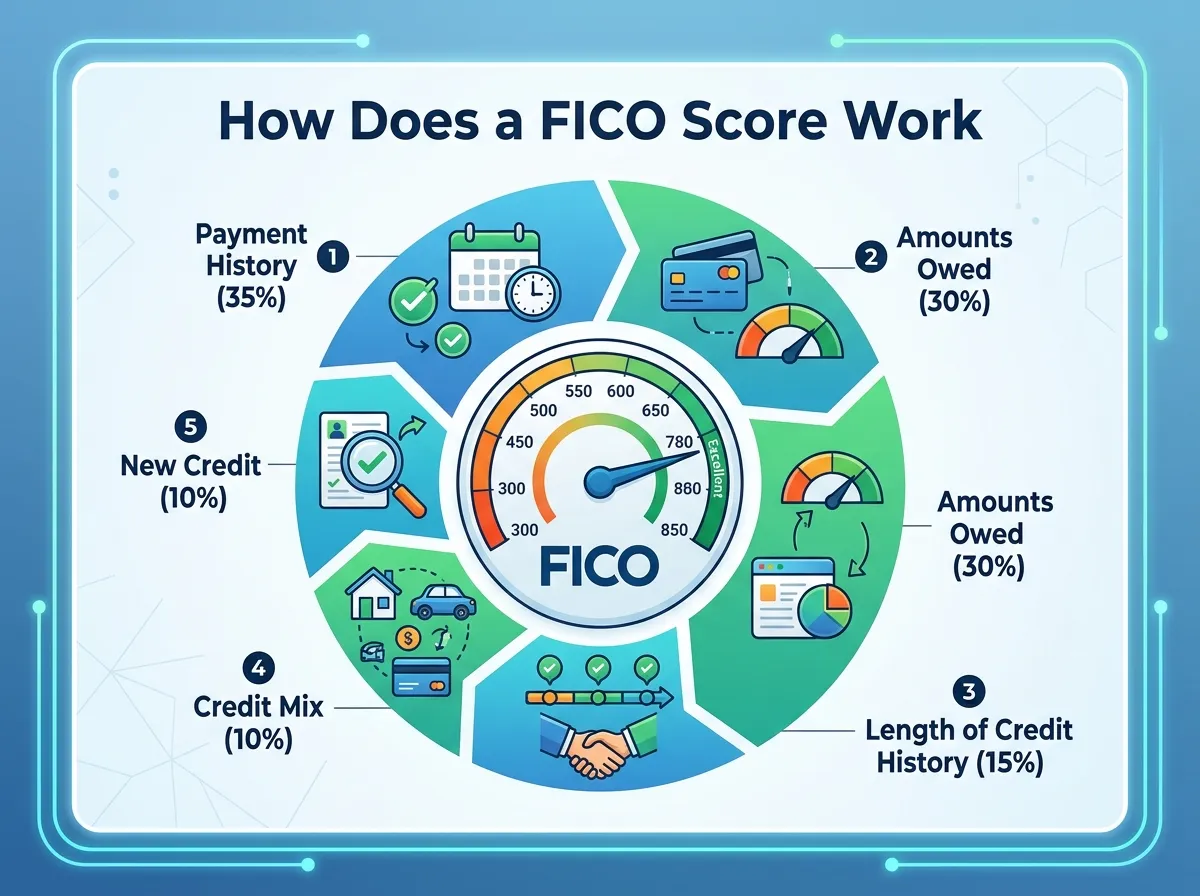
FICO scores use information from your credit report to estimate how likely you are to repay credit as agreed.
Credit reports may include details about credit cards, car loans, personal loans, mortgages, payment history, and the age of your credit accounts.
A FICO scoring model studies several parts of this information and gives you a score. Lenders can then use that score as one part of their decision.
Here is a simple example.
Suppose you have a credit card with a $1,000 limit. You use $200 of that limit and pay your bill on time each month. This can show that you use credit carefully.
Now imagine you use almost the full $1,000 limit and often miss payments. These habits may hurt your score.
Your exact score depends on your full credit history and the scoring model used. No single action guarantees a certain score.
What Is the FICO Score Range?
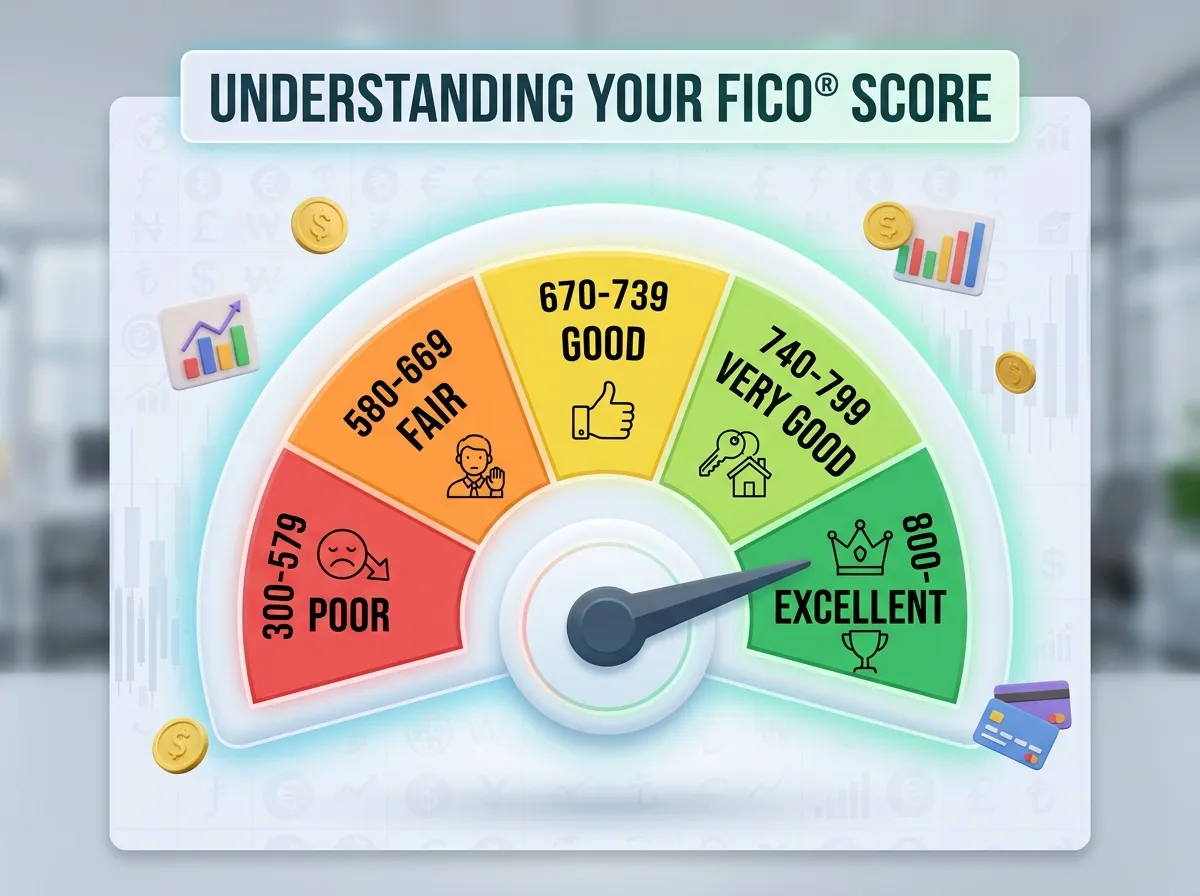
Many commonly used FICO scores range from 300 to 850. The standard score ranges are often grouped like this:
| FICO score | Common rating |
| 300–579 | Poor |
| 580–669 | Fair |
| 670–739 | Good |
| 740–799 | Very Good |
| 800–850 | Exceptional |
These labels are commonly used to explain FICO score ranges, but a lender may use different cutoffs for its own decisions.
A score of 700, for example, may be viewed more favorably than a score of 600. Still, the score alone does not guarantee approval.
Why Do Lenders Use FICO Scores?
Lenders need a way to estimate the risk of lending money. A FICO score gives them a standard tool to help make that decision.
Banks, credit card companies, mortgage lenders, and auto lenders may use FICO scores when reviewing applications.
A lender may use your score to help decide:
- Whether to approve your application
- How much money to lend you
- What interest rate to offer
- Whether you qualify for certain credit products
Each lender has its own rules. Some use other credit scores or extra information, so a FICO score is not the only factor that matters.
What Factors Affect Your FICO Score?
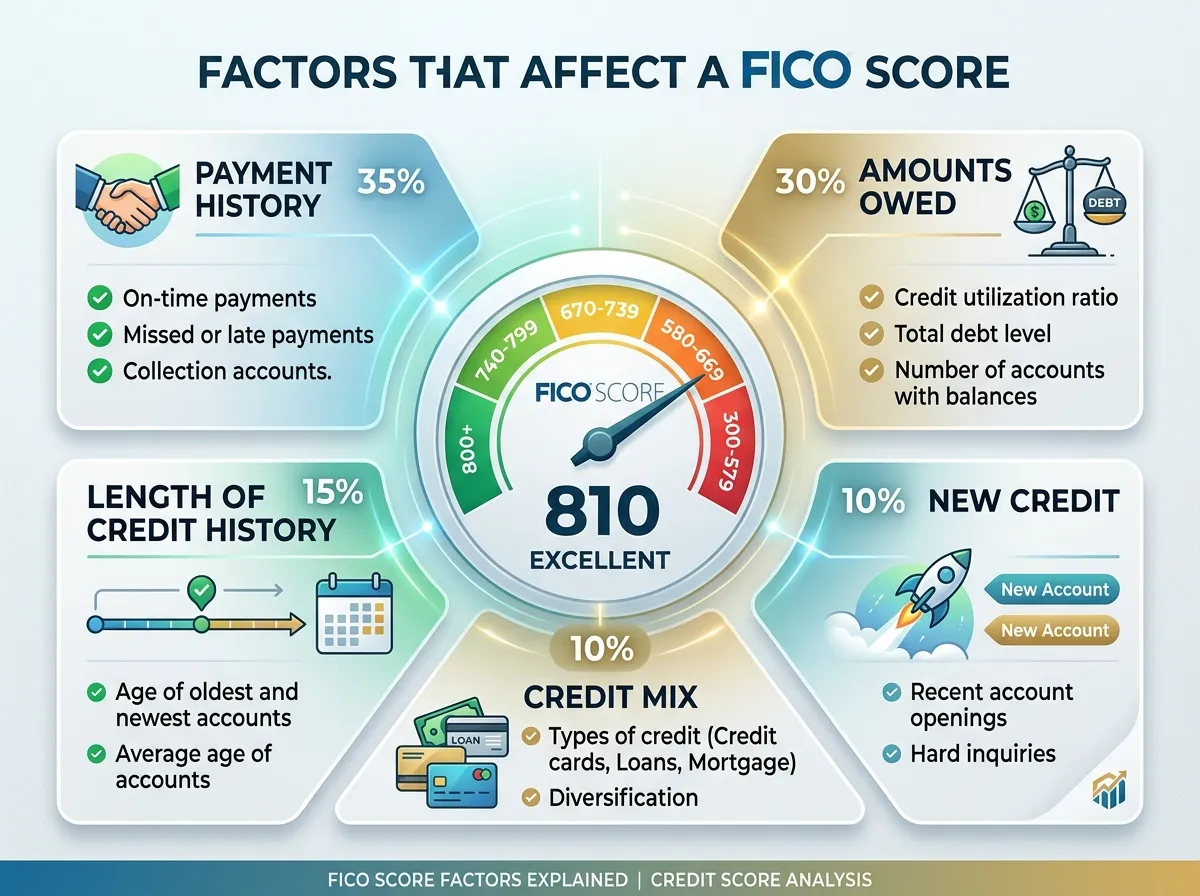
FICO scores consider several parts of your credit history. Each part has a different level of importance.
For the widely used FICO scoring model, the main factors are payment history, amounts owed, length of credit history, new credit, and credit mix.
1. Payment History: 35%
Payment history is the largest factor in the classic FICO scoring model. It looks at whether you have paid your credit accounts on time.
Late payments, missed payments, accounts sent to collections, and certain other negative records may hurt your score.
For example, if you pay your credit card bill by the due date every month, you build a stronger payment history. If you miss several payments, your score may fall.
Tip: Set payment reminders or use automatic payments for at least the minimum amount due. Make sure your bank account has enough money to cover automatic payments.
2. Amounts Owed: 30%
This factor looks at how much debt you have, including how much of your available credit you use.
One important part is your credit utilization ratio. It compares your credit card balances with your credit limits.
For example, if your credit card limit is $2,000 and your balance is $500, your utilization ratio is 25%.
Using a large share of your available credit can hurt your score, even if you make payments on time.
Tip: Try to keep credit card balances low compared with your limits. Paying down balances can help, although the size and timing of any score change will vary.
3. Length of Credit History: 15%
FICO also looks at how long you have used credit.
This factor may include the age of your oldest account, the age of your newest account, and the average age of your accounts.
A longer history can give lenders more information about how you manage credit.
For example, someone who has used a credit card responsibly for eight years may have a longer credit history than someone who opened their first account three months ago.
Tip: Think carefully before closing old credit card accounts.
Closing an account can affect your available credit, and the overall effect on your score depends on your credit profile and the scoring model.
4. New Credit: 10%
Opening several new credit accounts in a short time may hurt your score.
When you apply for credit, a lender may make a hard inquiry on your credit report. A hard inquiry can cause a small, temporary drop in your score.
Opening many accounts at once may also suggest that you need more credit than usual.
Tip: Apply for new credit only when you need it. When shopping for a mortgage, auto loan, or student loan, qualifying rate-shopping inquiries may be grouped by some FICO models within a set period. The rules depend on the score version and loan type.
5. Credit Mix: 10%
Credit mix refers to the different types of credit you use.
These may include revolving accounts, such as credit cards, and installment loans, such as car loans or mortgages.
A mix of credit types can help your score, but it is not necessary to take out a loan just to improve your credit mix.
Tip: Focus on paying existing accounts on time and managing debt well. Do not borrow money you do not need just to try to raise your score.
What Is a Good FICO Score?
A good FICO score is generally one that helps you qualify for the credit products you need on reasonable terms.
In the common FICO score range, a score from 670 to 739 is often considered good. Scores from 740 to 799 are very good, while scores from 800 to 850 are exceptional.
However, the score you need depends on the lender and the type of credit you want.
Is a 600 FICO Score Good?
A 600 FICO score is usually in the fair range under common FICO score categories.
You may still qualify for some credit products, but you could face higher interest rates or stricter requirements. Some lenders may decline your application.
If your score is around 600, focus on paying bills on time, reducing credit card balances, and checking your credit reports for errors.
Is a 700 FICO Score Good?
Yes. A 700 FICO score is generally considered good.
It may help you qualify for many credit products, depending on the lender and your wider financial situation. However, it does not guarantee approval or the lowest available interest rate.
Your income, debt, down payment, and other details may also affect the decision.
Is an 800 FICO Score Good?
Yes. An 800 FICO score falls within the exceptional range in common FICO score categories.
It usually reflects a strong credit history, but it does not guarantee that every application will be approved. Lenders may still consider income, existing debt, and other requirements.
A score above 800 is not necessary for everyone. Building reliable credit habits is more important than trying to reach a perfect score.
What Is the Difference Between FICO and a Credit Score?
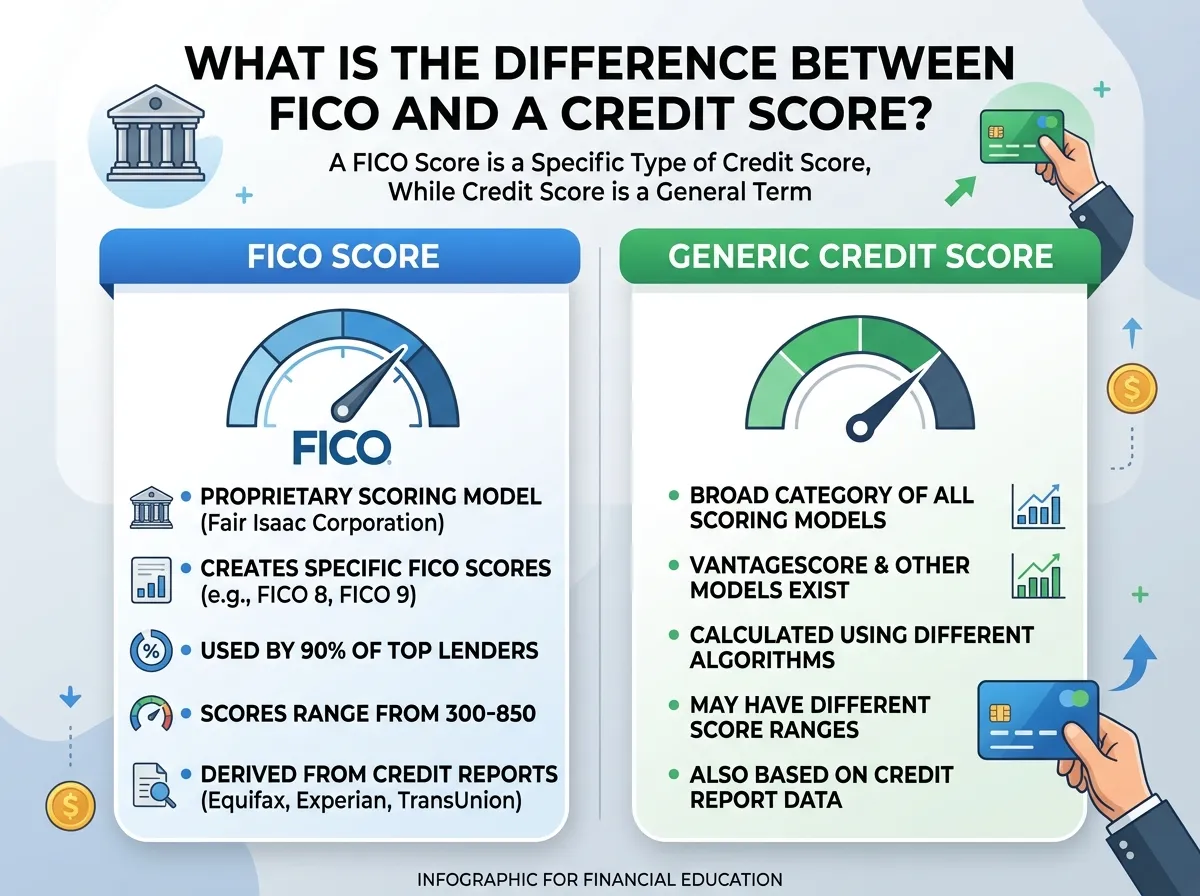
A credit score is a general term for a number used to estimate credit risk. A FICO score is one specific type of credit score.
Other companies and scoring systems also create credit scores using information from credit reports.
This means that every FICO score is a credit score, but not every credit score is a FICO score.
FICO Score vs. VantageScore
VantageScore is another credit scoring system used by some lenders and financial services.
Both FICO and VantageScore use credit report information to estimate credit risk. However, they may use different methods, and they may weigh or interpret information differently.
As a result, your FICO score and VantageScore may not match.
| Feature | FICO score | VantageScore |
| What it is | A credit scoring model from FICO | A credit scoring model developed by the three major credit bureaus |
| Main purpose | Helps assess credit risk | Helps assess credit risk |
| Score range | Many common models use 300–850 | Many common models use 300–850 |
| Results | Can vary by model and credit bureau | Can vary by model and credit bureau |
| Used by lenders | Widely used | Also used by some lenders |
Neither score is automatically wrong just because it differs from the other. The models may use different versions, dates, or credit report information.
Why Are My FICO Score and Credit Score Different?
Your scores may differ for several reasons.
First, the scores may come from different scoring models. Second, the credit reports used to calculate them may contain different information.
Third, the scores may have been calculated on different dates.
For example, one credit bureau may have received a recent credit card balance while another has not yet updated its report.
The resulting scores may be different.
When comparing scores, check which scoring model was used, which credit bureau supplied the data, and when the score was calculated.
How Can You Check Your FICO Score?
You may be able to check your FICO score through a credit card company, bank, lender, or paid credit monitoring service.
Some services provide a FICO score at no extra cost to eligible customers. Others provide a VantageScore or another type of credit score instead.
Before relying on a score, check its name and model.
Where Can You Get Your FICO Score for Free?
Start by checking your bank or credit card account. Look for a section called “Credit Score,” “Credit Health,” or “Credit Monitoring.”
Some lenders offer free FICO scores to their customers. Availability depends on the provider and account.
You can also visit the official FICO website to learn about score access and available products. Some options may require payment.
Remember that checking your own credit score generally does not create a hard inquiry or lower your score.
Can You Get Your Credit Report for Free?
In the United States, you can access free credit reports through AnnualCreditReport.com, the federally authorized source for free reports from Equifax, Experian, and TransUnion.
A credit report is not the same as a credit score. Your report shows information about your credit accounts and payment history, while a score summarizes information from a report using a scoring model.
Reviewing your reports can help you spot incorrect balances, accounts you do not recognize, or payment records that may need correction.
If you find an error, you can dispute it with the credit bureau and, when appropriate, the company that provided the information.
How Can You Improve Your FICO Score?
You cannot change your score overnight, but you can build better credit habits over time.
The best approach depends on what is hurting your score. Someone with high credit card balances may need a different plan from someone with a short credit history.
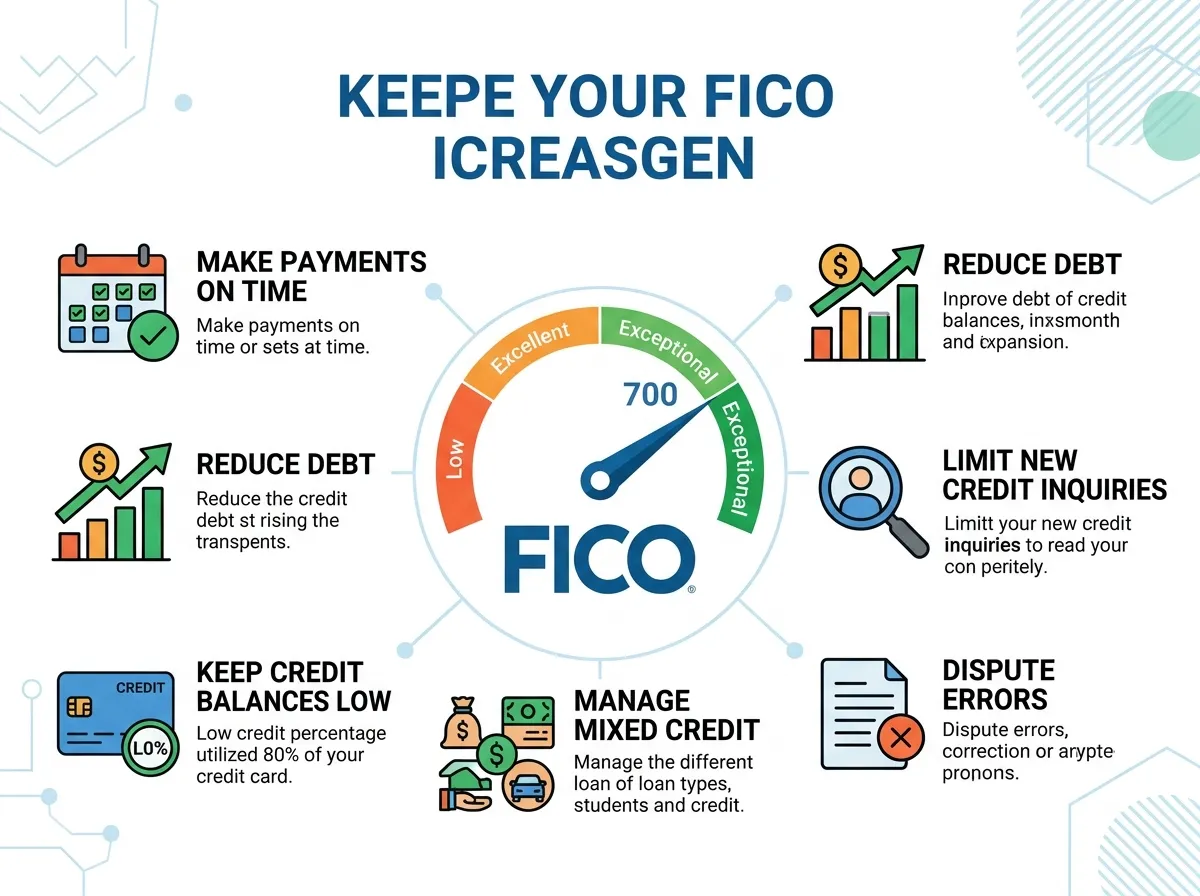
Pay Your Bills on Time
Payment history is a major part of your FICO score.
Pay at least the required amount by the due date. If possible, pay the full credit card statement balance to avoid interest on purchases when your card terms allow it.
If you have missed payments, start making future payments on time. Negative information may remain on your credit report for a period allowed by law, but its effect can lessen as your history improves.
Lower Your Credit Card Balances
High credit utilization can make your score lower.
If you can afford to do so, pay down credit card balances and avoid charging more than you can repay.
For example, lowering a $900 balance on a card with a $1,000 limit may reduce your utilization ratio from 90% to 30%. That change may help your score, but the exact result is not guaranteed.
You do not need to carry a balance or pay interest to build credit.
Check Your Credit Reports for Errors
An error on your credit report may affect your score.
Look for accounts that do not belong to you, incorrect late payments, wrong balances, and outdated information that should no longer appear.
If you find an error, file a dispute with the relevant credit bureau and provide any documents that support your claim.
Keep copies of your records and follow up if needed.
Avoid Applying for Too Much Credit at Once
Every credit application is not guaranteed to lower your score, but hard inquiries can have an effect.
Avoid opening several new credit accounts in a short period unless you have a good reason. Apply only for credit that fits your needs and budget.
If you are comparing loan offers, ask how the lender handles rate-shopping inquiries.
Keep Older Accounts in Mind
A long credit history can help show how you manage credit over time.
Before closing an old card, consider its annual fee, your spending habits, and how closing it might affect your available credit. You do not need to keep an expensive card just for your score, but it is wise to weigh the trade-offs.
Be Patient and Consistent
Your score may not improve immediately after you make changes.
Creditors usually report account information on a schedule, and scoring models use the information available when the score is calculated.
Keep paying on time, manage balances, and check your reports. Over time, these habits can help support a stronger credit profile.
Does Your FICO Score Affect Loan Approval?

Yes, your FICO score can affect a lender’s decision, but it is only one part of the application.
A lender may also look at your income, monthly debt payments, job stability, savings, down payment, and the type of loan you want.
For example, a person with a strong FICO score but very high monthly debt may have trouble qualifying for a large loan.
Another person with a lower score may qualify for a particular product if the lender’s requirements allow it and the rest of the application is strong.
How Does FICO Affect Mortgage Rates?
Mortgage lenders may use certain FICO score versions when reviewing a home loan application.
A higher score may help you qualify for a lower rate, while a lower score may lead to a higher rate or stricter requirements.
The effect depends on the loan program, lender, market conditions, and the rest of your application.
Some mortgage programs have specific credit rules. Check with a lender to learn which score model and requirements apply to your situation.
How Does FICO Affect Car Loans?
Auto lenders may use FICO scores to help assess the risk of financing a vehicle.
Your score can affect approval, the interest rate, and the loan terms offered. Some lenders use auto-specific FICO score versions designed for vehicle lending.
Compare loan offers carefully. A lower monthly payment does not always mean a lower total cost, especially if the loan lasts longer.
How Does FICO Affect Credit Cards?
Credit card companies may use FICO scores when deciding whether to approve an application and which terms to offer.
A stronger score may improve your chances of qualifying for cards with better terms, but approval also depends on income, existing debt, and the issuer’s rules.
Before applying, review the card’s fees, interest rate, rewards, and credit requirements.
Why Do I Have Different FICO Scores?
You may have more than one FICO score at the same time. This is normal.
FICO has developed different scoring models for different lending needs.
A lender may use a general-purpose score, a version designed for auto lending, or a model used for mortgage decisions.
Your scores may also differ because each credit bureau has its own report about your credit history.
For example, your bank may show one FICO score based on Experian data, while an auto lender uses a different FICO version and data from another bureau.
Neither number must be identical to the other.
When checking your score, look for three details:
- The scoring model or version
- The credit bureau supplying the report
- The date the score was calculated
These details help explain why two scores may differ and which one may matter for a particular application.
Common Myths About FICO Scores
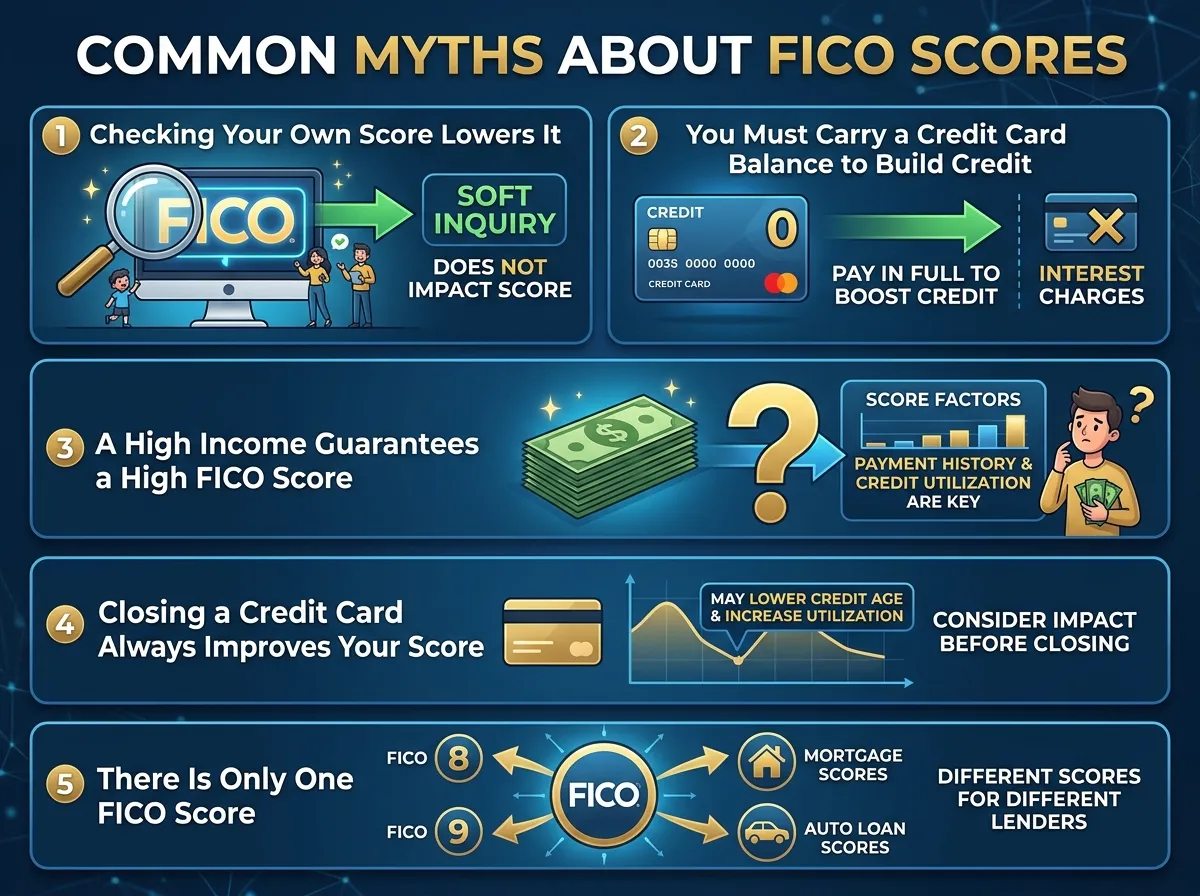
Checking Your Own Score Lowers It
Checking your own credit score is generally a soft inquiry and does not lower your FICO score.
A lender’s hard inquiry may affect your score, but your own check does not have the same effect.
You Must Carry a Credit Card Balance to Build Credit
You do not need to carry a balance or pay interest to build a credit history.
Using a credit card responsibly and paying on time can help you establish good habits. Paying your statement balance in full can also help you avoid interest on purchases when your card terms allow it.
A High Income Guarantees a High FICO Score
Your income is not directly included in the standard FICO score calculation.
A person with a high income may still have a low score if they miss payments or use a large amount of available credit. A person with a lower income may have a strong score if they manage credit well.
Lenders can still consider income when reviewing applications.
Closing a Credit Card Always Improves Your Score
Closing a credit card does not always help your score.
It can reduce your available credit and raise your credit utilization ratio if you have balances on other cards. The effect depends on your full credit profile and the scoring model.
There Is Only One FICO Score
There are many FICO score versions.
Different lenders may use different models and credit bureau data. That is why your score can change depending on where you check it and which type of loan you want.
FAQS
1. What does FICO mean in simple terms?
FICO stands for Fair Isaac Corporation. A FICO score is a number that helps lenders understand how you have managed credit and estimate the risk of lending you money.
2. What is a FICO score used for?
Lenders may use your FICO score to help decide whether to approve credit cards, car loans, mortgages, and other credit products. It may also affect the interest rate and terms you receive.
3. What is a good FICO score?
A FICO score of 670 to 739 is generally considered good. Scores of 740 to 799 are very good, while scores of 800 to 850 are exceptional under common FICO score categories.
4. Is FICO the same as a credit score?
No. FICO is one type of credit score. Other scoring systems, such as VantageScore, also estimate credit risk. Different models may produce different scores for the same person.
5. How can I check my FICO score for free?
Check your bank or credit card account to see whether it offers free FICO score access. Some providers offer this service to eligible customers, while others show a different type of credit score.
6. Does checking my FICO score lower it?
No. Checking your own FICO score generally does not lower it. This is usually treated as a soft inquiry. A hard inquiry from a credit application may affect your score.
7. How long does it take to improve a FICO score?
It depends on your credit history and the changes you make. Lowering credit card balances may help once updated information reaches the scoring model, while rebuilding a history of missed payments can take longer.
8. Can I have more than one FICO score?
Yes. You can have several FICO scores because different lenders may use different scoring versions and credit bureau reports. Your scores may vary based on the model, data, and date of calculation.
9. What is the difference between a FICO score and a credit report?
A credit report contains information about your credit accounts, balances, and payment history. A FICO score uses information from a credit report to calculate a number that helps lenders assess credit risk.
10. Does a higher FICO score guarantee loan approval?
No. A higher score may improve your chances, but lenders can also consider your income, debt, employment details, down payment, and other application requirements.
Article Summary
- FICO stands for Fair Isaac Corporation, the company behind the FICO credit scoring system.
- A FICO score helps lenders estimate how likely you are to repay borrowed money.
- Many common FICO scores range from 300 to 850.
- Payment history and amounts owed are major factors in the classic FICO scoring model.
- FICO scores and VantageScores can differ because they use different scoring methods or data.
- You may be able to check your FICO score through your bank or credit card provider.
- Paying bills on time, lowering credit card balances, and checking credit reports for errors may help improve your credit profile.
- A strong FICO score can help, but lenders also consider other parts of your application.
Conclusion
Understanding what FICO means can help you make better choices when borrowing money. FICO stands for Fair Isaac Corporation, and a FICO score is a number that helps lenders assess your credit risk.
Your score depends on information in your credit report, including payment history, credit card balances, the age of your accounts, new credit, and credit mix.
A higher score may improve your chances of getting approved for credit and receiving better terms, but it does not guarantee either result.
The best way to build a healthy credit profile is to pay bills on time, keep balances manageable, avoid unnecessary credit applications, and review your credit reports for errors.
These simple habits can help you work toward stronger credit over time.

Ryan Mitchell creates informative content about word definitions, acronyms, online slang, and modern communication. He enjoys exploring how people use language in text messages, on social media, and in daily life. Ryan focuses on delivering simple explanations and practical examples that help readers quickly understand the meaning of unfamiliar words and phrases.