
PDA most commonly means Public Display of Affection.
It refers to showing love, care, or romantic feelings toward another person while other people are around.
The term is often used when talking about couples who show affection in public places.
For example, when two people hold hands while walking through a shopping mall, they are showing PDA.
A quick kiss goodbye at a train station is another example.
PDA is not always romantic.
Friends and family members may also show affection through hugs, hand-holding, or other caring gestures.
However, the term is most often linked to romantic relationships.
Breaking Down the Meaning of PDA
Each word in PDA helps explain what it means:
- Public: A place where other people can see you.
- Display: An action that others can notice.
- Affection: A feeling of love, care, or closeness.
Together, these words describe showing affection where other people may see it.
What Is the Full Form of PDA?
The most common full form of PDA in everyday conversation is Public Display of Affection.
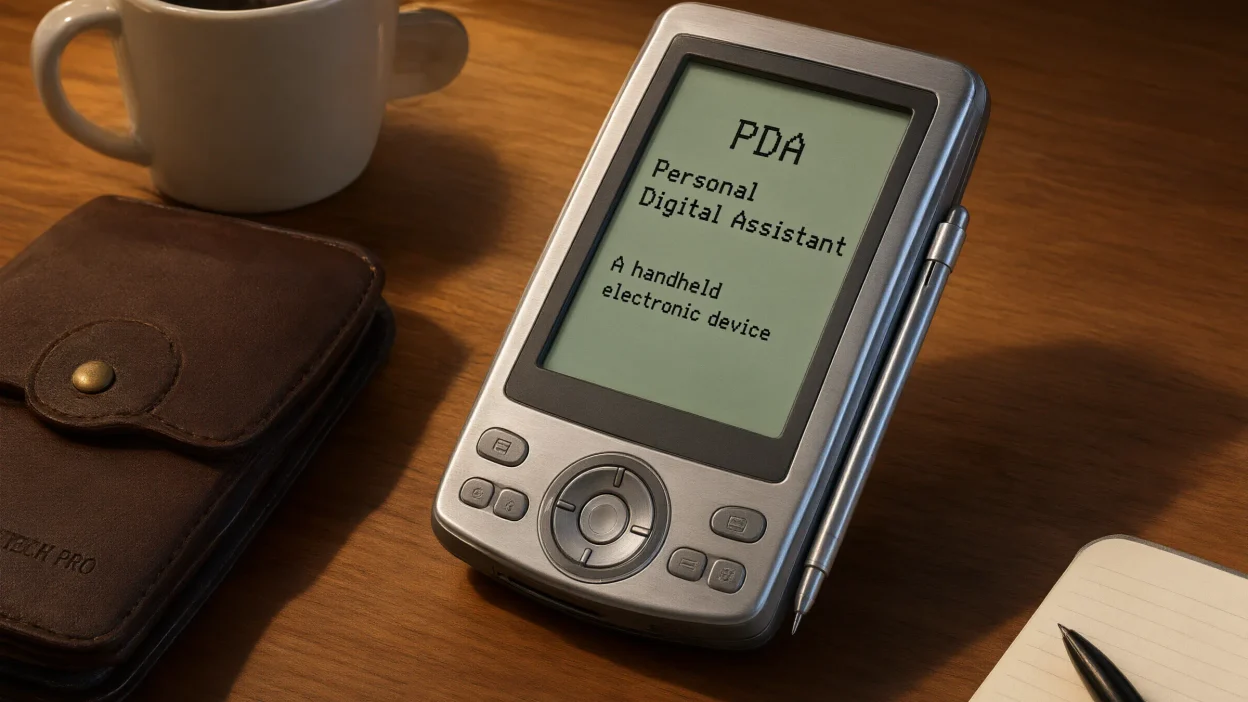
Still, the meaning can change depending on the topic. In technology, PDA can mean Personal Digital Assistant. In some professional settings, it may have other meanings.
If someone mentions PDA while talking about dating, kissing, or couples, they almost always mean Public Display of Affection.
What Does PDA Mean in a Relationship?

In a relationship, PDA means showing love or romantic affection in front of other people.
Some couples enjoy showing affection in public because it helps them feel close and connected. Others prefer to keep their relationship private. Both choices can be normal.
Common examples of PDA in a relationship include:
- Holding hands while walking.
- Hugging in a public place.
- Giving a quick kiss.
- Putting an arm around your partner.
- Sitting close together.
- Holding hands while watching a movie.
- Giving your partner a gentle kiss on the cheek.
The meaning of PDA can also depend on the couple and the situation.
For example, a couple may feel comfortable holding hands at a park but may avoid kissing in front of coworkers. Another couple may be comfortable with more public affection.
There is no single rule that fits every couple. What matters most is that both people feel comfortable and respect each other’s boundaries.
Is PDA a Sign of Love?
PDA can be a way to show love, but it does not prove how much someone cares about their partner.
Some people express love through physical touch. Others show love by helping, listening, spending time together, or giving thoughtful gifts.
A couple that rarely shows PDA may still have a strong and loving relationship. Likewise, frequent PDA does not always mean a relationship is healthy.
The best way to understand a relationship is to look at how both people treat each other, both in public and in private.
Why Do Couples Show PDA?
People show PDA for many reasons.
To express love: Holding hands or hugging can be a simple way to show care.
To feel close: Physical touch can help some couples feel connected.
To offer comfort: A hug or gentle hand squeeze may help a partner feel supported.
To celebrate a moment: Couples may kiss or hug when they meet after being apart.
To show support: Holding a partner’s hand during a hard moment can be a quiet sign of care.
Not every couple enjoys public affection, and no one should feel forced to show it.
What Are Common Examples of PDA?
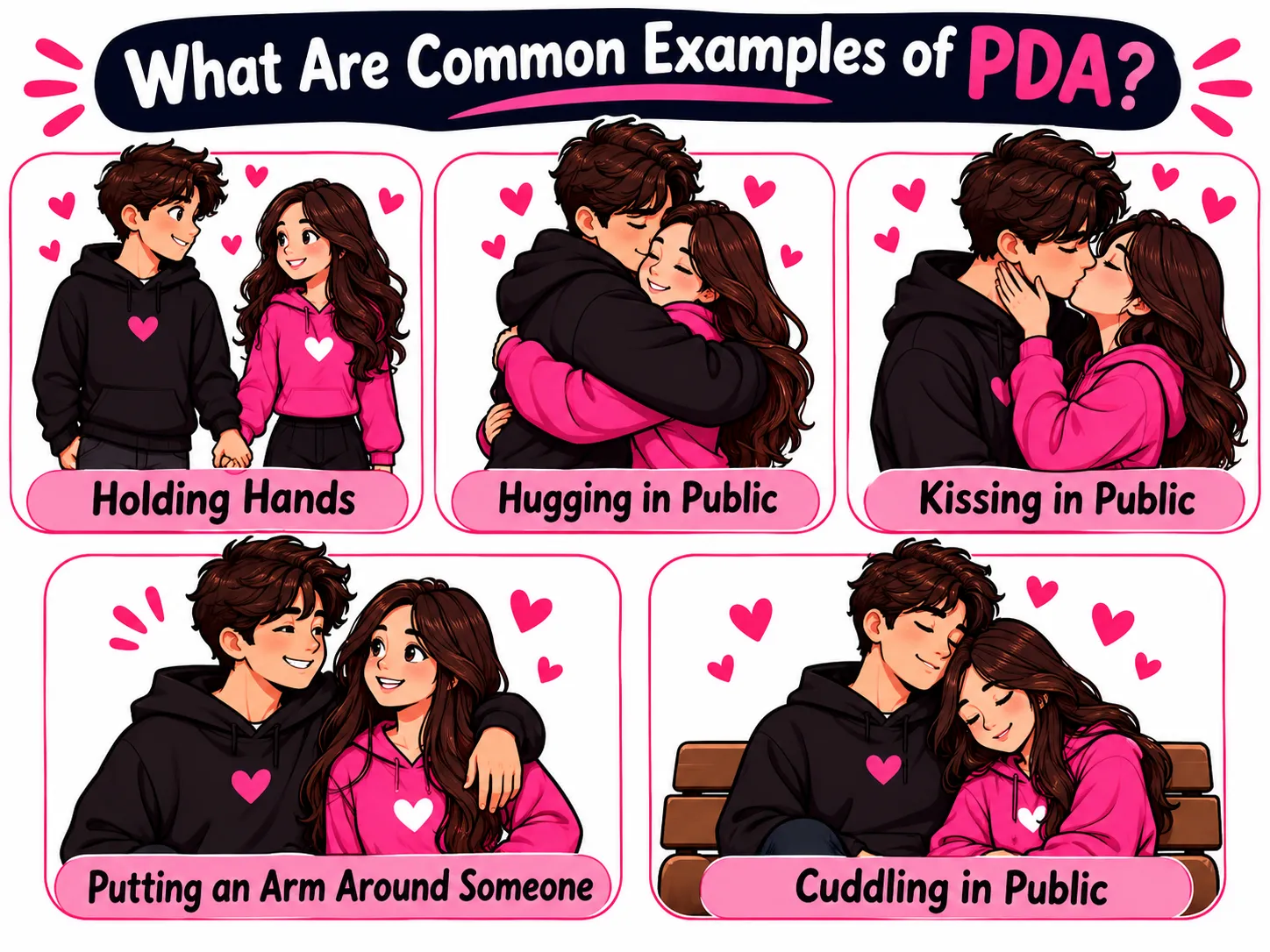
PDA can range from small gestures to more intimate actions. Here are some common examples to help you understand the term.
Holding Hands
Holding hands is one of the most common forms of PDA. Couples may hold hands while walking, shopping, or sitting together.
For example: “They were holding hands at the park.”
This is usually seen as a simple and casual display of affection.
Hugging in Public
A hug can show love, comfort, or happiness. Couples may hug when they meet, say goodbye, or celebrate good news.
For example: “He gave his girlfriend a hug outside the restaurant.”
Hugs can also happen between friends and family members, so context matters.
Kissing in Public
A quick kiss on the cheek or lips is another common form of PDA.
For example: “They shared a quick kiss before she left for work.”
Some people see a brief kiss as normal, while others may feel uncomfortable with public kissing. The setting and local social norms can affect how people react.
Putting an Arm Around Someone
A person may put an arm around their partner’s shoulders or waist while standing or sitting together.
For example: “They sat on the bench with his arm around her.”
This gesture can show closeness without being very noticeable.
Cuddling in Public
Some couples sit close together or cuddle while watching a movie or relaxing in a park.
For example: “The couple was cuddling on the couch at the outdoor movie.”
Whether this feels appropriate depends on the place and the people around them.
What Does PDA Mean in Texting and on Social Media?
In texting and on social media, PDA usually stands for Public Display of Affection.
People use it when talking about couples who show affection in front of others.
It can appear in messages, captions, comments, memes, and relationship discussions.
Here are a few examples:
Example 1:
“Those two are always showing PDA at school.”
Meaning: The couple often shows affection where other students can see them.
Example 2:
“I’m not a fan of PDA.”
Meaning: The person does not enjoy seeing couples show affection in public or may prefer to keep their own affection private.
Is PDA a Slang Word?
PDA is an abbreviation rather than a slang word in the strictest sense. However, people often use it casually, so it can feel like internet slang.
It is common in conversations about dating, relationships, celebrities, and social behavior.
The tone can be positive, negative, or neutral. Someone may use PDA to describe a sweet moment, tease a couple, or explain why public affection makes them uncomfortable.
Does PDA Have a Different Meaning on TikTok or Instagram?
Usually, PDA has the same meaning on TikTok, Instagram, Snapchat, and other social platforms: Public Display of Affection.
For example, someone might comment “PDA overload” on a video of a couple kissing or hugging.
The phrase suggests that the person thinks the couple is showing a lot of affection.
Depending on the context, it may be a joke, a complaint, or a playful comment.
Always look at the surrounding words, emojis, and video to understand the intended meaning.
What Are the Different Types of PDA?
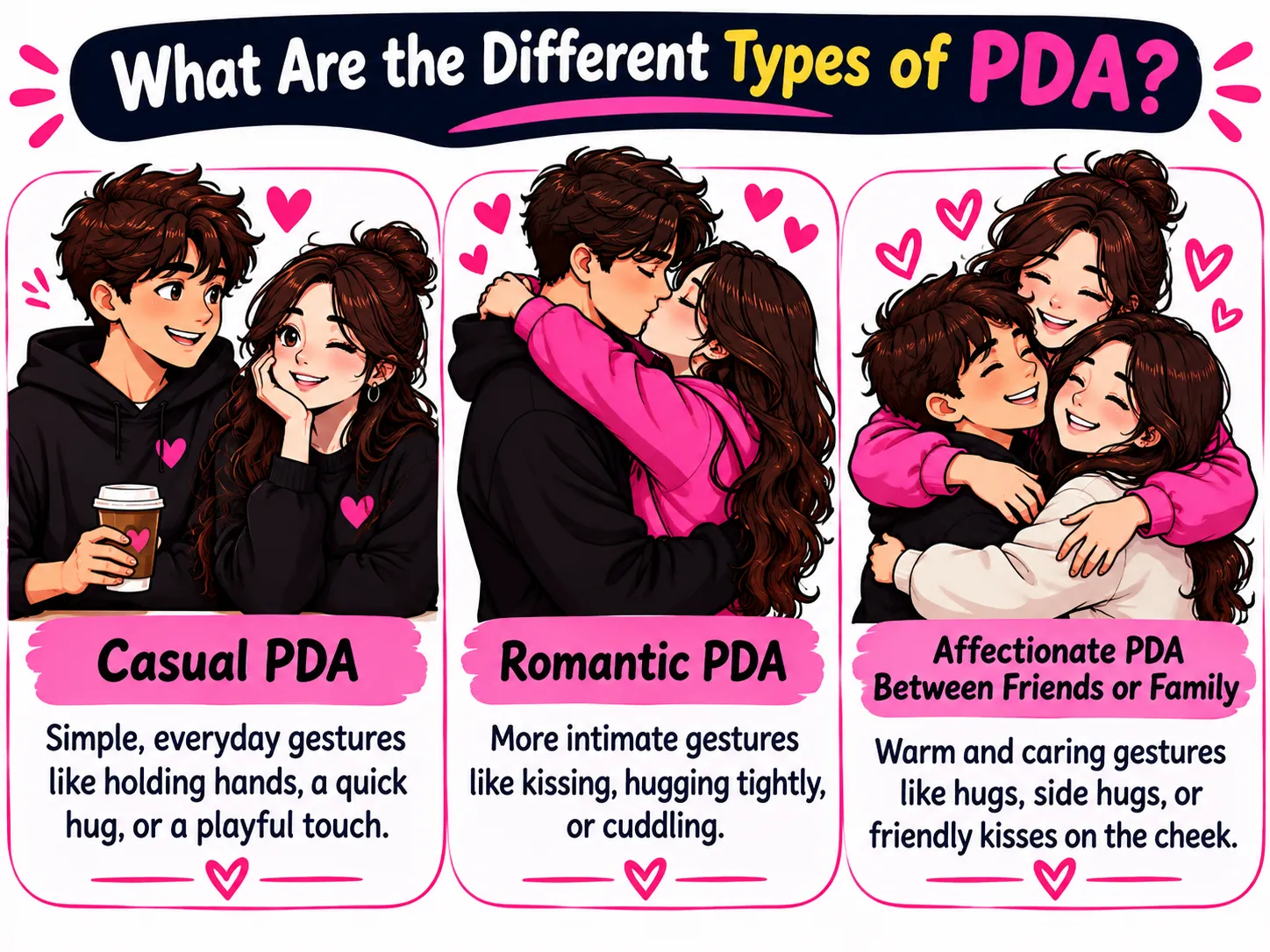
PDA can take different forms. Some are small and casual, while others are more intimate.
Casual PDA
Casual PDA includes simple gestures that many people find comfortable in public.
Examples include:
- Holding hands.
- A quick hug.
- Holding your partner’s arm.
- A brief kiss on the cheek.
These actions are often seen in everyday settings, such as parks, shopping centers, and streets.
Romantic PDA
Romantic PDA includes gestures that clearly show romantic interest or closeness.
Examples include:
- Kissing on the lips.
- Putting an arm around a partner’s waist.
- Cuddling on a bench.
- Hugging for a long time.
How people respond to these actions depends on their culture, personal views, and the setting.
Affectionate PDA Between Friends or Family
Although PDA often refers to romantic couples, affection in public can also happen between friends and relatives.
Examples include hugging a friend, holding a child’s hand, or embracing a family member at an airport.
In everyday speech, people are more likely to use the term PDA when discussing romantic affection, but the basic idea of showing affection in public is broader.
Is PDA Normal in a Relationship?
Yes, PDA is common in many relationships, but the amount of public affection people prefer can vary widely.
Some couples enjoy holding hands and kissing in public.
Others prefer to show affection only when they are alone. Neither choice automatically means that a relationship is better or worse.
Your comfort level may also change depending on where you are.
You might hold hands with your partner at a park but avoid kissing in front of your family or at work.
The key is to talk openly with your partner.
For example, one person might say, “I like holding hands when we go out, but I’m not comfortable kissing in public.”
A caring partner should listen and respect that boundary.
Is PDA Allowed at School or Work?
PDA rules can differ from one school, workplace, or organization to another.
PDA at School
Some schools allow students to hold hands or share brief hugs, while others limit physical affection on school grounds.
Students should follow their school’s rules and respect the comfort of others.
For example, holding hands in a hallway may be treated differently from prolonged kissing during class.
Check the school’s actual policy instead of assuming all schools have the same rules.
PDA at Work
At work, a quick greeting or friendly gesture may be acceptable, but romantic affection can make coworkers uncomfortable or appear unprofessional.
Workplaces may have policies about relationships, physical contact, and professional conduct.
It is usually best to keep romantic displays brief and consider the work environment. If a company has a written policy, follow it.
Why Do Some People Dislike PDA?
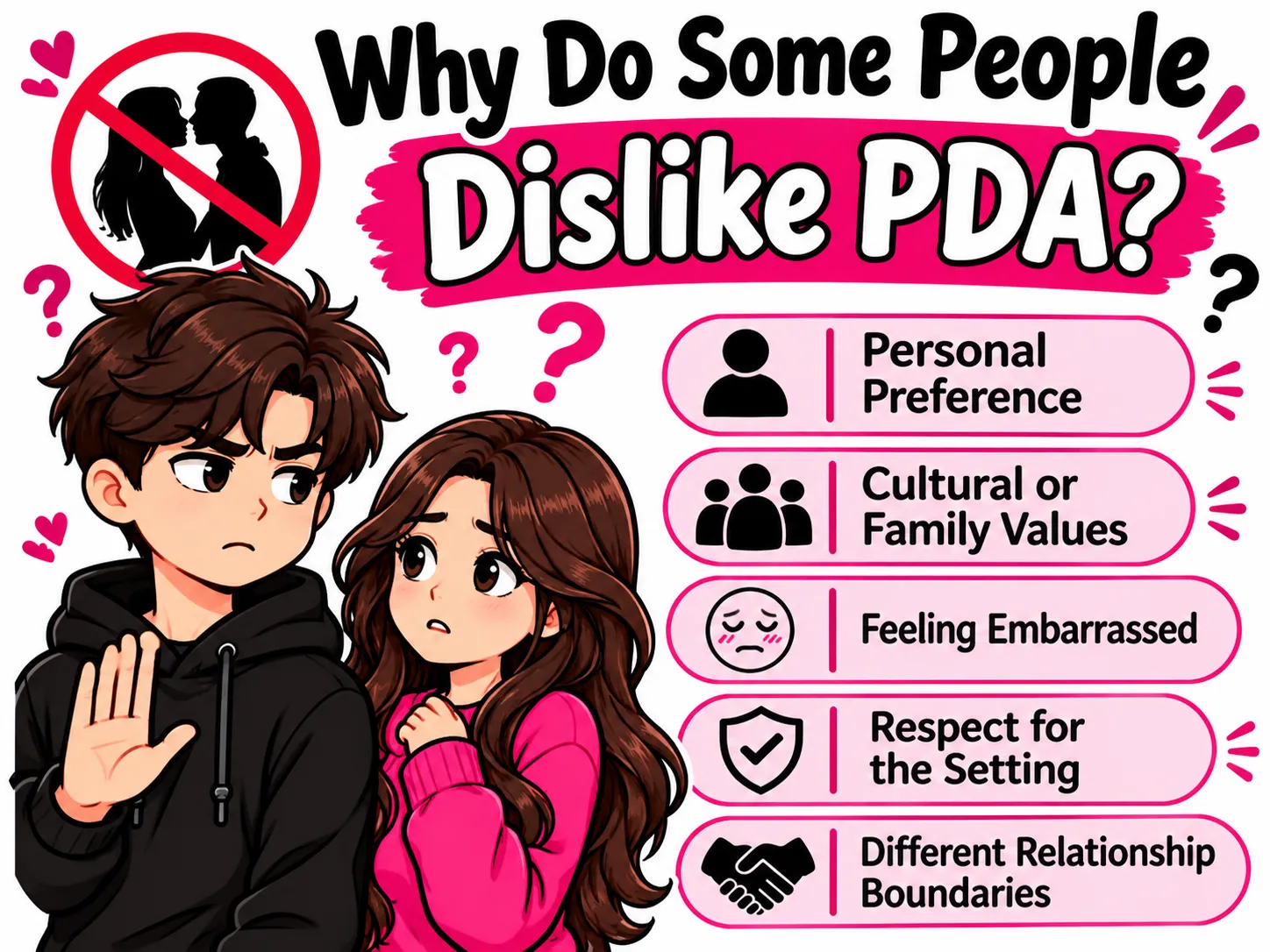
Not everyone feels comfortable seeing or showing affection in public. There are many reasons for this.
Personal Preference
Some people enjoy keeping romantic moments private. They may feel that affection is more meaningful when shared away from other people.
Cultural or Family Values
People grow up with different ideas about public behavior. In some families and cultures, public kissing is common.
In others, even holding hands may be viewed as too personal in certain settings.
Feeling Embarrassed
A person may feel shy when others can see them being affectionate. They might worry about being watched, teased, or judged.
Respect for the Setting
Some people believe that romantic affection should be limited in places where others are expected to act formally or quietly.
Different Relationship Boundaries
One partner may enjoy PDA while the other does not.
This difference does not have to cause a problem if both people communicate and respect each other’s wishes.
Disliking PDA does not mean someone lacks love or commitment. It may simply reflect their comfort level.
Is PDA Good or Bad?
PDA is not automatically good or bad. It depends on the people involved and the situation.
Possible Benefits of PDA
For couples who enjoy physical affection, PDA may help them feel close and cared for. Holding hands or sharing a hug can be a simple way to express warmth.
It can also help partners feel supported during a difficult moment or happy event.
Possible Downsides of PDA
Problems can arise when one person feels pressured to show affection or when a couple ignores the rules or expectations of a setting.
For example, one partner may feel embarrassed by kissing in front of friends.
Another may dislike seeing intimate behavior in a place where they expect a more formal atmosphere.
The solution is not to label all PDA as wrong. Instead, couples can discuss their boundaries and make choices that work for both of them.
Can PDA Cause Relationship Problems?
PDA can become a source of conflict when partners have different expectations.
One person might see public affection as a sign of love, while the other sees it as too personal to share with strangers.
Neither person needs to be blamed for having a different preference. An honest conversation can help both partners understand each other.
A healthy relationship allows both people to say what makes them comfortable without fear of pressure or ridicule.
PDA in Technology
In technology, PDA can mean Personal Digital Assistant.
A PDA was a small handheld electronic device used to organize information such as contacts, calendars, notes, and tasks. Many older models included a touch screen or stylus.
Smartphones later replaced most of the everyday functions of these devices.
How to Know Which Meaning Is Correct
Use the context to work out the meaning.
- Dating or relationships: Public Display of Affection.
- Text messages about couples: Usually Public Display of Affection.
- Older electronic devices: Personal Digital Assistant.
- Medical or professional documents: A field-specific meaning may apply.
If someone says, “They were showing PDA at the mall,” the relationship meaning is clear. If someone says, “I used a PDA to manage my calendar,” they are likely talking about technology.
Common Phrases Related to PDA
You may see PDA used in several everyday phrases.
“Too Much PDA”
This means someone thinks a person or couple is showing more affection in public than they find comfortable.
Example: “They were kissing throughout dinner. It was too much PDA for me.”
“No PDA”
This means public displays of affection are not allowed or are discouraged in a particular setting.
Example: “The school has a no-PDA rule during class.”
The exact rule depends on the organization.
“PDA Couple”
This describes a couple that often shows affection in public.
Example: “They are such a PDA couple; they always hold hands.”
The phrase may be affectionate, neutral, or teasing, depending on the speaker.
How to Respond When Someone Mentions PDA
Your response depends on the situation and what the other person means.
If a friend says, “I’m not into PDA,” you could reply, “That’s fair. Everyone has different comfort levels.”
If someone jokes, “PDA overload!” you might say, “They’re just happy together,” if you want to keep the conversation light.
If your partner says they dislike PDA, ask what kinds of affection feel comfortable to them.
You can also explain your own preferences in a calm way. For example: “I like holding hands in public, but I understand if you don’t want to kiss in front of other people.”
The goal is to understand each other rather than pressure anyone into behaving differently.
Tips for Showing PDA Respectfully

If you enjoy showing affection in public, a few simple habits can help you avoid awkward moments.
- Ask what your partner likes. Do not assume they enjoy every kind of public affection.
- Respect a no. Never pressure someone to kiss, hug, or hold hands.
- Think about the setting. A casual walk and a formal meeting call for different behavior.
- Follow local rules. Schools, workplaces, and other places may have their own policies.
- Pay attention to comfort. If your partner seems uneasy, check in rather than pushing them.
- Keep affection natural. You do not need to show affection to prove your relationship is real.
PDA should be a shared choice, not a test of love.
Summary
PDA most commonly stands for Public Display of Affection. It means showing affection in a public place where other people may see it.
Common examples include holding hands, hugging, kissing, cuddling, and putting an arm around your partner.
In texts and on social media, PDA usually has the same meaning and often appears in conversations about dating and relationships.
PDA is a personal choice. Some people enjoy it, while others prefer to keep affection private.
The most important things are mutual comfort, consent, and respect for the setting.
In technology, PDA can also mean Personal Digital Assistant, an older handheld device used to manage tasks and personal information.
The context helps you understand which meaning is intended.
Frequently Asked Questions (FAQs)
1. What does PDA stand for?
PDA most commonly stands for Public Display of Affection.
It means showing love or affection in front of other people, such as holding hands or kissing in public.
2. What does PDA mean in a relationship?
In a relationship, PDA means showing romantic affection in public.
Examples include hugging, holding hands, kissing, and sitting close to your partner.
3. What does PDA mean in texting?
In texting, PDA usually means Public Display of Affection.
People use it when discussing couples who show affection in public.
4. What are examples of PDA?
Common examples include holding hands, hugging, kissing, cuddling, putting an arm around a partner, and giving a quick kiss goodbye in a public place.
5. Is PDA a good thing?
PDA can be a positive way to show affection when both people enjoy it.
It can become uncomfortable when someone feels pressured or when the behavior does not suit the setting.
6. What does PDA mean on TikTok?
On TikTok, PDA usually means Public Display of Affection.
It may appear in videos or comments about couples holding hands, kissing, or showing other forms of affection.
7. Is holding hands considered PDA?
Yes. Holding hands in a public place is one of the most common examples of PDA, especially when the people involved are romantic partners.
8. Why do some people dislike PDA?
Some people feel shy, prefer privacy, follow different cultural or family values, or simply do not enjoy showing affection in front of others.
9. How much PDA is too much?
There is no single rule for everyone. It depends on personal comfort, mutual consent, the setting, and any rules that apply to the place.
10. What does PDA mean in technology?
In technology, PDA stands for Personal Digital Assistant.
It refers to an older handheld device used to manage contacts, calendars, notes, and other personal information.
11. Can PDA happen between friends?
Yes. Friends and family members can show affection in public through hugs or other caring gestures.
However, the term PDA is most often used when discussing romantic couples.
12. Does PDA prove that a couple is in love?
No. PDA can express affection, but it does not prove how strong or healthy a relationship is.
People show love in different ways, including through trust, support, kindness, and time together.
Conclusion
PDA stands for Public Display of Affection and usually refers to couples showing love in public through actions such as holding hands, hugging, or kissing.
It is common in everyday conversations, text messages, and social media posts.
Some people enjoy public affection, while others prefer to keep romantic moments private.
Both preferences are valid. What matters is that partners respect each other’s boundaries and consider the setting around them.
Remember that PDA can also mean Personal Digital Assistant in technology.
When you see the abbreviation, check the context to understand its intended meaning.
In most relationship conversations, however, PDA simply means showing affection in public.

Ryan Mitchell creates informative content about word definitions, acronyms, online slang, and modern communication. He enjoys exploring how people use language in text messages, on social media, and in daily life. Ryan focuses on delivering simple explanations and practical examples that help readers quickly understand the meaning of unfamiliar words and phrases.