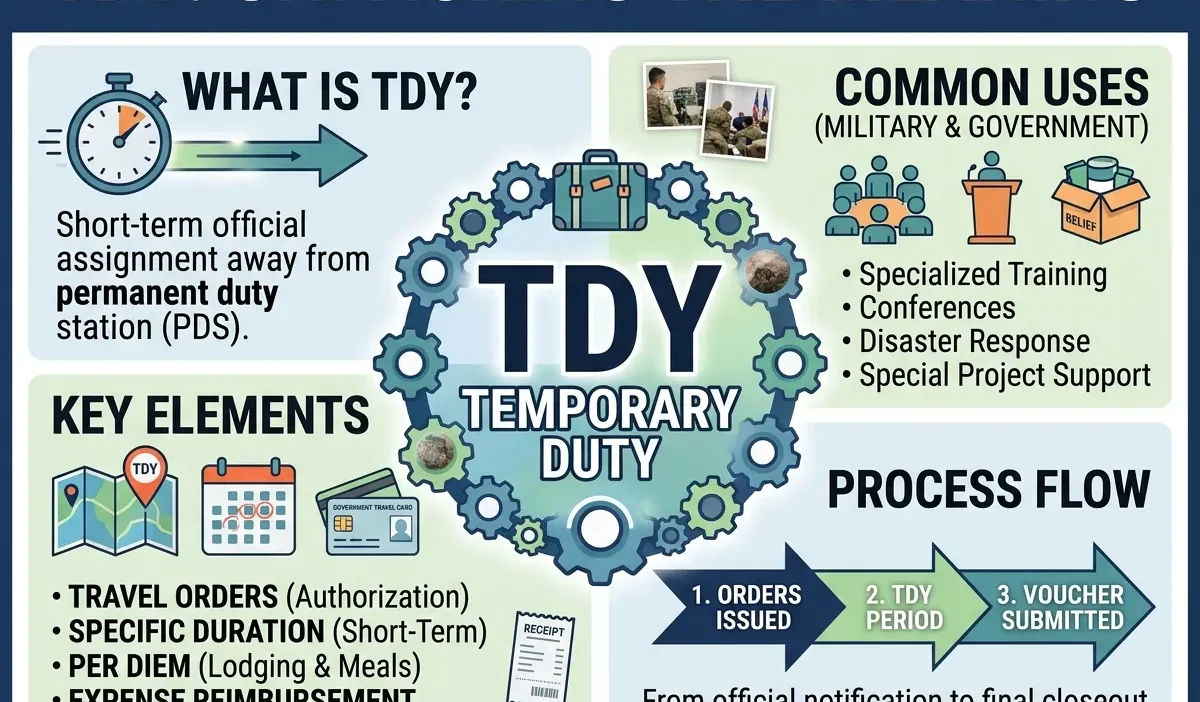
TDY stands for Temporary Duty. In the U.S. military, it refers to an authorized assignment at a location other than a service member’s regular duty station.
The assignment is temporary, which means the person is not normally moving to a new permanent workplace.
They travel to another location to complete a specific task and then return to their regular duty station.
For example, imagine a service member stationed in Texas who must attend a five-day training course in Virginia.
The service member may receive TDY orders for that trip. After the course ends, they return to Texas.
TDY is also used in some government and work settings, although the exact rules depend on the organization.
What Does TDY Stand For?
TDY stands for Temporary Duty.
Each part of the term explains something important:
- Temporary: The assignment lasts for a limited time.
- Duty: The person travels for an official work task.
- TDY: The person performs that task away from their usual duty location.
You may see the term in travel orders, military paperwork, work schedules, or official messages.
What Is the Main Purpose of TDY?
The main purpose of TDY is to let a person complete official work at another location without permanently changing their duty station.
Common reasons for TDY include:
- Attending military training.
- Taking part in a work meeting.
- Supporting another unit or office.
- Completing a special project.
- Receiving job-related education.
- Helping with an inspection or official event.
The length of a TDY assignment depends on the task and the rules of the organization. Some trips last only a few days, while others may last weeks or longer.
What Does TDY Mean in the Military?
In the military, TDY usually means that a service member has temporary orders to perform official duties away from their permanent duty station.
The U.S. Army, Air Force, Navy, Space Force, and other military organizations may use temporary-duty assignments.
The exact name, approval process, and travel rules can vary by branch.
A service member on TDY remains connected to their regular duty station. They are sent somewhere else to complete a task, but the trip does not normally mean they have permanently moved.
Examples of Military TDY
Here are a few simple examples:
Example 1: Military Training
A soldier stationed in Georgia receives orders to attend a leadership course in another state. The course lasts one week. The soldier travels for the course and returns to Georgia afterward.
This is a typical example of TDY.
Example 2: A Work Meeting
An Air Force member travels to another base for a three-day planning meeting. The member attends the meetings, completes the assigned work, and returns to their home base.
This may qualify as TDY when authorized under the applicable rules.
Does TDY Mean Deployment?
No. TDY and deployment are not the same thing.
TDY usually refers to a temporary work assignment away from a regular duty station. A deployment often involves sending military personnel to support an operation, mission, or other military requirement.
The purpose, length, location, and conditions of a trip help determine how it is classified. The terms should not be used as if they always mean the same thing.
A TDY assignment may involve travel to another military base or civilian location without being a deployment.
How Does TDY Work?
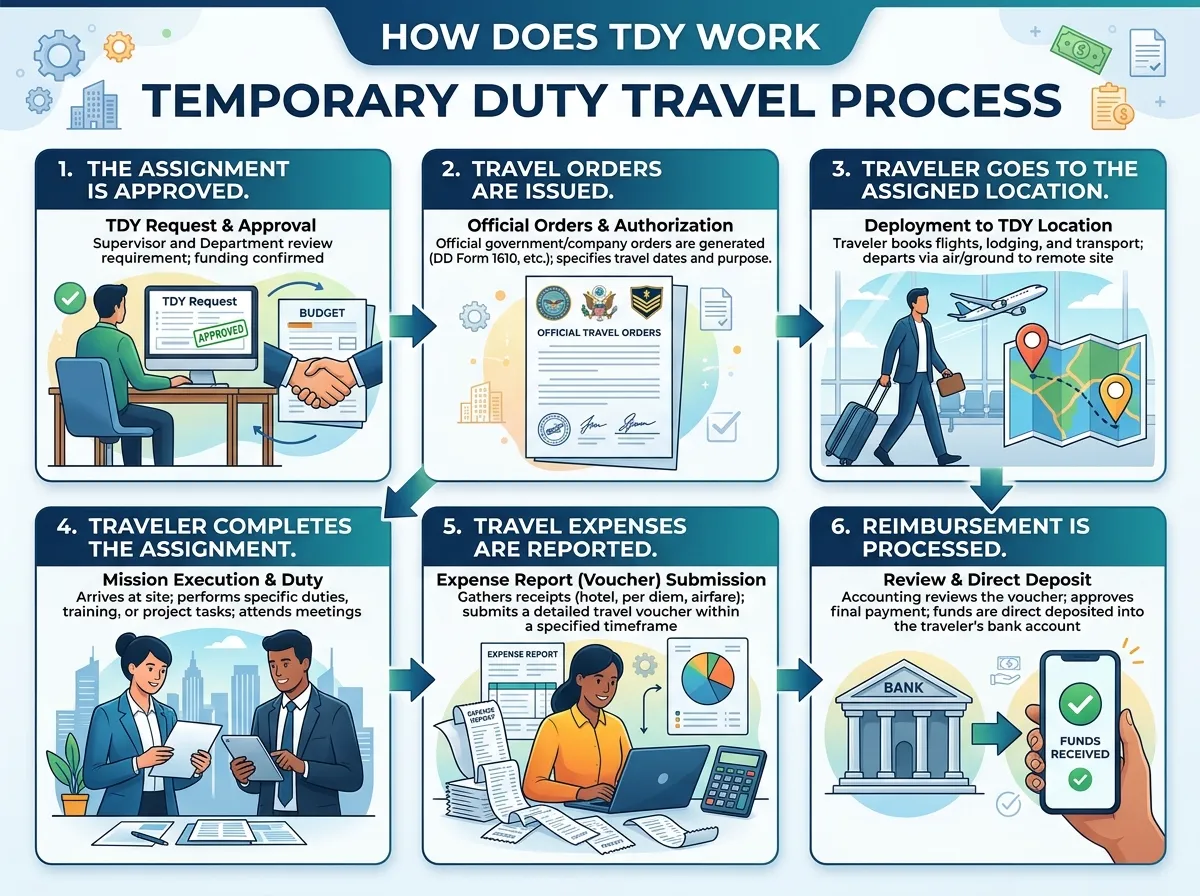
A TDY assignment generally follows a few basic steps. The exact process depends on the military branch or agency.
1. The Assignment Is Approved
A supervisor or authorized office identifies a work need. The service member or employee may then receive approval to travel.
The trip must follow the organization’s travel rules and approval process.
2. Travel Orders Are Issued
The traveler receives instructions that explain the purpose of the trip, where to go, and when to travel.
TDY orders may include details about travel dates, the destination, and approved expenses.
3. The Traveler Goes to the Assigned Location
The person travels to the approved location and completes the required work. This could include training, meetings, inspections, or other official duties.
4. The Traveler Completes the Assignment
Once the task is finished, the traveler follows the orders for returning to their regular duty station or continuing to another approved location.
5. Travel Expenses Are Reported
The traveler may need to submit a travel claim or voucher. This process helps the organization review approved expenses and pay any amount owed under the applicable rules.
Keeping receipts and following travel instructions can make this step easier.
Do You Get Paid Extra for TDY?
A common question is whether military members receive extra pay while on TDY.
TDY does not automatically mean extra salary. A traveler may receive reimbursement or allowances for approved travel expenses, depending on the orders and applicable rules.
These payments are meant to cover certain costs of official travel. They are separate from regular military pay.
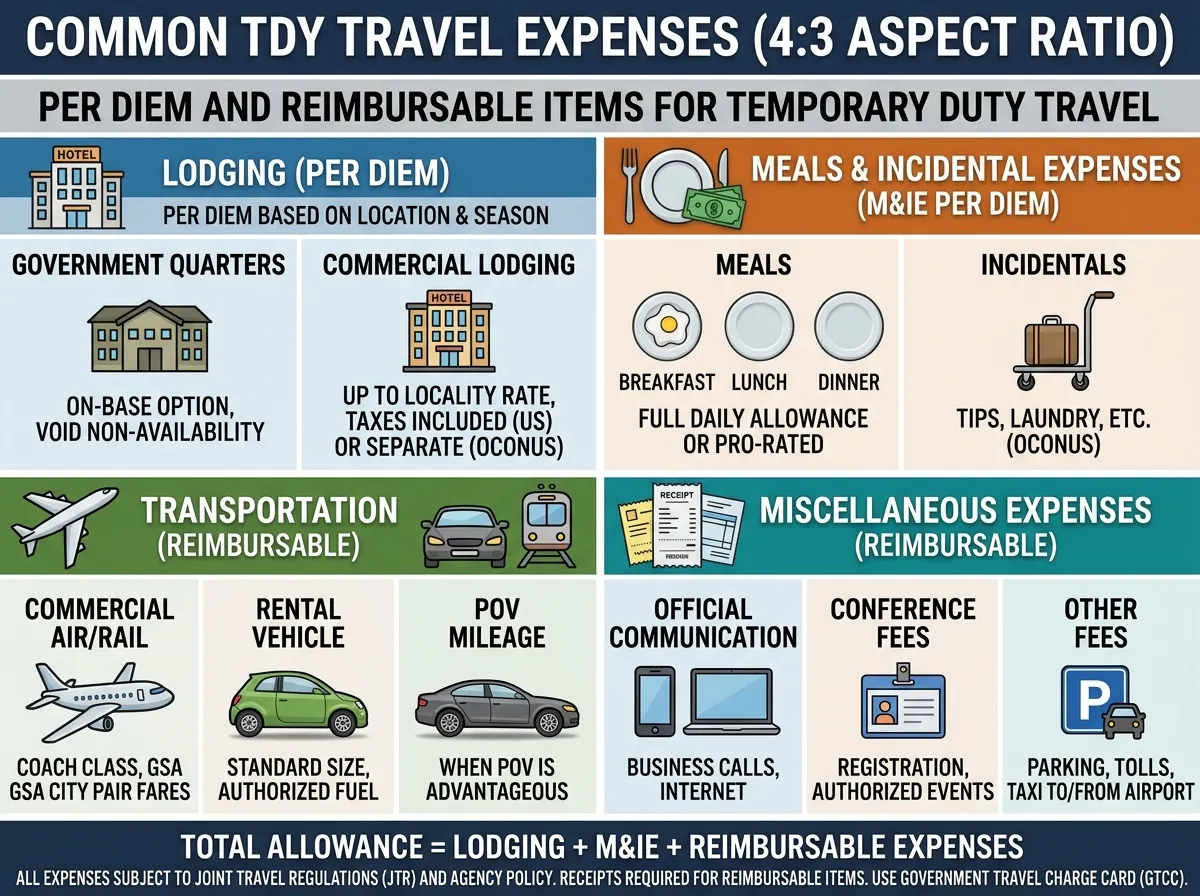
Common TDY Travel Expenses
Lodging
The traveler may receive reimbursement for an approved hotel or other authorized lodging expense. Some assignments use government-provided lodging.
Meals and Incidental Expenses
Eligible travelers may receive a daily allowance for meals and certain small expenses. This is often called the per diem allowance.
The amount depends on the destination, travel dates, and applicable travel rules.
Transportation
Approved transportation costs may include airfare, train tickets, rental cars, or mileage when permitted.
The travel orders and agency rules determine which expenses qualify.
Other Approved Costs
Some trips may include additional authorized costs related to official travel. These must meet the relevant rules and approval requirements.
What Is TDY Per Diem?
TDY per diem is an allowance used to cover eligible meals, incidental expenses, and, when applicable, lodging during official travel.
The amount is not the same for every trip. It can depend on the destination and the traveler’s eligibility.
For example, a service member traveling to another city for a training course may be eligible for lodging and meal allowances under their orders. The actual amount depends on the applicable rates and rules.
Travelers should check their orders and the current official guidance rather than assume that every expense will be paid.
How Long Does TDY Last?
There is no single length that applies to every TDY assignment.
A trip may last a few days, several weeks, or longer, depending on the purpose and the rules that apply. A short training course may require only a brief trip, while a major project may require a longer stay.
The length of an assignment can depend on:
- The task that must be completed.
- The travel orders.
- The needs of the unit or agency.
- The destination and travel schedule.
- Applicable rules and approval limits.
A temporary assignment does not become a permanent change of station simply because it lasts more than a few days. The official classification and orders matter.
Can TDY Be Extended?
Yes, a TDY assignment may sometimes be extended if the work requires more time and the extension receives the required approval.
A traveler should not assume that they can extend their stay or change their return date without permission. They should follow the instructions of their supervisor or travel office.
An extension may also affect lodging, per diem, transportation, and other travel arrangements.
TDY vs. PCS: What Is the Difference?
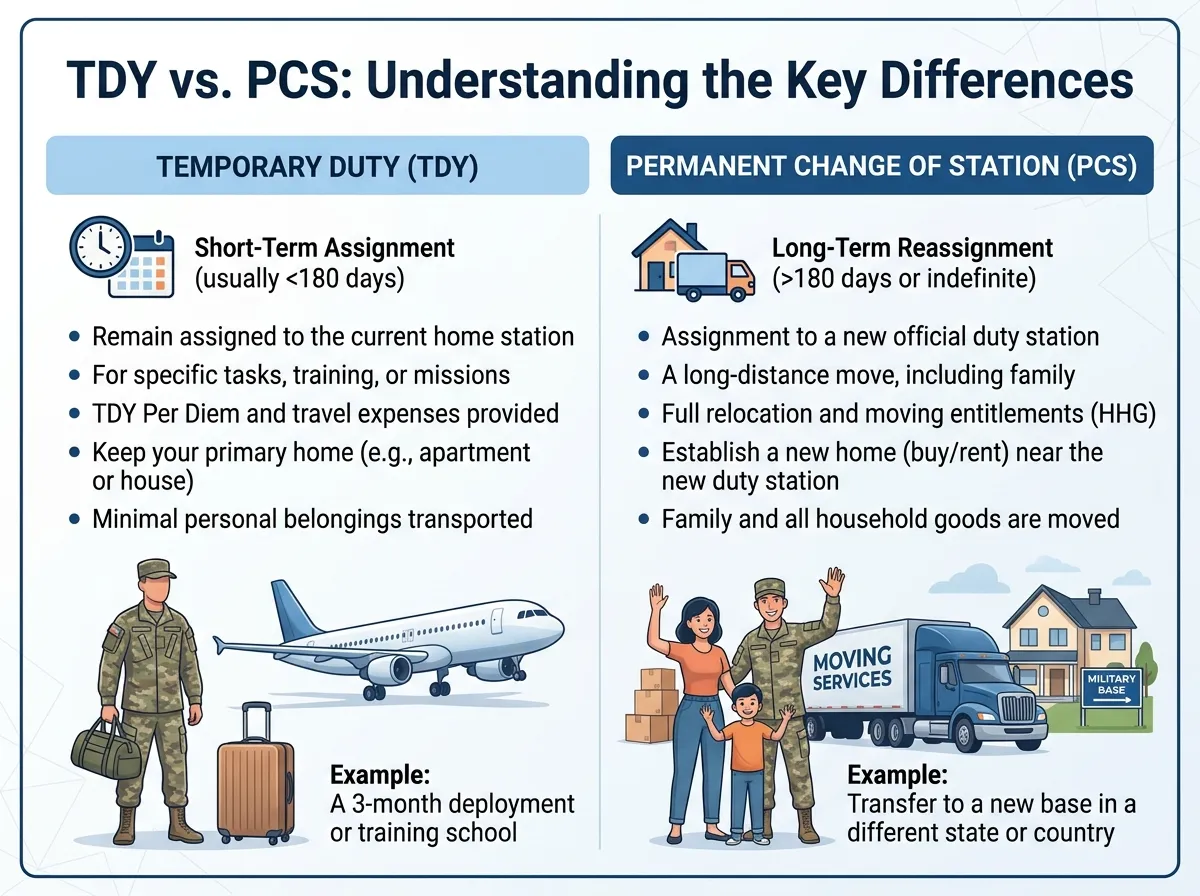
TDY and PCS are both terms used in military travel, but they describe different types of assignments.
PCS stands for Permanent Change of Station. It generally means a service member is officially reassigned to a new permanent duty station.
| Feature | TDY | PCS |
| Full meaning | Temporary Duty | Permanent Change of Station |
| Main purpose | Complete a temporary assignment | Move to a new permanent duty station |
| Work location | Usually temporary | New regular duty location |
| Return to old station | Usually expected after the assignment | Not normally part of the move |
| Travel arrangements | Based on temporary-duty orders | Based on PCS orders and relocation rules |
For example, traveling to another base for a one-week course may be TDY. Receiving orders to move to another base as your new permanent station is generally a PCS.
The exact travel benefits and requirements differ, so travelers should read their official orders carefully.
TDY vs. Deployment
TDY and deployment may both involve being away from home, but they describe different situations.
| Feature | TDY | Deployment |
| General meaning | Temporary official assignment | Assignment to support a military operation or mission |
| Common purpose | Training, meetings, projects, or support tasks | Operational or mission-related duties |
| Destination | Another work site, base, or approved location | A location connected to the mission |
| Length | Depends on the assignment | Depends on the operation and orders |
| Official classification | Determined by the orders | Determined by the orders and mission |
These descriptions are general. Some military assignments may involve overlapping features, and the official orders determine the classification.
The main point is that being away from a normal duty station does not automatically mean a person is deployed.
What Does TDY Mean in Civilian Government Jobs?
TDY is not limited to military service. Some U.S. government agencies use the term for official temporary travel away from an employee’s usual work location.
For example, a federal employee may travel to Washington, D.C., for a meeting, attend training in another state, or visit a project site for a short period.
The employee’s agency determines the travel approval process, eligible expenses, and reimbursement rules.
Civilian employees should not assume that all military TDY rules apply to them. Government agencies may have different policies, and private employers may use other terms for business travel.
Is TDY Used in Regular Workplace Messages?
It can be. In a workplace message, TDY may simply mean that an employee will be away from their normal office for a temporary work assignment.
For example:
“I’m TDY next week, so I’ll be working from the regional office.”
This means the person expects to work at another location temporarily.
However, TDY is not a universal workplace abbreviation. The surrounding message and the organization’s language help explain its meaning.
Common TDY Terms You Should Know

If you are reading military travel documents, you may see TDY alongside other travel terms.
TAD
TAD stands for Temporary Additional Duty. It is a term used by the U.S. Navy and Marine Corps for certain temporary assignments away from a normal duty location.
Its use and administrative details depend on the service’s rules.
PCS
PCS means Permanent Change of Station. It refers to a permanent reassignment to a new duty station rather than a temporary trip.
Per Diem
Per diem is a daily allowance for eligible travel expenses, such as meals and incidental costs, and sometimes lodging.
The applicable rates and rules depend on the destination and travel authorization.
DTS
DTS commonly stands for Defense Travel System, the U.S. Department of Defense system used to arrange and manage official travel for eligible personnel.
Not every traveler or trip uses the same process, so travelers should follow their organization’s instructions.
CONUS and OCONUS
These terms describe locations in relation to the continental United States.
- CONUS: Continental United States.
- OCONUS: Outside the continental United States, commonly used for locations beyond CONUS under military and government travel rules.
These terms may appear in travel orders and guidance because location can affect travel requirements and allowances.
How to Use TDY in a Sentence
TDY is often used in official messages and everyday conversations among people familiar with military or government work.
Here are some examples:
- “I will be TDY at another base next week.”
- “She received TDY orders for a training course.”
- “My father is on TDY and will return after the assignment.”
- “The team is TDY for three days to complete the inspection.”
- “Please check the travel voucher before closing out your TDY.”
In each example, TDY refers to a temporary official assignment away from the person’s normal duty location.
What Does “Going TDY” Mean?
“Going TDY” means traveling away from a normal duty station or work location to complete an authorized temporary assignment.
For example, if someone says, “I’m going TDY to California,” they usually mean they will travel to California for temporary official work.
It does not automatically mean they are moving there permanently or going on deployment.
What Does “TDY Orders” Mean?
TDY orders are official instructions authorizing or describing a temporary-duty assignment.
They may identify the destination, travel dates, purpose, and approved travel arrangements. Travelers should use their orders and official guidance to understand their responsibilities and eligible expenses.
Is TDY the Same as Business Travel?
TDY and business travel can be similar, but the terms are not always interchangeable.
In military and government settings, TDY often refers to an official temporary assignment under specific travel rules. In a private company, an employee might call a similar trip a business trip or work trip.
For example, a private employee who travels to another office for a two-day meeting is usually described as being on a business trip. A government employee performing similar work may have the trip classified as TDY under their agency’s rules.
The purpose of the trip may be similar, but the paperwork, reimbursement policies, and official terms can differ.
Why Is TDY Important?
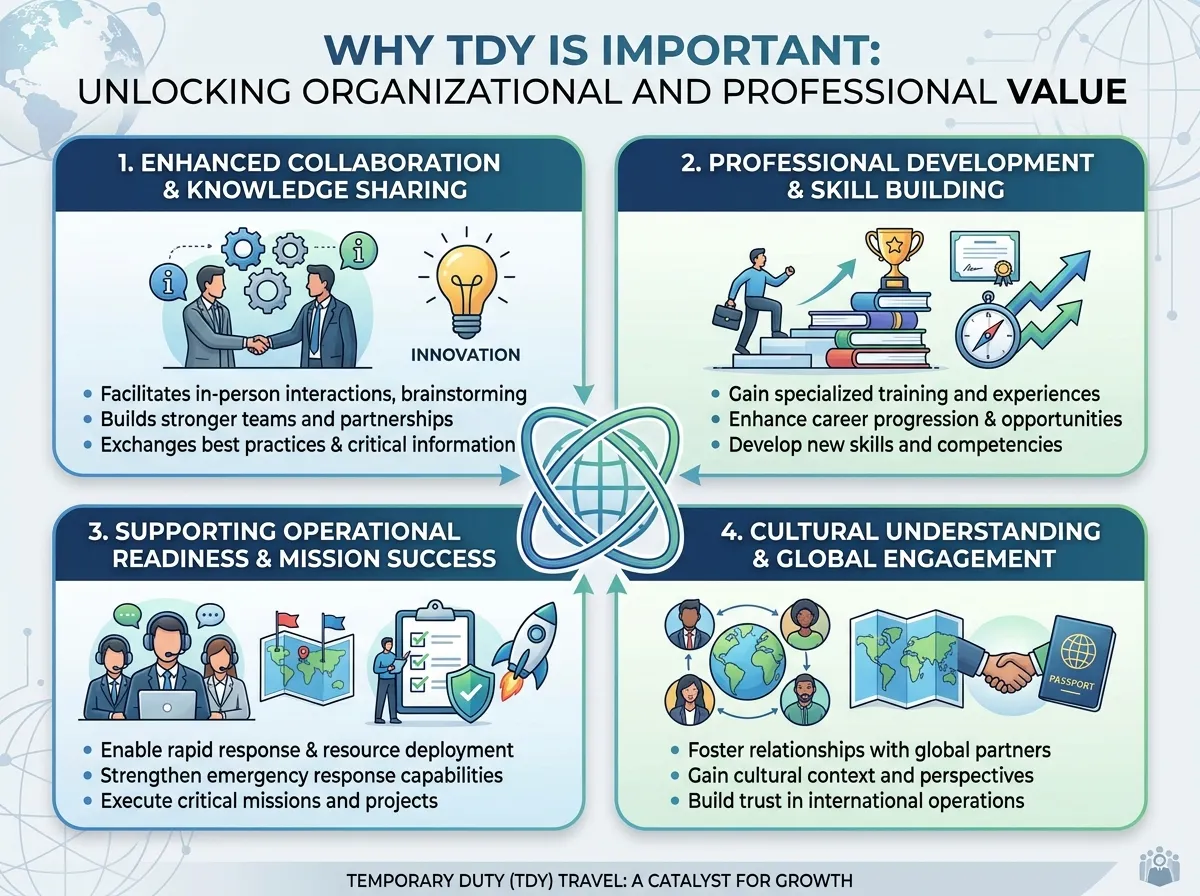
TDY allows military units and government organizations to send people where their skills are needed without making every assignment a permanent move.
It can help organizations provide training, share knowledge, support projects, and complete work at different locations.
For service members, understanding TDY can help them prepare for travel, follow orders, and manage eligible expenses. For family members, it can explain why someone may be away for a short period but still assigned to their usual duty station.
Knowing the meaning of TDY also makes military emails, travel documents, and workplace conversations easier to understand.
Article Summary
- TDY meaning: Temporary Duty.
- Military use: An authorized temporary assignment away from a regular duty station.
- Common reasons: Training, meetings, inspections, and special projects.
- TDY pay: Regular salary does not automatically increase, but eligible travel expenses may be reimbursed.
- Per diem: An allowance for eligible travel expenses under the applicable rules.
- TDY vs. PCS: TDY is temporary duty, while PCS means Permanent Change of Station.
- TDY vs. deployment: They are different classifications, and official orders determine how an assignment is classified.
- Civilian use: Some government agencies also use TDY for temporary official travel.
FAQS
1. What does TDY stand for?
TDY stands for Temporary Duty. It generally refers to an authorized assignment away from a person’s regular duty station for a limited time.
2. What does TDY mean in the military?
In the military, TDY means a service member travels away from their regular duty station to complete temporary official work, such as training, a meeting, or a special project.
3. Does TDY mean deployment?
No. TDY usually refers to a temporary assignment, while deployment generally involves supporting a military operation or mission. The official orders determine the assignment’s classification.
4. Do you get extra money for TDY?
Not automatically. Eligible travelers may receive reimbursement or allowances for approved expenses, such as lodging, meals, and transportation. The amount depends on the applicable rules and travel authorization.
5. How long can someone be on TDY?
TDY can last a few days, weeks, or longer. Its length depends on the work, travel orders, and rules of the military branch or agency.
6. What is the difference between TDY and PCS?
TDY means Temporary Duty and usually involves a short-term assignment away from a regular duty station. PCS means Permanent Change of Station and generally involves moving to a new permanent duty location.
7. What does TDY mean in a text message?
In a military or government-related text, TDY usually means Temporary Duty. Someone saying they are “TDY next week” likely means they will travel for temporary official work.
8. What are TDY orders?
TDY orders are official instructions for a temporary-duty assignment. They may explain the destination, travel dates, purpose, and authorized travel arrangements.
9. What does TAD mean, and is it the same as TDY?
TAD means Temporary Additional Duty. It is used by the Navy and Marine Corps for certain temporary assignments. The terms are similar, but the exact usage depends on the service.
10. What does TDY mean for civilian employees?
For some U.S. government employees, TDY means temporary official travel away from their usual work location. The employee’s agency sets the relevant approval and reimbursement rules.
11. Does TDY mean you have moved to a new base?
Usually, no. TDY normally means a temporary assignment, after which the traveler returns to their regular duty station. A permanent reassignment is generally handled through PCS orders.
12. What does “TDY per diem” mean?
TDY per diem is an allowance for eligible travel expenses, such as meals and incidental costs, and sometimes lodging. The rate depends on the location and applicable travel rules.
Conclusion
TDY means Temporary Duty, a term commonly used in the U.S. military and some government agencies.
It describes an authorized temporary assignment away from a person’s regular duty station. Common reasons include training, meetings, inspections, and special projects.
A TDY assignment may involve travel costs, lodging, and per diem allowances, but reimbursement depends on the official orders and applicable rules.
It is also important to understand the difference between TDY, PCS, and deployment because each term describes a different type of assignment.
The next time you see TDY in a military document, work email, or text message, you will know that it usually refers to temporary official duty rather than a permanent move.

Emma Wilson is a writer at MeaningVibz who enjoys exploring emoji meanings, texting expressions, and online communication trends. She helps readers understand how emojis and slang are used in different situations by providing clear explanations and relatable examples for everyday messaging.