
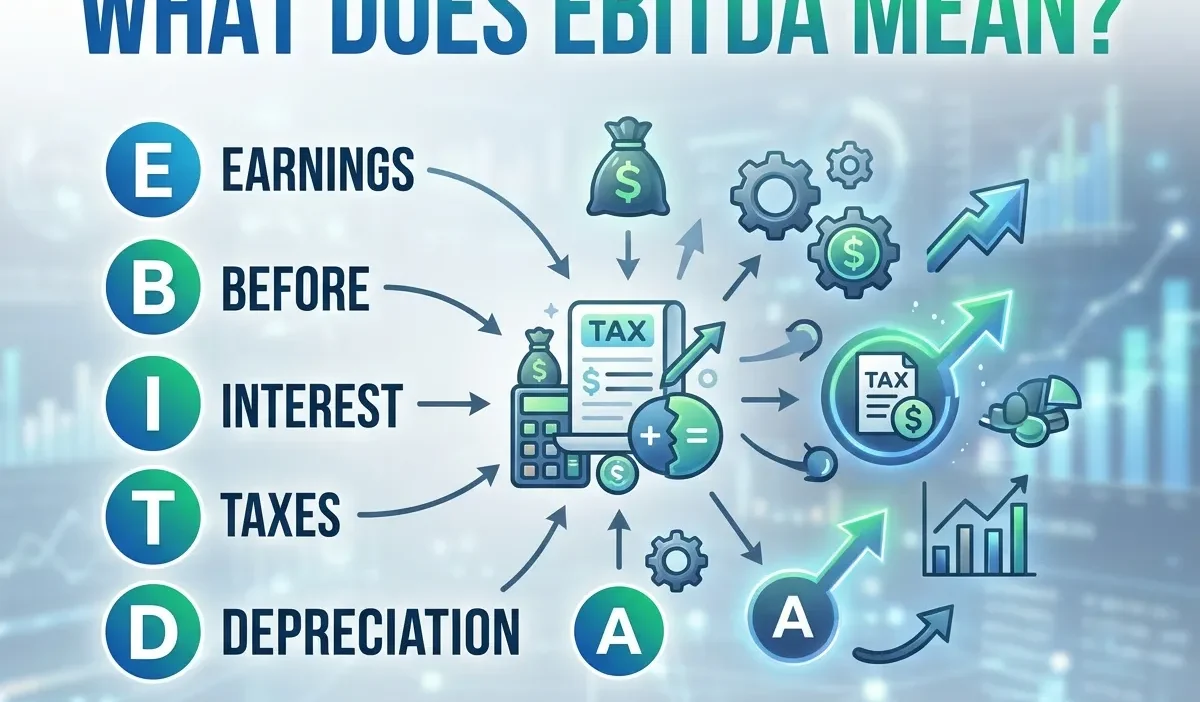
EBITDA stands for Earnings Before Interest, Taxes, Depreciation, and Amortization.
In simple words, EBITDA shows how much a business earns before subtracting four types of costs:
- Interest: The cost of borrowing money.
- Taxes: Money a company owes to the government.
- Depreciation: The cost of using physical assets, such as machines, over time.
- Amortization: The cost of certain non-physical assets spread over time.
EBITDA is often used to study the performance of a company’s main business activities. It helps people look at earnings before these four items affect the result.
A Simple Example
Imagine you own a small bakery.
Your bakery earns $100,000 in revenue in one year.
After paying workers, buying flour, paying rent, and covering other operating costs, you have $25,000 left before interest, taxes, depreciation, and amortization.
Your EBITDA is $25,000.
What Does Each Letter in EBITDA Stand For?
Each part of the term describes a cost that is left out of the EBITDA calculation.
E — Earnings
Earnings refer to the money a business makes after certain costs have been deducted.
In the EBITDA formula, the starting point is usually operating income or net income, depending on the method used.
B — Before
The word “before” means the four listed costs have not yet been deducted from the earnings figure.
I — Interest
Interest is the cost a company pays to borrow money. For example, a business may take out a bank loan to buy equipment or open a new store.
Two similar companies may have different interest costs because they use different amounts of debt. EBITDA leaves interest out to help people compare their operations without this difference.
T — Taxes
Taxes are payments a company makes to the government. Tax costs can vary based on where a company operates, the tax rules that apply, and other factors.
EBITDA leaves taxes out of the calculation.
D — Depreciation
Depreciation spreads the cost of a physical asset over its useful life. Examples include buildings, vehicles, tools, and factory equipment.
For example, a company may buy a machine for $50,000 and use it for several years. It may record part of the machine’s cost as depreciation each year.
A — Amortization
Amortization spreads the cost of certain intangible assets over time.
These assets may include patents, software rights, and acquired customer relationships, depending on the accounting rules.
Like depreciation, amortization is an accounting expense that may not involve a new cash payment in the period when the expense is recorded.
What Is the EBITDA Formula?
The EBITDA formula can be calculated in two common ways.
Method 1: Start With Operating Income
EBITDA = Operating Income + Depreciation + Amortization
Operating income is also called operating profit or, in many contexts, EBIT.
It measures income from operations after operating expenses, including depreciation and amortization, have been deducted.
Adding depreciation and amortization back gives you EBITDA.
Example:
Suppose a company has the following annual results:
| Item | Amount |
| Operating income | $80,000 |
| Depreciation | $10,000 |
| Amortization | $5,000 |
| EBITDA | $95,000 |
The calculation is:
$80,000 + $10,000 + $5,000 = $95,000
The company’s EBITDA is $95,000.
Method 2: Start With Net Income
EBITDA = Net Income + Interest + Taxes + Depreciation + Amortization
Net income is the amount left after the company has counted its expenses, interest, taxes, and other relevant items.
To calculate EBITDA from net income, add back the four items named in the term. Make sure the starting figure and adjustments are consistent with the company’s financial statements.
Example:
A company reports these figures for one year:
| Item | Amount |
| Net income | $40,000 |
| Interest expense | $8,000 |
| Income tax expense | $12,000 |
| Depreciation | $10,000 |
| Amortization | $5,000 |
| EBITDA | $75,000 |
The calculation is:
$40,000 + $8,000 + $12,000 + $10,000 + $5,000 = $75,000
The company’s EBITDA is $75,000.
Both methods can produce the same result when the figures are prepared consistently and all relevant adjustments are included.
How to Calculate EBITDA Step by Step
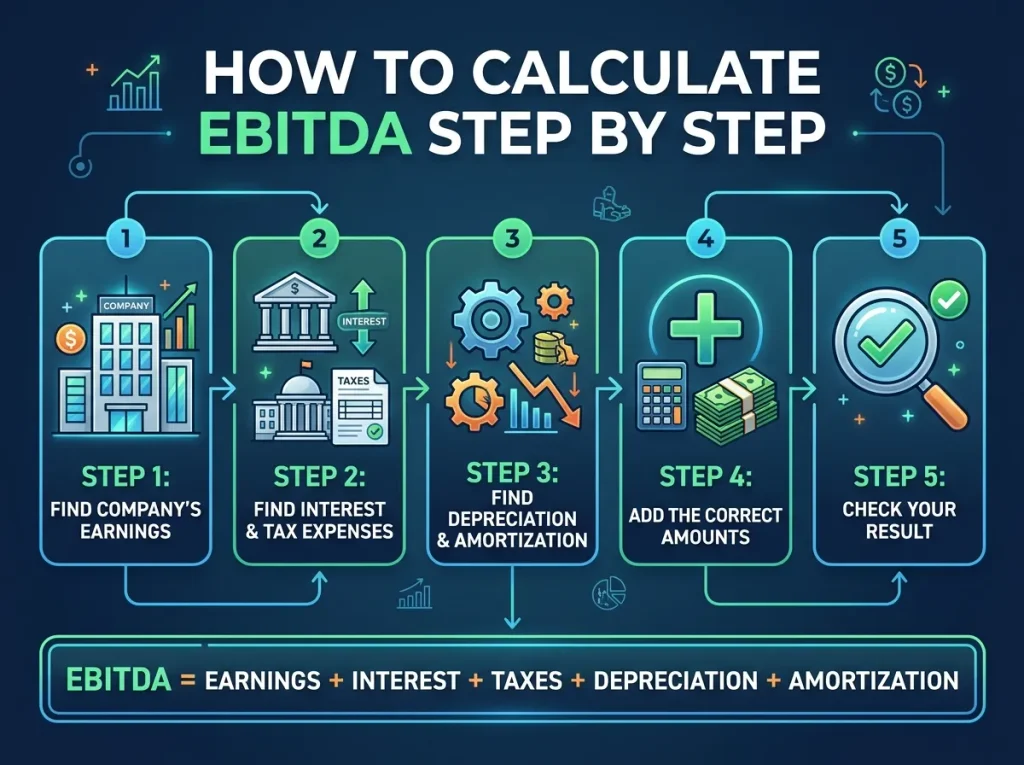
You do not need to be a financial expert to understand the basic calculation. Follow these steps.
Find the Company’s Earnings
Look at the company’s income statement. You can start with operating income or net income.
Operating income is often the simpler starting point because it focuses on business operations.
Find Interest and Tax Expenses
If you start with net income, find the interest expense and income tax expense listed in the financial statements.
You will add these amounts back to net income.
If you start with operating income, you generally do not add interest and taxes again because they are normally excluded from operating income already.
Find Depreciation and Amortization
Look for depreciation and amortization expenses in the income statement, cash flow statement, or notes to the financial statements.
These costs are often reported together, but they may also appear separately.
Add the Correct Amounts
Use the formula that matches your starting figure.
- Starting with operating income: Add depreciation and amortization.
- Starting with net income: Add interest, taxes, depreciation, and amortization.
Check Your Result
Review the figures to make sure you have not added the same expense twice or left out a relevant adjustment.
Also check whether the company reports standard EBITDA or an adjusted version. The two measures may be different.
What Is a Good EBITDA?
There is no single EBITDA amount that is good for every company. A figure that is strong for a small business may be low for a large company.
The right way to judge EBITDA is to consider the company’s size, industry, costs, debt, and past results.
Compare EBITDA With Revenue
A business that earns $1 million in revenue and has EBITDA of $200,000 has a different earnings profile from one that earns $1 million in revenue and has EBITDA of $50,000.
The EBITDA margin helps you compare these results.
Compare Similar Businesses
A grocery store, a software company, and a construction business may have very different operating costs. Comparing their EBITDA amounts alone may not tell you much.
It is usually more useful to compare businesses in the same industry with similar business models.
What Is EBITDA Margin?
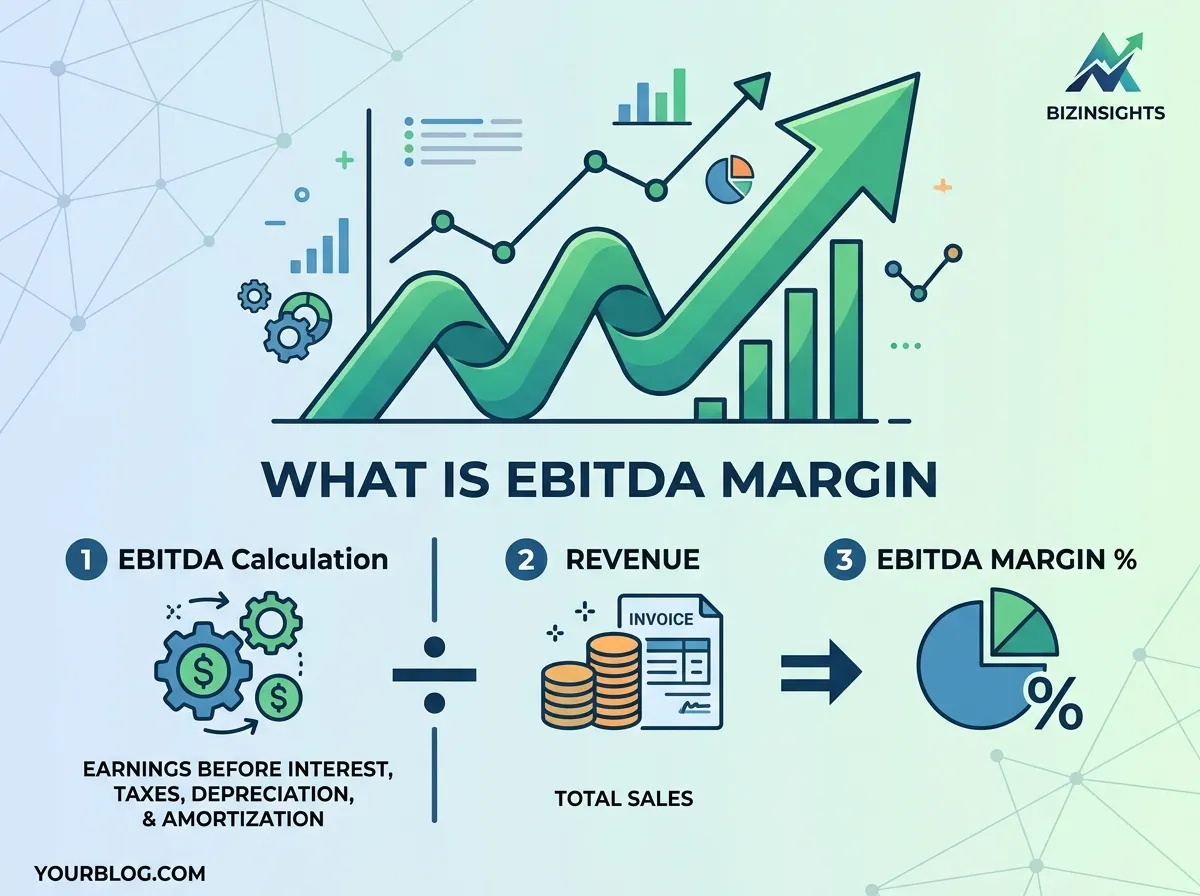
EBITDA margin shows how much EBITDA a company earns for each dollar of revenue.
It is expressed as a percentage.
EBITDA Margin Formula:
EBITDA Margin = (EBITDA ÷ Revenue) × 100
EBITDA Margin Example
Suppose a company has:
- Revenue: $500,000
- EBITDA: $100,000
The calculation is:
($100,000 ÷ $500,000) × 100 = 20%
The company’s EBITDA margin is 20%.
This means the business generates $0.20 in EBITDA for every $1 of revenue.
Why Does EBITDA Margin Matter?
EBITDA margin helps people compare businesses of different sizes. It can also show whether a company is keeping more or less of its revenue after operating costs.
For example, if a company’s margin rises from 12% to 16%, its EBITDA has grown relative to revenue.
This may reflect better cost control, higher prices, or a change in its sales mix.
A higher margin is not always proof that a company is healthier.
You still need to consider its debt, cash flow, investment needs, and other financial details.
Why Is EBITDA Important?
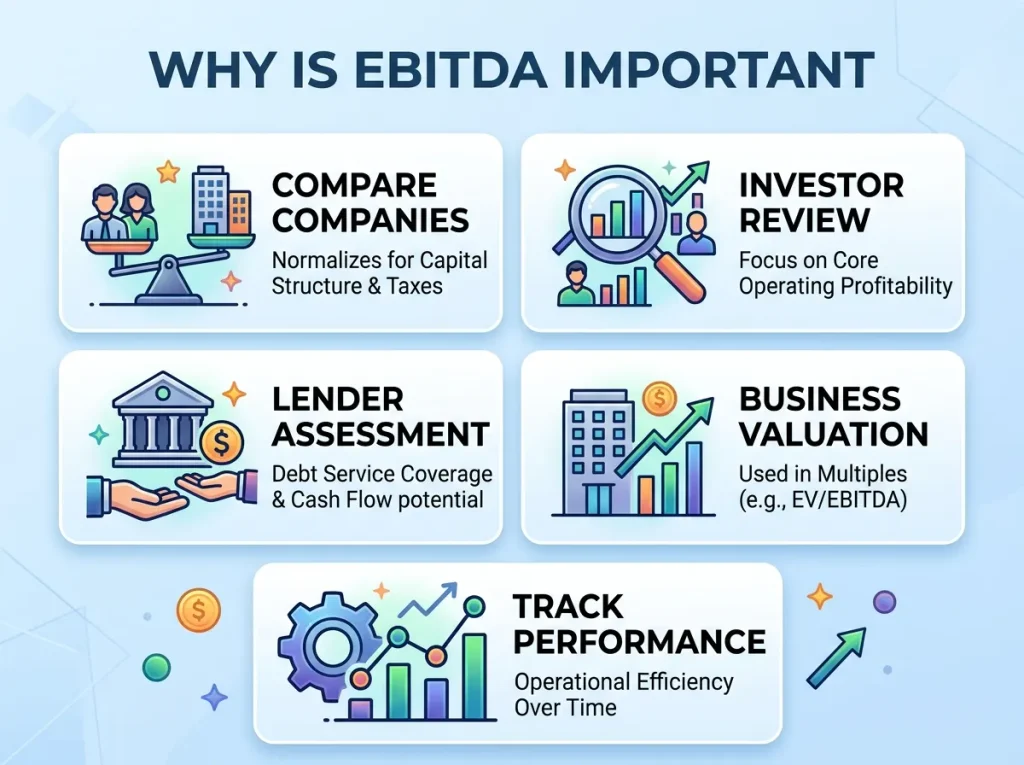
EBITDA is useful because it gives people another way to study a company’s operating performance.
It Helps Compare Companies
Companies may have different debt levels, tax costs, and asset histories.
EBITDA removes the effect of interest, taxes, depreciation, and amortization from the calculation.
This can make comparisons easier, especially when the companies have similar business models.
However, EBITDA does not remove every difference between companies. Operating costs and accounting choices can still affect comparisons.
It Helps Investors Review Businesses
Investors may use EBITDA to get a quick view of a company’s operating earnings.
They often review it alongside revenue growth, profit, debt, and cash flow before deciding whether a business is worth investing in.
EBITDA alone cannot tell you whether a stock is a good investment.
It Helps Lenders Assess Borrowers
Banks and other lenders may review EBITDA when deciding whether a company can support its debt.
For example, a lender may compare EBITDA with interest costs or total debt.
These comparisons can help show how much room a business has to meet its financial commitments.
But lenders also look at cash flow, loan terms, assets, and other risks.
It Can Help With Business Valuation
Buyers may use EBITDA when estimating what a business is worth.
One common method uses an EBITDA multiple. The buyer compares a company’s EBITDA with valuation multiples seen in similar businesses.
The right multiple depends on factors such as growth, risk, industry, and market conditions.
It Can Help Track Business Performance
Business owners may compare EBITDA across months, quarters, or years.
This can help them see whether operating earnings are improving and whether costs are rising faster than sales.
For a fair comparison, use consistent methods and consider seasonal changes or one-time events.
What Is an EBITDA Multiple?
An EBITDA multiple compares a company’s value with its EBITDA. It is often used when buying, selling, or valuing a business.
One common measure is the enterprise value-to-EBITDA ratio.
EV/EBITDA Formula:
EV/EBITDA = Enterprise Value ÷ EBITDA
Enterprise value is a measure of the value of the business as a whole. It generally considers equity value, debt, and cash, with the exact calculation depending on the context.
Example of an EBITDA Multiple
Imagine a company has:
- Enterprise value: $2 million
- Annual EBITDA: $400,000
The calculation is:
$2,000,000 ÷ $400,000 = 5
The company’s EV/EBITDA multiple is 5 times.
This means its enterprise value is five times its annual EBITDA.
What Is Adjusted EBITDA?
Adjusted EBITDA is a version of EBITDA that excludes certain additional costs or income items.
Companies may use it to show what they believe their earnings would look like without unusual or non-recurring items.
Possible adjustments include:
- Certain restructuring costs
- Some legal expenses
- Specific transaction costs
- Certain one-time expenses
The exact adjustments depend on the company and the rules or agreements being used.
Adjusted EBITDA Example
Suppose a business reports EBITDA of $300,000. It also reports $20,000 in restructuring costs and adds that amount back to calculate adjusted EBITDA.
Its calculation is:
$300,000 + $20,000 = $320,000
Its adjusted EBITDA is $320,000.
This calculation is valid only if the adjustment is clearly defined and appropriate for the purpose. Calling a cost “one-time” does not automatically mean it should be ignored.
What Is the Difference Between EBITDA and Net Income?
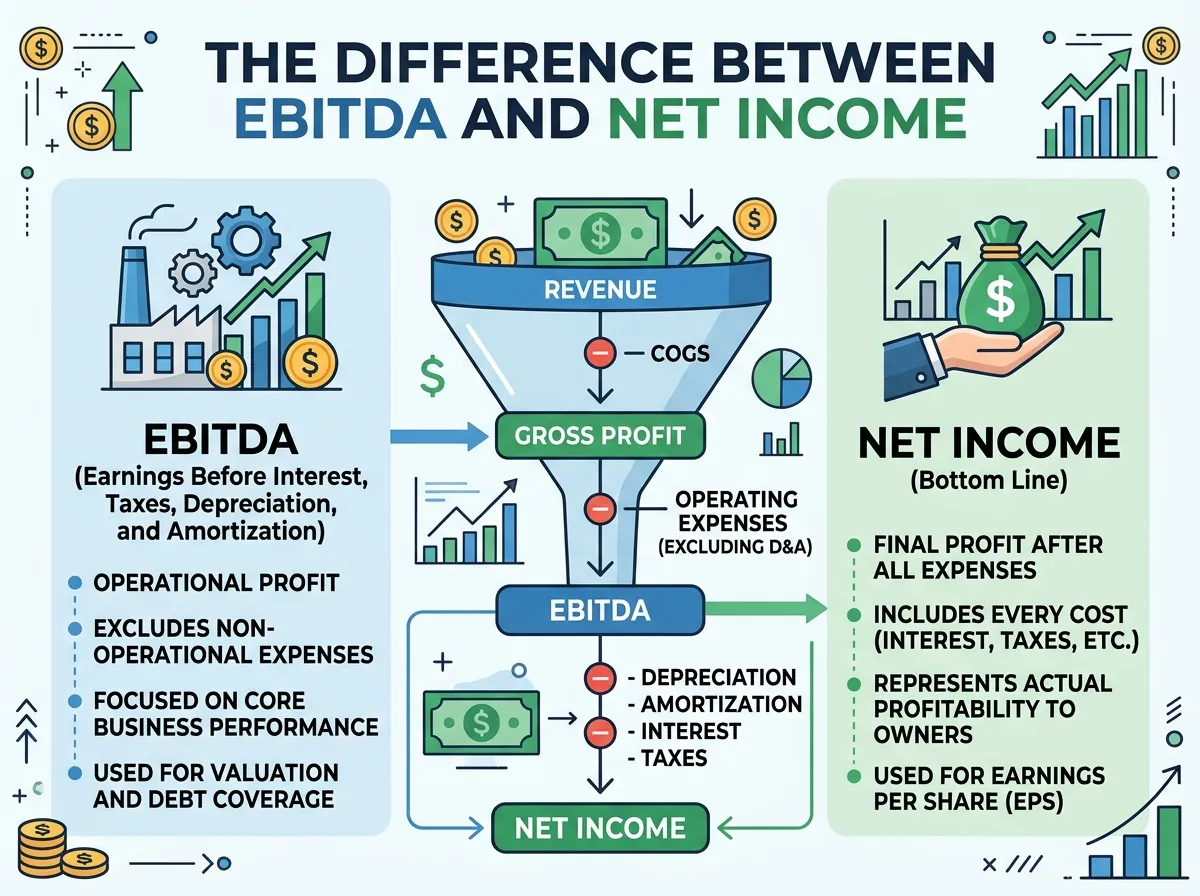
EBITDA and net income measure different things.
EBITDA excludes interest, taxes, depreciation, and amortization. Net income includes these expenses and other relevant income and expenses in the final profit calculation.
| Feature | EBITDA | Net Income |
| Interest expense | Excluded | Generally included |
| Income tax expense | Excluded | Included |
| Depreciation | Added back or excluded | Included |
| Amortization | Added back or excluded | Included |
| Shows final accounting profit | No | Yes |
| Equals cash in the bank | No | No |
Example
Suppose a business has EBITDA of $100,000.
It pays $10,000 in interest, records $15,000 in taxes, and has $20,000 in depreciation and amortization combined.
If these are its only adjustments between EBITDA and net income, its net income would be $55,000.
The calculation is:
$100,000 − $10,000 − $15,000 − $20,000 = $55,000
This example shows why EBITDA can be higher than net income.
In real financial statements, other income, expenses, and adjustments may also affect net income.
What Is the Difference Between EBITDA and EBIT?
EBIT stands for Earnings Before Interest and Taxes.
It is often similar to operating income, though the exact definition may depend on how a company reports its results.
The key difference is that EBIT generally includes depreciation and amortization as expenses, while EBITDA adds those costs back.
Formula:
EBITDA = EBIT + Depreciation + Amortization
Example
A company has EBIT of $70,000, depreciation of $10,000, and amortization of $5,000.
Its EBITDA is:
$70,000 + $10,000 + $5,000 = $85,000
EBIT is $70,000, while EBITDA is $85,000.
Both figures can be useful. EBIT includes the effect of depreciation and amortization, while EBITDA leaves those costs out.
What Is the Difference Between EBITDA and Cash Flow?
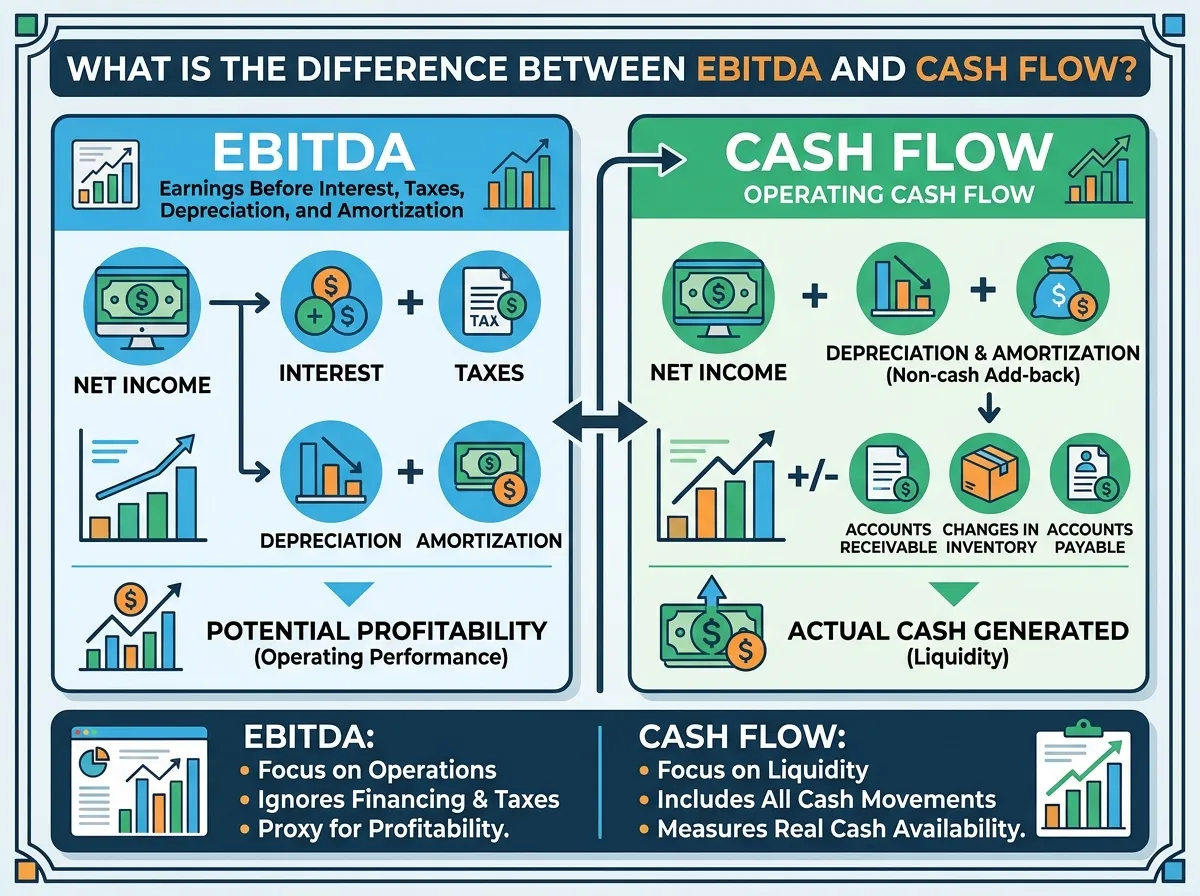
EBITDA is not the same as cash flow.
EBITDA is an earnings measure. Cash flow shows money moving into and out of a business during a period.
A company may report strong EBITDA but still have limited cash because it needs to buy equipment, pay down debt, build up inventory, or cover other costs.
Example
Imagine a company has EBITDA of $200,000 for the year.
During that year, it spends $80,000 on new equipment, pays $40,000 toward loan principal, and needs additional money for inventory.
Even though its EBITDA is positive, much of its cash may be used for these needs.
This is why investors and business owners often review the cash flow statement alongside EBITDA.
What Are the Limitations of EBITDA?
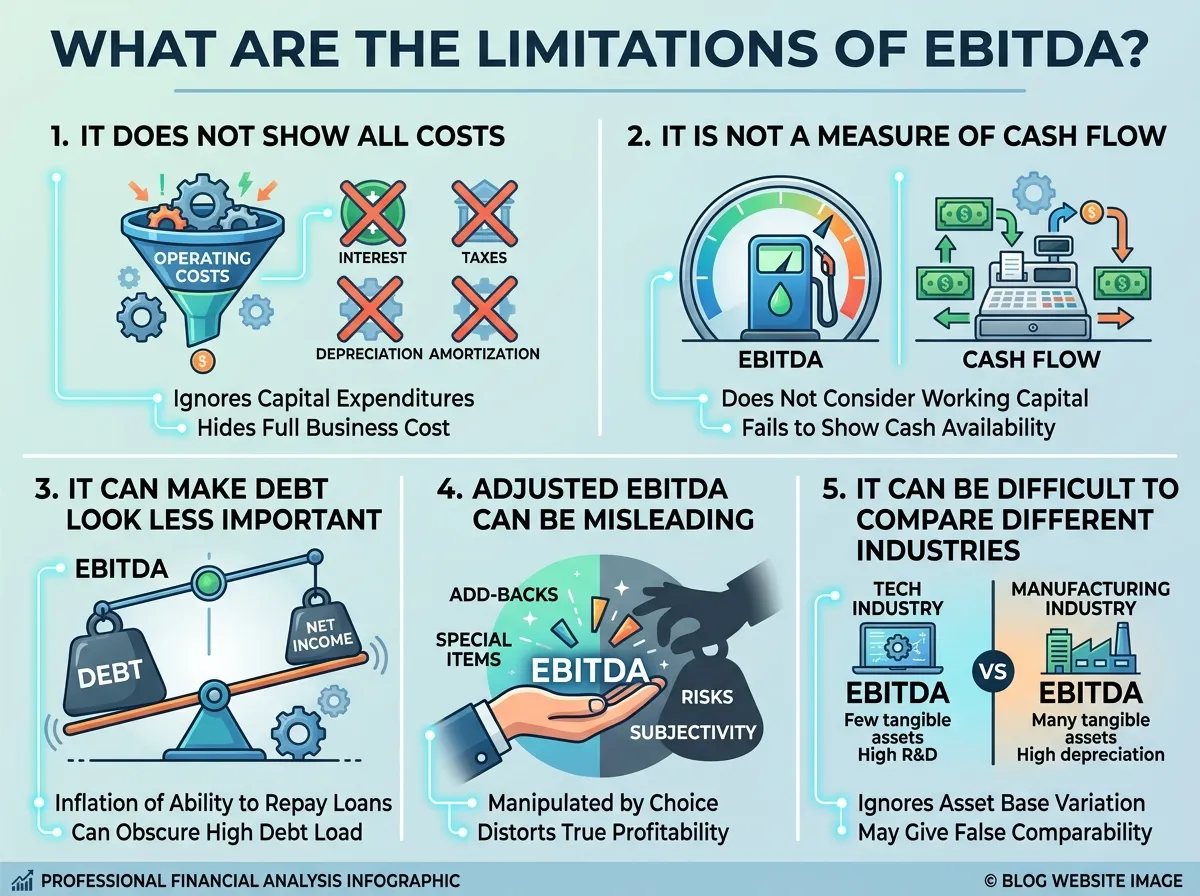
EBITDA can be helpful, but it does not tell the whole story. Understanding its limits can help you avoid poor business or investment decisions.
1. It Does Not Show All Costs
EBITDA leaves out interest, taxes, depreciation, and amortization.
These costs can be important. A company with large loans may face high interest payments.
A company that owns expensive equipment may need to spend a lot to maintain or replace it.
2. It Is Not a Measure of Cash Flow
EBITDA does not fully account for changes in inventory, unpaid customer bills, equipment purchases, or loan principal payments.
A company can have positive EBITDA and still face cash shortages.
3. It Can Make Debt Look Less Important
Because interest is excluded, EBITDA may make a company with high debt look stronger than it really is.
You should also review debt levels, interest costs, and the company’s ability to make payments.
4. Adjusted EBITDA Can Be Misleading
Some companies add back many expenses to report adjusted EBITDA.
If these adjustments are not reasonable or are repeated every year, the measure may give an overly positive view of performance.
Read the notes and explanations that accompany the figure.
5. It Can Be Difficult to Compare Different Industries
Businesses have different needs and cost structures.
A software company may need less physical equipment than a factory. Their depreciation costs and investment needs may be very different.
Compare similar businesses and consider the nature of their operations.
Can EBITDA Be Negative?
Yes. EBITDA can be negative when the company’s operating expenses exceed the earnings included in the calculation.
For example, a business may earn $100,000 in revenue but have $130,000 in relevant operating costs before depreciation and amortization.
Its EBITDA would be negative $30,000.
Negative EBITDA may signal that a business is struggling to cover its operating costs. However, the reason matters.
A new company may be investing heavily as it grows, while a long-established company may be facing a more serious problem.
Look at the company’s sales, cost trends, cash reserves, and future plans before drawing a conclusion.
Who Uses EBITDA?
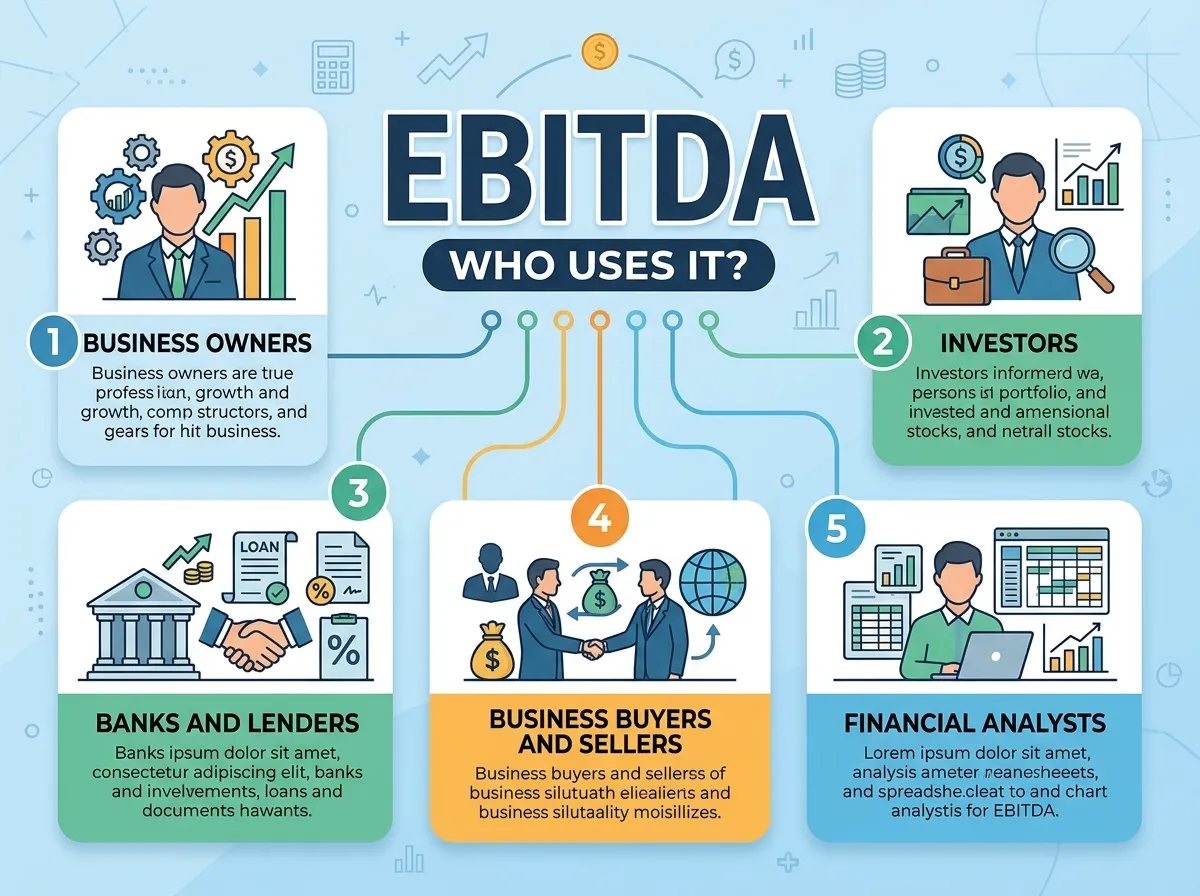
Several groups use EBITDA to understand business performance.
Business Owners
Owners may use EBITDA to track operating results, compare periods, and find ways to control costs.
Investors
Investors may use EBITDA to compare companies, estimate business value, and review earnings trends.
Banks and Lenders
Lenders may use EBITDA as one part of a review of debt repayment ability.
Business Buyers and Sellers
People buying or selling a company may use EBITDA when discussing valuation and comparing similar businesses.
Financial Analysts
Analysts may use EBITDA alongside other financial measures to study a company’s results and risks.
In every case, EBITDA works best as one part of a broader financial review rather than a stand-alone answer.
FAQS
What does EBITDA mean in simple terms?
EBITDA stands for Earnings Before Interest, Taxes, Depreciation, and Amortization. It measures earnings before these four costs are deducted.
What is EBITDA used for?
EBITDA is used to review operating performance, compare similar companies, help assess business value, and study a company’s earnings trends.
How do you calculate EBITDA?
You can calculate EBITDA by adding depreciation and amortization to operating income.
If you start with net income, add interest, taxes, depreciation, and amortization.
Is EBITDA the same as revenue?
No. Revenue is the money a business earns from sales before expenses.
EBITDA is calculated after relevant operating costs have been deducted, but before interest, taxes, depreciation, and amortization.
Is EBITDA the same as net income?
No. Net income includes interest, taxes, depreciation, amortization, and other relevant items. EBITDA excludes the four costs in its name.
What is a good EBITDA margin?
There is no single good margin for every business. Compare the margin with similar companies and consider the company’s size, industry, growth, and costs.
Why do investors look at EBITDA?
Investors use EBITDA to study operating earnings and compare companies.
They should also review net income, debt, cash flow, and other financial measures.
Can EBITDA be negative?
Yes. EBITDA is negative when the relevant operating costs exceed the earnings included in the measure.
It may indicate operating problems, but the reason should be examined.
What is an EBITDA multiple?
An EBITDA multiple compares a company’s enterprise value with its EBITDA. It is commonly used to help value businesses.
What is the difference between EBITDA and EBIT?
EBIT includes depreciation and amortization expenses, while EBITDA adds them back. EBITDA is therefore usually higher than EBIT when these expenses are positive and the figures are otherwise consistent.
Does EBITDA include debt?
EBITDA does not subtract interest expense or loan principal payments. It is not a measure of debt. Analysts often compare EBITDA with debt to help assess a company’s financial position.
Is EBITDA reported on every income statement?
Not always. EBITDA is a non-GAAP financial measure in the United States when it is calculated outside the standard GAAP measures.
Companies may report it separately, and the definition or presentation can vary. Investors should check the company’s financial disclosures and reconciliations.
Article Summary
- EBITDA stands for Earnings Before Interest, Taxes, Depreciation, and Amortization.
- It helps show how much a company earns before four specific costs.
- You can calculate it from operating income or net income.
- EBITDA margin shows EBITDA as a percentage of revenue.
- Investors and business owners use EBITDA to compare operations and assess business value.
- Adjusted EBITDA may exclude additional costs, so its calculation needs careful review.
- EBITDA is not the same as net income, profit, or cash flow.
- A complete financial review should include other measures, such as debt, cash flow, and net income.
Conclusion
Conclusion
Understanding what EBITDA means can help you make better sense of a company’s financial results. EBITDA stands for Earnings Before Interest, Taxes, Depreciation, and Amortization.
It shows how much a business earns before these four costs are counted.
You can calculate EBITDA by adding depreciation and amortization to operating income, or by adding interest, taxes, depreciation, and amortization to net income.
You can also use EBITDA margin to see how much EBITDA a company earns from its revenue.
However, EBITDA does not tell the whole story. It does not show all expenses, cash flow, or the money a company needs to repay debt and buy equipment.
A business can have strong EBITDA and still face financial problems.
For the clearest picture, compare EBITDA with net income, cash flow, debt, and revenue growth.
These measures work together to help you understand how well a business is performing and whether its financial position is strong.

Ryan Mitchell creates informative content about word definitions, acronyms, online slang, and modern communication. He enjoys exploring how people use language in text messages, on social media, and in daily life. Ryan focuses on delivering simple explanations and practical examples that help readers quickly understand the meaning of unfamiliar words and phrases.