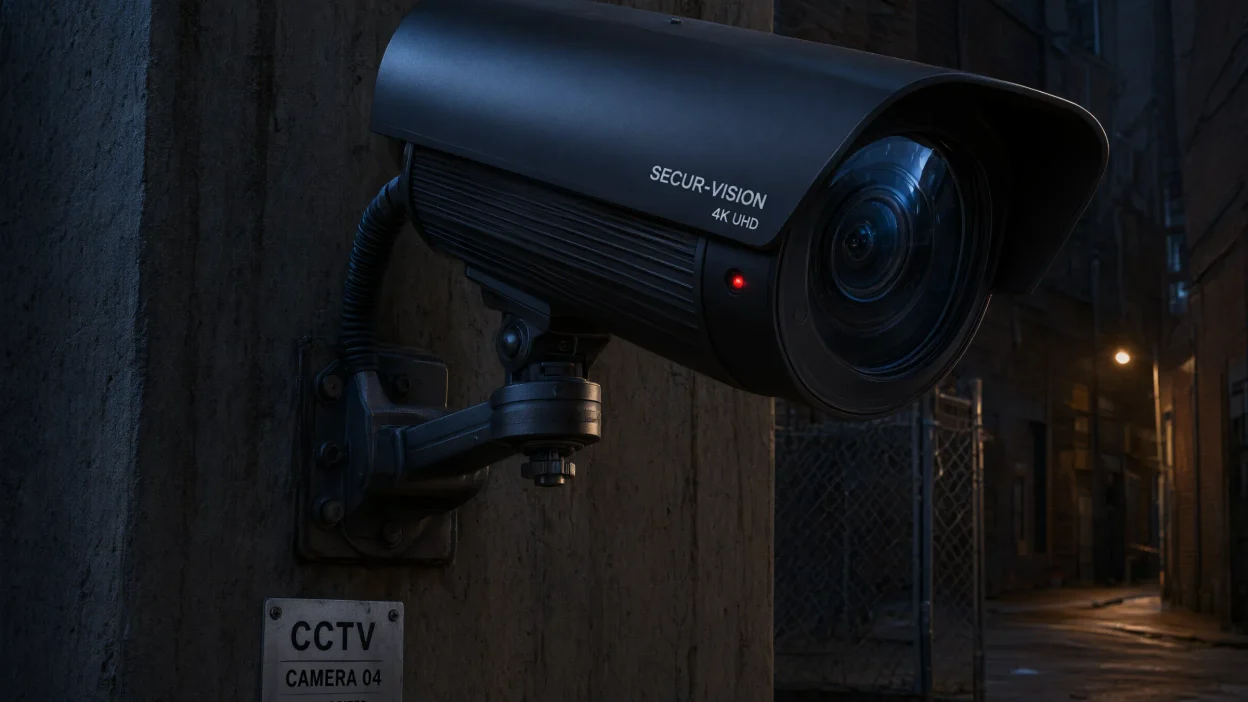
CCTV stands for Closed-Circuit Television.
The term has three main parts:
- Closed: The video is sent to a set group of devices or users.
- Circuit: The system sends video through a set connection or network.
- Television: The system sends moving pictures from a camera to a screen or recording device.
In simple words, CCTV is a system that lets people watch and record activity in a chosen area.
For example, a grocery store may use CCTV cameras to watch its doors, aisles, and checkout counters. If an item goes missing, an authorized worker may review the video to learn what happened.
CCTV systems can use cables or a network connection. Some record video all day, while others record only when they detect movement. Some let authorized users watch live video on a phone or computer.
The main goal is to help people monitor a place and review events when needed.
What Is CCTV Used For?

CCTV is used to watch places, protect property, and record events. Its purpose can vary based on where the cameras are installed.
Home Security
Homeowners use CCTV cameras to watch doors, driveways, yards, and other areas around their homes.
A camera may help them see who is at the front door or check what happened while they were away. Some home systems send alerts when they detect movement.
Business Security
Stores, offices, banks, and other businesses often use CCTV to monitor their buildings.
Cameras can help staff notice unusual activity, review theft reports, and check events in work areas. They may also help managers understand how people move through a store.
Traffic Monitoring
Traffic cameras help agencies monitor roads, bridges, tunnels, and busy crossings.
Some cameras show live traffic conditions. Others record events or work with systems that help enforce traffic laws. Not every traffic camera is a CCTV camera, and not every traffic camera records video.
Schools and Colleges
Schools may use CCTV in entrances, hallways, parking lots, and other approved areas.
These cameras can help staff review safety concerns and understand what happened during an incident. Camera use should follow school policies and local privacy rules.
Public Places
CCTV may be used in airports, train stations, parking garages, and other public spaces.
It helps authorized staff monitor activity and respond to certain safety concerns. However, cameras do not prevent every crime or guarantee that an area is safe.
How Does CCTV Work?
A CCTV system uses cameras and other devices to capture, send, display, or store video.
The exact setup depends on the type of system, but most CCTV systems follow a few basic steps.
The Camera Captures Video
A CCTV camera records the view of an area. It may capture video during the day, at night, or in low light if it has the right features.
Some cameras can also record sound, but audio recording may be subject to extra legal rules.
The Video Is Sent
The camera sends video to another device. In a traditional system, this may happen through a cable. In a network-based system, video may travel over a computer network.
Some cameras connect wirelessly, although they may still need a power cable or battery.
The Video Is Viewed or Recorded
The video may appear on a monitor or be saved for later use.
Many systems use a recording device, such as a digital video recorder (DVR) or network video recorder (NVR). Some store footage on a memory card or in cloud storage.
A User Reviews the Footage
An authorized person can watch live video or review saved recordings.
For example, if a delivery goes missing, a property owner may check the footage near the entrance. The video may help explain what happened, though the camera’s view and image quality can limit what it shows.
What Are the Main Types of CCTV Cameras?
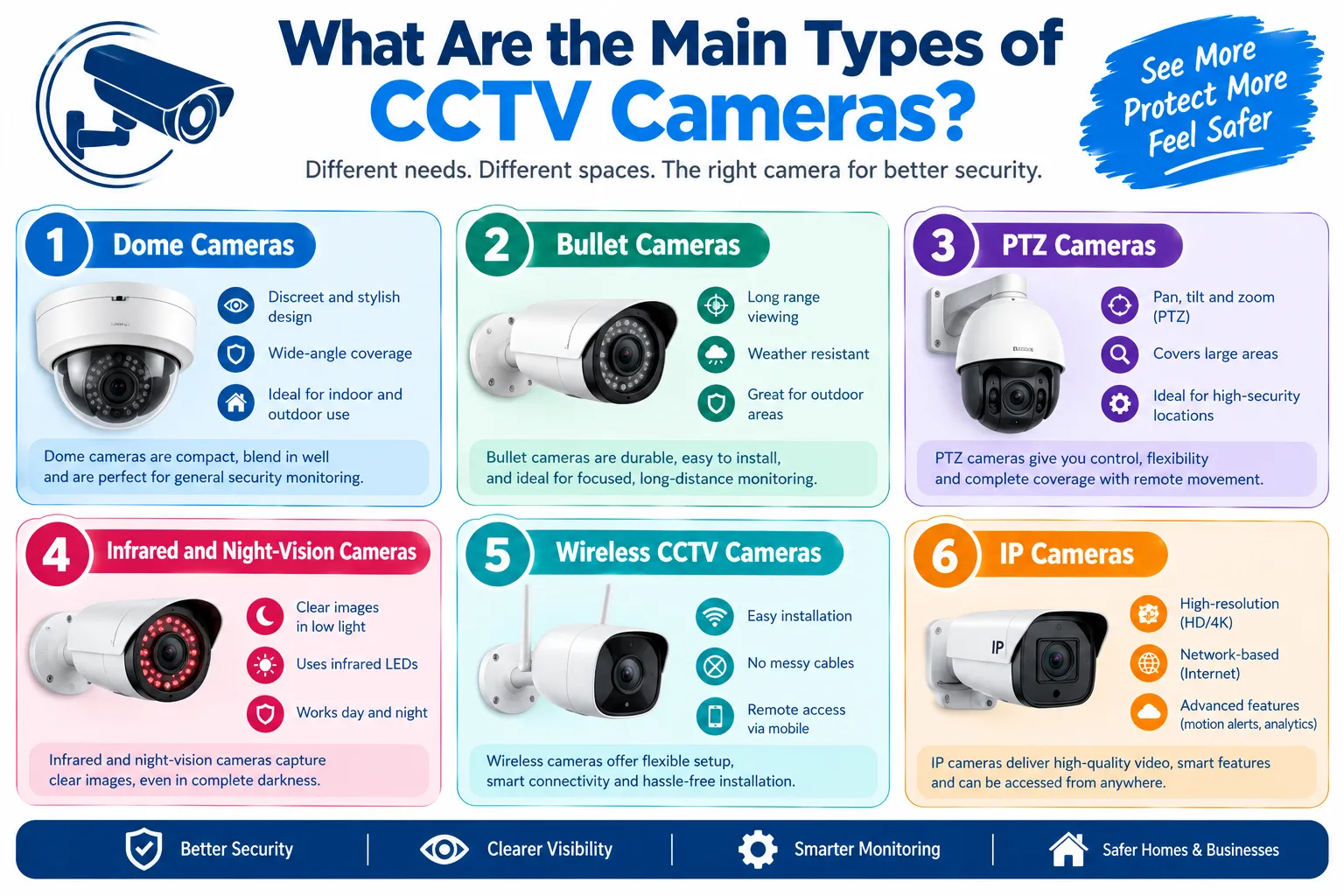
CCTV cameras come in several forms. Each type has features that make it useful for different places.
Dome Cameras
<PRIVATE_PERSON> cameras have a rounded cover shaped like a dome. They are often mounted on ceilings in stores, offices, and indoor public areas.
Their shape can make it harder to tell which way the camera is pointing. However, not all dome cameras can move or turn.
Bullet Cameras
Bullet cameras have a long, tube-like shape. They are often used outside homes, businesses, and buildings.
They are easy to spot and can be aimed at a specific area, such as a gate or driveway. Many outdoor models are made to handle rain and dust.
PTZ Cameras
PTZ stands for Pan, Tilt, and Zoom.
These cameras can move from side to side, tilt up and down, and zoom in on a view. They are useful for monitoring large spaces, such as parking lots or public areas.
Some PTZ cameras can be controlled by a person, while others can follow programmed movement patterns.
Infrared and Night-Vision Cameras
These cameras can help capture video in low light or darkness. Many use infrared light to show objects that are hard to see with the naked eye.
The footage may appear in black and white at night. The actual image quality depends on the camera, the light level, and the distance from the subject.
Wireless CCTV Cameras
Wireless cameras send video without a direct video cable. Many use Wi-Fi to connect to a network.
They can be easier to install than wired systems, but they still need power. Some use batteries, and others plug into an outlet.
Wireless cameras also depend on a reliable network connection for certain features.
IP Cameras
IP stands for Internet Protocol.
An IP camera sends video over a computer network. It may connect to a local network or allow secure remote viewing over the internet.
IP cameras often offer high image quality and can work with network video recorders. However, their features depend on the model and system setup.
What Is the Difference Between CCTV and Security Cameras?
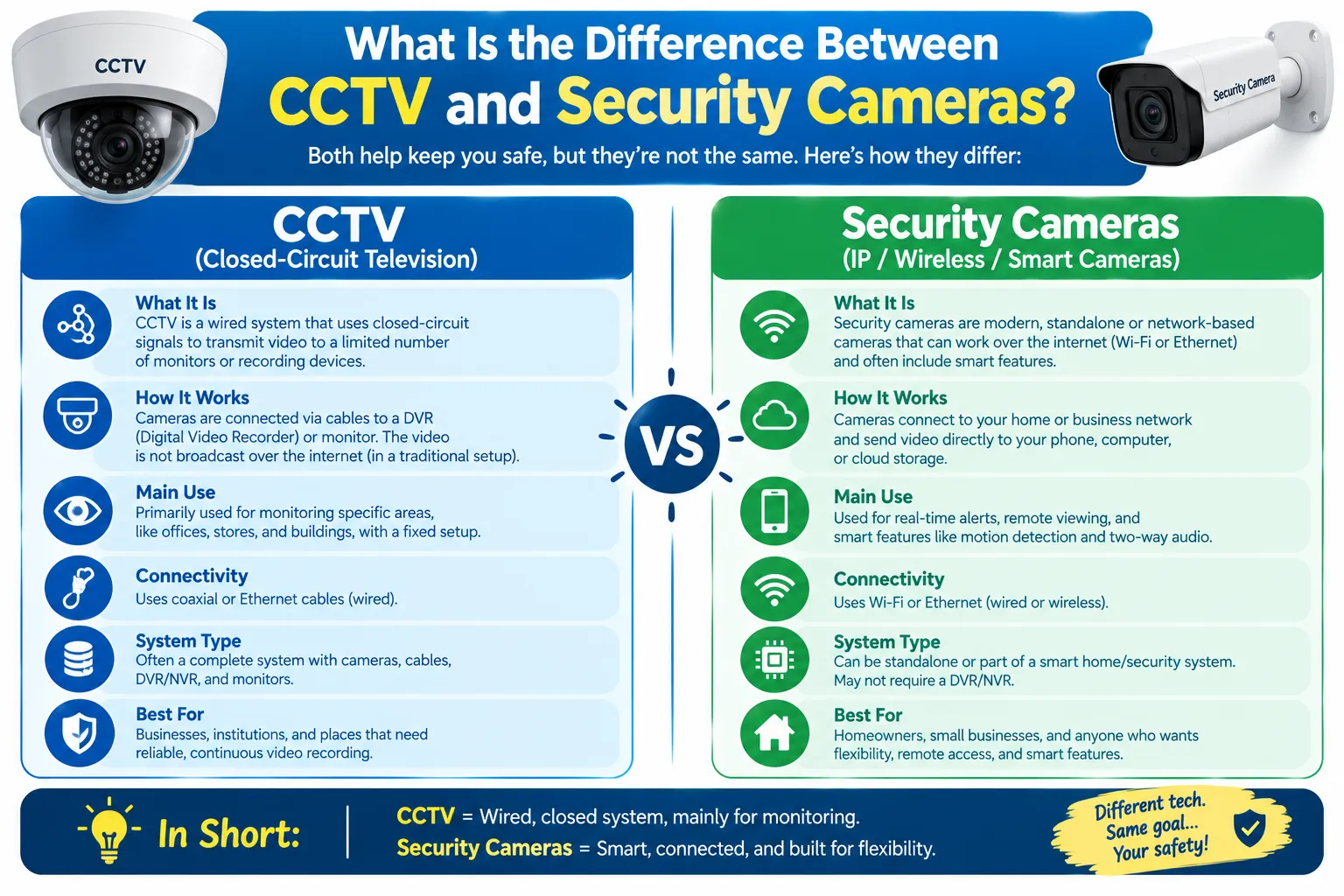
People often use the terms CCTV and security camera as if they mean the same thing. They are closely related, but there is a small difference.
A security camera is any camera used to monitor an area for safety or protection. CCTV is a video surveillance system that sends video to a limited set of users or devices.
A CCTV system can include security cameras, cables, screens, and recording equipment. An internet-connected security camera may also work on its own or through a phone app.
Here is a simple comparison:
| Feature | Traditional CCTV | Internet-Connected Security Camera |
| Main purpose | Monitor an area | Monitor an area |
| Video connection | Often uses cables | Often uses a network |
| Viewing | Local monitor or system | Often a phone or computer |
| Recording | DVR, NVR, or other storage | Memory card, recorder, or cloud |
| Internet needed | Not always | Often needed for remote access |
| Common use | Stores, offices, buildings | Homes, small businesses, offices |
These are general patterns, not strict rules. Modern CCTV systems can also use IP cameras and internet connections.
What Is CCTV Footage?
CCTV footage is the video captured by a CCTV camera.
People may use this footage to review an event, check a safety concern, or find out what happened in a certain place at a certain time.
For example, a building manager may review CCTV footage after someone reports damage to a door. The recording may show when the damage occurred or who was nearby.
CCTV footage can be live or recorded. Live footage is viewed as the camera captures it. Recorded footage is saved and watched later.
The quality of CCTV footage depends on several factors:
- Camera resolution
- Lighting conditions
- Camera position
- Distance from the subject
- Recording settings
- How long the footage is stored
Not every recording will show a person’s face or other details clearly. A camera may miss an event if the area is outside its view or if the system is not recording at that time.
What Do CCTV, DVR, NVR, and IP Mean?
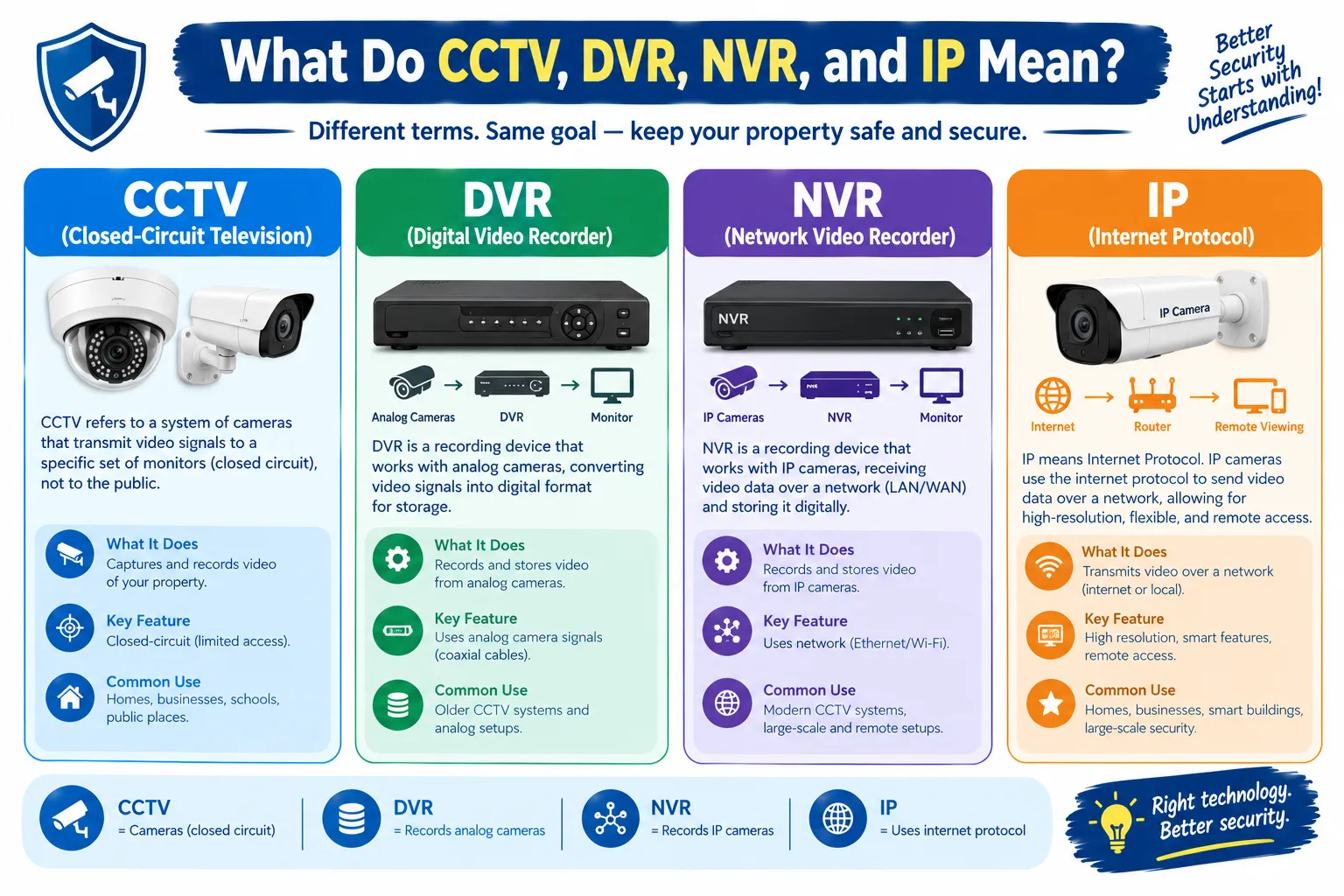
You may see these terms when buying or using a surveillance system. Each one has a different meaning.
CCTV
Closed-Circuit Television is the video monitoring system itself. It may include cameras, cables, recording devices, and screens.
DVR
Digital Video Recorder is a device that records video in digital form. Many traditional CCTV systems use a DVR with cameras that send video through cables.
NVR
Network Video Recorder records video from network-based cameras, often IP cameras. It is common in modern surveillance systems.
IP Camera
An Internet Protocol camera sends video over a network. Depending on its setup, it may work with an NVR or other recording system.
CCTV Monitoring
CCTV monitoring means watching camera feeds or checking recorded footage. This may be done by a security worker, a business owner, or another authorized person.
These terms are related, but they do not mean the same thing. CCTV describes the broader system, while DVR and NVR refer to types of recording equipment.
What Are the Benefits of CCTV?
CCTV can be useful for homes, businesses, and public places. Its benefits depend on how the system is set up and used.
Helps Monitor Property
Cameras let people check activity in areas that may be hard to watch all the time. A homeowner, for example, can view a driveway without standing outside.
Helps Review Incidents
Recorded footage may help people understand what happened during an incident. It can provide useful details about timing, movement, or events in the camera’s view.
May Discourage Some Wrongdoing
Visible cameras may make some people think twice before stealing or damaging property. However, CCTV does not stop every crime, and its impact varies by place and situation.
Allows Remote Viewing
Many modern systems let authorized users check camera feeds from a phone or computer. This can be useful for people who need to monitor a property while away.
Supports Workplace Safety
Cameras may help authorized staff review accidents, check access points, and understand certain safety concerns. They should be used in a way that respects workers’ rights and privacy.
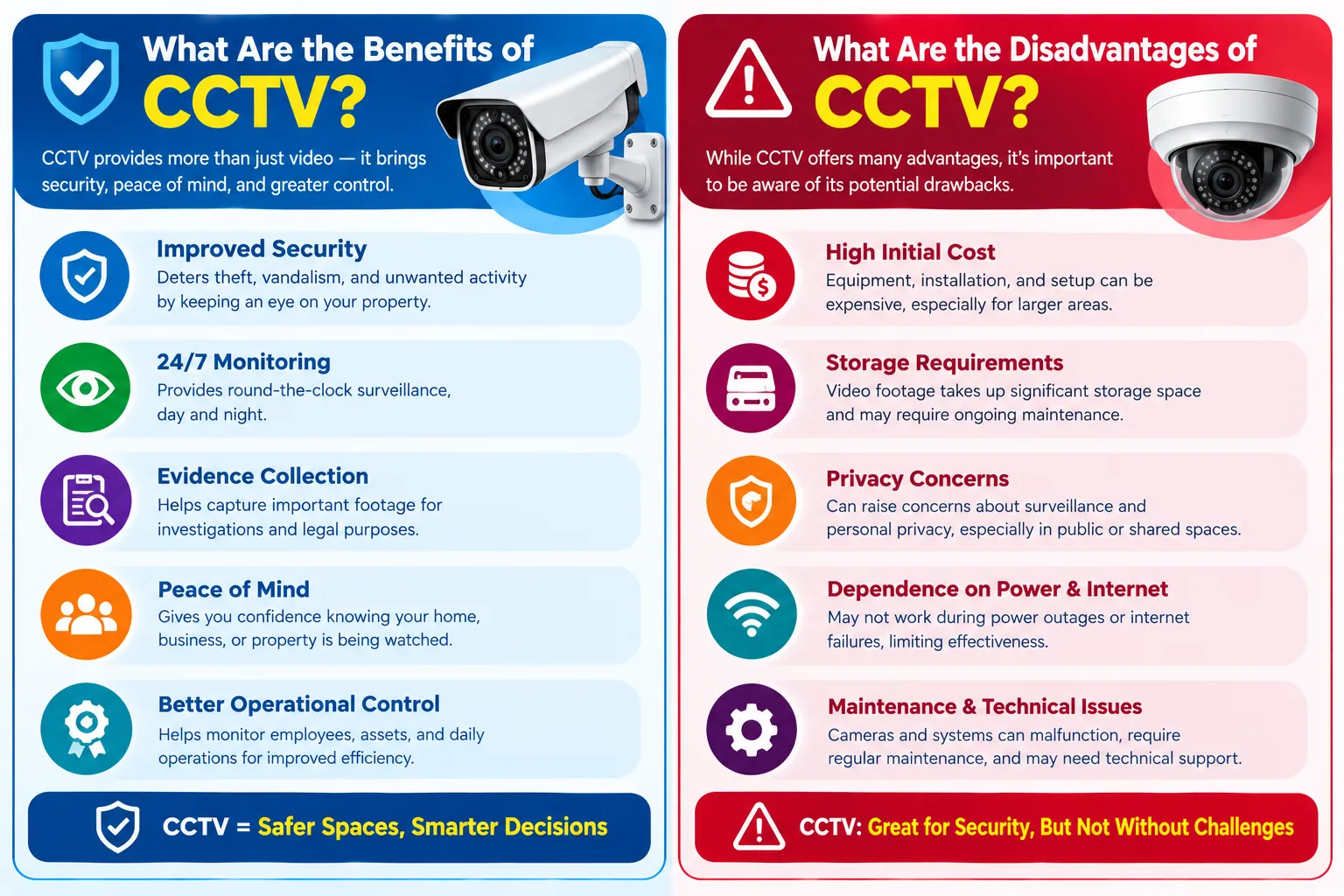
What Are the Disadvantages of CCTV?
CCTV has limits, and it is important to understand them before installing a system.
Installation and Maintenance Costs
A CCTV system may require cameras, cables, storage devices, network equipment, and professional installation. Some systems also have ongoing cloud storage or service fees.
Privacy Concerns
Cameras can collect information about people’s movements and activities. Poor placement or unclear rules may make people feel watched without a good reason.
Security Risks
Connected cameras can be exposed to cyber risks if they use weak passwords, outdated software, or unsafe network settings.
Limited Camera Views
A camera only records what it can see. Poor lighting, blocked views, bad placement, or low resolution may make footage hard to use.
Storage Limits
Recording devices have limited space unless storage is expanded or footage is moved elsewhere. Some systems delete older recordings automatically when storage fills up.
For these reasons, CCTV should be part of a wider safety plan, not the only way to protect a place.
Is CCTV Legal in the United States?
CCTV is widely used in the United States, but the rules depend on the location, purpose, and type of recording.
Businesses and homeowners should consider both federal and state laws, as well as local rules that may apply.
In general, cameras are more commonly used in visible areas such as entrances, hallways, stores, and parking lots. Areas where people expect strong privacy, such as bathrooms and changing rooms, raise serious legal and ethical concerns.
Audio recording can be subject to separate consent laws. A camera that records sound may therefore create legal issues even if video monitoring is allowed.
Employers should also consider workplace privacy rules and tell staff about monitoring when required.
Before installing CCTV, it is wise to:
- Check the laws that apply to your state and location.
- Avoid private areas where people have a strong expectation of privacy.
- Tell people about monitoring when required.
- Limit who can view recorded footage.
- Use secure passwords and protect stored video.
- Keep recordings only as long as needed for a lawful purpose.
This is general information, not legal advice. If your situation involves audio recording, employees, tenants, or shared property, check the rules that apply to your specific case.
How to Choose a CCTV System
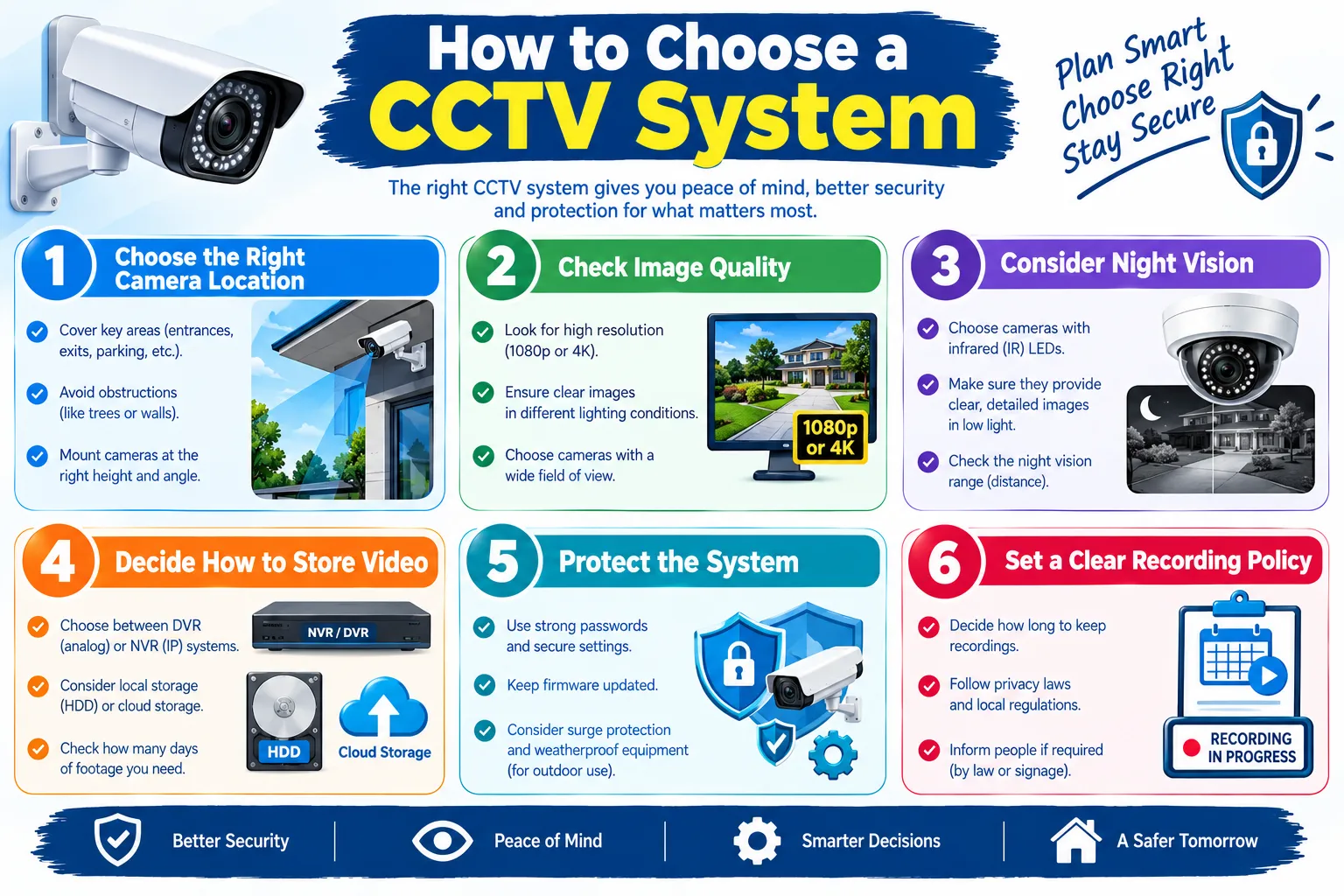
The best CCTV system depends on what you want to monitor, where the cameras will go, and how you plan to view recordings.
Choose the Right Camera Location
First, decide which areas need monitoring. A front door may need a different camera from a large parking lot.
Try to cover important entry points while avoiding places where people expect privacy.
Check Image Quality
Choose a camera with enough detail for the area you need to monitor. A wider view may cover more space, while a narrower view may show more detail in one spot.
Consider Night Vision
If you need to monitor an area after dark, look for a camera that works well in low light. Check the manufacturer’s specifications and consider how far away objects will be.
Decide How to Store Video
Some systems record to a DVR or NVR. Others use memory cards or cloud storage.
Think about how much footage you need to keep, how easy it should be to find old recordings, and whether ongoing storage fees apply.
Protect the System
Change default passwords, use strong unique passwords, install software updates, and secure remote access. These steps can help lower the risk of someone accessing your camera without permission.
Set a Clear Recording Policy
Decide who can view the footage, when recordings will be checked, and how long they will be kept. A clear policy helps protect both the property and the people being recorded.
Real-Life Examples of CCTV
Here are a few simple examples of how CCTV may be used.
Example 1: At a store
A store owner places cameras near the entrance and checkout area. When a customer reports a lost bag, the owner checks the available footage to see whether it was left at the counter.
Example 2: At home
A homeowner installs a camera near the front door. When a delivery arrives, the homeowner can check the video to see where the package was placed.
Example 3: In an office
An office uses cameras near its main entrance. If an access card goes missing, an authorized manager may review footage to understand who entered the area.
FAQ
1. What does CCTV stand for?
CCTV stands for Closed-Circuit Television. It is a video system used to monitor and record activity in places such as homes, stores, offices, and public areas.
2. What does CCTV mean in simple words?
CCTV means using cameras to watch a specific area. The video can be viewed live or saved so an authorized person can review it later.
3. What is the full form of CCTV?
The full form of CCTV is Closed-Circuit Television.
4. What is a CCTV camera used for?
A CCTV camera is used to monitor places, protect property, and record activity. Common locations include homes, schools, stores, parking lots, and offices.
5. Does CCTV record all the time?
Not always. Some CCTV systems record continuously, while others record only when they detect movement or when a user starts recording. The recording settings depend on the system.
6. Can CCTV work without the internet?
Yes. Many CCTV systems can record and display video without an internet connection. However, features such as remote viewing through a phone may require internet access.
7. Can CCTV cameras see at night?
Many CCTV cameras can record in low light or darkness with the help of infrared night vision. How well they work depends on the camera’s features and the surrounding conditions.
8. What is the difference between CCTV and IP cameras?
CCTV refers to a video surveillance system, while an IP camera is a camera that sends video over a computer network. IP cameras can be part of a modern CCTV system.
9. How long does CCTV footage stay saved?
There is no single storage period for all CCTV systems. Footage may be kept for a few days, several weeks, or longer, depending on storage space, recording settings, and the owner’s retention policy.
10. Can CCTV cameras record sound?
Some CCTV cameras have microphones and can record sound. However, audio recording may be subject to different legal requirements from video recording, so local laws should be checked before using this feature.
11. Is CCTV the same as a security camera?
The terms are often used interchangeably. A security camera is a camera used for monitoring or protection, while CCTV commonly refers to the complete video surveillance system.
12. Why is it called closed-circuit television?
It is called closed-circuit television because the video is sent to a limited set of connected devices or authorized viewers instead of being broadcast to the general public.
Article Summary
- CCTV full form: Closed-Circuit Television.
- CCTV meaning: A system used to monitor and record video in a specific area.
- Main purpose: Security, surveillance, and reviewing events.
- Common locations: Homes, offices, schools, stores, roads, and parking areas.
- Main camera types: Dome, bullet, PTZ, infrared, wireless, and IP cameras.
- Recording methods: DVR, NVR, memory cards, and cloud storage.
- Internet requirement: Not always necessary for basic recording.
- Important consideration: Privacy, secure access, and applicable laws.
Conclusion
CCTV stands for Closed-Circuit Television. It is a system that uses cameras to monitor places and record video for security and other purposes. You can find CCTV in homes, stores, schools, offices, parking lots, and many public areas.
CCTV systems come in different types, from basic wired cameras to modern network-based cameras with remote viewing. They can help people monitor property, review incidents, and improve safety. However, they also have limits, including installation costs, privacy concerns, and possible security risks.
If you plan to use CCTV, choose a system that fits your needs, protect it with strong security settings, and follow the privacy laws that apply to your location.
In short, CCTV means Closed-Circuit Television, a video monitoring system designed to help people watch and record activity in a specific area.

Ryan Mitchell creates informative content about word definitions, acronyms, online slang, and modern communication. He enjoys exploring how people use language in text messages, on social media, and in daily life. Ryan focuses on delivering simple explanations and practical examples that help readers quickly understand the meaning of unfamiliar words and phrases.