
ADD stands for Attention Deficit Disorder. It is a term once used to describe people who have trouble paying attention, staying focused, or keeping things organized.
For example, a child may forget homework, lose school supplies, or daydream during class. An adult may miss deadlines, forget appointments, or struggle to finish work.
Today, ADD is no longer the official medical term. Doctors use ADHD, which stands for Attention-Deficit/Hyperactivity Disorder.
ADHD includes different patterns of symptoms. Some people mainly have trouble paying attention. Others show more hyperactive and impulsive behavior. Some experience both types.
People still say ADD because it is a familiar name for attention difficulties, especially when a person does not seem very active or restless.
What Is the Simple Definition of ADD?
In simple words, ADD describes ongoing trouble with attention and focus. It may involve problems with:
- Paying attention to details
- Following instructions
- Finishing tasks
- Remembering daily activities
- Staying organized
- Avoiding distractions
These problems are not always signs of ADHD. Stress, poor sleep, anxiety, and other issues can also affect attention. A health professional can help determine the cause.
What Does ADD Stand for in Medical Terms?
In older medical use, ADD meant Attention Deficit Disorder.
The name changed as doctors developed a clearer understanding of ADHD and its different patterns.
The current term is ADHD, even when a person mainly has attention problems without obvious hyperactivity.
What Is the Difference Between ADD and ADHD?
What Is the Difference Between ADD and ADHD?
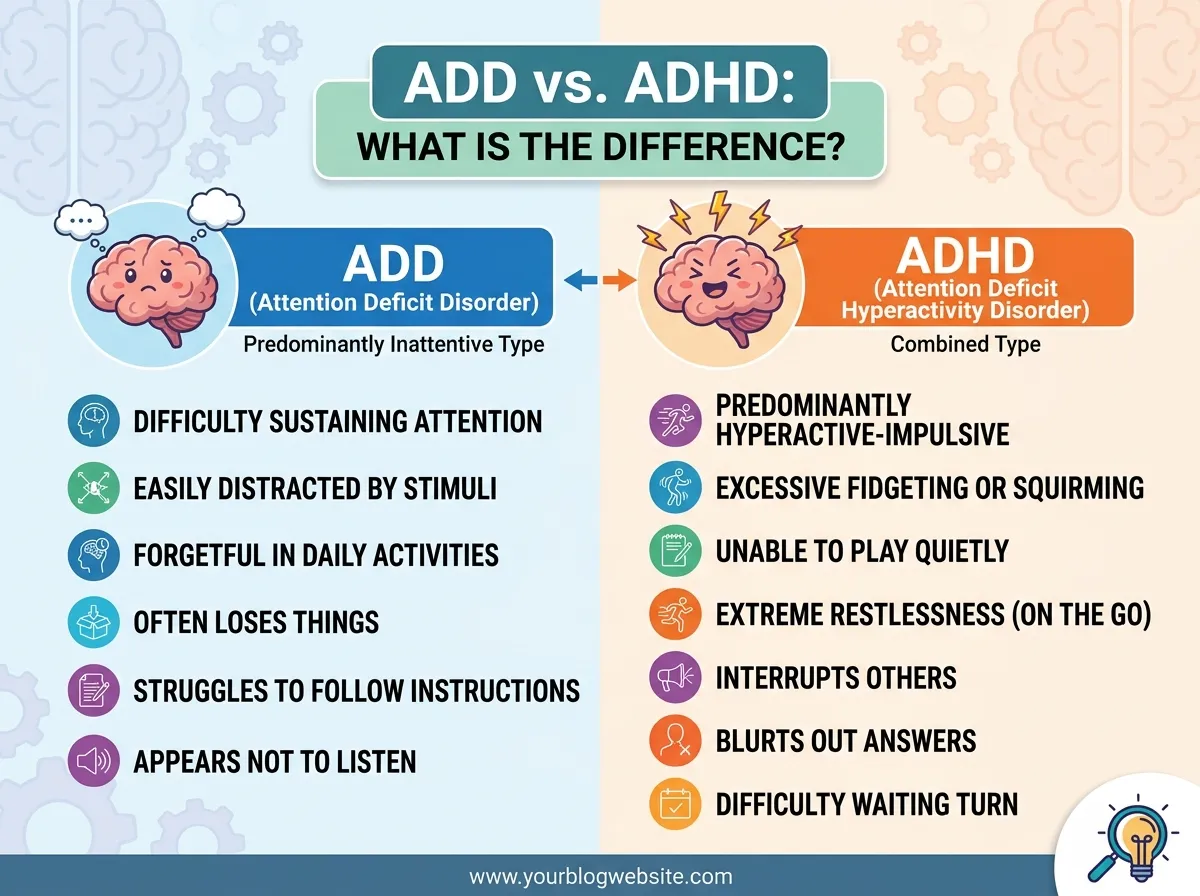
The main difference is that ADD is an older term, while ADHD is the current medical name. People often use ADD to describe attention problems without much hyperactivity.
Doctors now recognize three presentations of ADHD. Each one has a different mix of symptoms.
1. ADHD, Predominantly Inattentive Presentation
People with this presentation mainly struggle with attention and organization.
Common signs include:
- Getting distracted easily
- Forgetting instructions
- Losing important items
- Making careless mistakes
- Having trouble finishing tasks
- Avoiding work that needs long periods of focus
This pattern is often what people mean when they say ADD.
For example, a student may understand a lesson but forget to turn in the homework. An adult may start several projects but struggle to complete them.
2. ADHD, Predominantly Hyperactive-Impulsive Presentation
People with this presentation may have trouble sitting still or controlling quick actions.
They may:
- Talk more than expected
- Interrupt other people
- Feel restless
- Have trouble waiting in line
- Act before thinking about the results
For example, a person may interrupt a conversation because they are excited to share an idea. They may also find it hard to sit through a long meeting.
3. ADHD, Combined Presentation
This presentation includes signs of both inattention and hyperactivity or impulsivity.
A person may lose track of tasks, forget appointments, feel restless, and interrupt others. The exact symptoms can vary from person to person.
The type of ADHD someone has depends on their symptoms and a professional assessment. These presentations can also change over time. See the CDC’s guide to ADHD symptoms for more information.
What Are the Common Signs and Symptoms of ADD?
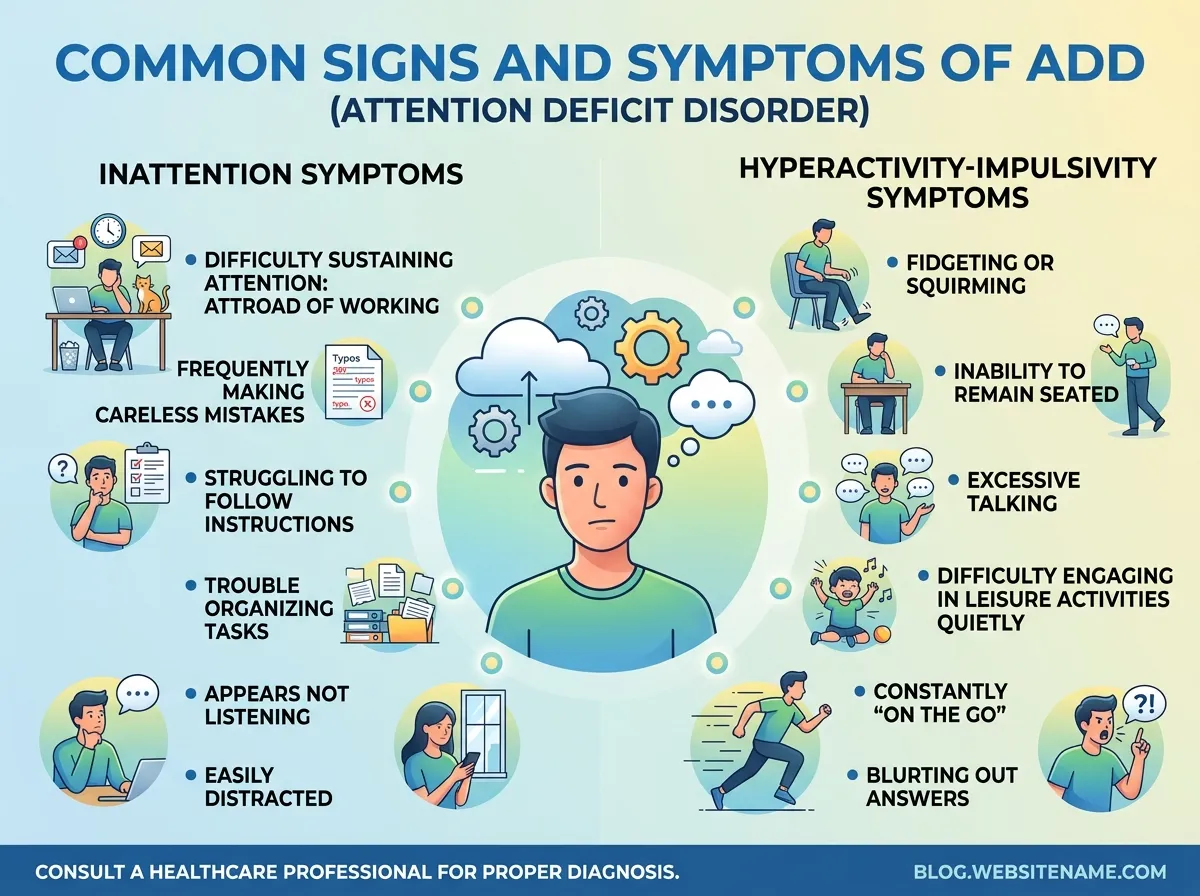
The signs people associate with ADD are mainly related to attention. These signs can affect school, work, home life, and relationships.
Having a few of these behaviors does not automatically mean someone has ADHD. The symptoms need to be persistent and cause real problems in daily life.
Trouble Paying Attention
A person may find it hard to focus on a conversation, book, or work task. Their mind may wander even when they want to pay attention.
For example, someone may read the same page several times without remembering what it says.
Being Easily Distracted
Small sounds, phone alerts, or thoughts may pull a person’s attention away from the task at hand.
A student may stop doing homework after hearing a noise outside. An employee may lose focus every time a new message appears on their computer.
Forgetfulness
People with attention difficulties may forget daily tasks or important details.
Examples include:
- Forgetting appointments
- Leaving items at home
Problems With Organization
Planning and keeping things in order may feel difficult.
Someone may have a messy desk, forget where they put important papers, or struggle to break a large project into smaller steps.
Trouble Finishing Tasks
A person may start a task with good intentions but become distracted before finishing it.
For example, they may begin cleaning a room, notice a pile of laundry, start washing clothes, and then forget to finish cleaning the room.
What Does ADD Look Like in Adults?
Adults can have ADHD even if nobody identified their symptoms during childhood. Some people learn to hide their struggles or develop ways to manage them.
Adult ADHD may affect work, relationships, money management, and daily routines.
Common Signs in Adults
Adults with attention-related symptoms may:
- Forget meetings or appointments
- Struggle to manage time
- Put off important tasks
- Lose keys, phones, or paperwork
- Have trouble following long conversations
- Start projects without finishing them
- Feel overwhelmed by daily responsibilities
For example, an adult may work hard all day but still miss a deadline because they struggle to plan their time.
Another person may forget to pay a bill, even when they have enough money and fully intend to pay it.
How ADHD Can Affect Relationships
Attention problems may sometimes cause misunderstandings between partners, friends, or family members.
A person may forget plans, miss details in a conversation, or seem distracted when someone is speaking. Others may wrongly believe the person does not care.
Clear communication, reminders, and professional support may help reduce these problems.
Can Adults Develop ADD Later in Life?
ADHD is a developmental condition, meaning symptoms begin during childhood. However, they may not be recognized until adulthood.
Work demands, parenting, or other responsibilities can make long-standing attention problems easier to notice.
If someone begins having serious focus problems for the first time as an adult, they should not assume they have ADHD. Sleep problems, stress, anxiety, depression, medication effects, and other health issues can also affect attention.
A healthcare professional can help find the cause.
What Does ADD Look Like in Children?

Children may sometimes daydream, forget things, or struggle to follow directions. These behaviors are common during childhood.
The difference is that ADHD symptoms tend to be ongoing, occur in more than one setting, and interfere with a child’s daily life.
Signs at School
A child with an inattentive presentation may:
- Miss details in assignments
- Forget to bring school supplies
- Have trouble following directions
- Leave work unfinished
- Seem not to listen
- Become distracted during lessons
For example, a child may know the answer to a question but forget to write it down on a test.
Signs at Home
Parents may notice that a child often forgets chores, loses toys, or needs repeated reminders to complete simple tasks.
One missed chore is not a warning sign by itself. What matters is the overall pattern and how much it affects the child’s life.
How Parents Can Help
Parents can support a child by using clear instructions, simple routines, and regular reminders.
Helpful ideas include:
- Give one or two instructions at a time.
- Keep school supplies in the same place.
- Use a calendar or picture checklist.
- Break homework into short steps.
- Praise effort and progress.
- Stay in contact with teachers.
If the child’s difficulties continue or affect school, friendships, or family life, talk with a healthcare professional.
What Causes ADD or ADHD?
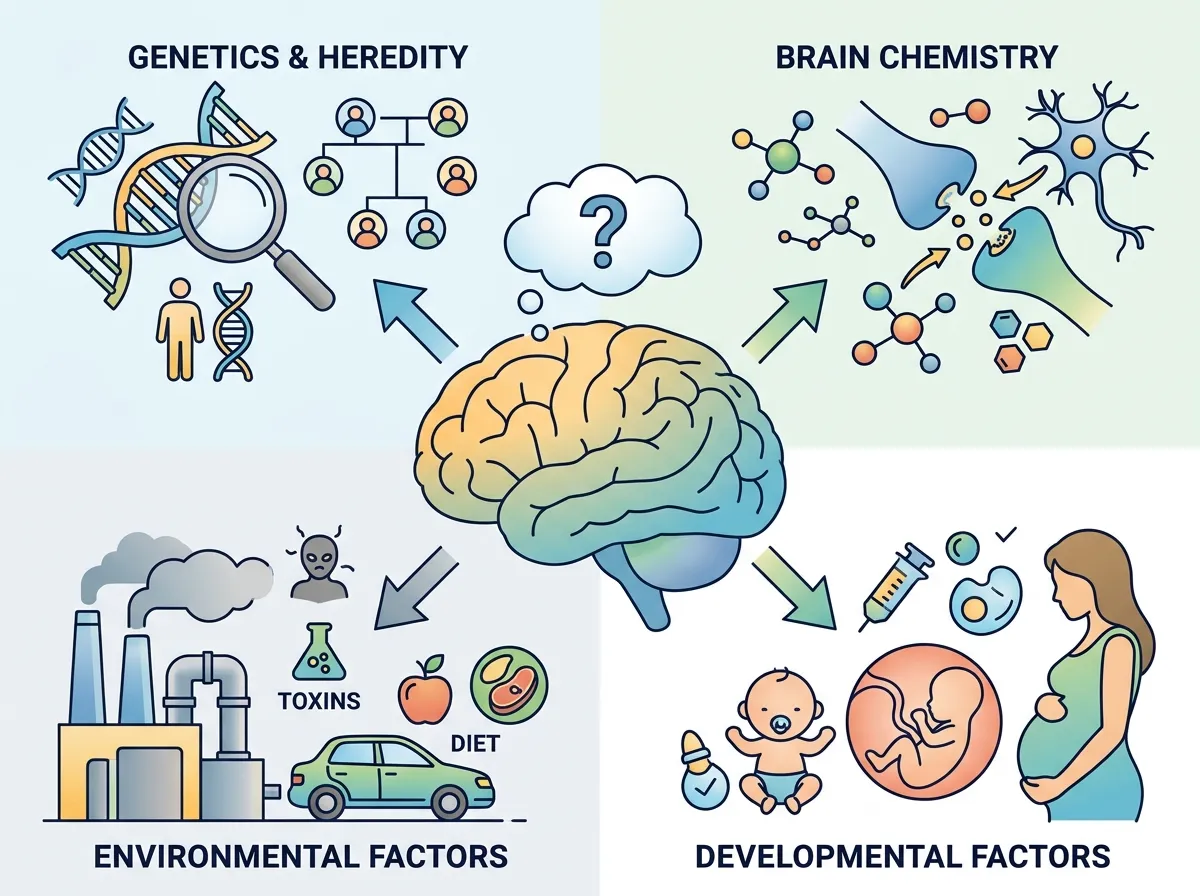
The exact cause of ADHD is not fully understood. Research suggests that genes play an important role. Brain development and other factors may also contribute.
ADHD is not caused simply by being lazy or having poor discipline.
Genetics and Family History
ADHD can run in families. A child with a close relative who has ADHD may have a higher chance of having it, too.
However, family history alone does not prove that someone has ADHD.
Brain Development
Research has found differences in brain development and function among people with ADHD. These differences may affect attention, planning, and impulse control.
Scientists continue to study how these processes work.
Environmental and Other Risk Factors
Researchers are also studying possible risk factors, including certain exposures during pregnancy or early childhood.
These factors do not mean that every exposed person will develop ADHD. The condition likely involves a mix of genetic and other influences.
There is no single cause that explains every case.
How Is ADD Diagnosed?
There is no single test that can confirm ADHD. A healthcare professional uses a person’s history, symptoms, and the effect those symptoms have on daily life.
The goal is to find out whether the symptoms fit ADHD or may have another explanation.
Step 1: Discuss the Symptoms
The professional may ask about attention, memory, behavior, school, work, and relationships.
They may also ask when the problems began and how often they happen.
Step 2: Review Past and Present Behavior
ADHD symptoms begin during childhood, even if the condition is not diagnosed until later.
For adults, the professional may ask about childhood experiences, school reports, or information from family members when available.
For children, parents and teachers may be asked to describe behavior in different settings.
Step 3: Check for Other Possible Causes
Sleep disorders, anxiety, depression, and learning difficulties can cause symptoms that look like ADHD.
A healthcare professional may review medical history and recommend further checks when needed.
Step 4: Decide Whether ADHD Criteria Are Met
The professional considers how long symptoms have lasted, where they occur, and whether they interfere with daily functioning.
For example, trouble focusing only during one stressful week may not indicate ADHD. Long-term problems that affect both home and work may need a closer assessment.
The CDC’s ADHD diagnosis guide explains the process in more detail.
How Is ADD Treated?
There is no single treatment that works for everyone. ADHD can often be managed with a plan based on the person’s age, symptoms, needs, and daily life.
Treatment may include medication, therapy, behavior support, and practical changes at home, school, or work.
Medication
Healthcare professionals may prescribe medication to help reduce ADHD symptoms.
Stimulant medications are commonly used. Nonstimulant options are also available.
Medication can have side effects, and the right choice depends on the individual. A qualified healthcare professional should explain the benefits and risks and monitor treatment.
Never start, stop, or change prescription medication without appropriate medical advice.
Therapy and Behavioral Support
Therapy can help people develop skills for managing daily challenges.
It may focus on:
- Building routines
- Managing strong emotions
- Improving planning skills
- Handling frustration
- Developing better habits
For children, parent training can help caregivers use effective behavior strategies and create a more supportive home environment.
School Support
Children may benefit from classroom changes and school-based support.
Depending on their needs, helpful steps may include written instructions, fewer distractions, extra organizational support, or suitable testing arrangements.
Parents can work with teachers and healthcare professionals to decide what support is appropriate.
Workplace Support
Adults may find it helpful to use task lists, calendar alerts, written instructions, or quiet work areas.
Some people may also qualify for workplace accommodations, depending on their situation and applicable laws.
Daily Habits That May Help
Daily habits cannot replace professional treatment when it is needed, but they may help people manage their routines.
Consider these steps:
- Keep a regular sleep schedule.
- Use one calendar for appointments.
- Break large tasks into smaller steps.
- Set reminders for important activities.
- Reduce distractions during focused work.
- Schedule short breaks.
- Ask trusted people for support.
Small changes can make daily tasks easier to manage.
For more information, read the National Institute of Mental Health’s ADHD guide.
Is ADD a Learning Disability?
ADD is not the same as a specific learning disability. ADHD is a neurodevelopmental condition that can affect attention, behavior, and executive functioning.
A learning disability, such as dyslexia, can affect a particular skill, such as reading, spelling, or writing.
However, a person can have both ADHD and a learning disability. When this happens, they may need support for attention and for the specific learning difficulty.
For example, a student may struggle to stay focused during reading because of ADHD. Another student may stay focused but have trouble understanding written words because of dyslexia.
A proper assessment can help identify the support each student needs.
Is ADD the Same as Being Distracted?
No. Everyone gets distracted sometimes. People may lose focus when they are tired, stressed, bored, or worried.
ADHD involves a more persistent pattern of symptoms that can interfere with daily life.
For example, forgetting one appointment does not mean someone has ADHD. Repeatedly forgetting important tasks across different areas of life may be a reason to seek advice, especially if the problem has been present since childhood.
A professional assessment is the best way to understand ongoing attention problems.
Common Misunderstandings About ADD
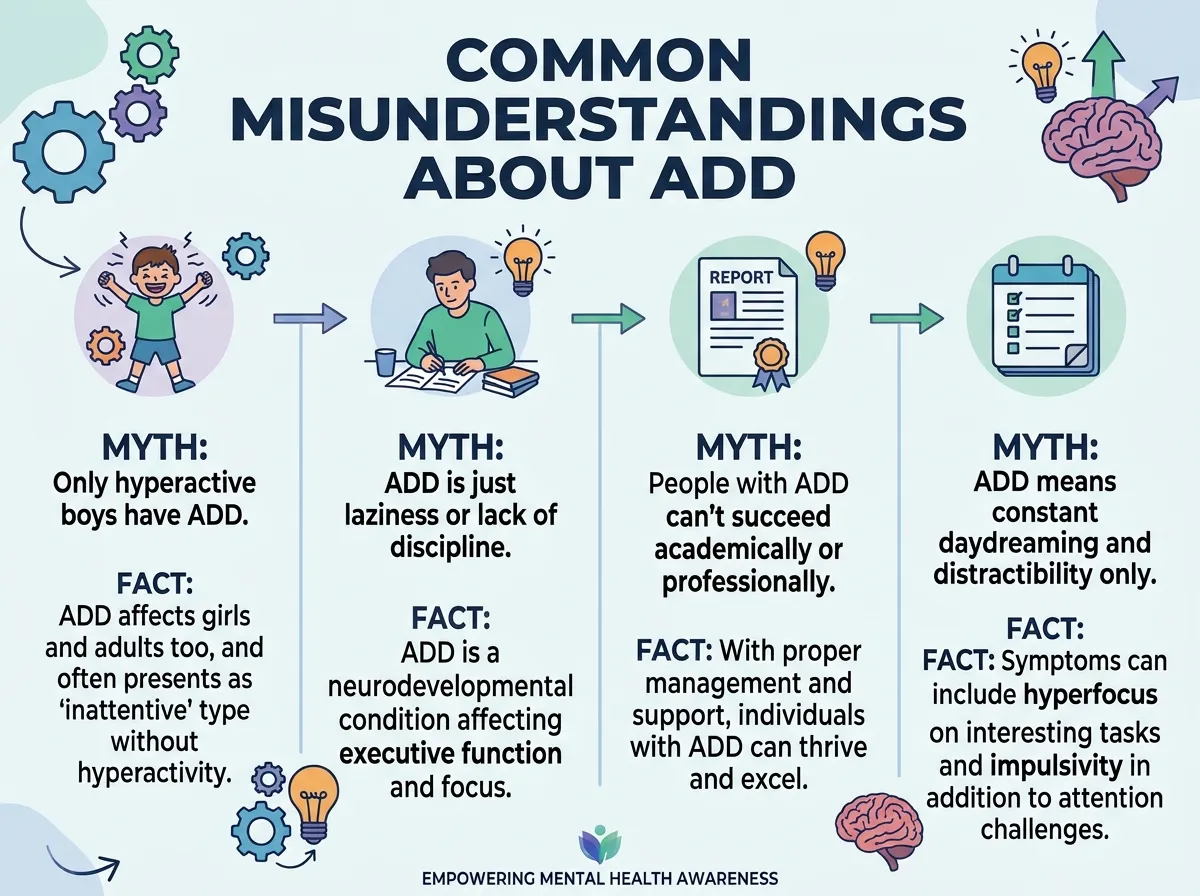
Several myths can make attention difficulties harder to understand.
Myth 1: ADD Is Still the Official Diagnosis
Fact: ADD is an older term. The current medical name is ADHD, including the predominantly inattentive presentation.
Myth 2: Everyone With ADHD Is Hyperactive
Fact: Some people mainly have trouble with attention and organization. They may not appear unusually active or restless.
Myth 3: ADHD Only Affects Children
Fact: ADHD symptoms can continue into adulthood. Some adults are diagnosed later because their earlier symptoms were not recognized.
Myth 4: People With ADHD Just Need to Try Harder
Fact: ADHD can affect attention, planning, and impulse control. Support and treatment may help people manage these challenges.
Myth 5: Forgetfulness Always Means ADHD
Fact: Many issues can affect memory and focus. Sleep loss, stress, anxiety, and other conditions may cause similar problems.
Article Summary
ADD stands for Attention Deficit Disorder, an older term for attention-related difficulties. Today, doctors use ADHD, or Attention-Deficit/Hyperactivity Disorder, as the official diagnosis.
Key points to remember:
- ADD is no longer the current medical term.
- ADHD can mainly affect attention, hyperactivity and impulsivity, or both.
- Symptoms can affect children and adults.
- Forgetfulness and distraction alone do not prove someone has ADHD.
- A healthcare professional can assess symptoms and rule out other causes.
- Treatment may include medication, therapy, behavioral support, and practical daily strategies.
FAQS
1. What does ADD stand for?
ADD stands for Attention Deficit Disorder. It is an older term that people still use to describe attention problems. The current medical term is ADHD.
2. What does ADD mean in simple words?
In simple words, ADD refers to ongoing difficulty with focus, attention, organization, or remembering tasks. Today, these symptoms may be described as the inattentive presentation of ADHD.
3. What is the difference between ADD and ADHD?
ADD is an older name, while ADHD is the current medical term. ADHD includes inattentive, hyperactive-impulsive, and combined presentations.
4. Can you have ADD without hyperactivity?
People can have ADHD without noticeable hyperactivity. This is called ADHD, predominantly inattentive presentation. It mainly affects attention, organization, and task completion.
5. What are the most common signs of ADD?
Common signs include being easily distracted, forgetting things, struggling to organize tasks, missing details, and having trouble finishing work. These signs alone are not enough to confirm ADHD.
6. Can adults have ADD?
Yes. Adults can have ADHD, including the inattentive presentation. Some people are not diagnosed until adulthood, even though their symptoms began during childhood.
7. How do I know if I have ADD?
If you have ongoing attention problems that affect your daily life, speak with a healthcare professional. They can review your symptoms, history, and other possible causes.
8. Is ADD a mental illness?
ADD is an older term for a condition now classified as ADHD, a neurodevelopmental disorder. It affects attention and, in some people, activity levels and impulse control.
9. Can ADD be treated?
Yes. ADHD can often be managed with medication, therapy, behavioral support, and practical changes to daily routines. Treatment should be tailored to the person’s needs.
10. Does ADD go away with age?
ADHD symptoms may change as a person grows older. Some people experience fewer hyperactive symptoms, while attention and organization difficulties may continue into adulthood.
11. Is ADD genetic?
Genetics play an important role in ADHD. It can run in families, although having a family member with ADHD does not mean someone will definitely have it.
12. Is ADD the same as laziness?
No. Attention difficulties are not the same as laziness. However, forgetfulness or unfinished tasks can have many causes, so it is important not to assume ADHD without an assessment.
Conclusion
So, what does ADD mean? ADD stands for Attention Deficit Disorder, an older term used to describe problems with attention and focus.
Today, healthcare professionals use ADHD, or Attention-Deficit/Hyperactivity Disorder, as the official name.
ADHD can affect children and adults in different ways. Some people mainly struggle with attention and organization, while others also experience hyperactivity or impulsive behavior.
Having trouble focusing from time to time is normal. But when these problems continue and affect school, work, or relationships, seeking professional advice can help.
With the right assessment, support, and treatment, people with ADHD can learn useful skills and manage daily challenges more effectively.

Emma Wilson is a writer at MeaningVibz who enjoys exploring emoji meanings, texting expressions, and online communication trends. She helps readers understand how emojis and slang are used in different situations by providing clear explanations and relatable examples for everyday messaging.