

Vosotros is a Spanish pronoun that means “you all,” “you guys,” or “you” when speaking to more than one person informally.
English uses the word “you” for one person and for a group. Spanish has more pronouns to show who is being addressed.
Vosotros helps speakers talk to several people in a friendly or casual way.
For example:
- Vosotros sois amigos. — You are friends.
- Vosotros habláis español. — You all speak Spanish.
- Vosotros tenéis tiempo. — You guys have time.
- Vosotros estáis aquí. — You are here.
The word itself refers to a group. It does not usually refer to one person.
Is Vosotros Singular or Plural?
Vosotros is plural. It refers to two or more people.
Use tú when speaking to one person informally. Use vosotros when speaking to a group informally in places where this pronoun is common.
| Spanish pronoun | English meaning | Number |
| Tú | You | Singular |
| Vosotros / vosotras | You all | Plural |
| Usted | You | Singular, polite |
| Ustedes | You all | Plural |
The exact choice depends on the country, the setting, and how formal the conversation is.
When Do You Use Vosotros?
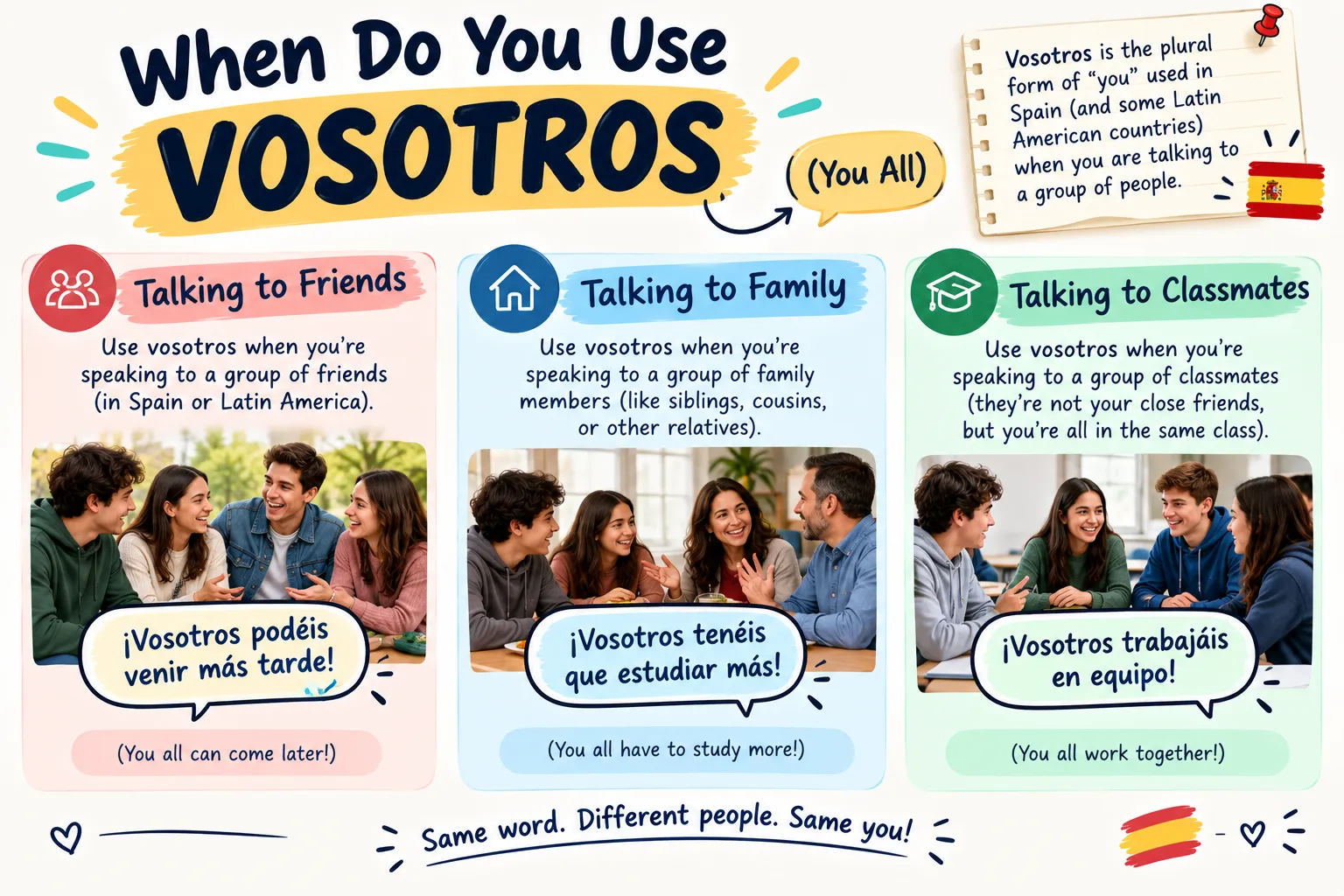
You mainly use vosotros when speaking informally to a group in Spain.
It is common when talking to friends, family members, classmates, children, or people you know well.
It can also appear in casual conversations with other groups, depending on the situation.
Talking to Friends
Imagine you are meeting your friends at a café in Madrid.
You could say:
- ¿Vosotros queréis café? — Do you all want coffee?
- ¿Vosotros venís conmigo? — Are you coming with me?
- ¿Vosotros tenéis hambre? — Are you hungry?
These sentences address the whole group.
Talking to Family
You can use vosotros when speaking to several family members in an informal setting.
Examples:
- Vosotros sois mi familia. — You are my family.
- ¿Vosotros vais a casa? — Are you all going home?
- Vosotros podéis ayudarme. — You guys can help me.
Talking to Classmates
Students may use vosotros when speaking to classmates in Spain.
Examples:
- ¿Vosotros estudiáis inglés? — Do you all study English?
- Vosotros tenéis un examen mañana. — You all have a test tomorrow.
- ¿Vosotros entendéis la lección? — Do you understand the lesson?
Asking a Group to Do Something
The informal plural command form is often used with groups of people.
Examples:
- ¡Escuchad! — Listen!
- ¡Venid aquí! — Come here!
- ¡Mirad esto! — Look at this!
These are common plural commands in Spain. They are not formed by simply adding vosotros to the sentence.
Vosotros vs. Ustedes: What Is the Difference?
One of the most common questions Spanish learners ask is whether vosotros and ustedes mean the same thing.
Both can mean “you all” or “you guys.” The main difference is how they are used across Spanish-speaking regions and in formal situations.
In Spain, vosotros is generally used for informal groups, while ustedes is used for formal groups. In most of Latin America, ustedes is the normal plural “you” for both casual and formal situations.
Examples of Vosotros and Ustedes
| English | Spain: informal | Latin America: common usage |
| You all speak Spanish. | Vosotros habláis español. | Ustedes hablan español. |
| You all are ready. | Vosotros estáis listos. | Ustedes están listos. |
| You all have time. | Vosotros tenéis tiempo. | Ustedes tienen tiempo. |
| You all eat here. | Vosotros coméis aquí. | Ustedes comen aquí. |
The examples use common masculine or mixed-group forms where relevant. For an all-female group, use vosotras in Spain.
Vosotros vs. Vosotras
The words vosotros and vosotras have the same basic meaning. Both refer to an informal group of people.
The difference is grammatical gender.
- Vosotros: Used for an all-male group or a mixed group of males and females.
- Vosotras: Used for a group made up entirely of females.
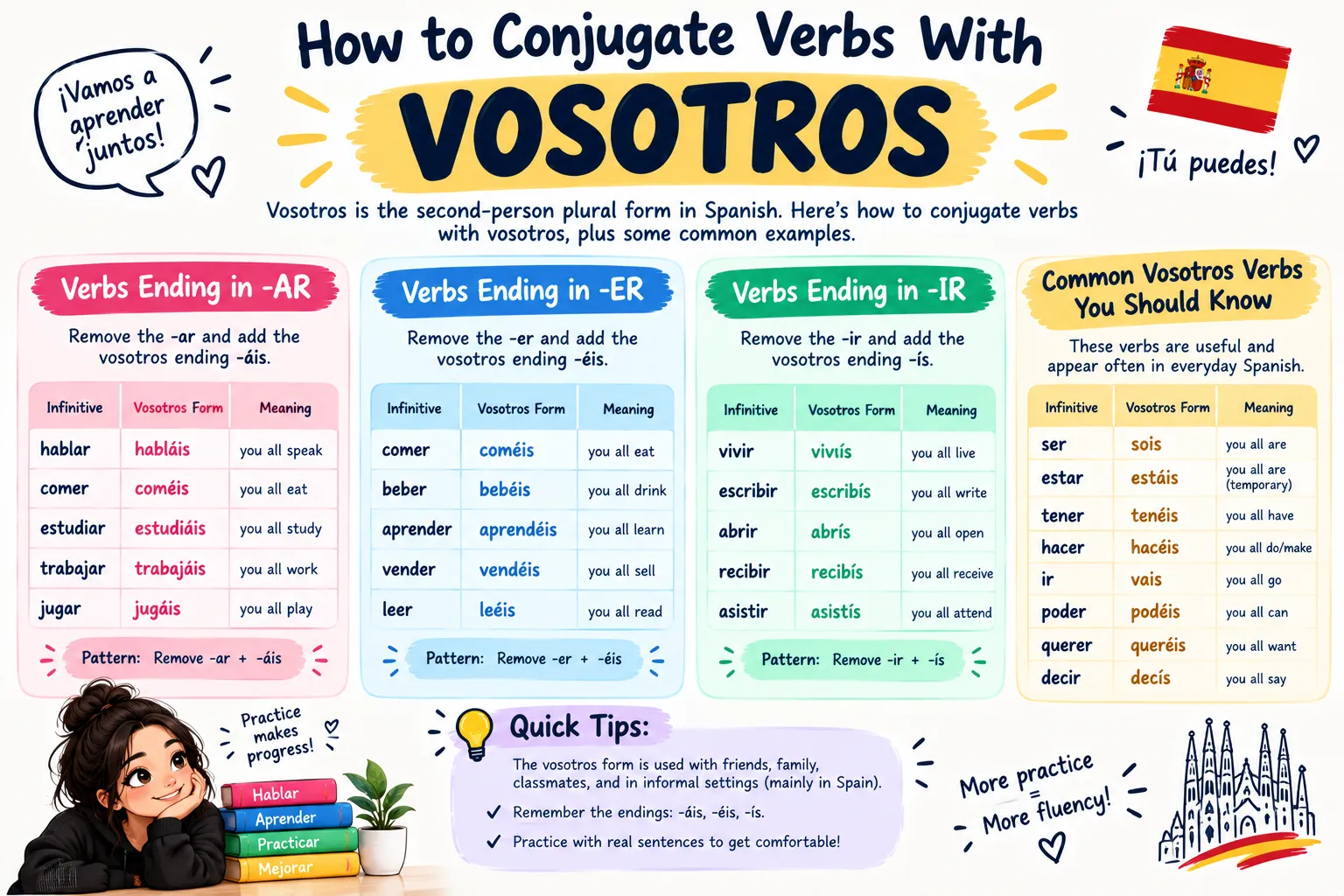
How to Conjugate Verbs With Vosotros
When you use vosotros, the verb must match the pronoun. This is called verb conjugation.
Many regular Spanish verbs follow easy patterns in the present tense. Learning these patterns will help you build many sentences.
Verbs Ending in -AR
For most regular verbs ending in -ar, replace -ar with -áis when using vosotros in the present tense.
Example: hablar means “to speak.”
| Pronoun | Verb | English |
| Yo | hablo | I speak |
| Tú | hablas | You speak |
| Él / Ella | habla | He / she speaks |
| Nosotros | hablamos | We speak |
| Vosotros | habláis | You all speak |
| Ellos / Ellas | hablan | They speak |
Example sentence:
Vosotros habláis muy rápido. — You all speak very fast.
Other regular -ar verbs include estudiar (to study), trabajar (to work), and bailar (to dance).
- Vosotros estudiáis mucho. — You all study a lot.
- Vosotros trabajáis aquí. — You all work here.
- Vosotros bailáis bien. — You all dance well.
Verbs Ending in -ER
For most regular verbs ending in -er, replace -er with -éis.
Example: comer means “to eat.”
| Pronoun | Verb | English |
| Yo | como | I eat |
| Tú | comes | You eat |
| Él / Ella | come | He / she eats |
| Nosotros | comemos | We eat |
| Vosotros | coméis | You all eat |
| Ellos / Ellas | comen | They eat |
Example sentence:
Vosotros coméis juntos. — You all eat together.
Other examples:
- Vosotros bebéis agua. — You all drink water.
- Vosotros aprendéis español. — You all learn Spanish.
- Vosotros leéis libros. — You all read books.
Verbs Ending in -IR
For most regular verbs ending in -ir, replace -ir with -ís.
Example: vivir means “to live.”
| Pronoun | Verb | English |
| Yo | vivo | I live |
| Tú | vives | You live |
| Él / Ella | vive | He / she lives |
| Nosotros | vivimos | We live |
| Vosotros | vivís | You all live |
| Ellos / Ellas | viven | They live |
Example sentence:
Vosotros vivís en Madrid. — You all live in Madrid.
Other examples:
- Vosotros escribís cartas. — You all write letters.
- Vosotros abrís la puerta. — You all open the door.
- Vosotros compartís la comida. — You all share the food.
Remember that these are regular present-tense patterns. Some Spanish verbs are irregular and have different forms.
Common Vosotros Verbs You Should Know
Some verbs appear often in everyday conversations. Learning their vosotros forms can help you understand Spanish more quickly.
| Infinitive | Vosotros form | English meaning |
| Ser | Sois | You all are |
| Estar | Estáis | You all are |
| Tener | Tenéis | You all have |
| Ir | Vais | You all go |
| Hacer | Hacéis | You all do or make |
| Poder | Podéis | You all can |
| Querer | Queréis | You all want |
| Decir | Decís | You all say |
| Venir | Venís | You all come |
| Saber | Sabéis | You all know |
| Ver | Veis | You all see |
| Dar | Dais | You all give |
Here are these forms in simple sentences:
- Vosotros sois buenos amigos. — You are good friends.
- Vosotros estáis felices. — You are happy.
- Vosotros tenéis una casa grande. — You have a big house.
- Vosotros vais al parque. — You go to the park.
- Vosotros podéis hacerlo. — You can do it.
- Vosotros queréis aprender. — You want to learn.
Some verbs change their stem or spelling in other forms, so it is helpful to learn common verbs as complete forms rather than guess every ending.
How to Make Negative Sentences With Vosotros
Making a negative sentence is simple. Put no before the verb.
Examples:
- Vosotros no habláis inglés. — You all do not speak English.
- Vosotros no tenéis tiempo. — You all do not have time.
- Vosotros no estáis listos. — You are not ready.
- Vosotros no queréis salir. — You do not want to go out.
In everyday English, these may sound more natural as “You guys don’t speak English” or “You aren’t ready.”
The word no usually comes directly before the conjugated verb. You do not need another word for “not.”
How to Ask Questions With Vosotros
You can ask questions by using vosotros with the matching verb. In Spanish writing, questions begin with an inverted question mark and end with a regular question mark.
Examples:
- ¿Vosotros habláis español? — Do you all speak Spanish?
- ¿Vosotros vivís aquí? — Do you all live here?
- ¿Vosotros tenéis hambre? — Are you all hungry?
- ¿Vosotros queréis venir? — Do you all want to come?
Spanish often allows you to leave out the pronoun because the verb ending shows who you mean.
For example:
¿Habláis español?
This also means “Do you all speak Spanish?” in a setting where vosotros is used.
Including vosotros can add emphasis or make it clearer who you are talking to.
Vosotros in Everyday Spanish Conversations
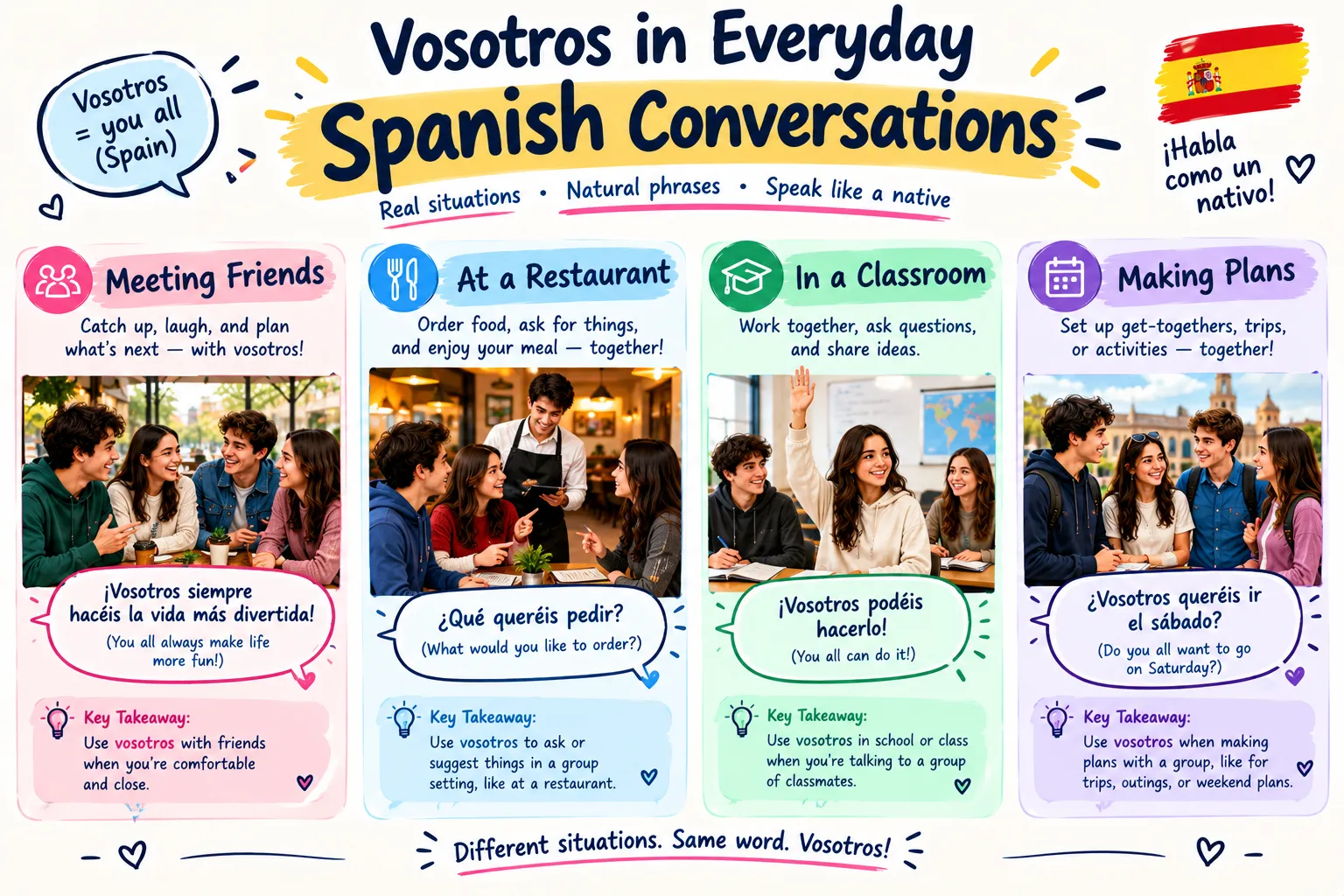
You will often hear vosotros and its verb forms in everyday conversations in Spain.
Here are some short examples to show how they work in context.
Meeting Friends
Ana: ¿Vosotros venís a la fiesta?
Luis: Sí, vamos todos.
English:
Ana: Are you all coming to the party?
Luis: Yes, we are all going.
At a Restaurant
Waiter: ¿Vosotros queréis ver el menú?
Friends: Sí, por favor.
English:
Waiter: Would you all like to see the menu?
Friends: Yes, please.
This is one possible casual way to address a group. The exact choice of pronoun can vary by speaker and setting.
In a Classroom
Teacher: ¿Vosotros entendéis la pregunta?
Students: Sí, la entendemos.
English:
Teacher: Do you all understand the question?
Students: Yes, we understand it.
Making Plans
Marta: ¿Vosotros vais al cine esta noche?
Pablo: Sí, ¿queréis venir con nosotros?
English:
Marta: Are you all going to the movies tonight?
Pablo: Yes, do you want to come with us?
These examples show how vosotros works with different verbs in natural speech.
Common Mistakes When Using Vosotros
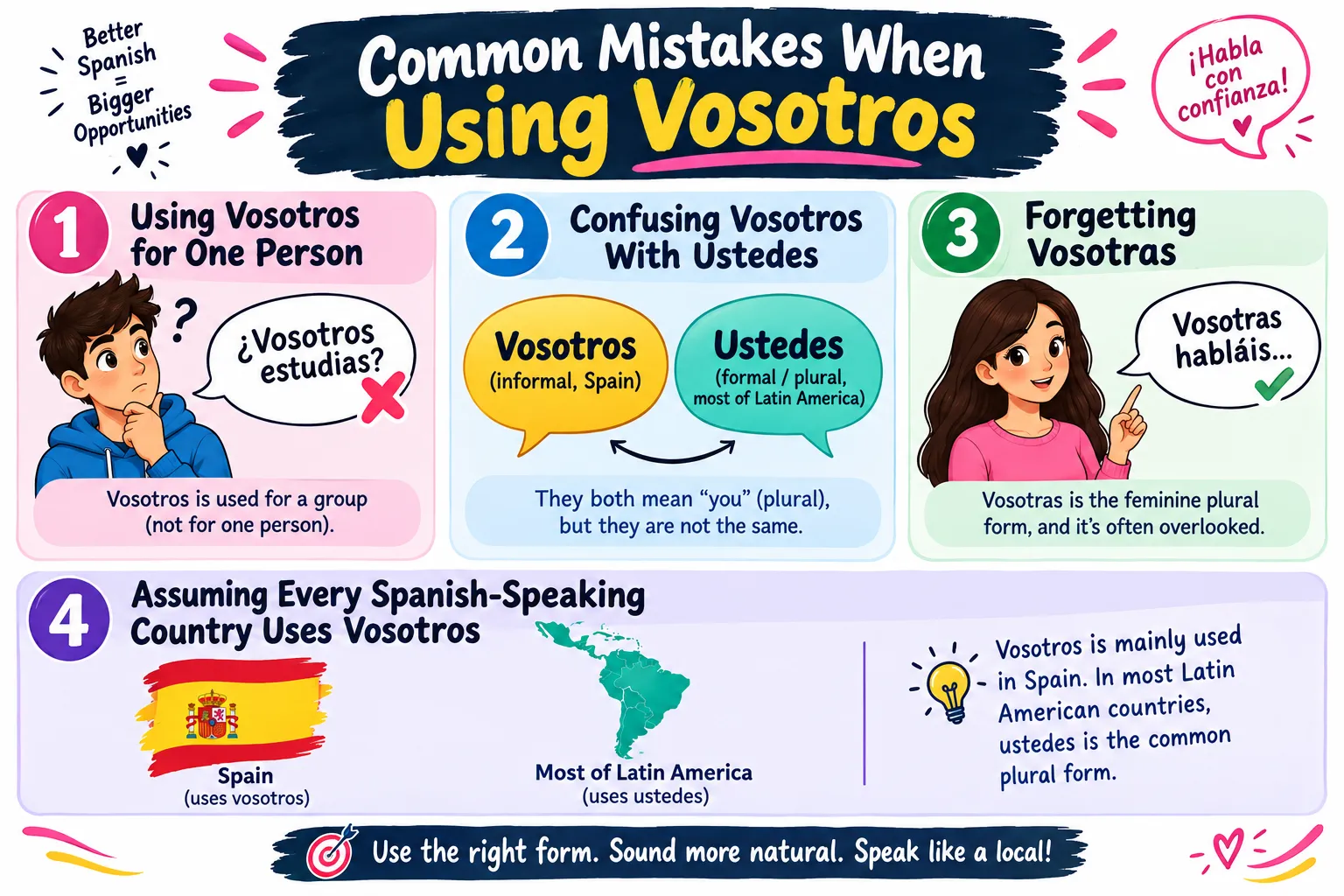
Spanish learners often make a few simple mistakes when they first learn this pronoun.
Using Vosotros for One Person
Vosotros refers to a group, not one person.
Incorrect for one person: Vosotros eres mi amigo.
Correct for one person: Tú eres mi amigo. — You are my friend.
Correct for a group: Vosotros sois mis amigos. — You are my friends.
Using the Wrong Verb Form
The verb must match vosotros.
Incorrect: Vosotros habla español.
Correct: Vosotros habláis español. — You all speak Spanish.
Incorrect: Vosotros tiene tiempo.
Correct: Vosotros tenéis tiempo. — You all have time.
Confusing Vosotros With Ustedes
Both pronouns can mean “you all,” but they use different verb forms.
- Vosotros habláis español.
- Ustedes hablan español.
In Spain, use vosotros for most informal groups. In much of Latin America, ustedes is the usual choice for groups.
Forgetting Vosotras
Use vosotras when speaking informally to a group made up entirely of females in places where the pronoun is used.
For example:
Vosotras sois muy simpáticas. — You all are very nice.
The word simpáticas also uses the feminine plural form.
Assuming Every Spanish-Speaking Country Uses Vosotros
Many Spanish learners first meet vosotros in textbooks or Spanish lessons. However, it is not the usual everyday plural pronoun throughout the Spanish-speaking world.
If you travel to Mexico, Colombia, Argentina, or many other Latin American countries, you will generally hear ustedes when people speak to groups.
Is Vosotros Used in Latin America?
In most of Latin America, people use ustedes instead of vosotros when talking to more than one person.
For example, in Mexico, a person would commonly say:
Ustedes son mis amigos. — You are my friends.
In Spain, the common informal version is:
Vosotros sois mis amigos. — You are my friends.
There are regional differences in Spanish, and language use can vary among communities.
Does Vosotros Mean “You Guys”?
Yes. In many situations, “you guys” is a natural English translation of vosotros.
For example:
¿Vosotros estáis preparados?
This can mean “Are you guys ready?” or “Are you all ready?”
However, English translations depend on context. “You all,” “you guys,” and simply “you” can all work.
The important point is that vosotros addresses a group informally. It does not mean “we,” “they,” or “you” in the singular.
Quick Tips to Remember Vosotros
Use these simple tips to remember the word and its grammar.
- Think of a group: Vosotros means “you all” or “you guys.”
- Remember the region: It is common in informal speech in Spain.
- Learn the endings: Regular present-tense verbs often end in -áis, -éis, or -ís with vosotros.
- Use ustedes in most of Latin America: This is the normal plural “you” in many countries.
- Know the gender forms: Use vosotros for an all-male or mixed group and vosotras for an all-female group.
- Practice with short sentences: Try vosotros sois, vosotros tenéis, and vosotros habláis.
A little daily practice can help you recognize these forms when reading, listening, or speaking Spanish.
FAQs
1. What does vosotros mean in English?
Vosotros means “you all,” “you guys,” or the informal plural “you.” It is mainly used in Spain.
2. Is vosotros formal or informal?
Vosotros is informal. In Spain, ustedes is generally used for formal groups, while vosotros is used in most casual situations.
3. What is the difference between vosotros and ustedes?
Both mean “you all,” but vosotros is mainly used for informal groups in Spain. Ustedes is the normal plural form in most of Latin America and is also used for formal groups in Spain.
4. Is vosotros singular or plural?
Vosotros is plural. It refers to two or more people.
5. What is the feminine form of vosotros?
The feminine form is vosotras. It is used when speaking informally to a group made up entirely of females.
6. Do Mexicans use vosotros?
Most Mexicans do not use vosotros in everyday conversation. They normally use ustedes when speaking to a group.
7. How do you conjugate hablar with vosotros?
The present-tense form is habláis. For example, Vosotros habláis español means “You all speak Spanish.”
8. Can you leave out vosotros in a sentence?
Yes. Spanish often leaves out subject pronouns because the verb ending shows who is speaking or being addressed. For example, Habláis español can mean “You all speak Spanish” in Spain.
9. Does vosotros mean “we”?
No. Vosotros means “you all,” while nosotros means “we.”
10. Why should I learn vosotros?
Learn vosotros if you want to understand or speak Spanish as used in Spain. It is also useful when reading Spanish textbooks, watching Spanish media, or learning how Spanish varies by region.
Article Summary
Vosotros is an informal plural pronoun in Spanish that means “you all” or “you guys.” It is mainly used in Spain when speaking to friends, family, classmates, and other groups in casual settings.
The feminine form is vosotras, used for an all-female group. Verbs must match the pronoun, as in vosotros habláis, vosotros coméis, and vosotros vivís. In most of Latin America, people use ustedes instead of vosotros for both casual and formal groups.
Learning the meaning of vosotros, its verb forms, and the difference between vosotros and ustedes will help you understand Spanish conversations and choose the right words for your audience.
Conclusion
The meaning of vosotros is simple: it means “you all” or “you guys” when speaking informally to a group.
It is mainly used in Spain, where it helps speakers talk naturally to friends, family, and other people they know.
To use it correctly, remember to match the verb with the pronoun.
For example, say vosotros sois, vosotros tenéis, and vosotros habláis.
Use vosotras for an all-female group, and remember that ustedes is the common plural form in most of Latin America.
Start with a few easy sentences and practice them aloud.
With time, you will find it easier to recognize vosotros and use it in the right situations.

Ryan Mitchell creates informative content about word definitions, acronyms, online slang, and modern communication. He enjoys exploring how people use language in text messages, on social media, and in daily life. Ryan focuses on delivering simple explanations and practical examples that help readers quickly understand the meaning of unfamiliar words and phrases.