
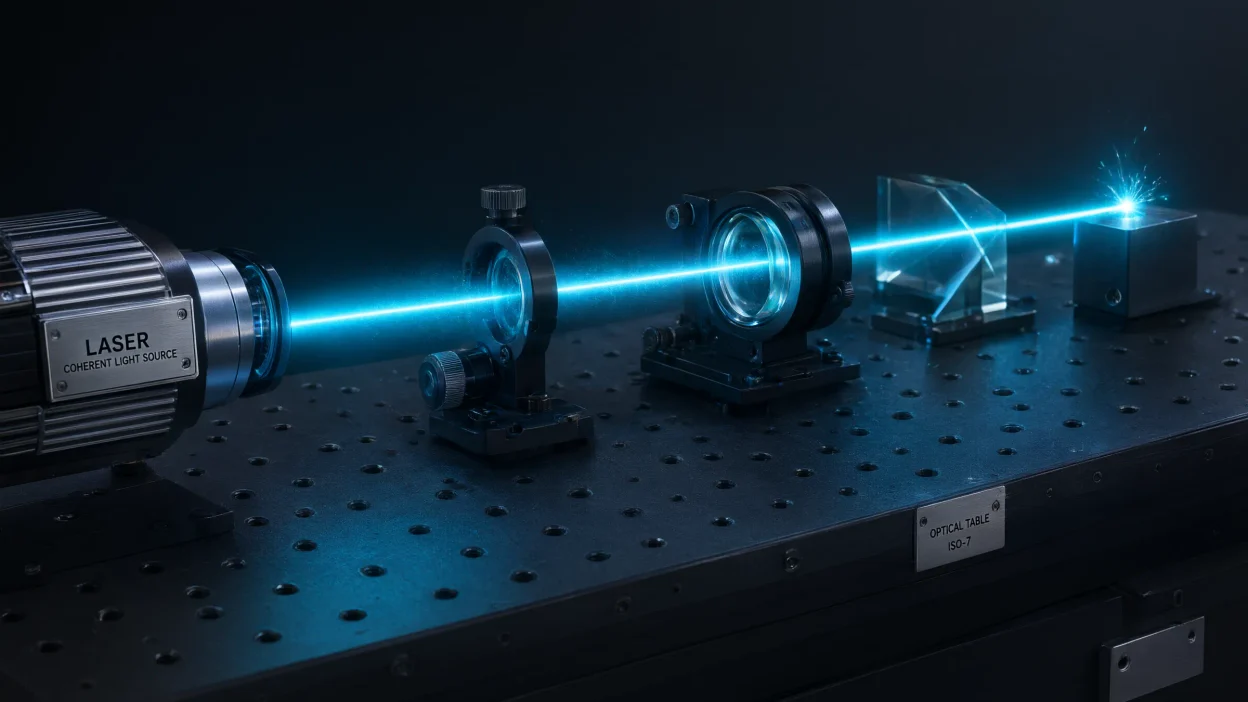
LASER stands for Light Amplification by Stimulated Emission of Radiation.
Each word explains part of how a laser works.
- Light: The energy we see as visible light, though lasers can also produce light outside the visible range.
- Amplification: Making the light stronger.
- Stimulated: Caused or triggered by another source of energy.
- Emission: The release of energy.
- Radiation: Energy that travels in the form of waves or particles.
Together, these words describe how a laser creates and strengthens light.
A laser uses energy to make atoms or other particles release light in a controlled way. The light is then amplified and formed into a beam.
Although the full form is scientific, the main idea is simple: a laser produces a focused beam of light using a controlled process.
What Is a Laser in Simple Words?
A laser is a device that creates a narrow and focused beam of light.
Think about a regular light bulb. It sends light in many directions, lighting up a whole room.
A laser, on the other hand, produces light that can stay in a narrow beam over a distance.
This makes lasers useful for jobs that need great accuracy.
For example:
- A laser pointer helps someone point to a small area on a screen.
- A laser printer uses laser technology to help form images on paper.
- A medical laser can be used for certain treatments.
- A laser cutter can cut or mark materials with high accuracy.
- A laser measuring tool can measure distances.
Not every laser looks like a bright red line. Some lasers produce infrared or ultraviolet light, which the human eye cannot see.
Others produce visible light in colors such as red, green, or blue.
The color and strength of a laser depend on how the device is designed and what it is meant to do.
How Does a Laser Work?
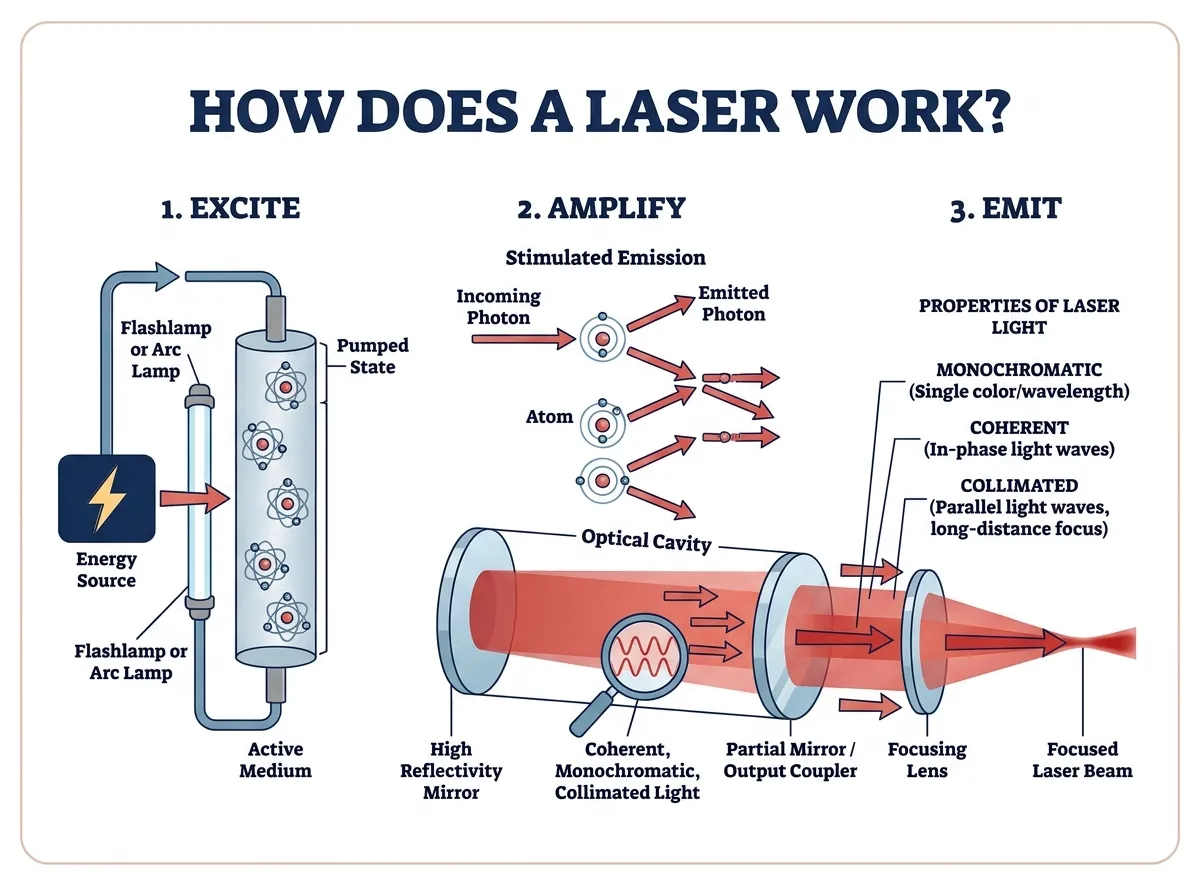
A laser works by using energy to produce light and then building that light into a strong, organized beam.
The process can be explained in a few simple steps.
1. Energy Enters the Laser
A laser needs an energy source. This may be electricity, light from another source, or another form of energy.
The energy is supplied to a material inside the laser called the active medium.
2. The Active Medium Produces Light
The active medium may be a gas, a crystal, glass, a liquid, or a special semiconductor.
When energy is supplied, particles in this material can move into higher-energy states. When they release that energy, they can produce light.
3. Stimulated Emission Takes Place
This is the key process behind a laser.
A passing photon can trigger an excited particle to release another photon with matching properties.
Under the right conditions, this process produces more light that is closely matched in frequency, direction, and phase.
This process is called stimulated emission.
4. The Light Is Amplified
Many lasers use mirrors to send light back and forth through the active medium. This allows the light to trigger more emissions and grow stronger.
One mirror lets some of the light pass through. That light leaves the device as the laser beam.
Some laser designs use different structures, so not every laser works with the same mirror setup.
5. A Focused Beam Comes Out
The result is a beam of light that can be directed and focused.
The beam may be used to measure distance, read data, cut material, or carry out other tasks.
The exact result depends on the laser’s wavelength, power, and design.
What Makes Laser Light Different From Ordinary Light?
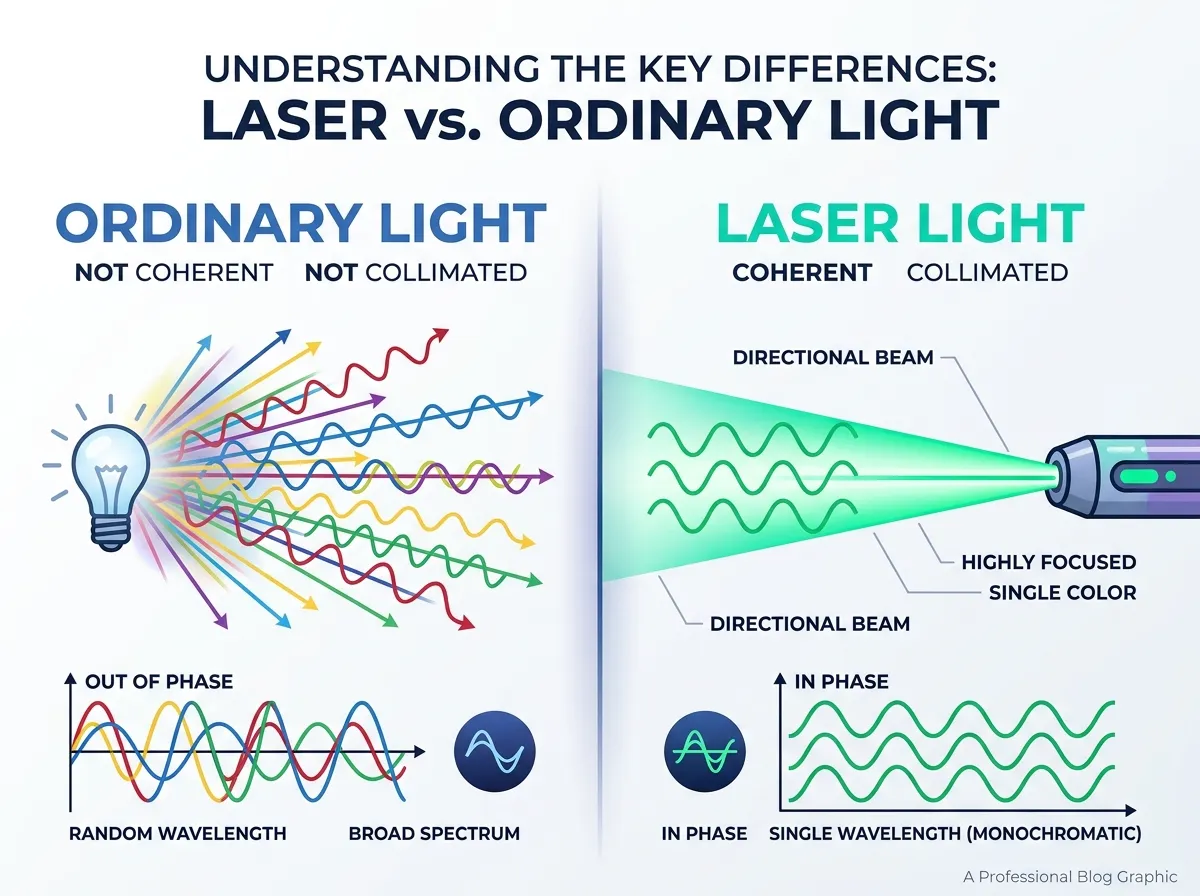
Laser light has several special features that make it useful for precise work.
Laser Light Is Directional
A laser beam can travel in a narrow direction with little spreading compared with light from an ordinary bulb.
This helps lasers work over long distances.
Laser Light Can Be Coherent
Laser light is often described as coherent. This means its light waves have a stable relationship with one another.
Coherence is one of the properties that makes lasers useful in science, measurement, and communications.
Laser Light Can Be Focused
A laser beam can be focused onto a very small spot. This allows energy to be placed on a small area.
For example, some industrial lasers can cut or mark materials by concentrating energy on the surface.
Laser Light Has a Specific Wavelength
Many lasers produce light in a narrow range of wavelengths. The wavelength helps determine the light’s color and how it interacts with different materials.
Some lasers produce visible light, while others produce infrared or ultraviolet light.
What Are the Main Types of Lasers?
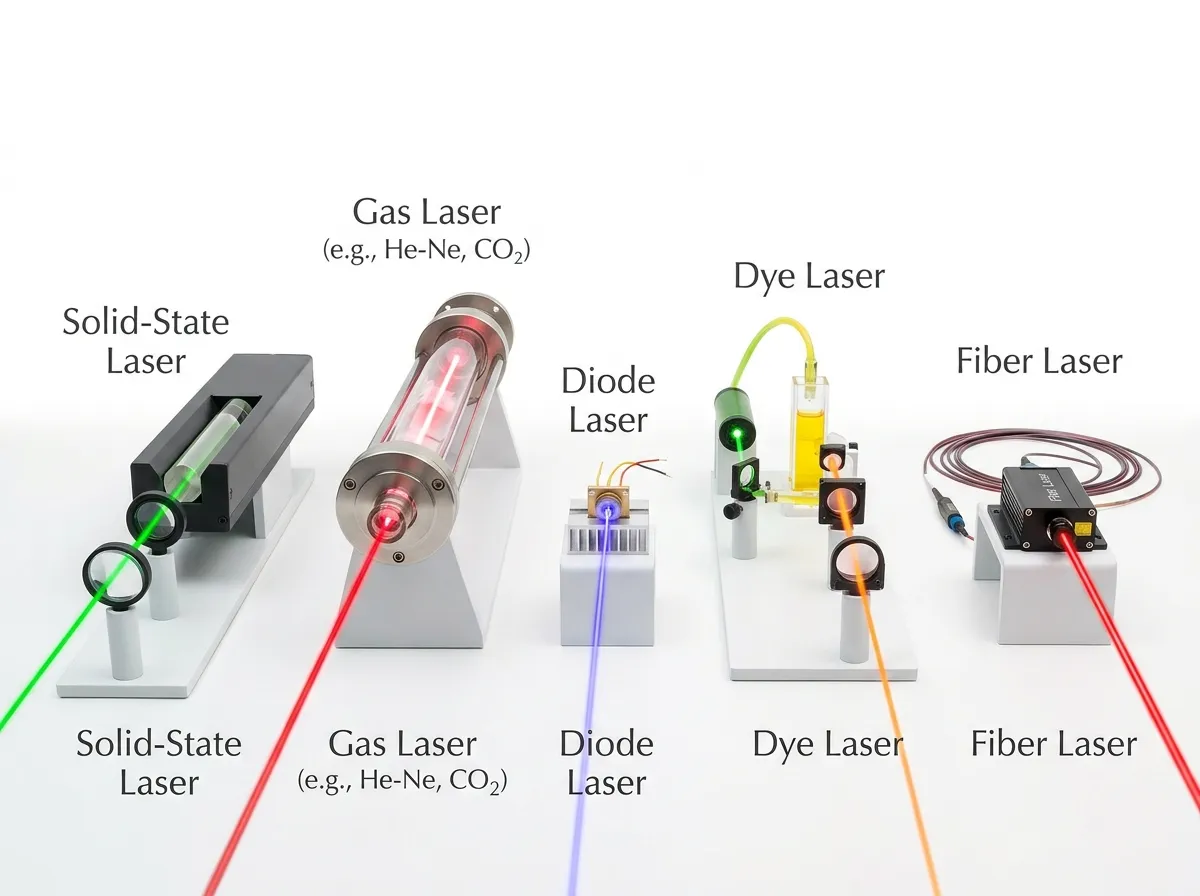
There are several types of lasers. Each type uses a different active medium or design and is suited to different jobs.
1. Solid-State Lasers
Solid-state lasers use a solid material, such as a crystal or glass, to produce light.
They are used in scientific research, industry, and some medical procedures.
Some solid-state lasers can produce powerful pulses of light for cutting, marking, or other precise tasks.
2. Gas Lasers
Gas lasers use gas as the active medium.
A well-known example is the carbon dioxide (CO2) laser. It is widely used in industrial cutting, engraving, and material processing.
Helium-neon lasers are another type. They have been used in alignment tools, demonstrations, and measurement systems.
3. Semiconductor Lasers
Semiconductor lasers use special electronic materials to produce light.
They are small and can be built into many everyday devices.
Examples include lasers used in optical data storage, fiber-optic communications, barcode readers, and some sensors.
4. Fiber Lasers
Fiber lasers use a special optical fiber as the active medium.
They are common in industrial work because they can deliver light efficiently and make precise cuts or marks on many materials.
They are also used in some measurement and research systems.
5. Dye Lasers
Dye lasers use a liquid containing a special dye to produce light.
Some dye lasers can be adjusted across a range of wavelengths. This makes them useful in certain scientific and research applications.
6. Excimer Lasers
Excimer lasers often produce ultraviolet light.
They are used in some eye procedures, including certain forms of laser vision correction, and in specialized manufacturing processes.
Different excimer lasers are designed for different tasks, so their uses depend on the equipment and wavelength.
What Are Lasers Used For?
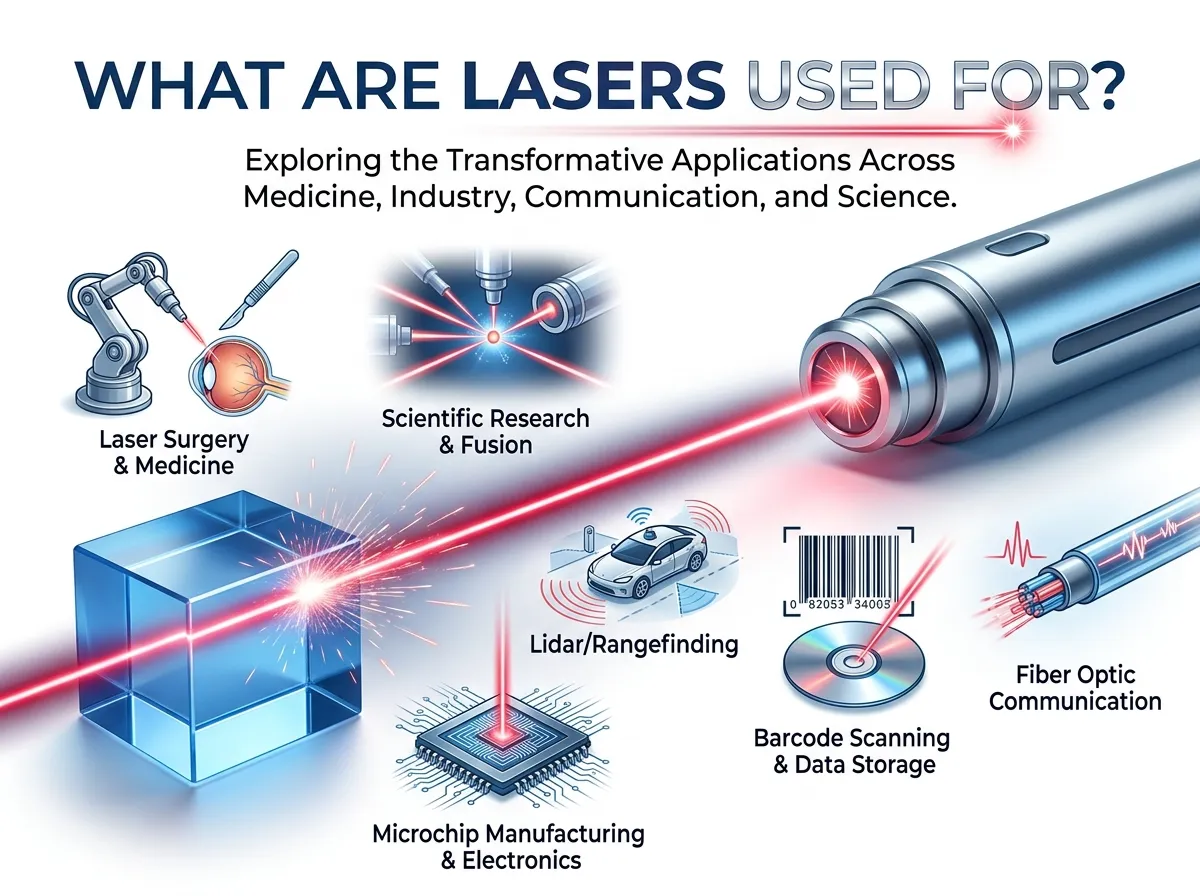
Lasers are used in medicine, communication, manufacturing, science, and many everyday devices.
Their ability to deliver light in a controlled way makes them valuable when accuracy matters.
1. Medical Treatments
Doctors use lasers for certain medical and dental procedures.
Depending on the device, a laser may cut tissue, remove unwanted tissue, treat some skin conditions, or help reshape the cornea during selected eye procedures.
Laser treatment is not right for every condition. A qualified medical professional must decide whether it is suitable.
2. Eye Surgery
Some laser procedures help correct vision problems, such as nearsightedness, farsightedness, and astigmatism.
For example, LASIK uses a laser as part of a procedure that reshapes the cornea. Other laser procedures are used to treat certain eye diseases.
Laser eye procedures have risks and are not suitable for everyone.
3. Industrial Cutting and Engraving
Factories use lasers to cut, drill, weld, or mark materials.
A laser can make detailed cuts and marks on materials such as metal, plastic, wood, and glass, depending on the laser and setup.
For example, a business may use a laser to mark a serial number on a metal part.
4. Barcode Scanners
Some barcode scanners use laser light to read the lines on product labels.
The scanner detects reflected light and turns the pattern into information that a computer can process.
Not all barcode scanners use lasers. Many modern models use cameras or other light sources.
5. Laser Printers
Laser printers use laser technology in the printing process.
A laser helps create an image of the page on a light-sensitive part inside the printer. Toner is then placed and transferred to paper before heat helps fix it in place.
This process allows laser printers to produce sharp text and images.
6. Fiber-Optic Communication
Lasers are important in many fiber-optic communication systems.
They can send information through thin strands of glass or plastic called optical fibers. The information is carried as light signals.
This technology supports many internet, telephone, and data networks.
7. Distance Measurement
Laser measuring tools use light to estimate the distance between two points.
Some devices measure how long it takes light to travel to a target and return. Others use different optical methods.
These tools are useful in construction, surveying, and home improvement.
8. Scientific Research
Scientists use lasers to study materials, measure tiny changes, and test ideas about how light and matter interact.
Lasers are also used in advanced systems such as laser spectroscopy, precision measurement, and some forms of imaging.
9. Entertainment and Displays
Lasers are used in light shows, stage effects, and some display systems.
They can create bright patterns and beams that move across a stage or other space.
High-powered show lasers need careful control because direct or reflected beams can injure the eyes.
10. Everyday Electronics
Laser technology appears in many electronic products, including some computer storage devices, sensors, and communication equipment.
You may not see the beam because it can be inside a closed device or use infrared light.
What Is the Difference Between a Laser and Regular Light?
Laser light and ordinary light both carry energy, but they are produced and behave in different ways.
| Feature | Laser Light | Ordinary Light |
| Direction | Often forms a narrow beam | Usually spreads in many directions |
| Wavelength | Often has a narrow range | Often contains a wider range of wavelengths |
| Coherence | Usually highly coherent | Usually less coherent |
| Focus | Can be focused into a small spot | Can also be focused, depending on the source and optics |
| Common uses | Cutting, measurement, communication, medical procedures | Lighting, vision, and general illumination |
For example, a ceiling lamp lights up a room. A laser pointer creates a small spot on a wall.
The difference is not simply brightness. A low-power laser can look less bright than a lamp but still pose a risk to the eyes if its beam enters them.
Is Laser Light Dangerous?
Laser light can be dangerous, but the risk depends on its power, wavelength, design, and how it is used.
The eyes are especially sensitive to some laser beams. Light entering the eye can be focused onto the retina, where it may cause injury.
Some high-powered lasers can also burn skin or start fires.
Basic Laser Safety Tips
- Never point a laser at someone’s eyes.
- Do not aim a laser at cars, aircraft, or other vehicles.
- Avoid looking directly into a laser beam.
- Do not assume a laser is safe just because its beam is hard to see.
- Follow the safety instructions supplied with the device.
- Use the correct protective equipment for industrial or medical laser work.
Laser pointers should be used with care, especially around children. Higher-powered laser devices can cause serious injury.
For medical and industrial lasers, trained professionals should follow the required safety rules.
What Is the Difference Between LASER and LED?
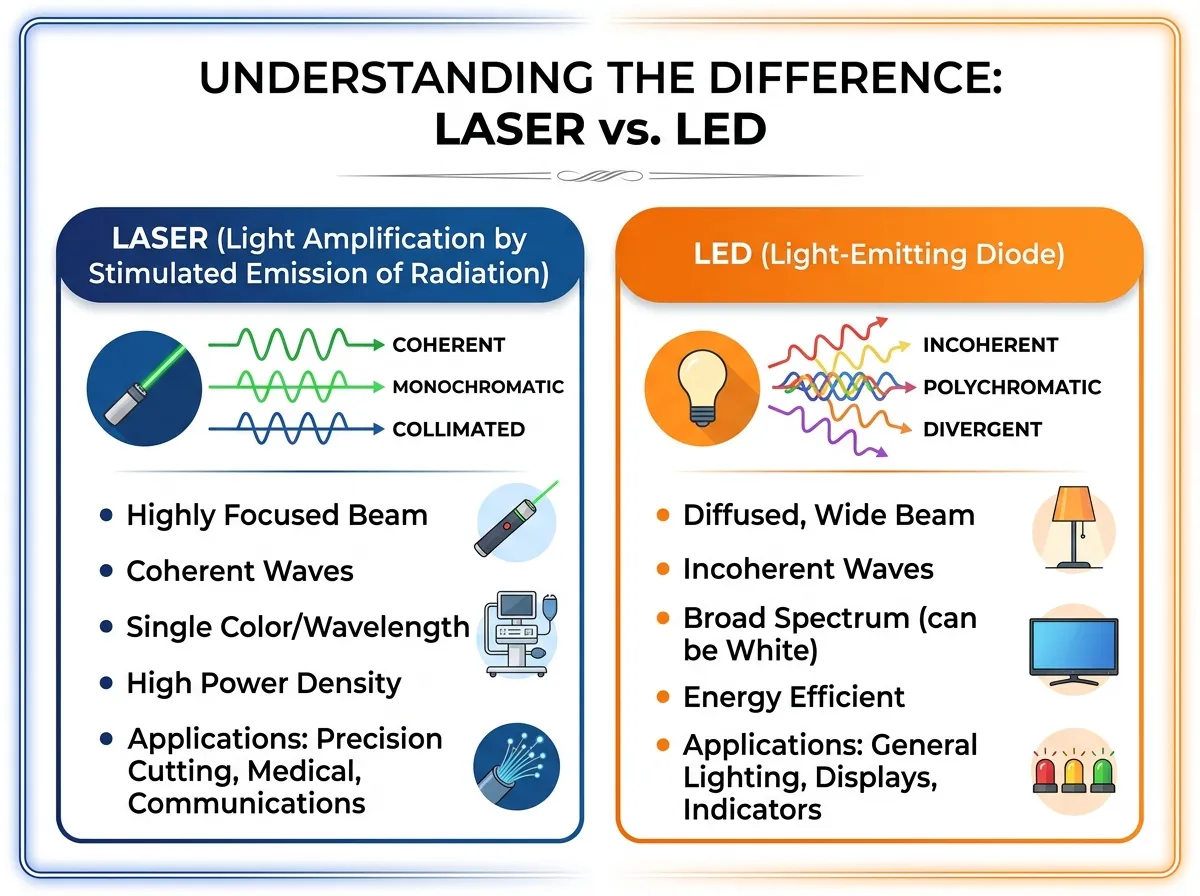
LASER and LED are both technologies that produce light, but they work differently.
LED stands for Light-Emitting Diode. It is an electronic component that produces light when electric current passes through it.
A laser produces light through stimulated emission and is designed to create a laser beam.
Here are some key differences:
- Laser: Often produces a narrow, coherent beam.
- LED: Usually produces light that spreads over a wider angle.
- Laser uses: Precision cutting, optical communication, distance measurement, and some medical treatments.
- LED uses: Room lighting, indicator lights, screens, and flashlights.
Both technologies are useful. The better choice depends on the job.
Why Is LASER Written in Capital Letters?
LASER is often written in capital letters because it began as an acronym formed from the first letters of a scientific phrase.
Over time, the word became common enough that it is also written as “laser” in everyday English.
Both forms are correct:
- LASER: Highlights the original acronym.
- Laser: Treats it as a regular word.
For example, you may see “LASER technology” in a science lesson and “laser printer” in a product description.
The meaning remains the same.
What Is the Difference Between a Laser and a Laser Beam?
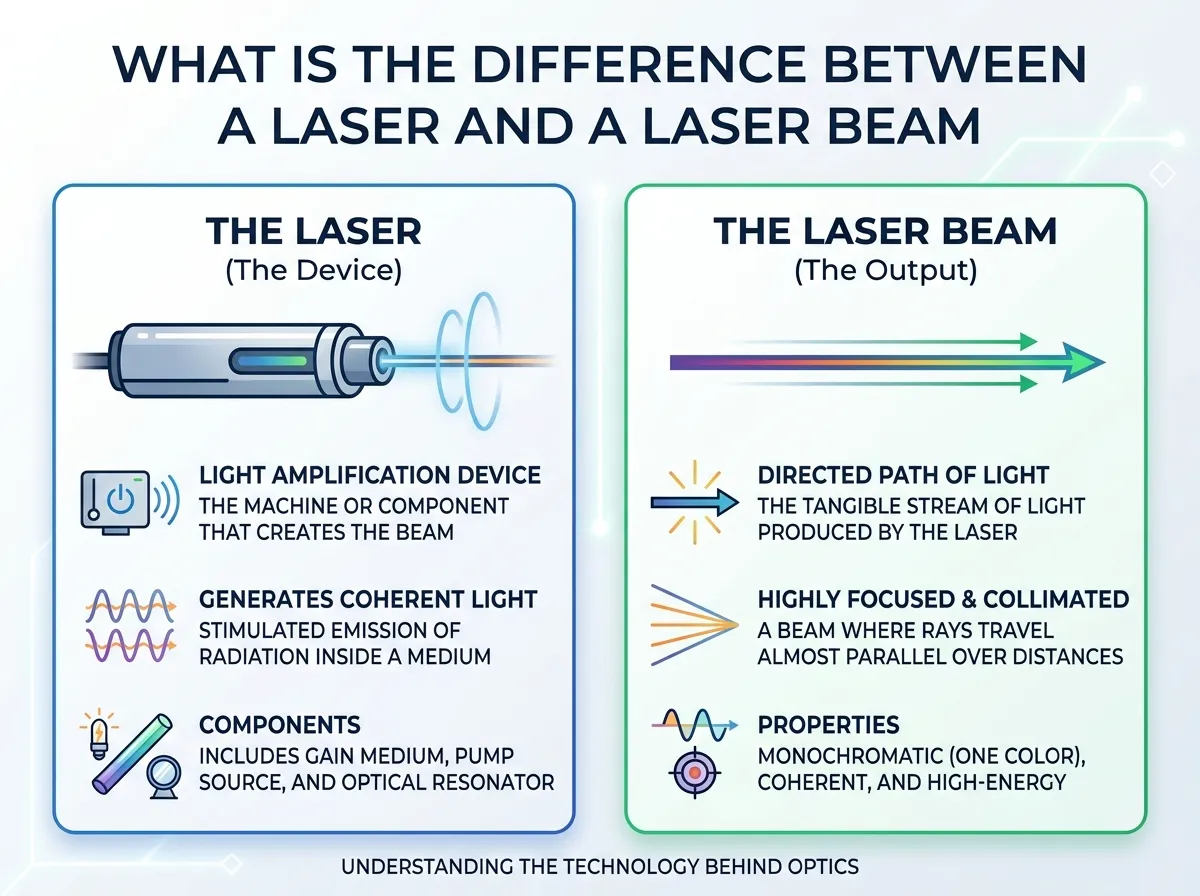
A laser is the device or system that creates the light. A laser beam is the light that comes out of the device.
For example, a laser measuring tool contains a laser system. The narrow line of light it sends toward a surface is the laser beam.
The words are related, but they do not mean exactly the same thing.
FAQS
1. What does LASER stand for?
LASER stands for Light Amplification by Stimulated Emission of Radiation. It describes the process used to create and amplify laser light.
2. What does laser mean in simple words?
A laser is a device that creates a narrow, focused beam of light. It is used for tasks that need accuracy, such as measuring distance, cutting materials, and some medical treatments.
3. Who invented the laser?
The first working laser was demonstrated by Theodore H. Maiman in 1960. His device used a ruby crystal as its active medium. Earlier scientific work on stimulated emission made the invention possible.
4. What is the full form of LASER in physics?
In physics, LASER means Light Amplification by Stimulated Emission of Radiation. It refers to the process through which light is amplified using stimulated emission.
5. Is laser light natural or artificial?
The laser beam from a laser device is produced by a controlled process inside the device. Natural light sources, such as the Sun, produce light through different physical processes.
6. Why is laser light so powerful?
A laser can concentrate light into a narrow beam or a small spot. Some lasers also produce very high energy levels. However, not every laser is powerful; some are designed for low-power tasks such as pointing or sensing.
7. What are the most common uses of lasers?
Lasers are used in medical procedures, manufacturing, barcode scanning, printers, distance measurement, fiber-optic communication, and scientific research.
8. Is a laser the same as a light beam?
No. A light beam is a stream of light that travels in a direction. A laser is a device that produces a special type of light beam with properties such as high directionality and coherence.
9. Can laser light damage your eyes?
Yes. Some laser beams can damage the eyes, even if the beam looks small or dim. Avoid looking into laser beams and follow the device’s safety instructions.
10. What is the difference between a laser and an LED?
A laser is designed to produce a focused, coherent beam through stimulated emission. An LED produces light through a semiconductor process and usually sends light over a wider angle.
11. Why is LASER written in capital letters?
LASER is an acronym made from the first letters of its full scientific name. It is also commonly written as “laser” because it has become a regular word in English.
12. What is a laser beam used for?
A laser beam can be used to measure distance, cut or mark materials, read certain codes, send information through optical fibers, and perform selected medical procedures.
Article Summary
LASER stands for Light Amplification by Stimulated Emission of Radiation. It is a device that creates a narrow, focused beam of light through a controlled process.
Lasers are different from ordinary light because they are often more directional, coherent, and easier to focus on a small area.
Different types include solid-state, gas, semiconductor, fiber, dye, and excimer lasers.
Lasers are used in medicine, manufacturing, printers, barcode scanners, distance measuring tools, communication networks, and scientific research.
Although many laser devices are designed for everyday use, some can cause serious eye or skin injuries, so proper safety measures are important.
Conclusion
Now you know what laser means and why it is such an important technology. LASER stands for Light Amplification by Stimulated Emission of Radiation.
In simple terms, it is a way to create a focused beam of light for precise tasks.
Lasers help doctors perform certain treatments, allow factories to cut materials, support internet communication, and make distance measurement easier.
They are also found in many devices used in everyday life.
Although laser technology can be very useful, it must be handled with care because some beams can harm the eyes or skin.
The next time you see a laser pointer, printer, or measuring tool, remember that the technology behind it is based on the controlled production and amplification of light.
Clarify the laser acronym more preciselyRemove repeated explanations of laser meaning

Emma Wilson is a writer at MeaningVibz who enjoys exploring emoji meanings, texting expressions, and online communication trends. She helps readers understand how emojis and slang are used in different situations by providing clear explanations and relatable examples for everyday messaging.