
FIFO means First In, First Out. It is a method for handling items in the order they arrive.
The basic idea is simple: whatever comes in first should go out first. This keeps items in order and can make a process easier to manage.
For example, imagine a store receives 10 cartons of milk on Monday and 10 more on Tuesday.
If the store follows FIFO, it will sell the Monday cartons before the Tuesday cartons, assuming the products are suitable for sale.
FIFO can be used for physical products, money-related records, and data stored in computer systems.
The exact process may change from one field to another, but the main rule stays the same.
What Does FIFO Stand For?
Each letter in FIFO has a clear meaning:
- F — First: The item that arrives before the others.
- I — In: The item enters a store, system, or process.
- F — First: That same item is chosen to leave first.
- O — Out: The item leaves the store, system, or process.
In short, the first item in is the first item out.
What Is the Main Purpose of FIFO?
The main purpose of FIFO is to keep items moving in the order they arrive.
This can help businesses track stock, reduce the risk of spoilage, and make daily work more organized.
In accounting, FIFO helps determine the cost assigned to goods sold and the value of the inventory that remains.
In computing, it helps process items in the order they enter a queue.
The method is useful because it follows a clear and easy-to-understand rule.
How Does FIFO Work?
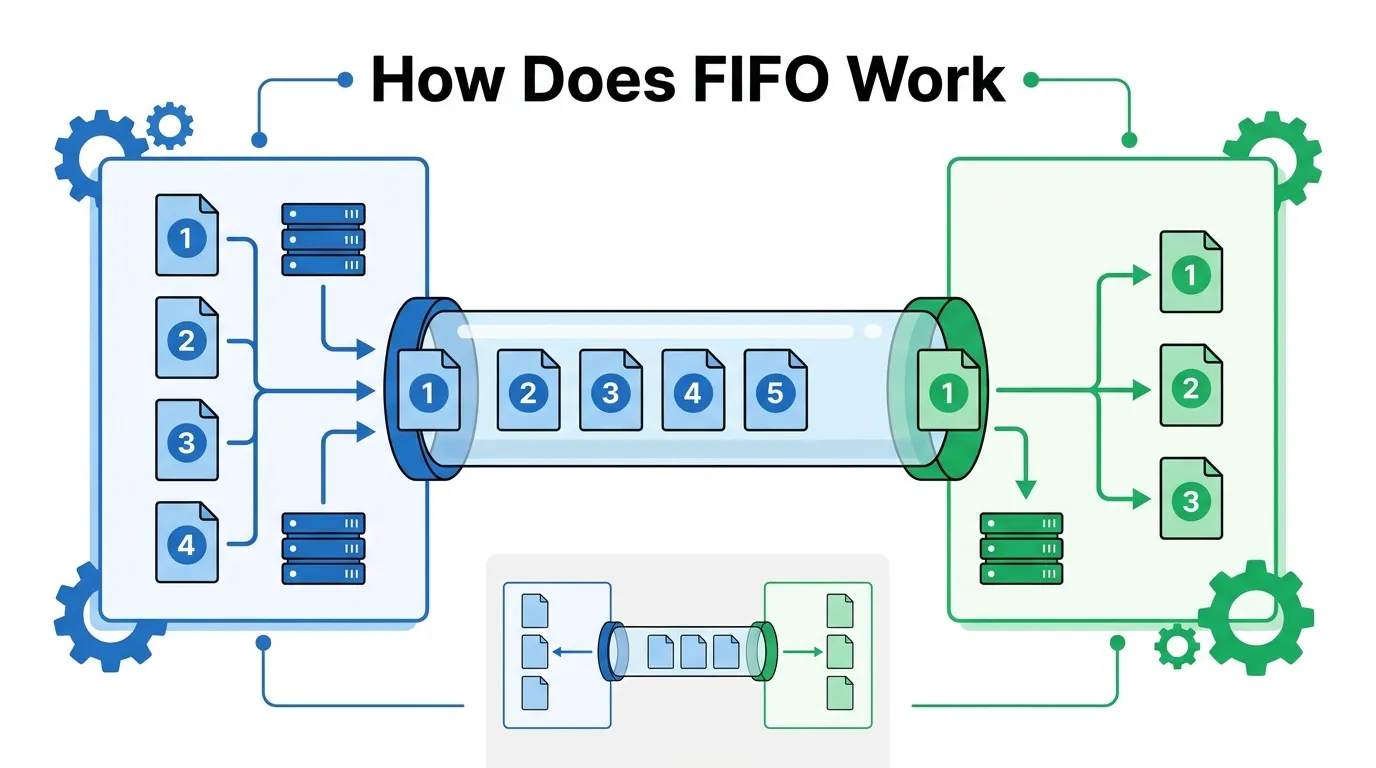
FIFO works by placing items in order based on when they arrive.
The oldest item is used, sold, or processed first. New items are placed behind the older ones.
Here is a simple example.
Imagine a small shop buys three boxes of cookies at different times:
| Box | Arrival time | Cost per box |
| Box A | Monday | $10 |
| Box B | Tuesday | $12 |
| Box C | Wednesday | $15 |
If the shop sells one box on Thursday, FIFO assumes Box A is sold first. If it sells a second box, Box B is sold next.
The shop uses the order of arrival to decide which costs to assign to the goods sold.
A Simple FIFO Example
Suppose a business has 30 notebooks in stock:
- 10 notebooks bought first for $2 each.
- 10 notebooks bought next for $3 each.
- 10 notebooks bought last for $4 each.
The business sells 12 notebooks.
Under FIFO, the first 10 notebooks are assigned a cost of $2 each. The next two are assigned a cost of $3 each.
The cost of the 12 notebooks sold is:
- 10 × $2 = $20
- 2 × $3 = $6
- Total cost = $26
The remaining stock contains eight notebooks from the second group and all 10 notebooks from the third group. Its total value is $76.
This example shows how FIFO tracks the cost of items as they move out of inventory.
Where Is FIFO Used?
FIFO is common in several areas:
- Inventory management: Businesses sell or use older stock first.
- Accounting: Companies assign inventory costs to goods sold in arrival order.
- Food storage: Staff rotate stock to help reduce waste and spoilage.
- Computer science: Systems process queued tasks in the order they arrive.
- Customer service: Many waiting lines serve customers in arrival order.
Although the details differ, each example follows the same basic rule.
What Does FIFO Mean in Accounting?
In accounting, FIFO is an inventory costing method. It assumes that the oldest inventory costs are assigned to the goods sold first.
This does not always mean a company physically ships the oldest item first.
FIFO is an accounting assumption about costs. The physical flow of goods and the accounting method may be different.
FIFO helps businesses work out two important figures:
- The cost of goods sold (COGS).
- The value of the inventory still on hand.
FIFO Accounting Example
Suppose a business buys the following products:
| Purchase | Quantity | Cost per item | Total cost |
| First purchase | 20 | $5 | $100 |
| Second purchase | 20 | $6 | $120 |
| Third purchase | 20 | $7 | $140 |
The business sells 30 items.
Using FIFO, the cost of goods sold is:
- First 20 items: 20 × $5 = $100
- Next 10 items: 10 × $6 = $60
- Total COGS = $160
The business has 30 items left:
- 10 items at $6 = $60
- 20 items at $7 = $140
- Ending inventory = $200
The total inventory cost was $360. After assigning $160 to the goods sold, $200 remains in inventory.
How Does FIFO Affect Profit?
FIFO can affect reported profit when the cost of products changes over time.
When purchase costs rise, FIFO usually assigns older, lower costs to the goods sold.
This can lead to a lower cost of goods sold and a higher reported gross profit than some other inventory costing methods.
When purchase costs fall, the result may be the opposite.
However, the actual effect depends on purchase costs, sales, and the accounting rules that apply. FIFO does not automatically make a business more profitable.
It changes how inventory costs are assigned in the accounts.
Is FIFO Allowed Under Accounting Rules?
FIFO is an accepted inventory costing method under both U.S. generally accepted accounting principles (GAAP) and International Financial Reporting Standards (IFRS).
In the United States, businesses may also be able to use other methods, such as LIFO, subject to the applicable rules. IFRS does not permit LIFO for inventory costing.
Businesses should choose and apply a suitable method consistently and follow the accounting standards that apply to them.
What Does FIFO Mean in Inventory Management?

In inventory management, FIFO means that older stock should be used or sold before newer stock.
This is especially helpful for goods that may lose quality over time. Examples include food, drinks, cosmetics, and some medicines.
A business can use FIFO by placing older stock at the front of a shelf and newer stock behind it. Workers then pick the older stock first.
FIFO in Grocery Stores
Think about a grocery store that receives fresh milk every morning.
The store places the new milk behind the milk already on the shelf. Customers and workers can then access the older cartons first.
This helps reduce waste and lowers the chance that older products will remain unsold for too long.
However, FIFO alone does not guarantee food safety. Staff must still check expiration dates, storage conditions, and product quality. Products that are unsafe should never be sold just because they arrived first.
FIFO in Warehouses
Warehouses often receive many shipments of the same product. Without an organized system, workers may accidentally leave older stock at the back while newer items are shipped first.
A FIFO system helps staff track arrival dates and pick the correct items.
Businesses may use labels, shelf locations, barcodes, or inventory software to manage this process.
Benefits of FIFO for Inventory
FIFO can help a business:
- Reduce waste from old or expired stock.
- Keep stock organized.
- Track inventory costs.
- Make picking and packing easier.
- Improve stock rotation.
- Lower the chance of forgotten inventory.
It works best when products are easy to identify and their arrival dates are recorded correctly.
What Does FIFO Mean in Computer Science?
In computer science, FIFO describes a queue in which the first item added is the first item removed.
A queue works much like a line of people waiting for service. The first person to join the line is usually the first person served.
Computers use queues to manage tasks, messages, requests, and other data.
FIFO Queue Example
Imagine a printer receives three print jobs:
- A report arrives first.
- A photo arrives second.
- A letter arrives third.
If the printer processes jobs using a FIFO queue, it prints the report first, then the photo, and finally the letter.
This helps keep the jobs in the order they were received.
FIFO Data Structure
A FIFO queue is a common data structure in programming. It typically supports two main actions:
- Enqueue: Add an item to the back of the queue.
- Dequeue: Remove an item from the front of the queue.
For example, if a queue contains A, B, and C, the first item removed will be A. The next will be B, followed by C.
FIFO queues are useful in task scheduling, network communication, and systems that handle incoming requests.
Not every computer system uses FIFO for every task. Some use priority queues or other methods when certain tasks need to be handled first.
What Does FIFO Mean in Everyday Life?
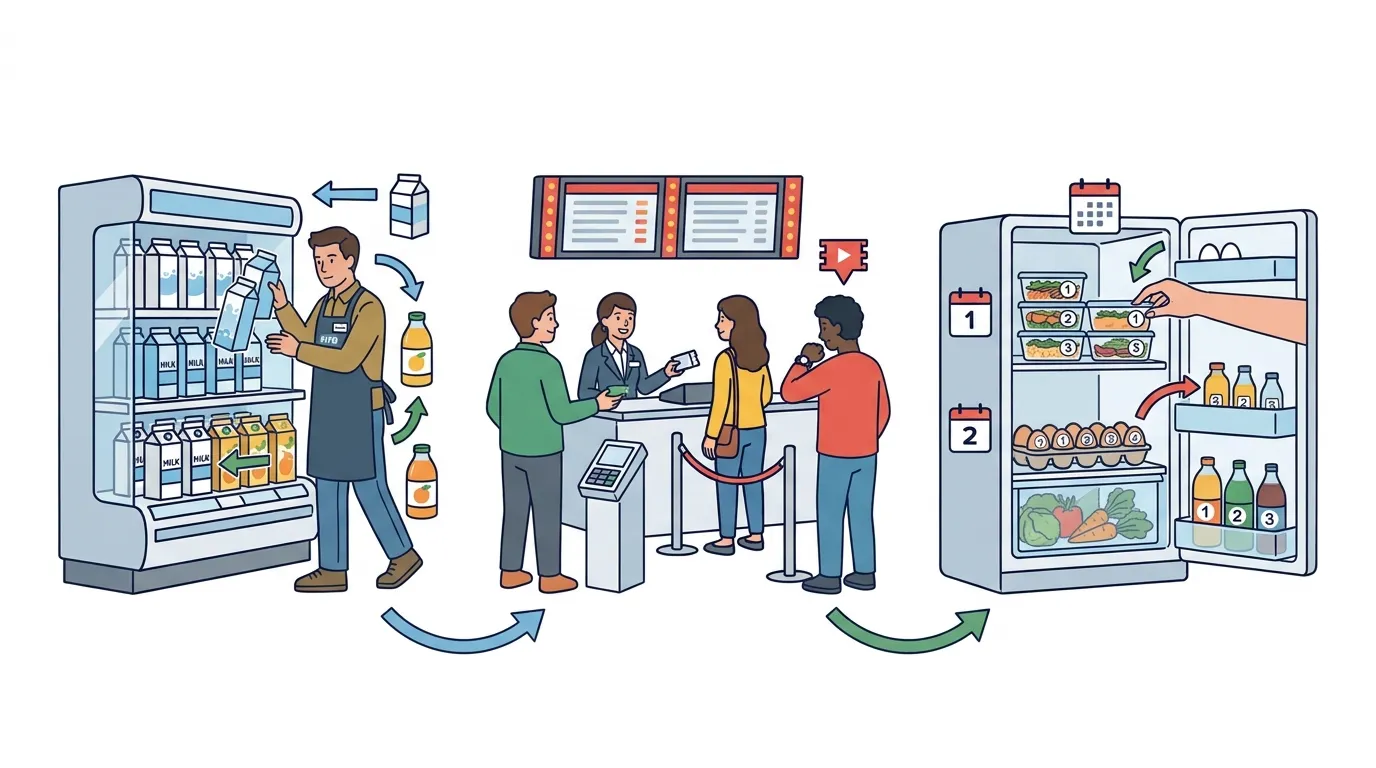
FIFO is not limited to business or technology. The same idea appears in many daily activities.
Waiting in Line
When you wait in line at a bank, store, or ticket counter, people are often served in the order they arrive.
The person who joins first is served first. This is a real-life example of FIFO.
Organizing Food at Home
Suppose you buy yogurt on Monday and buy more on Thursday. You can place the Monday yogurt at the front of the fridge and the newer yogurt behind it.
When you want yogurt, you use the older one first, as long as it is still safe to eat.
Using School or Office Supplies
If you have several boxes of pens or paper, you can use the oldest box before opening a new one. This keeps supplies organized and prevents older items from being forgotten.
These examples show why FIFO is easy to understand: it follows the natural order in which things arrive.
What Are the Advantages of FIFO?
FIFO offers several benefits, especially for businesses that handle stock or large amounts of data.
1. It Is Easy to Understand
FIFO follows a simple rule. Workers do not need to guess which item should be used first if arrival dates are clear.
2. It Helps Reduce Waste
Using older stock first can help businesses sell or use products before they expire or lose quality.
3. It Keeps Inventory Organized
FIFO encourages businesses to track when products arrive and where they are stored. This can make stock checks and order picking easier.
4. It Makes Cost Tracking Clearer
In accounting, FIFO assigns older inventory costs to goods sold first. This creates a clear way to calculate the cost of goods sold and ending inventory.
5. It Supports Fair Queues
In many situations, FIFO lets people or tasks be handled in the order they arrive. This can make a process easier to follow.
What Are the Disadvantages of FIFO?
FIFO is useful, but it is not perfect for every situation.
1. It Can Be Hard to Manage in Large Warehouses
A warehouse with many products and storage areas may need labels, software, and staff training to follow FIFO correctly.
2. It May Not Fit Every Product
Some goods need special handling based on expiration dates, temperature, or other risks. FIFO may need to be combined with other stock controls.
For example, a product with an earlier expiration date may need to be used first even if it arrived later. In that case, first-expired, first-out (FEFO) may be more suitable.
3. It Can Affect Reported Profit
When purchase costs rise, FIFO often results in lower reported costs for goods sold than LIFO would, assuming comparable inventory layers. This may lead to higher reported profit and, depending on the circumstances, higher taxable income.
The effect depends on the business and the rules it follows.
4. It Does Not Always Prioritize Urgent Tasks
In computing, a FIFO queue processes items in arrival order. A new task that is more urgent may have to wait behind older tasks.
A priority-based system may be a better choice when urgency matters more than arrival time.
What Is the Difference Between FIFO and LIFO?
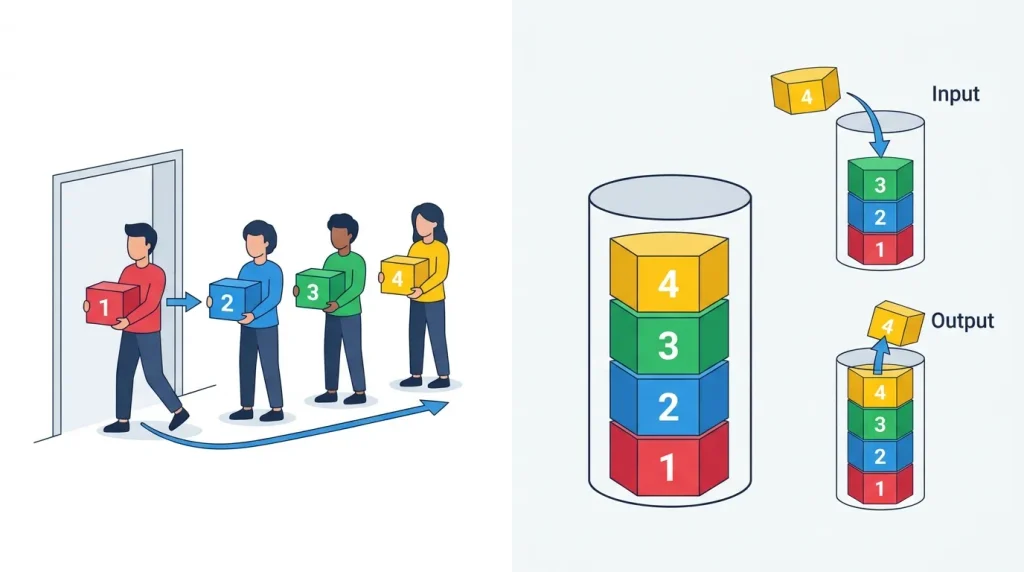
FIFO and LIFO are two inventory costing methods that use different assumptions about which costs are assigned to goods sold first.
FIFO means First In, First Out. LIFO means Last In, First Out.
Under FIFO, the oldest inventory costs are assigned to goods sold first. Under LIFO, the newest inventory costs are assigned to goods sold first.
| Feature | FIFO | LIFO |
| Full form | First In, First Out | Last In, First Out |
| Cost assigned to goods sold first | Oldest costs | Newest costs |
| Ending inventory | Often reflects newer costs | Often reflects older costs |
| Common use | Inventory costing and stock rotation | Inventory costing where permitted |
| Allowed under IFRS | Yes | No |
Example of FIFO vs. LIFO
A business buys two items:
- First item: $10
- Second item: $15
The business then sells one item.
Under FIFO, the cost assigned to the item sold is $10. Under LIFO, the cost assigned to the item sold is $15.
If the selling price is $25, the gross profit on that sale would be $15 under FIFO or $10 under LIFO, before other expenses.
This is a simplified illustration. The choice of inventory method must follow the accounting rules that apply to the business.
What Is the Difference Between FIFO and FEFO?
FIFO and FEFO both help manage stock, but they use different rules.
- FIFO: First In, First Out. The oldest stock by arrival date is used first.
- FEFO: First Expired, First Out. The stock with the nearest expiration date is used first.
Imagine a warehouse receives one box of food on Monday with an expiration date of December 20. On Tuesday, it receives another box that expires on December 15.
FIFO would normally select the Monday box first. FEFO would select the Tuesday box first because it expires sooner.
FEFO can be especially useful for products where expiration dates matter more than arrival dates. Businesses should also follow all required safety and storage rules.
When Should You Use FIFO?
FIFO is a good choice when the order of arrival matters or when using older stock first can help reduce waste.
It may be suitable for:
- Grocery stores and food services.
- Warehouses and retail shops.
- Businesses that sell products with changing costs.
- Computer programs that process tasks in order.
- Offices that need an organized supply system.
Before choosing FIFO, consider the type of items you handle, how quickly they move, and whether expiration dates or task priority should affect the order.
For inventory accounting, check the rules that apply to your business. For food or medicine, follow the relevant safety requirements rather than relying on FIFO alone.
FAQS
What does FIFO stand for?
FIFO stands for First In, First Out. It means the first item to enter a system is the first item to leave.
What is a simple example of FIFO?
A grocery store places older milk at the front of the shelf and newer milk behind it. The older milk is sold first, as long as it is safe and suitable for sale.
What does FIFO mean in accounting?
In accounting, FIFO is an inventory costing method that assigns the oldest inventory costs to goods sold first. The remaining inventory is valued using the costs of the items left.
What does FIFO mean in a warehouse?
In a warehouse, FIFO means older stock is picked or shipped before newer stock. This helps keep inventory moving in the order it arrived.
What does FIFO mean in computer science?
In computer science, FIFO describes a queue where the first item added is the first item removed. It is commonly used to manage tasks, requests, and messages.
Is FIFO better than LIFO?
Neither method is always better. FIFO can be useful for stock rotation and is permitted under U.S. GAAP and IFRS. LIFO is permitted under U.S. GAAP but not IFRS. The right choice depends on the business, its reporting needs, and applicable rules.
Does FIFO increase profit?
FIFO may increase reported gross profit when purchase costs are rising because older, lower costs are assigned to goods sold first. It does not guarantee higher sales or better overall business performance.
What is the opposite of FIFO?
LIFO, or Last In, First Out, is the opposite of FIFO in inventory costing. It assumes the newest inventory costs are assigned to goods sold first.
What is a FIFO queue?
A FIFO queue is a data structure that removes items in the same order they were added. The first item added is the first one removed.
What is the difference between FIFO and FEFO?
FIFO uses arrival order, while FEFO uses expiration dates. FEFO prioritizes the product that will expire soonest, even if it arrived later.
Why is FIFO important?
FIFO helps keep stock and tasks organized. It can reduce waste, support inventory tracking, and make sure items or requests are handled in arrival order.
Article Summary
FIFO stands for First In, First Out. It is a method that uses or removes the oldest item first.
Key points to remember:
- FIFO is used in accounting, inventory management, and computer science.
- In accounting, it assigns the oldest inventory costs to goods sold first.
- In warehouses and stores, it can help with stock rotation and waste reduction.
- In computing, a FIFO queue processes items in the order they arrive.
- FIFO differs from LIFO, which uses the newest inventory costs first.
- FIFO differs from FEFO, which prioritizes items with the nearest expiration dates.
- FIFO is useful, but the best method depends on the product, process, and applicable rules.
Conclusion
FIFO means First In, First Out. It is a simple method that helps people and businesses handle items in the order they arrive.
From selling older products in a grocery store to processing tasks in a computer system, FIFO makes many processes easier to organize.
In accounting, FIFO helps determine the cost of goods sold and the value of remaining inventory. In warehouses and food storage, it can help reduce waste when used with proper safety checks.
Although FIFO has some limits, it remains a useful method in many settings.
Once you understand the rule, it is easy to spot FIFO in everyday life: the first thing in is the first thing out.
Add a quick-answer definition boxClarify the repeated accounting examples

Emma Wilson is a writer at MeaningVibz who enjoys exploring emoji meanings, texting expressions, and online communication trends. She helps readers understand how emojis and slang are used in different situations by providing clear explanations and relatable examples for everyday messaging.