

Vato means “guy,” “dude,” “man,” or “fellow” in Mexican Spanish and Mexican American slang.
It is an informal word people may use when talking about a man or addressing a male friend. In some settings, it can also refer to a person more generally.
Here are a few simple examples:
- “That vato is funny.” — That guy is funny.
- “Hey, vato!” — Hey, dude!
- “Who is that vato?” — Who is that guy?
- “What’s up, vato?” — What’s up, man?
The word is most closely associated with Mexican and Mexican American speech. It may also appear in movies, music, and other forms of popular culture.
Its tone depends on how it is said and who is saying it. Friends may use it in a relaxed way, while strangers may hear it as overly familiar or rough.
What Does Vato Mean in English?
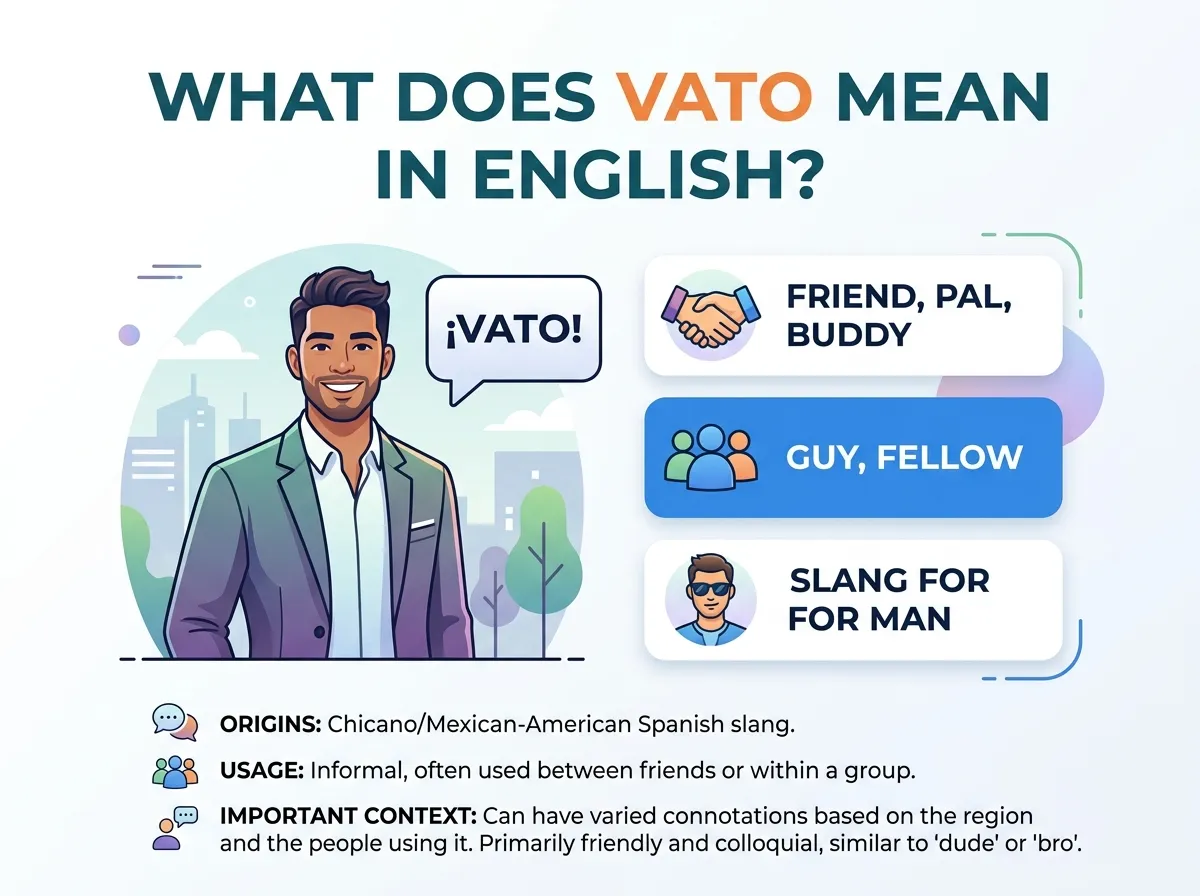
In English, the closest translations of vato are “dude,” “guy,” “man,” and “bro,” depending on the context.
There is no single English word that fits every use. The speaker’s tone and relationship with the listener can change the meaning.
For example:
| Spanish slang | Possible English meaning |
| Ese vato | That guy |
| Qué onda, vato | What’s up, dude? |
| Mi vato | My guy or my man, depending on context |
| Ese vato es mi amigo | That guy is my friend |
In some contexts, vato can sound more street-oriented than the everyday English word “guy.” Still, it does not automatically mean someone is dangerous, involved in a gang, or behaving badly.
The best translation depends on the full sentence and the people speaking.
Where Does the Word Vato Come From?
The word vato is strongly linked to Mexican Spanish and Mexican American slang.
It has been used in informal speech for many years and became more familiar to wider audiences through music, films, and popular culture.
Its exact origin is not fully settled. Some accounts connect it to older Mexican slang, including the word chivato, but the history is not clear enough to treat that connection as certain.
Over time, vato became a familiar way to refer to a guy or man in some Mexican and Mexican American communities.
Vato and Mexican American Culture
Vato is often heard in casual conversations, especially in settings where Mexican American slang is common.
It may be used between friends, in neighborhood talk, or in music and films.
For example, a character might say, “Hey, vato, come over here!” This could simply mean, “Hey, dude, come over here!”
However, not every Spanish speaker uses this word. Spanish slang varies by country, region, age, and social group. A word that sounds normal in one community may sound unusual in another.
Is Vato a Mexican Word or an English Word?
Vato is a Spanish slang word, most closely associated with Mexican Spanish and Mexican American speech. It is not a standard English word.
Still, some English speakers use it because they have heard it in songs, movies, or conversations. When used in English, it usually keeps its informal meaning of “guy” or “dude.”
Is Vato a Good or Bad Word?
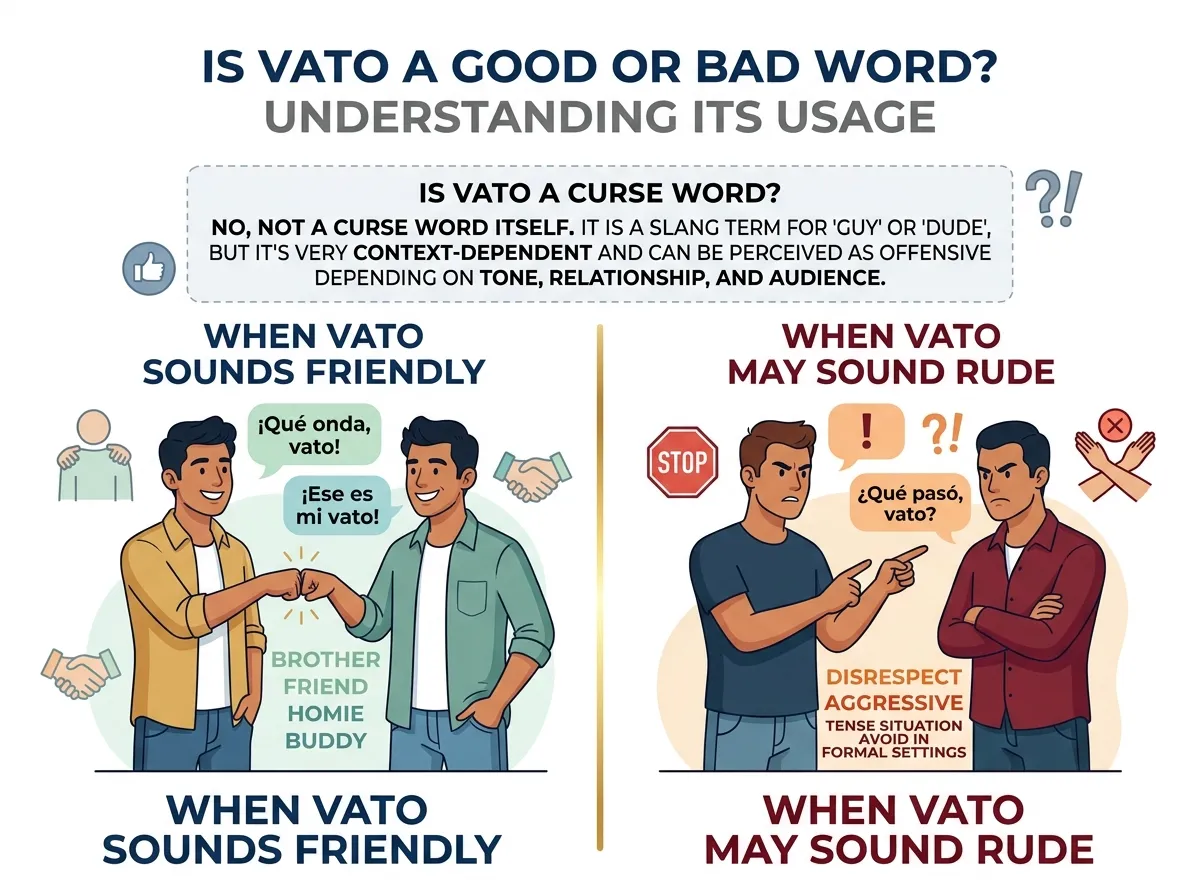
Vato is not automatically a bad word. In many situations, it is simply an informal way to say “guy” or “dude.”
The meaning can depend on the speaker, tone, and setting.
When Vato Sounds Friendly
Friends may use vato to greet each other or talk about another person.
For example:
- “What’s up, vato?” — What’s up, dude?
- “That vato is cool.” — That guy is cool.
- “Come on, vato!” — Come on, man!
In these examples, the word can sound friendly and relaxed.
When Vato May Sound Rude
The word may sound disrespectful if it is used with an angry tone, during an argument, or toward someone who does not know the speaker.
For example, shouting “Hey, vato!” at a stranger may come across as too familiar or confrontational, depending on the situation.
The word itself is not necessarily an insult. The way it is used matters.
Is Vato a Curse Word?
No, vato is not generally considered a curse word. It is slang.
However, slang can carry different meanings in different settings. If you are unsure whether the word is suitable, it is best to use a more neutral term, such as hombre or persona, depending on what you want to say.
What Does Vato Mean in Spanish Slang?
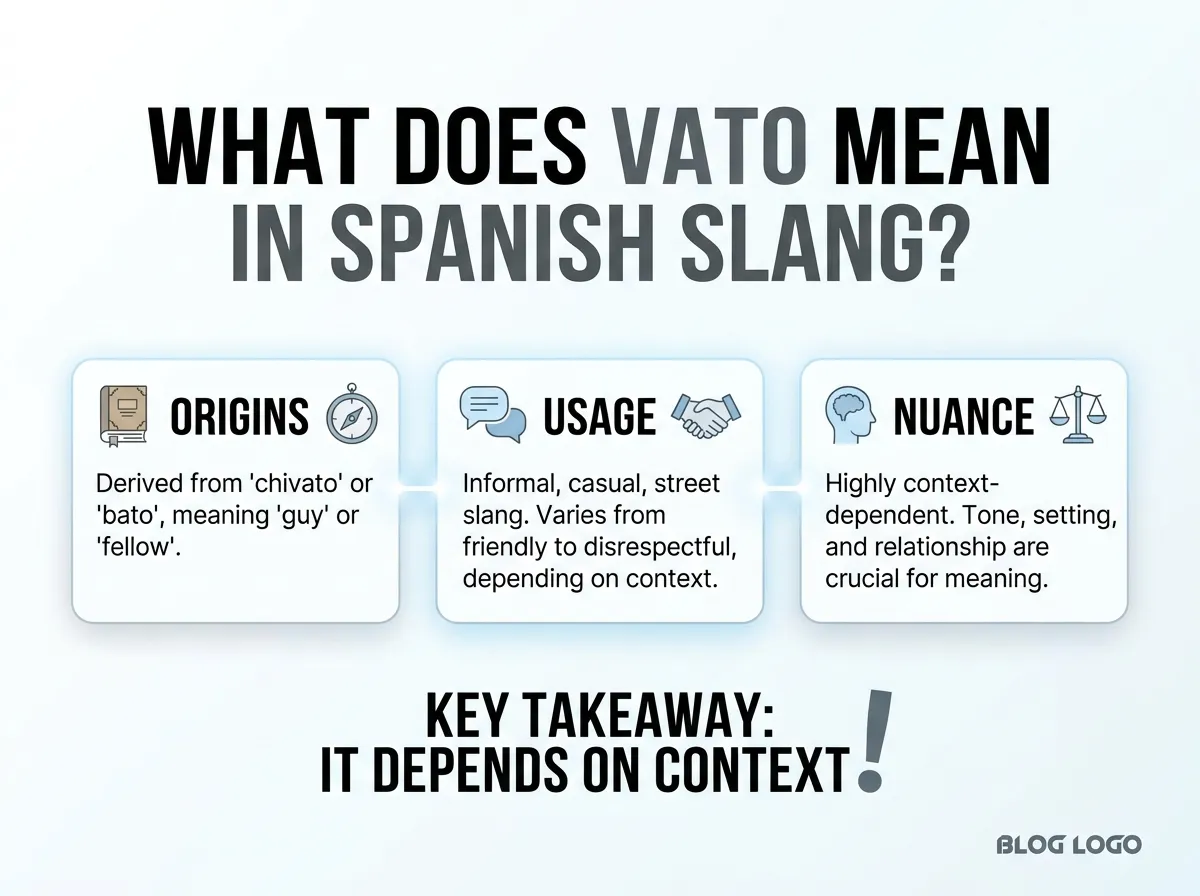
In Spanish slang, vato most often means “guy,” “dude,” or “man.” It is especially associated with informal Mexican and Mexican American speech.
Here are some common ways it may appear in conversation.
1. Vato as “Dude”
When speaking directly to a friend, vato can work much like “dude” in American English.
Example:
“¿Qué onda, vato?”
English meaning: “What’s up, dude?”
This is an informal greeting. The phrase qué onda also means something like “what’s up?” in casual Mexican Spanish.
2. Vato as “Guy”
When talking about another man, vato may mean “guy.”
Example:
“Ese vato vive aquí.”
English meaning: “That guy lives here.”
In this sentence, the word describes a person rather than greeting someone.
3. Vato as “Man”
In some conversations, vato can be translated as “man.”
Example:
“Tranquilo, vato.”
English meaning: “Relax, man.”
The exact tone depends on the speaker and the situation. It may sound reassuring, casual, or impatient.
4. Vato as “My Guy”
Some speakers use the word when talking about a man they know or are close to.
Example:
“Ese es mi vato.”
Depending on the speaker and context, this might mean “That’s my guy” or “That’s my man.” In some contexts, mi vato can refer to a male romantic partner.
Because the meaning can vary, it is important to look at the full sentence rather than translate each word on its own.
What Is the Difference Between Vato and Bato?
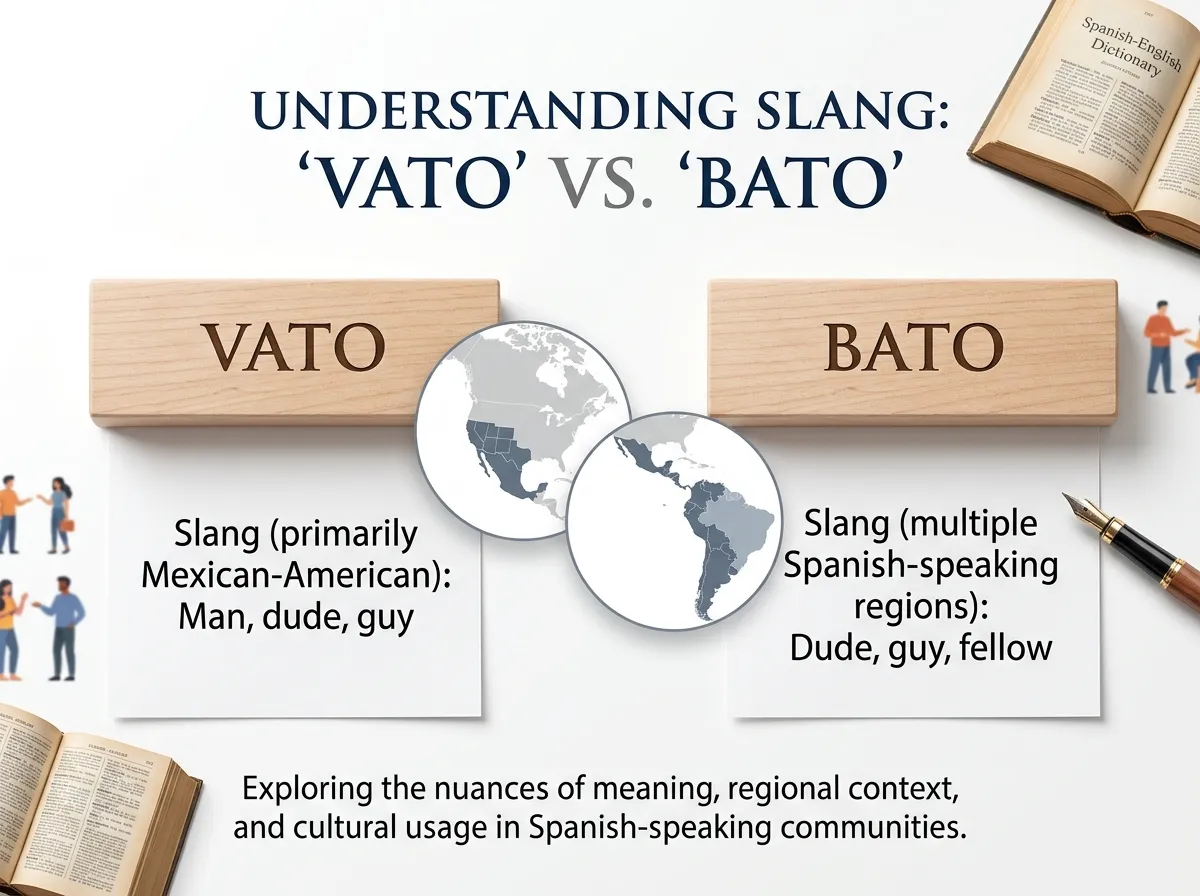
You may also see the spelling bato. Both vato and bato are associated with informal Mexican slang, and both may be used to mean “guy” or “dude.”
However, usage and spelling can vary by region, speaker, and context.
Vato is a widely recognized spelling in Mexican American slang and popular culture. Bato also appears in some slang usage.
If you are learning Spanish, remember that these are informal terms. In formal writing or everyday situations with people you do not know well, words such as hombre (man) or chico (guy or boy) may be more appropriate.
What Is the Difference Between Vato, Wey, and Amigo?
Spanish has many informal words for friends, men, and people in general. Vato, güey, and amigo can sometimes be translated in similar ways, but they are not always interchangeable.
| Word | Common meaning | Typical use |
| Vato | Guy, dude, man | Informal Mexican and Mexican American slang |
| Güey (also spelled wey) | Dude, guy, fool | Very common informal Mexican Spanish; tone matters |
| Amigo | Friend | More widely understood Spanish word |
| Chico | Boy, young man, guy | Common Spanish word, with regional differences |
| Hombre | Man | General word for an adult male |
Vato vs. Güey
Both words can be used to address a friend. Güey is especially common in informal Mexican Spanish and can mean “dude,” “guy,” or, in some contexts, “fool.”
Vato may sound more closely tied to certain Mexican American slang styles, although usage varies.
Neither word is suitable for every setting.
Vato vs. Amigo
Amigo means “friend” in Spanish. It is widely understood across Spanish-speaking countries.
Vato usually means “guy” or “dude,” though it can refer to a friend in context.
For example:
- “Él es mi amigo.” — He is my friend.
- “Ese vato es mi amigo.” — That guy is my friend.
The second sentence uses more informal language.
Vato vs. Hombre
Hombre is the standard Spanish word for “man.” Vato is more casual and slang-based.
If you are speaking in a formal setting, hombre is usually the safer choice when you mean “man.”
How Do You Use Vato in a Sentence?
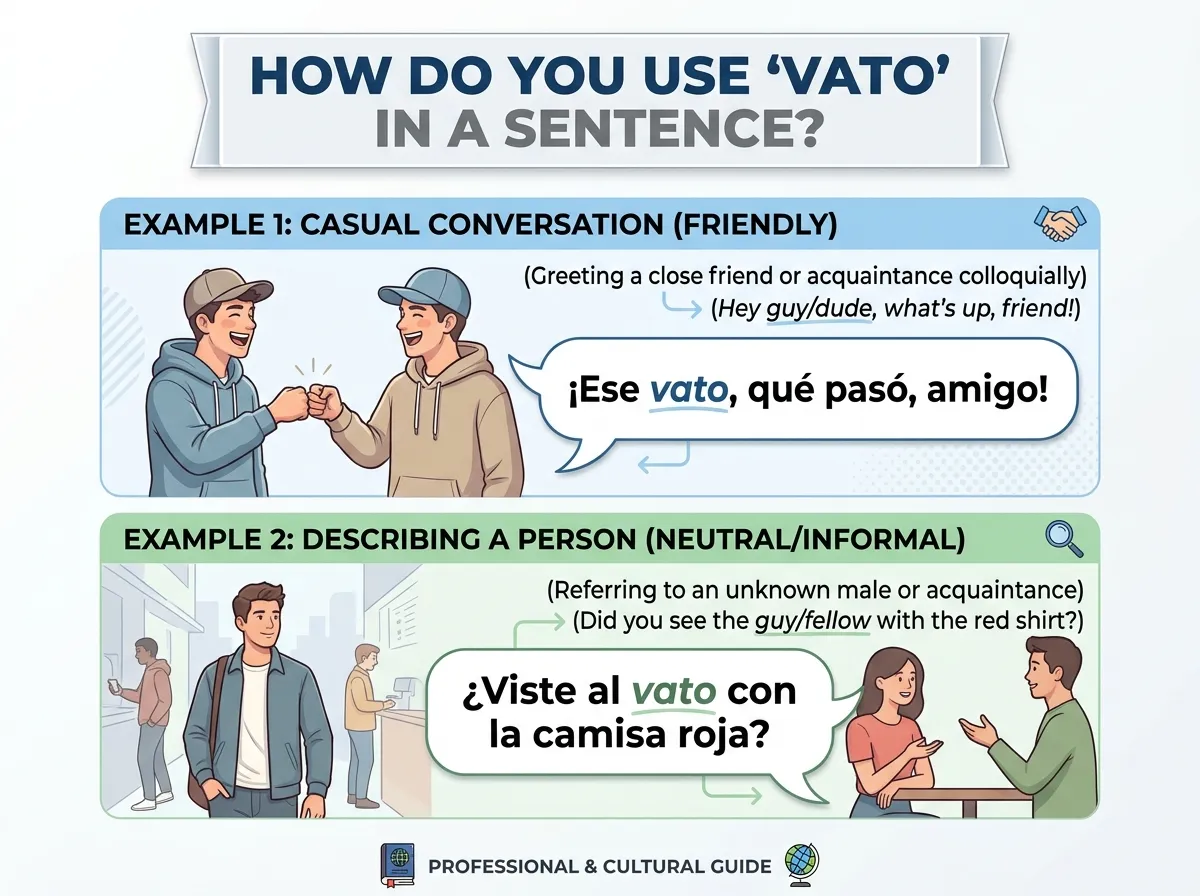
You can use vato in different ways, depending on whether you are greeting someone, describing a person, or talking about a friend.
Here are some examples with simple English translations.
Example 1: Greeting a Friend
Spanish: “¿Qué onda, vato?”
English: “What’s up, dude?”
This is a casual greeting that may be used among people who know each other.
Example 2: Talking About Someone
Spanish: “Ese vato es muy amable.”
English: “That guy is very kind.”
Here, vato refers to a man being discussed.
Example 3: Asking About a Person
Spanish: “¿Quién es ese vato?”
English: “Who is that guy?”
This sentence can sound neutral or informal, depending on the tone.
Example 4: Calling Someone Over
Spanish: “Ven acá, vato.”
English: “Come here, dude.”
This is an informal way to address someone. It may sound friendly or demanding, depending on how it is said.
Example 5: Talking About a Friend
Spanish: “Ese vato es mi amigo.”
English: “That guy is my friend.”
This example shows how the word can describe someone without being insulting.
Example 6: Expressing Surprise
Spanish: “¡No manches, vato!”
English: “No way, dude!” or “You can’t be serious, man!”
The phrase no manches is informal Mexican Spanish. The exact translation depends on the situation.
These examples show that vato often works like “dude” or “guy” in English. However, it is best to learn it in context rather than assume it means exactly the same thing in every conversation.
What Does Vato Mean in Songs and Movies?
Vato appears in some songs, movies, and TV shows that feature Mexican American characters or settings.
Writers may use the word to make dialogue sound informal or to reflect the way certain characters speak. It can also appear in music connected to regional identity and street culture.
For example, if a character says, “That vato is trouble,” the meaning is usually “That guy is trouble.”
However, the word does not automatically suggest crime, gang membership, or violence. Such meanings come from the wider story, not from the word alone.
Popular culture can also spread slang to people who do not use it in their own daily lives. This is one reason someone may recognize vato without speaking Spanish.
Is Vato Still Used Today?
Yes, vato is still used in some Mexican and Mexican American communities.
However, slang changes over time. The word may be more common among certain speakers, age groups, or social circles than others.
Some people use it often, while others prefer different terms. It is also familiar to many people through older songs, films, and other media.
If you hear vato today, the safest starting point is to understand it as an informal word for “guy,” “dude,” or “man.” Then consider the speaker’s tone and the context to understand its exact meaning.
FAQS
1. What does vato mean in English?
Vato usually means “guy,” “dude,” or “man.” It is an informal slang term associated with Mexican Spanish and Mexican American speech.
2. Is vato Spanish slang?
Yes. Vato is a slang word linked to Mexican Spanish and Mexican American communities. It is commonly used in informal conversations.
3. Is vato a bad word?
No, vato is not generally a curse word. It can be friendly or casual, although the tone and situation may make it sound rude or confrontational.
4. What does vato mean in Mexican slang?
In Mexican slang, vato often means “guy,” “dude,” or “man.” It may be used to address a male friend or refer to another man.
5. What does “qué onda, vato” mean?
“Qué onda, vato” usually means “What’s up, dude?” It is a casual greeting associated with informal Mexican Spanish.
6. What is the difference between vato and bato?
Both spellings appear in informal slang and can refer to a guy or dude. Vato is a widely recognized spelling, especially in Mexican American slang, but usage varies by region.
7. Does vato mean boyfriend?
Not always. Vato usually means “guy” or “dude.” In some contexts, mi vato may refer to a male romantic partner, but the relationship meaning depends on the speaker and situation.
8. Can women use the word vato?
Yes, women can use the word when speaking about or addressing a man. However, whether it sounds natural depends on the person’s background, social group, and speaking style.
9. What is the female version of vato?
There is no single female equivalent used everywhere. Some speakers use vata in certain slang contexts, but it is less widely established. Chica or mujer may be more suitable when you simply mean “girl” or “woman.”
10. Is vato used in the United States?
Yes. Vato is used in some Mexican American communities in the United States. It is also familiar to many people through music, movies, and popular culture.
11. What does vato mean in a text message?
In a text message, vato usually means “dude,” “guy,” or “man.” For example, “What’s up, vato?” means “What’s up, dude?”
12. What are some other words like vato?
Similar informal words include güey or wey, compa, and carnal in some Mexican Spanish contexts. Their meanings and levels of familiarity differ, so they should not always be used as direct substitutes.
Article Summary
Vato is an informal slang word that usually means “guy,” “dude,” or “man.” It is closely linked to Mexican Spanish and Mexican American speech and is often heard in casual conversations, songs, and movies.
The word is not automatically rude or offensive, but its tone depends on the situation. It can be used as a friendly greeting or to talk about another man. Vato differs from words such as amigo, which means “friend,” and hombre, which means “man.”
Although its exact historical origin is uncertain, its modern meaning is widely understood in the communities where it is used. Learning the context can help you understand when the word sounds natural and when a more neutral term would be better.
Conclusion
The meaning of vato is simple: it usually means “guy,” “dude,” or “man.” It is a common slang term associated with Mexican Spanish and Mexican American culture.
You may hear it in greetings such as “Qué onda, vato?” or in sentences about another person. While it is not generally a curse word, it is informal and may sound too familiar in some situations.
The key is to understand the context, tone, and relationship between the speakers. If you are unsure whether to use vato, choose a more neutral Spanish word until you feel comfortable with how the slang works.