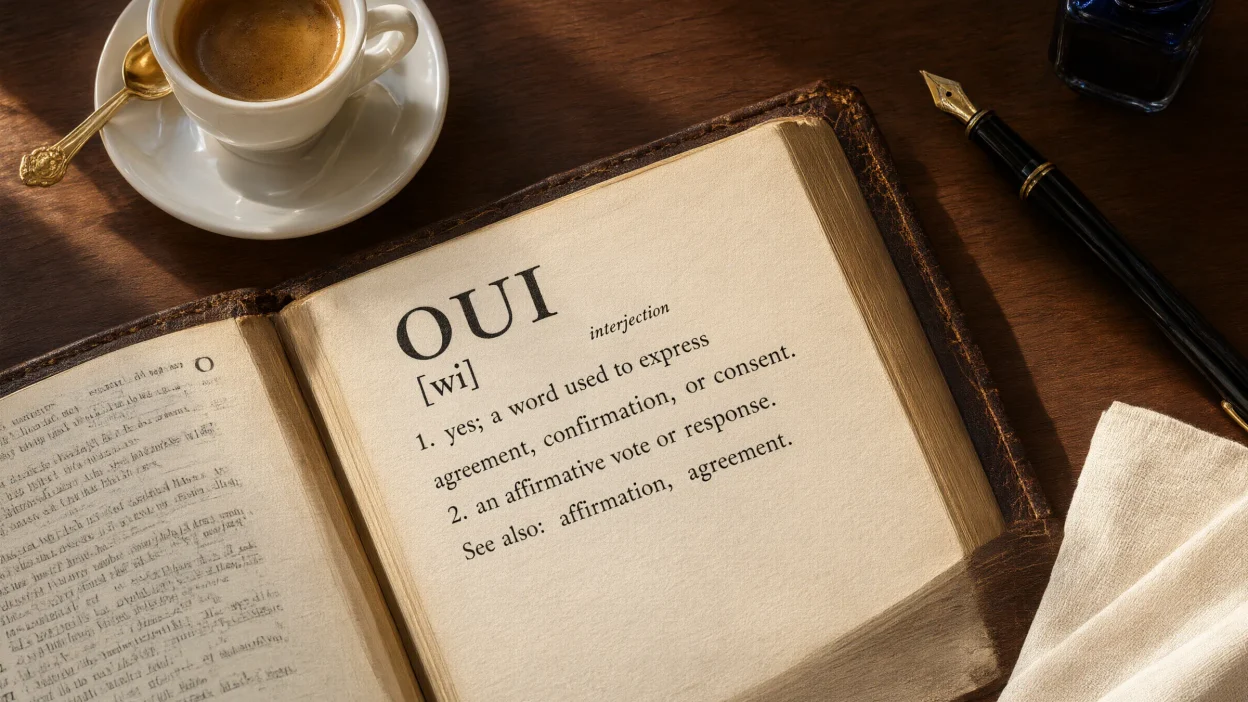
OUI is the French word for “yes” in English. It is one of the most common words in the French language.
People use “oui” to answer questions, agree with someone, or accept an offer. It works in both formal and casual situations.
For example:
- French: Tu aimes le chocolat?
- English: Do you like chocolate?
- Answer: Oui!
- Meaning: Yes!
In English conversations, people may use “oui” instead of “yes” to add a French touch to what they say. It may sound playful, stylish, or humorous, depending on the context.
What Does OUI Stand For?
In everyday French, OUI is not an acronym. It is a regular French word that means “yes.”
However, OUI can stand for something else in a technical field, organization, or special context. For example, in computer networking,
OUI can mean Organizationally Unique Identifier.
The correct meaning depends on where you see the word.
OUI Meaning in Text Messages
In text messages, “oui” usually means “yes.” Someone may use it when agreeing with a plan, answering a question, or responding to a request.
For example:
Person A: Are we still meeting tonight?
Person B: Oui!
Here, “oui” simply means “yes.”
People who speak English may also use it as a fun alternative to “yeah” or “yep.” It can make a reply feel playful or give it a French style.
Examples of OUI in Texting
Here are some common examples:
- “Oui, of course!” — Yes, of course!
- “OUI!!” — An excited way to say yes.
- “Oui oui 😂” — Yes, yes, sometimes used playfully.
- “Oui, see you tomorrow.” — Yes, see you tomorrow.
- “Oui ma’am.” — A French word mixed with an English form of address.
The tone depends on the person and the conversation. “Oui!” may show excitement, while a simple “oui” may be a calm answer.
Does OUI Mean Yes or Something Else in Text?
Most of the time, it means “yes,” especially when it appears in a normal conversation.
If it appears in a work document, a technical report, or a company name, it may have another meaning.
Always read the words around it before deciding what the sender means.
How to Pronounce OUI
The French word “oui” is pronounced roughly like “wee” in English.
It has one smooth sound, rather than three separate sounds.
Simple Pronunciation Guide
- Word: Oui
- Pronunciation: Wee
- English meaning: Yes
For example, if someone asks, “Ça va?” meaning “How are you?” you could answer, “Oui,” if the question calls for a yes-or-no response.
A more natural answer to “Ça va?” would be “Ça va bien,” meaning “I’m doing well.”
Learning this small word can help you understand basic French conversations, songs, films, and online posts.
How to Use OUI in French

French speakers use “oui” in many everyday situations. It can be a full answer by itself or part of a longer sentence.
1. To Answer a Question
Use “oui” when someone asks a question that needs a yes-or-no answer.
Example:
- French: Tu es prêt?
- English: Are you ready?
- Answer: Oui.
- Meaning: Yes.
2. To Accept an Offer
You can use “oui” when someone offers you food, help, or something else.
Example:
- French: Tu veux du café?
- English: Do you want coffee?
- Answer: Oui, merci.
- Meaning: Yes, thank you.
3. To Agree With Someone
“Oui” can show that you agree with what another person says.
Example:
- French: C’est une bonne idée.
- English: That’s a good idea.
- Reply: Oui!
- Meaning: Yes!
4. To Confirm Information
You can also use “oui” to confirm that something is correct.
Example:
- French: Vous êtes Marie?
- English: Are you Marie?
- Answer: Oui.
- Meaning: Yes.
In each example, “oui” has the same basic meaning. The words around it help explain the full message.
What Does OUI OUI Mean?
“Oui oui” means “yes, yes” in French. It can be used to repeat or stress agreement.
For example:
- “Oui, oui, je comprends.” — “Yes, yes, I understand.”
- “Oui oui!” — “Yes, yes!” or an enthusiastic “Yes!”
In English-speaking online spaces, people sometimes use “oui oui” as a joke or to sound French. It may appear in memes, comments, or funny messages.
The phrase does not always mean the speaker is excited. Depending on tone, repeating “yes” can show patience, emphasis, or even mild annoyance.
For example, someone might say “Oui, oui” when they already understand what another person is explaining.
OUI vs. SI: What Is the Difference?
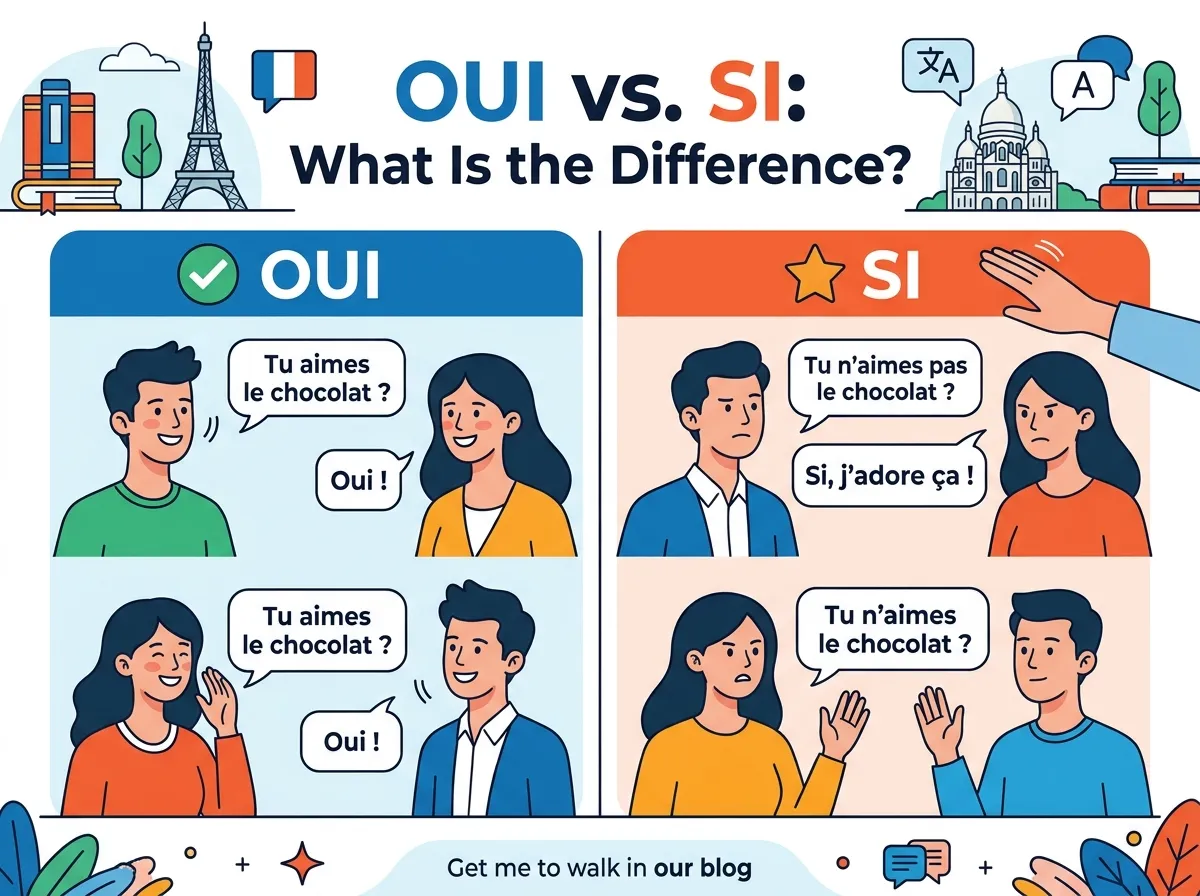
Both “oui” and “si” can mean “yes” in French, but they are not used in exactly the same way.
Oui is the normal word for saying yes to a positive question or statement.
Si is often used to contradict a negative question or statement.
Examples of OUI and SI
Using oui:
- Question: Tu aimes le thé? — Do you like tea?
- Answer: Oui. — Yes.
Using si:
- Question: Tu n’aimes pas le thé? — You don’t like tea?
- Answer: Si! — Yes, I do!
In the second example, “si” corrects the idea that the person does not like tea.
For English speakers, this difference can feel unusual at first.
The easiest way to remember it is that “oui” is the standard yes, while “si” can be used to answer back against a negative statement.
OUI vs. NON
“Oui” and “non” are opposite words in French.
- Oui means yes.
- Non means no.
Examples
Example 1:
- Question: Tu viens?
- English: Are you coming?
- Answer: Oui.
- Meaning: Yes.
Example 2:
- Question: Tu viens?
- English: Are you coming?
- Answer: Non.
- Meaning: No.
These two words are useful for beginners because they can answer many simple questions.
You may also see “non” in English text messages when someone wants to say no in a playful or French-inspired way.
Is OUI Formal or Informal?
“OUI” can be used in both formal and informal situations. It is a standard French word, not slang.
In a formal conversation, someone might use “oui” to answer a question from a teacher, customer, manager, or stranger.
In a casual conversation, they might use it with friends and family.
Formal Examples
- “Oui, monsieur.” — Yes, sir.
- “Oui, madame.” — Yes, ma’am.
- “Oui, je comprends.” — Yes, I understand.
Informal Examples
- “Oui!”
- “Oui, bien sûr!” — Yes, of course!
- “Oui, pourquoi pas?” — Yes, why not?
The word itself is not rude or overly casual. The way you say it, the words you add, and the situation can affect how polite it sounds.
Why Do People Use OUI Instead of Yes in English?
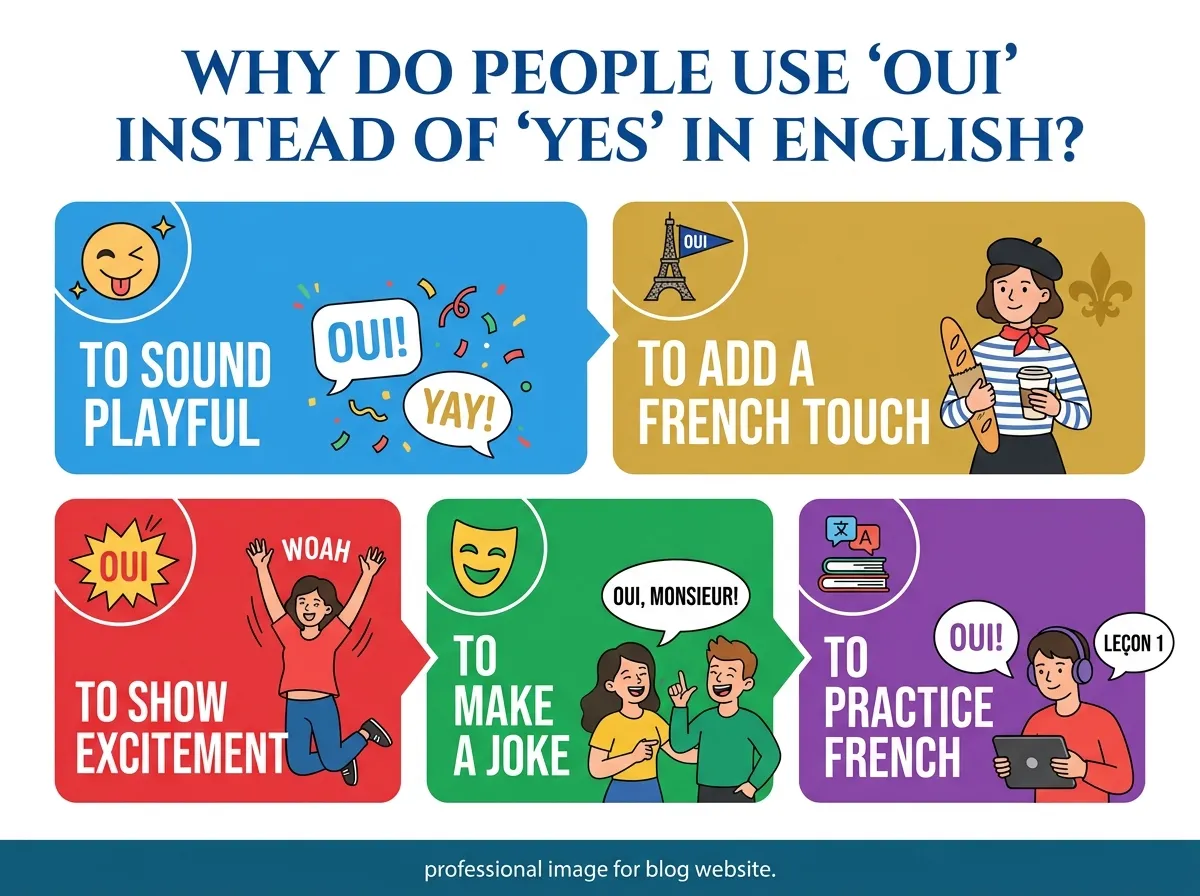
People sometimes use “oui” in English conversations even when they do not speak French fluently.
There are several possible reasons.
1. To Sound Playful
A person might say “oui” because it sounds fun or different from a normal English “yes.”
2. To Add a French Touch
French words are sometimes used in fashion, food, travel, and pop culture. Using “oui” can give a message a French feel.
3. To Show Excitement
Writing “OUI!” in capital letters may show strong agreement or excitement, just as “YES!” does in English.
4. To Make a Joke
Friends may use “oui oui” in a meme or funny conversation. The humor often comes from pretending to speak French or exaggerating a simple answer.
5. To Practice French
Someone learning French may use “oui” to practice a new word or become more comfortable with the language.
Remember that these are possible reasons, not fixed meanings.
The person’s tone and the surrounding conversation help explain why they chose the word.
OUI Meaning in Social Media and Memes
On social media, “oui” usually keeps its French meaning of “yes.” However, it may carry extra emotion or humor.
For example, someone may comment “OUI!” on a post about a new outfit, a favorite song, or a plan they strongly support.
Someone else may write “oui oui” in a meme to imitate a French speaker or make a simple response sound dramatic.
Common Social Media Examples
- “OUI, this outfit is everything!” — A strong, playful yes.
- “Oui oui, let’s go!” — Yes, yes, let’s go.
- “OUI 🇫🇷” — Yes, possibly with a French theme.
- “Oui, I agree.” — A mix of French and English.
Emojis, capital letters, and punctuation can change the tone. Still, the core meaning is usually easy to understand.
Other Meanings of OUI
Although “oui” most commonly means “yes” in French, the capitalized form “OUI” can have other meanings in certain fields.
One important example is computer networking.
OUI in Computer Networking
In networking, OUI stands for Organizationally Unique Identifier.
It is a number assigned to an organization and used as part of certain hardware addresses, such as MAC addresses.
These addresses help identify network interfaces on devices.
For example, a network administrator may look at the beginning of a MAC address to identify the organization associated with its registered identifier.
This technical meaning is different from the French word “oui.”
If you see OUI in a networking guide, device report, or technical discussion, the identifier meaning may be the right one.
OUI in Other Specialized Contexts
OUI may also be used as an abbreviation in a business, institution, or specialized document. These meanings depend on the organization or subject.
Do not assume every use of OUI is an acronym. Look at the topic and nearby words to work out which meaning fits.
Common Mistakes About OUI

People who are new to French or see the word online may misunderstand it. Here are a few common mistakes to avoid.
Thinking OUI Is Always an Acronym
In everyday French, “oui” is a normal word meaning “yes.” It does not stand for a longer phrase.
Pronouncing It Like “Oh-You-Eye”
The French word is pronounced roughly like “wee,” not by saying each letter separately.
Thinking It Is Always Slang
“OUI” is standard French. It may be used as a joke or slang-like expression in English chats, but the word itself is not slang.
Confusing OUI With SI
Both can mean yes, but “si” is often used to disagree with a negative question or statement.
Assuming the Tone Is Always Excited
“OUI!” may show excitement, but a simple “oui” can be neutral. Context matters.
Quick Examples of OUI in Everyday Conversations
The following examples show how the word works in different situations.
| Situation | Example | Meaning |
| Answering a question | “Oui.” | Yes. |
| Accepting an offer | “Oui, merci.” | Yes, thank you. |
| Showing agreement | “Oui, c’est vrai.” | Yes, that’s true. |
| Showing excitement | “OUI!!” | Yes!! |
| Casual texting | “Oui oui 😂” | Yes, yes, used playfully. |
| French conversation | “Oui, bien sûr.” | Yes, of course. |
| Technical networking | “OUI” | Organizationally Unique Identifier. |
These examples cover the most common uses. When in doubt, check whether the conversation is about French, texting, or technology.
Article Summary
OUI is the French word for “yes.” It is used to answer questions, agree with someone, accept offers, and confirm information.
It is pronounced roughly like “wee” and is suitable for both formal and casual conversations.
In English texts and social media posts, “oui” may be used playfully, humorously, or to add a French touch. The phrase “oui oui” means “yes, yes.”
In French, “si” can also mean yes when responding to a negative question or statement.
In computer networking, OUI has a separate technical meaning: Organizationally Unique Identifier. The correct definition depends on the context in which the word appears.
FAQS
1. What does OUI mean in English?
OUI means “yes” in English. It is a French word used to agree, answer a question, or accept something.
2. What does OUI mean in text?
In a text message, “oui” usually means “yes.” It may also be used playfully or humorously by English speakers.
3. How do you pronounce OUI?
OUI is pronounced roughly like “wee” in English. It sounds like one smooth syllable.
4. What does oui oui mean?
“Oui oui” means “yes, yes” in French. It can show agreement or emphasis, and it is sometimes used humorously in English conversations.
5. Is OUI French for yes?
Yes. “Oui” is the standard French word for “yes.”
6. Is OUI slang?
No. “Oui” is a standard French word, not slang. Its use in English memes and casual chats can be playful.
7. What is the difference between OUI and SI?
“Oui” is the usual French word for yes. “Si” is often used to answer a negative question or statement when you want to correct it.
8. What is the opposite of OUI?
The opposite is “non,” which means “no” in French.
9. What does OUI stand for in networking?
In computer networking, OUI stands for Organizationally Unique Identifier. It is used as part of certain hardware addresses.
10. Can I use OUI in an English conversation?
Yes. You can use “oui” in an English conversation if it fits the situation. People may understand it as a French way of saying yes, though not everyone will know the word.
Conclusion
The most common OUI meaning is simple: it means “yes” in French. You can use it to answer questions, agree with someone, accept an offer, or confirm information.
It is pronounced like “wee” and works in both formal and casual French conversations.
In texts and social media posts, “oui” may also add humor, excitement, or a French touch.
Meanwhile, in computer networking, OUI stands for Organizationally Unique Identifier.
The best way to understand the word is to look at the context.
If you see it in a normal conversation, it most likely means “yes.” If you see it in a technical document, it may refer to something else.

Emma Wilson is a writer at MeaningVibz who enjoys exploring emoji meanings, texting expressions, and online communication trends. She helps readers understand how emojis and slang are used in different situations by providing clear explanations and relatable examples for everyday messaging.