Tit for tat means responding to someone’s action with a similar action. In simple words, it means giving someone the same treatment they gave you.
The response may be good or bad. If someone helps you and you help them in return, that can be tit for tat. If someone insults you and you insult them back, that can also be tit for tat.
The main idea is that one action leads to a similar response.
Simple Definition of Tit for Tat
Here is an easy way to understand the phrase:
- Someone does something to you.
- You respond by doing something similar to them.
- Your response matches their action in some way.
For example, if your friend buys you lunch and you buy lunch for them the next day, you are returning the favor.
If your friend plays a harmless prank on you and you play one on them, that is another example.
Is Tit for Tat Positive or Negative?
The phrase can have either a positive or negative meaning.
A positive example is returning kindness. A negative example is trying to punish someone by treating them badly because they treated you badly first.
However, tit for tat often has a negative tone when people use it to describe arguments, fights, or disputes.
The situation tells you whether the phrase describes fair treatment, a friendly exchange, or a cycle of retaliation.
Tit for Tat Meaning in Different Situations

The phrase can be used in many parts of life. Its meaning stays much the same, but the type of action changes.
Tit for Tat in Everyday Life
In daily life, tit for tat often means matching what another person does.
For example, two neighbors may take turns helping each other with small tasks.
One neighbor waters the plants while the other is away. Later, the second neighbor collects a package for the first.
This is a friendly exchange because both people help each other.
It can also describe small acts of payback. If one person refuses to share because the other person did not share earlier, the behavior may be called tit for tat.
Tit for Tat in Relationships
In relationships, tit for tat happens when one person responds to a partner’s actions with similar behavior.
For example, one partner may stop talking after an argument because the other partner did the same thing earlier.
Both people may feel that they are responding fairly, but the behavior can make the problem worse.
Healthy relationships work better when people talk about their feelings instead of trying to get even.
Not every matching action is harmful. Returning care, respect, and support can help build a strong relationship.
The problem starts when people use silence, insults, or other hurtful actions to punish each other.
Tit for Tat Between Friends
Friends may use tit for tat in a playful way.
For example, Mia jokes about Alex always being late. Alex jokes about Mia taking too many pictures.
If both friends enjoy the jokes and nobody feels hurt, their exchange may be harmless.
But if one friend feels upset and starts making mean comments in return, the situation can turn into a fight.
The difference is whether both people understand and accept the joke.
Tit for Tat at Work
At work, tit for tat may describe coworkers who respond to each other’s behavior.
For example, one coworker refuses to help another because that person refused to help them last week. This response may create tension and make teamwork harder.
A better choice is to discuss the problem clearly and agree on how to work together.
The phrase can also describe fair exchanges, such as coworkers taking turns covering a shift or helping each other finish a task.
Tit for Tat in Politics and Business
In politics and business, tit for tat often refers to one side responding to the actions of another side.
For example, one country may place a trade restriction on another country. The other country may respond with a similar restriction.
In business, a company may respond to a competitor’s price cut by lowering its own prices. People may describe this as a tit-for-tat move.
These responses can lead to a series of actions and reactions. Each side may believe it is protecting its own interests, but the conflict can grow if neither side backs down.
Tit for Tat Examples in Sentences
The easiest way to learn a phrase is to see how people use it. Here are some simple examples.
- Their argument turned into tit for tat.
Each person kept responding to the other person’s insults. - I do not want to play tit for tat.
I do not want to keep getting even with someone. - The two teams began a tit-for-tat exchange.
Each team responded to the other team’s actions. - She helped me move, so I helped her paint her room.
They returned each other’s favors. - He ignored my message, so I ignored his.
Both people responded to each other in the same way. - The leaders exchanged tit-for-tat warnings.
Each side responded to the other’s warnings. - Their friendship became a game of tit for tat.
They kept trying to match or repay each other’s actions. - Instead of using tit for tat, they talked through the problem.
They chose to solve the issue without trying to get even. - The neighbors took a tit-for-tat approach to sharing chores.
Each neighbor did a similar amount of work for the other. - The online argument became a tit-for-tat battle.
Each person posted a reply to the other’s attacks.
What Is the Origin of Tit for Tat?
The expression tit for tat has been used in English for centuries. It developed as a short, memorable way to describe an exchange in which one action is matched by another.
The phrase is often linked to the idea of giving someone something equal to what they gave you.
Over time, it became common in situations involving both equal exchanges and retaliation.
The exact early development of the words is not fully certain.
It is best to understand the modern expression through its common use rather than assume one definite origin story.
Today, people use it in everyday conversation, news reports, books, and discussions about conflict. Its meaning remains simple: one action is met with a similar response.
Is Tit for Tat the Same as Revenge?
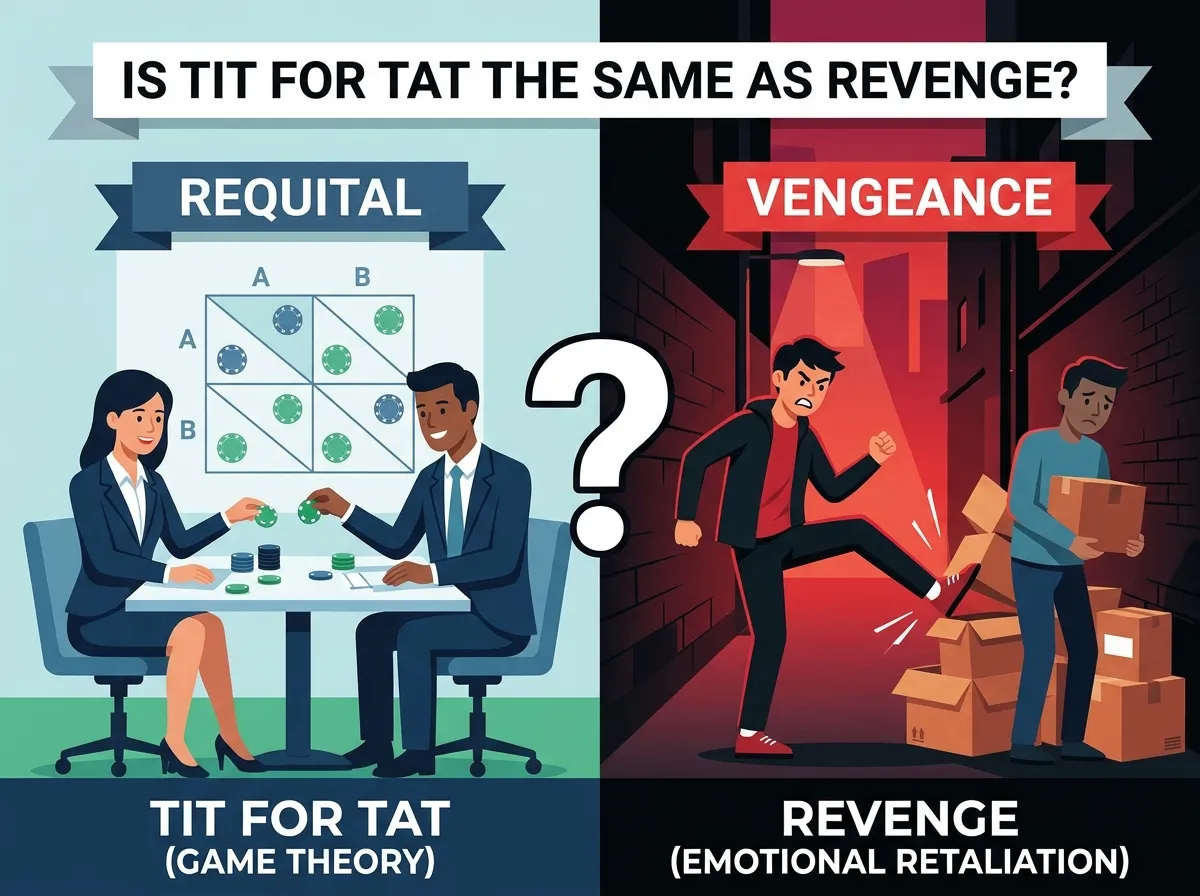
Tit for tat and revenge are closely related, but they do not mean exactly the same thing.
Tit for tat means responding with a similar action. Revenge means trying to hurt or punish someone because they hurt you or caused a problem.
Tit for tat can involve returning a favor or matching an action without a strong desire to cause harm. Revenge usually focuses more on making the other person pay.
For example, if a friend helps you move and you help them move later, that is a form of returning a favor. It is not revenge.
If someone spreads a rumor about you and you spread a rumor about them to hurt them, that may be revenge and tit for tat at the same time.
The key difference is the purpose behind the action.
Tit for Tat vs. Getting Even
Getting even means trying to balance things after someone has treated you unfairly. It often involves payback.
Tit for tat can describe getting even, but it can also describe a fair or friendly exchange.
For example, taking turns paying for lunch may be tit for tat, but it is not usually described as getting even.
Tit for Tat vs. Retaliation
Retaliation means responding to an action, often a harmful one, with another action meant to push back or punish.
Tit for tat is one way retaliation can happen. The response is often similar to the first action.
For example, if one team breaks a rule and the other team responds by breaking a similar rule, people may describe the exchange as tit for tat. The term retaliation focuses more on the act of striking back.
What Are the Synonyms for Tit for Tat?
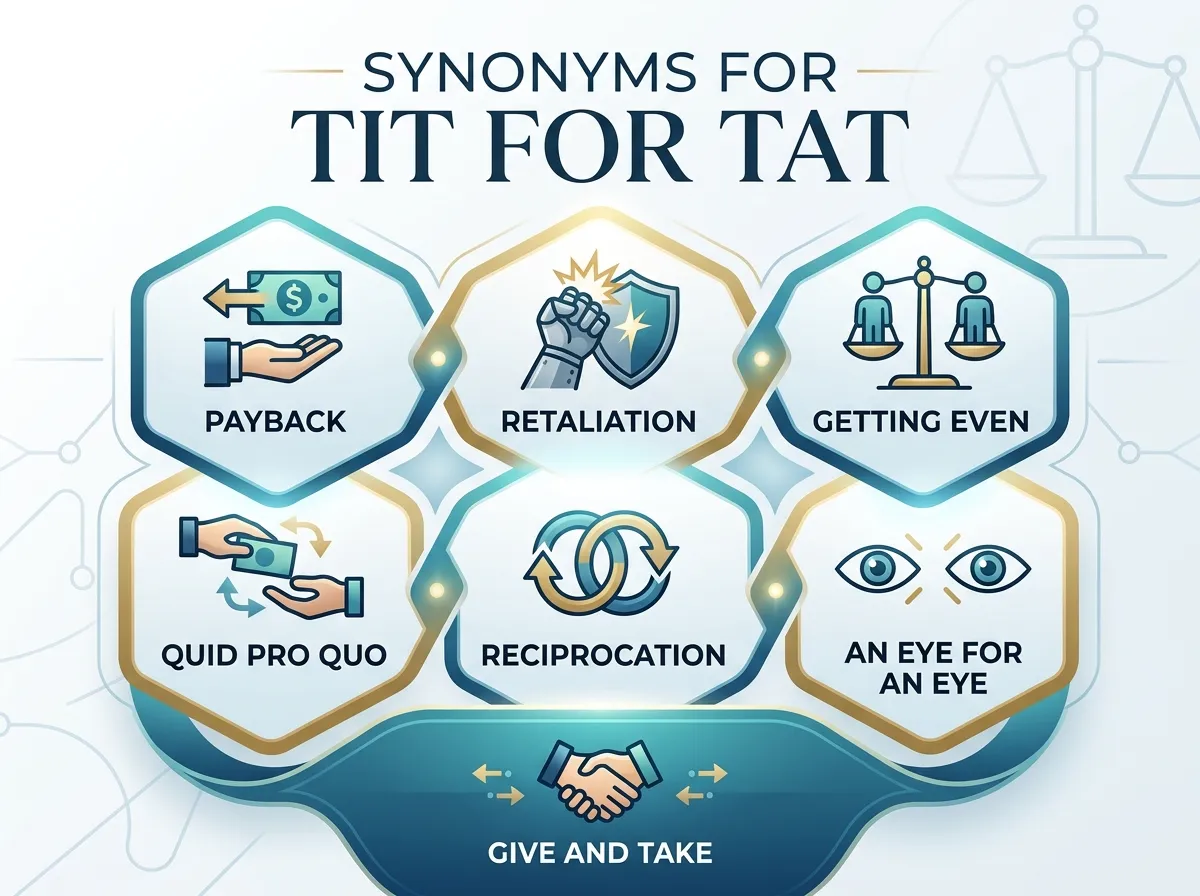
Several words and phrases have meanings close to tit for tat. However, they are not always interchangeable.
1. Payback
Payback means doing something in return for what another person did. It often suggests punishment.
Example: “He saw the prank as payback for what his friend had done.”
2. Retaliation
Retaliation means responding to an action, especially one seen as harmful or unfair.
Example: “The company feared retaliation after announcing the changes.”
3. Getting Even
Getting even means trying to balance an unfair situation by responding to someone who hurt or wronged you.
Example: “She wanted to get even, but her sister told her to move on.”
4. Reciprocation
Reciprocation means giving something back in response to what someone else has done. It can be positive and does not usually suggest revenge.
Example: “Their friendship grew through the reciprocation of kindness.”
5. Quid Pro Quo
Quid pro quo is a Latin phrase meaning something given or done in exchange for something else. It is often used in formal, legal, or business settings.
Example: “The agreement involved a service in exchange for another service.”
6. An Eye for an Eye
This expression describes the idea of responding to harm with similar harm.
Example: “He believed in an eye for an eye, but she preferred to forgive.”
7. Give and Take
Give and take describes an exchange in which people make room for each other’s needs or offer things in return. It is usually more positive than tit for tat.
Example: “A good friendship needs give and take.”
What Is the Opposite of Tit for Tat?
The opposite depends on the meaning you want to express.
If you mean refusing to retaliate, possible opposites include:
- Forgiveness
- Patience
- Understanding
- Breaking the cycle
- Turning the other cheek
- Taking the high road
For example, if someone insults you and you choose not to insult them back, you are refusing to take part in tit for tat.
If the phrase refers to an exchange of favors, an exact opposite is harder to define.
You might describe the situation as a one-sided exchange, where only one person gives or helps.
Is Tit for Tat a Good Thing?
Tit for tat can be good or bad, depending on the action and the reason behind it.
When Tit for Tat Can Be Good
It can help people share work fairly and return kindness.
For example, two friends may take turns driving each other to work. One friend drives on Monday, and the other drives on Tuesday.
Both people contribute, and the exchange feels fair.
In some situations, matching another person’s actions can also help set clear limits.
For example, someone may stop offering extra help to a coworker who repeatedly refuses to help them. This can be a way to manage time and effort, rather than to cause harm.
When Tit for Tat Can Be Harmful
Tit for tat becomes harmful when people keep trying to punish each other.
For example, one person makes a rude comment. The other person replies with an even ruder comment. The first person then tries to hurt them again.
Soon, the original problem becomes harder to solve because both people are focused on winning.
This pattern can harm friendships, families, workplaces, and other relationships.
How to Avoid a Negative Tit-for-Tat Cycle
If you find yourself in a cycle of payback, try these steps:
- Pause before reacting. Give yourself time to calm down.
- Think about your goal. Ask whether your response will solve the problem or make it worse.
- Explain how you feel. Use clear words instead of insults.
- Set fair limits. You do not have to accept poor treatment.
- Look for a solution. Focus on what needs to change rather than who should suffer.
You can stand up for yourself without trying to hurt someone in return.
Tit for Tat in Games and Psychology
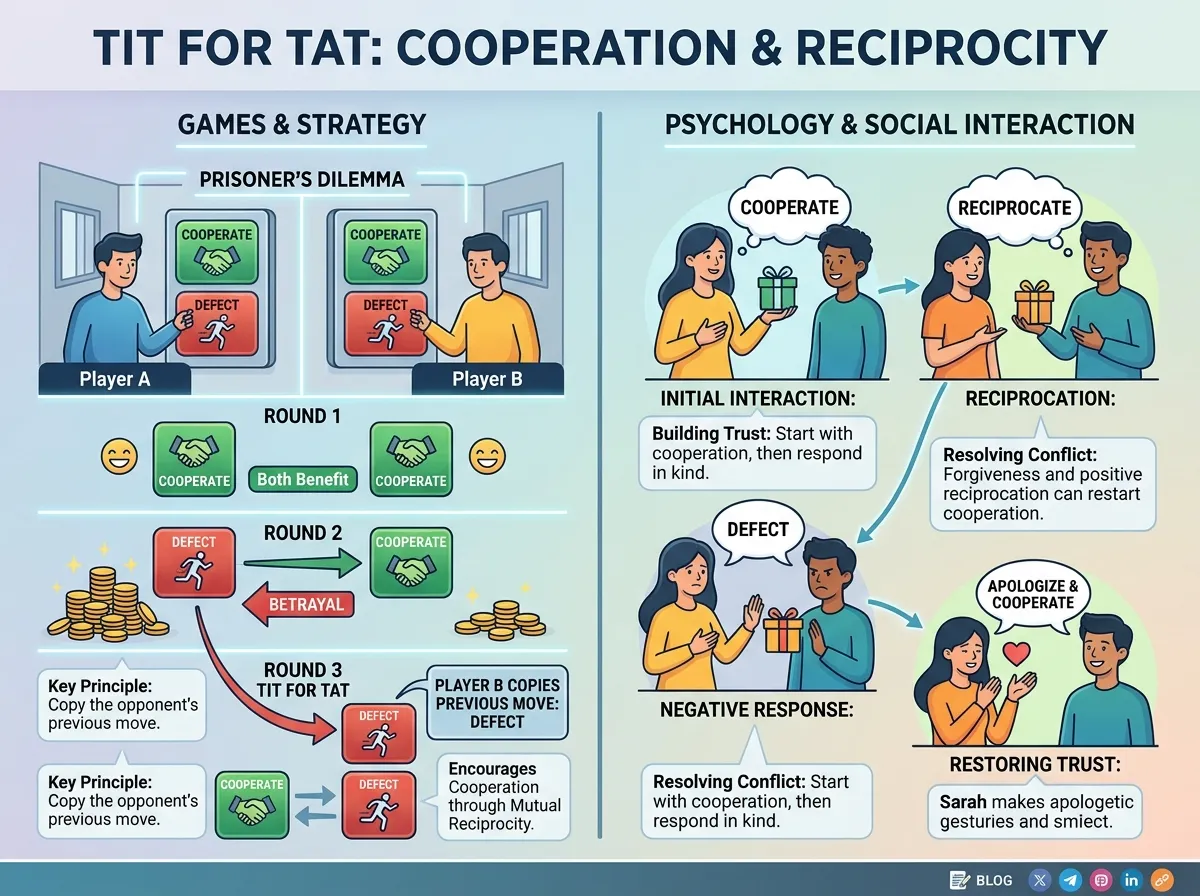
The phrase also appears in discussions about games, choices, and human behavior.
Tit for Tat in Game Theory
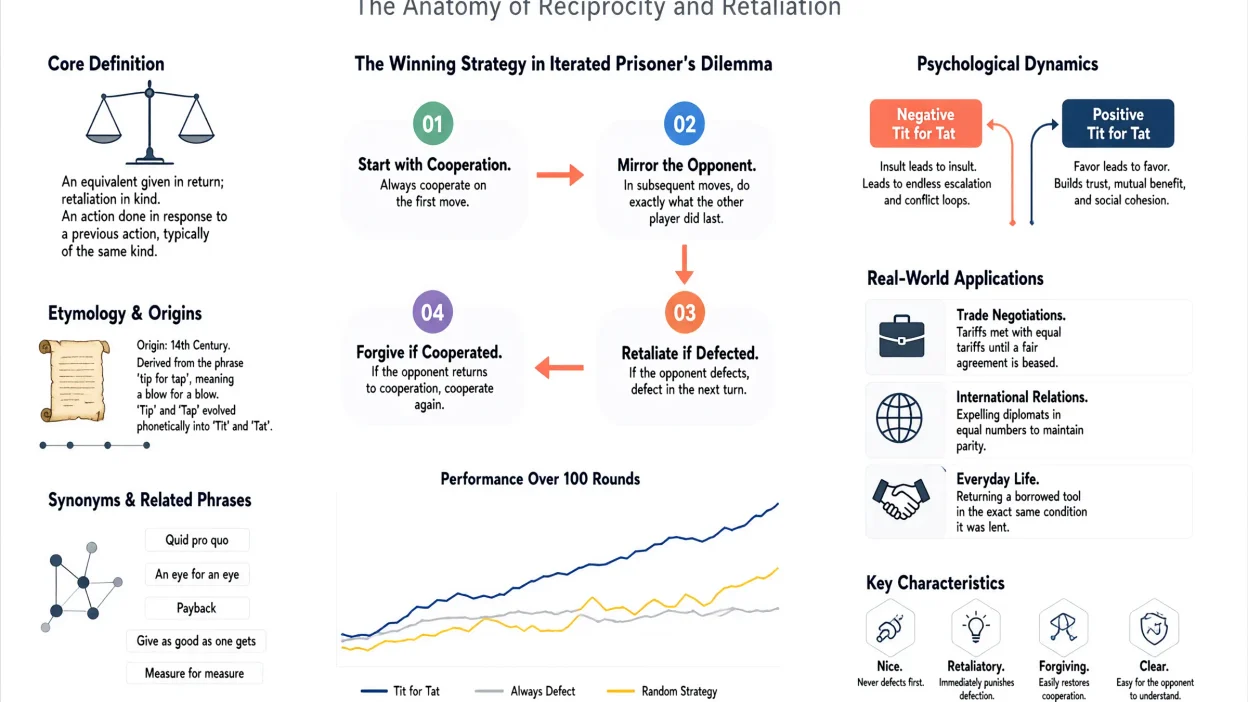
In game theory, Tit for Tat is a well-known strategy for repeated games. A player starts by cooperating and then copies the other player’s previous move.
In a simple example, two players can choose to cooperate or act against each other.
The Tit for Tat strategy begins with cooperation. After that, it responds to the other player’s last move in the same way.
If the other player cooperates, the strategy cooperates again. If the other player acts against it, the strategy responds in kind.
This example shows how tit for tat can encourage cooperation when both sides are willing to work together. However, repeated negative responses can also keep both sides in conflict.
Tit for Tat in Human Behavior
People may use tit for tat because they want fairness. They may feel that matching another person’s actions is a way to protect themselves or make the relationship balanced.
For example, a person may stop sharing personal details with a friend who keeps sharing their secrets. This response can be a form of setting boundaries.
But people can also misread each other’s actions. Someone may forget to reply to a message because they are busy, while the other person assumes they are being ignored.
Responding with the same behavior can create a problem that neither person intended.
It helps to ask questions before assuming that someone meant to hurt you.
Common Mistakes When Using Tit for Tat

Although the phrase is simple, a few mistakes are common.
Mistake 1: Thinking It Always Means Revenge
Tit for tat can describe revenge, but it can also refer to returning favors or matching behavior.
Mistake 2: Using It to Mean Any Exchange
Not every exchange is tit for tat. The actions usually need to be connected, with one action serving as a response to another.
For example, two strangers buying separate cups of coffee is not necessarily tit for tat.
Mistake 3: Confusing It With a Fair Agreement
A fair agreement may involve people exchanging services, but tit for tat often highlights a direct response to another person’s action.
The context determines which phrase fits best.
Mistake 4: Assuming It Is Always Intentional
Sometimes people copy another person’s behavior on purpose. At other times, they may react without thinking.
The phrase can describe the pattern even when the person’s exact intention is unclear.
Related Expressions You Should Know
Here are a few expressions that are useful when discussing tit for tat.
- What goes around comes around: People may eventually face the results of their own actions.
- Two wrongs do not make a right: Someone else’s bad behavior does not make your own bad behavior right.
- Turn the other cheek: Choose not to retaliate after being treated badly.
- Give as good as you get: Respond with equal force or skill, often in an argument.
- Return the favor: Do something helpful for someone who helped you.
- Fight fire with fire: Use a similar method to respond to a difficult or harmful action.
These expressions are related, but each has its own meaning. Choose the one that best matches the situation.
Article Summary
The phrase tit for tat means responding to someone’s action with a similar action.
It can describe returning a favor, matching someone’s behavior, or getting back at someone after being treated badly.
The expression is common in daily conversation, relationships, business, politics, and game theory.
It may be positive when it helps people share fairly, but it can become harmful when both sides keep trying to punish each other.
Tit for tat is not always the same as revenge. Its meaning depends on the action, the situation, and the reason for the response. Understanding the context helps you use the phrase correctly.
FAQS
1. What does tit for tat mean in simple words?
Tit for tat means doing something similar in response to what someone else has done. It can mean returning a favor or getting back at someone.
2. Is tit for tat positive or negative?
It can be either. Returning a favor is positive, while responding to an insult with another insult is negative. The situation determines the meaning.
3. Does tit for tat mean revenge?
Not always. Revenge means trying to punish someone for hurting you. Tit for tat means matching someone’s action and can include revenge, but it can also describe fair exchanges.
4. What is an example of tit for tat?
If one friend helps another friend move, and the second friend helps them move later, that is a friendly example. If two people keep insulting each other in response to earlier insults, that is a negative example.
5. What is another word for tit for tat?
Depending on the context, similar terms include payback, retaliation, getting even, reciprocation, and an eye for an eye.
6. What does tit for tat mean in a relationship?
It means one partner responds to the other’s behavior with similar behavior. This can be positive when partners return care and support, but negative when they use silence or hurtful words to punish each other.
7. Is tit for tat an idiom?
Yes. It is an English idiom used to describe a matching response to another person’s action.
8. How do you use tit for tat in a sentence?
You can say, “Their disagreement turned into a game of tit for tat.” This means both people kept responding to each other’s actions.
9. What is the opposite of tit for tat?
When tit for tat means retaliation, opposites include forgiveness, patience, and refusing to retaliate. When it means an exchange, the opposite may be a one-sided arrangement.
10. What does tit for tat mean in politics?
In politics, it often describes one government responding to another government’s action with a similar measure, such as matching a trade restriction or responding to a diplomatic move.
11. What does tit for tat mean in game theory?
In game theory, Tit for Tat is a strategy that begins by cooperating and then copies the other player’s previous move in later rounds.
12. Is tit for tat the same as give and take?
No. Give and take usually means a balanced exchange or compromise. Tit for tat focuses more on responding to a specific action with a similar one.
Conclusion
The meaning of tit for tat is simple: respond to an action with a similar action. It can describe a friendly exchange, a fair response, or an attempt to get even with someone.
You can hear it in everyday conversations, relationships, business, politics, and discussions about games.
The most important thing to remember is that tit for tat is not always good or bad. Returning kindness can strengthen relationships, while returning harm can lead to a cycle of conflict.
Before responding to someone’s actions, think about what you want to achieve.
Sometimes, a calm conversation or a clear boundary is better than trying to match what the other person did.
When you understand the context, you can recognize the phrase easily and use it naturally in your own conversations.

Emma Wilson is a writer at MeaningVibz who enjoys exploring emoji meanings, texting expressions, and online communication trends. She helps readers understand how emojis and slang are used in different situations by providing clear explanations and relatable examples for everyday messaging.