

The word whether is used to show a choice, doubt, or uncertainty between possible outcomes.
It often appears when someone does not know what will happen or needs to consider different options.
Simple Definition of Whether
Whether means that there are two or more possible answers, choices, or results.
Examples:
- I wonder whether she is at home.
- He asked whether I needed help.
- We must decide whether to travel today.
- She could not choose whether to wear the blue dress or the red one.
In each example, the word whether shows that something is uncertain or that a choice needs to be made.
Whether Meaning in Simple English
In simple English, whether can mean:
- If something is true or not.
- If something will happen or not.
- Which of two or more choices is better.
- A situation where the answer is not yet known.
For example, “I am not sure whether he will come” means you do not know if he will come.
Remember that whether does not always mean a direct question. It can also be part of a longer sentence that describes doubt or a choice.
How to Use Whether in a Sentence
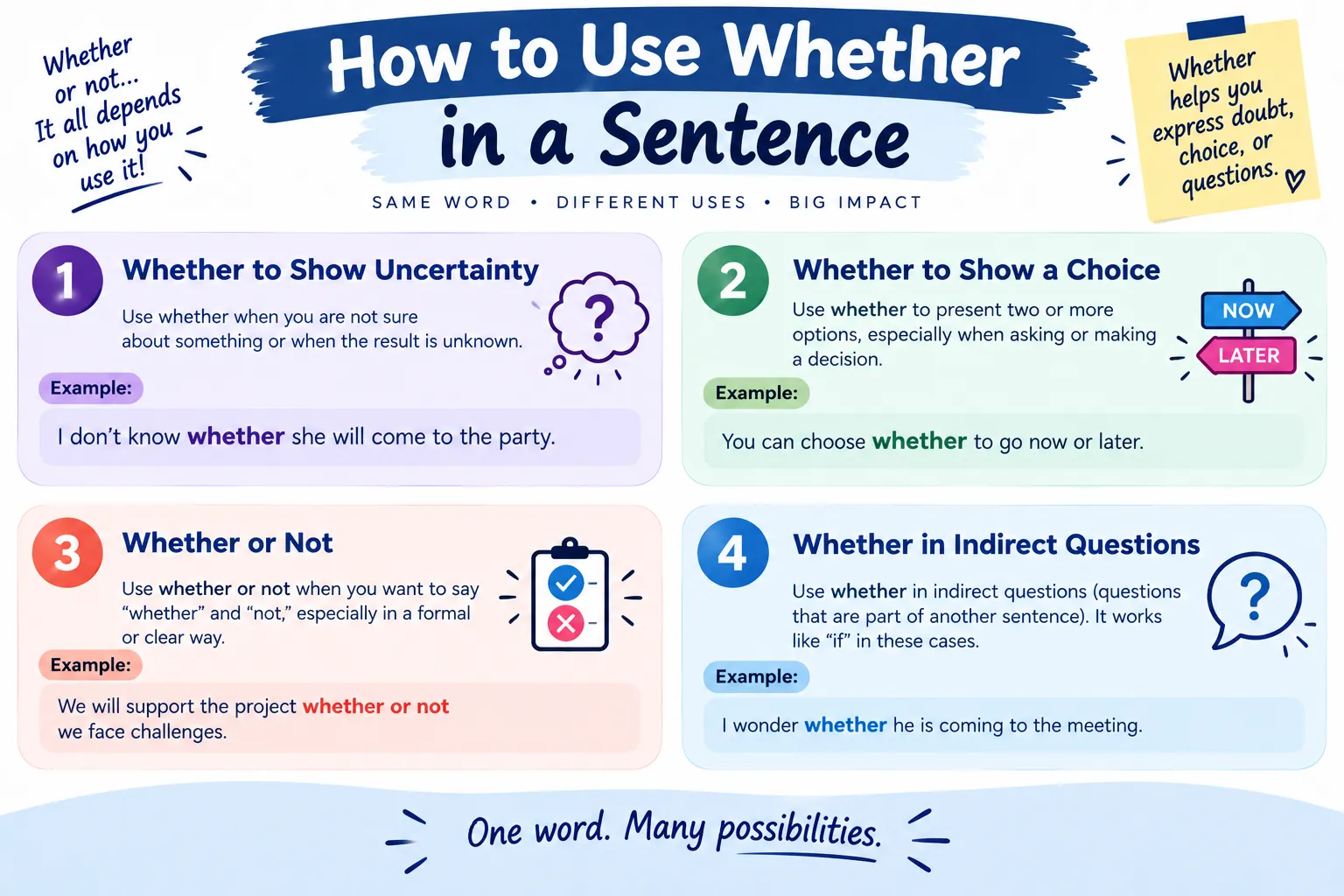
You can use whether in several common ways. The meaning depends on the words around it.
Whether to Show Uncertainty
Use whether when you are unsure about something.
Examples:
- I do not know whether she likes coffee.
- We are unsure whether the store is open.
- He wondered whether his answer was correct.
- I cannot tell whether this key fits the lock.
These sentences show that the speaker does not know the answer for sure.
Whether to Show a Choice
Use whether when someone must choose between two or more options.
Examples:
- I cannot decide whether to walk or take the bus.
- She asked whether we wanted tea or coffee.
- We need to choose whether to stay home or go out.
- He was unsure whether to buy a new phone or fix his old one.
In these examples, whether introduces the choices that a person is thinking about.
Whether or Not
The phrase “whether or not” is used to show that something may happen regardless of the result or choice. It can also stress that there are two possible outcomes.
Examples:
- I will go whether or not it rains.
- She must finish the work whether or not she feels tired.
- We will support you whether or not you win.
- He plans to attend whether or not his friends come.
The first sentence means that rain will not change the speaker’s plan.
Whether in Indirect Questions
An indirect question reports or describes a question without asking it directly.
Examples:
- Direct question: “Is he home?”
- Indirect question: “I wonder whether he is home.”
More examples:
- She asked whether I was ready.
- Can you tell me whether the train has arrived?
- He wanted to know whether the meeting was canceled.
Notice that an indirect question usually follows normal statement word order. We say, “I wonder whether he is home,” not “I wonder whether is he home.”
Whether vs. If: What Is the Difference?
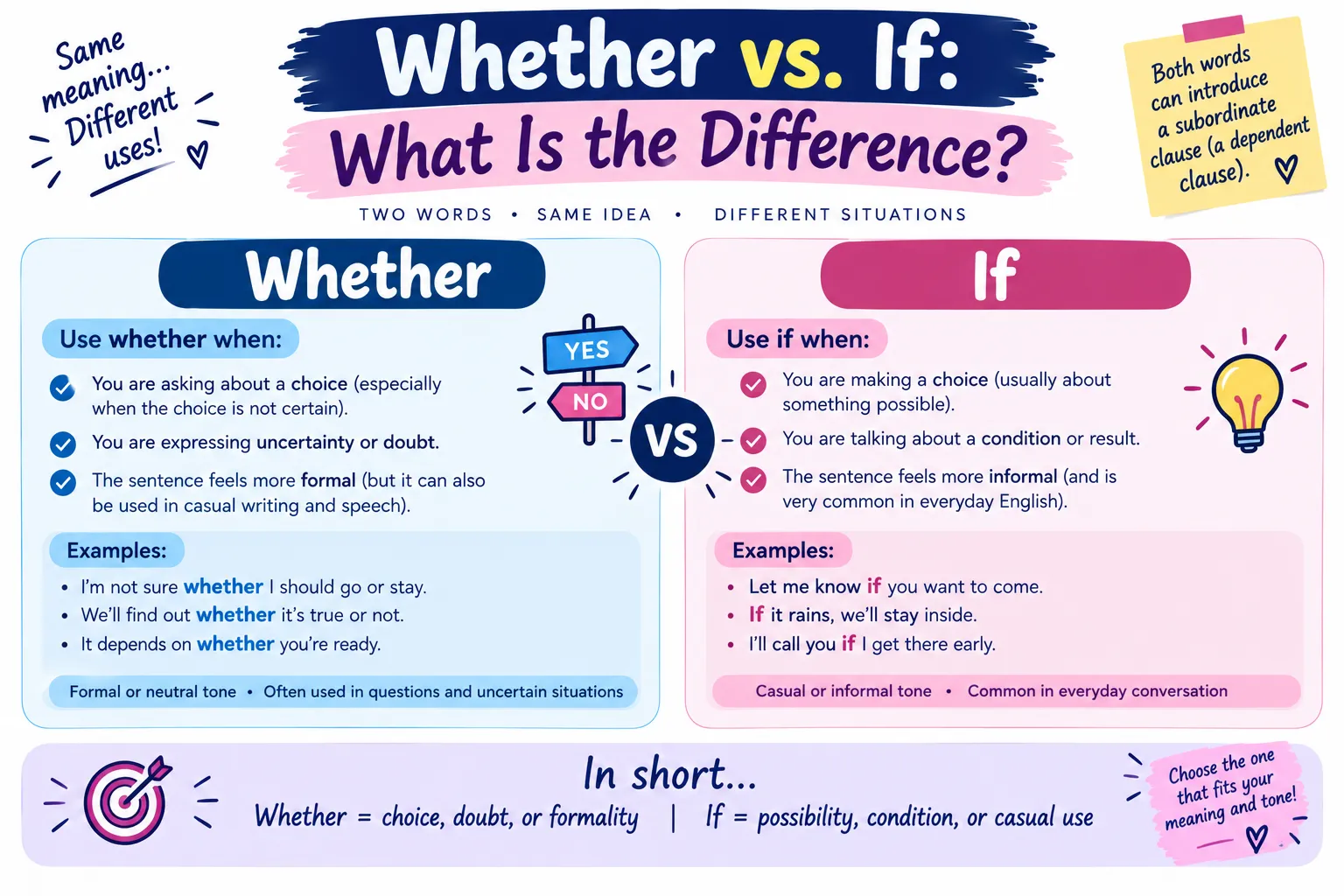
The words whether and if can sometimes have the same meaning. Both may introduce an indirect question about something that is uncertain.
However, they are not always interchangeable.
When Whether and If Mean the Same Thing
Both words can be used to talk about uncertainty.
Examples:
- I do not know whether she is coming.
- I do not know if she is coming.
Both sentences mean that the speaker is unsure about her plans.
Here are more examples:
- He asked whether I was busy.
- He asked if I was busy.
Both forms are correct in these examples.
When You Should Use Whether
Use whether when you are showing a choice between options, especially when the sentence includes “or.”
Examples:
- I cannot decide whether to stay or leave.
- She asked whether I wanted tea or coffee.
- We need to find out whether the door is locked or unlocked.
In many sentences with an explicit choice, whether is the clearer and more natural option.
When If Is Better
Use if to introduce a condition, especially when one thing depends on another.
Examples:
- If it rains, we will stay home.
- If you study, you may pass the test.
- Call me if you need help.
In these sentences, if introduces a condition. It does not simply report uncertainty between choices.
Whether vs. If: Quick Comparison
| Whether | If |
| Often shows a choice or uncertainty | Often shows a condition |
| I wonder whether he is ready. | If he is ready, we can leave. |
| She asked whether I wanted tea or coffee. | If you want tea, I can make some. |
| Use it before “or not” when suitable | Use it to explain what happens under a condition |
Easy tip: If you mean “in case this happens, then that happens,” you usually need if.
If you are talking about an unknown answer or a choice, whether is often a good fit.
Common Sentence Patterns With Whether
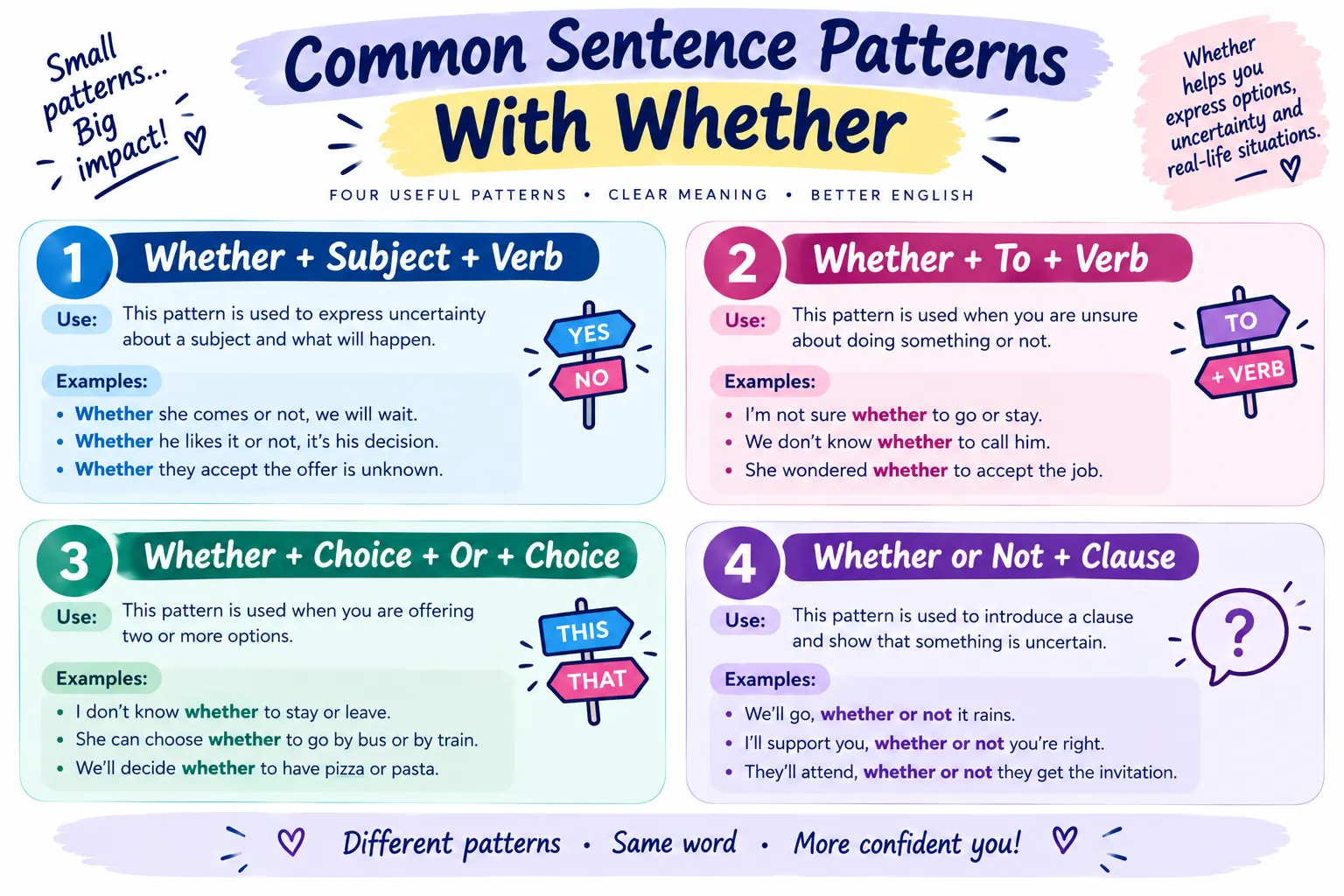
Learning common sentence patterns can help you use whether correctly.
Whether + Subject + Verb
Use this pattern when talking about an uncertain fact.
Examples:
- I wonder whether she knows.
- We do not know whether he is coming.
- They asked whether the shop was open.
Whether + To + Verb
Use this pattern when someone is thinking about what action to take.
Examples:
- I cannot decide whether to go.
- She wondered whether to call him.
- He asked whether to wait.
This pattern is common when someone has to make a choice.
Whether + Choice + Or + Choice
Use this pattern to show two or more options.
Examples:
- I do not know whether to cook or order food.
- She must choose whether to drive or take the train.
- We are deciding whether to move now or wait.
Whether or Not + Clause
Use this pattern to show that an outcome does not change what happens next.
Examples:
- I will help whether or not you ask.
- We will play whether or not the weather is perfect.
- She will keep trying whether or not she succeeds today.
Whether Meaning in Everyday Conversations
People use whether in daily speech, school, work, and online messages. It often sounds natural when someone is unsure or is discussing a decision.
Examples in Daily Life
At home:
- “I am not sure whether we have enough milk.”
- “Can you check whether the door is locked?”
At school:
- “The teacher asked whether we had finished our homework.”
- “I cannot decide whether to study math or English first.”
At work:
- “Please confirm whether the meeting is still planned.”
- “We need to decide whether to change the schedule.”
With friends:
- “I wonder whether they will join us.”
- “Let me know whether you want to come.”
These examples show how whether helps people talk about questions and choices without always asking a direct question.
Common Mistakes When Using Whether
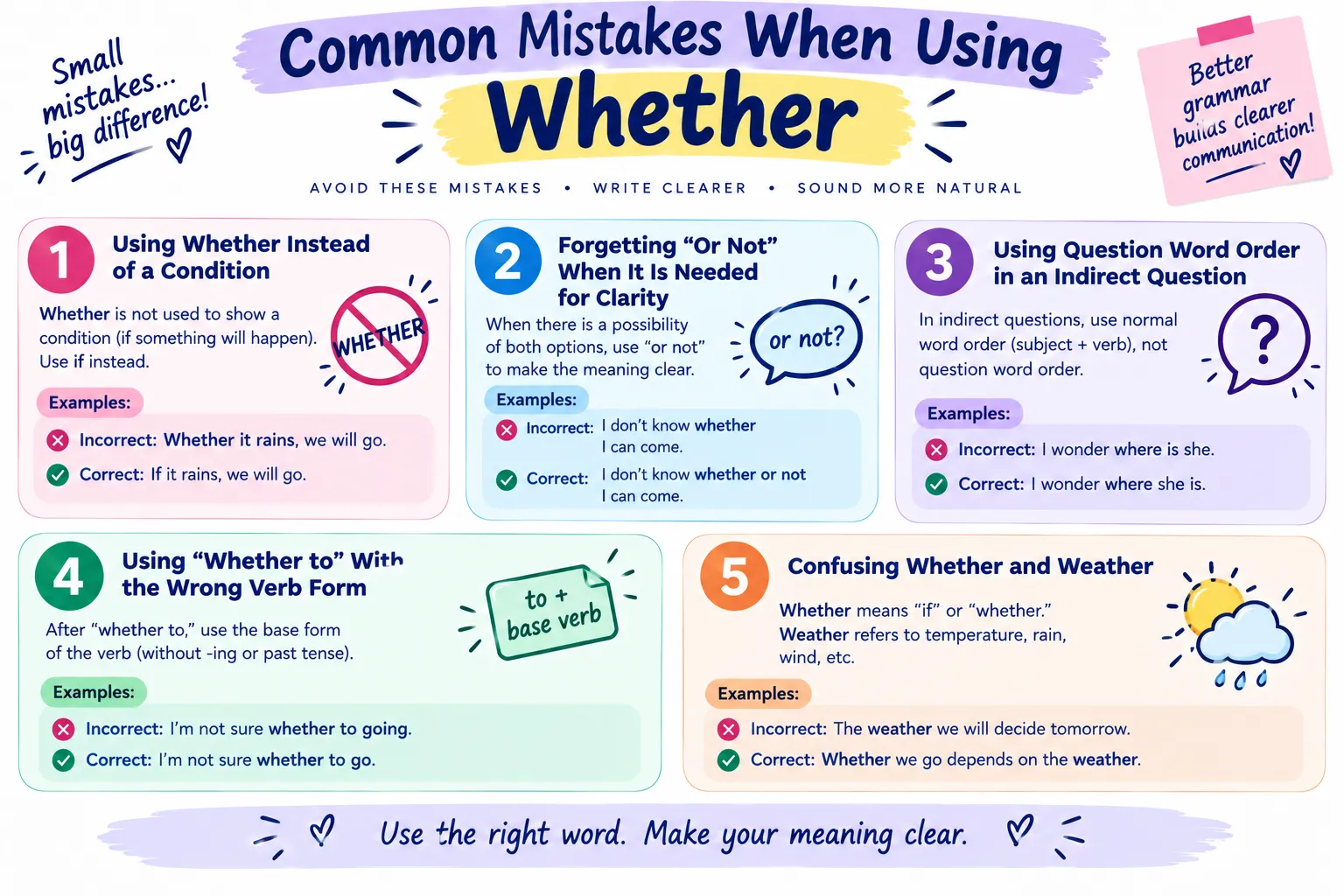
Some English learners mix up whether, if, and other words. Here are common mistakes and how to fix them.
Using Whether Instead of a Condition
Incorrect: Whether it rains, we will stay home.
Correct: If it rains, we will stay home.
Why? The sentence describes a condition that may cause a result. If is the right word here.
Forgetting “Or Not” When It Is Needed for Clarity
Incorrect: I will go whether it rains.
Better: I will go whether or not it rains.
The shorter version can occur in English, but adding “or not” makes the meaning clearer for many readers.
Using Question Word Order in an Indirect Question
Incorrect: She asked whether was I ready.
Correct: She asked whether I was ready.
Why? An indirect question normally uses statement word order: subject first, followed by the verb.
Using “Whether to” With the Wrong Verb Form
Incorrect: I cannot decide whether going.
Correct: I cannot decide whether to go.
Why? When whether introduces a choice about an action, it can be followed by “to” and the base form of a verb.
Confusing Whether and Weather
These words sound alike, but they have different meanings.
- Whether: shows uncertainty or a choice.
- Weather: describes conditions outside, such as rain, wind, or sunshine.
Examples:
- I do not know whether he will come.
- The weather is warm today.
A simple way to remember the difference is that weather is about the sky and outdoor conditions, while whether is about choices and possibilities.
Is Whether a Conjunction?
Yes. In common uses, whether is a conjunction that introduces a clause, often one that expresses an indirect question or uncertainty.
Examples:
- I know whether she is ready.
- They asked whether the road was safe.
- We must decide whether we should wait.
In these sentences, whether connects the main part of the sentence to the part that expresses the question or choice.
Can You Start a Sentence With Whether?
Yes, you can start a sentence with whether when the sentence is written in a suitable structure.
Examples:
- Whether we win or lose, we will have fun.
- Whether she agrees or not, we must make a decision.
- Whether you stay or leave is your choice.
In these examples, the opening phrase sets up a choice or situation. The rest of the sentence explains what follows.
Whether Meaning in Formal and Informal English
Whether works in both formal and informal English. It is common in conversations, text messages, schoolwork, business emails, and formal writing.
Formal Examples
- Please confirm whether you can attend the meeting.
- We must determine whether the plan is suitable.
- The report explains whether the changes were effective.
Informal Examples
- I don’t know whether he’ll come.
- Let me see whether I have time.
- I can’t decide whether to stay or go.
In everyday speech, people often use if in place of whether when asking about an unknown fact.
In formal writing, whether can make a choice or indirect question more precise.
Article Summary
The word whether is used to show uncertainty, possible outcomes, or a choice between options.
It often means “if” when someone does not know an answer.
Key points to remember:
- Whether can introduce an indirect question.
- It can show a choice, such as whether to stay or leave.
- “Whether or not” can show that an outcome will not change a plan.
- If often introduces a condition.
- Whether and if can sometimes be used in the same way.
- Whether is different from weather, which describes outdoor conditions.
The easiest way to learn whether is to practice using it in short sentences about choices and things you do not know.
Frequently Asked Questions (FAQs)
1. What does whether mean in simple words?
Whether means that something is uncertain or that there are two or more possible choices or outcomes. For example, “I do not know whether he is home” means you are unsure if he is home.
2. What is an example of whether in a sentence?
“I cannot decide whether to walk or drive.” This sentence uses whether to show two choices.
3. Does whether mean the same as if?
Sometimes. Both words can introduce an indirect question, such as “I wonder whether she is ready” and “I wonder if she is ready.” However, if is commonly used to introduce conditions.
4. How do you use whether or not?
Use “whether or not” to show that two possible outcomes will not change a decision or result. For example, “I will go whether or not it rains.”
5. What is the difference between whether and weather?
Whether refers to uncertainty or choices. Weather refers to outdoor conditions, such as rain, snow, wind, and sunshine.
6. Can whether be used at the beginning of a sentence?
Yes. For example, “Whether we win or lose, we will enjoy the game.” This structure is correct because the opening phrase introduces two possible outcomes.
7. Is whether a conjunction?
Yes. Whether commonly acts as a conjunction that introduces an indirect question or a clause about a choice or possibility.
8. Is it correct to say “whether to go”?
Yes. “Whether to go” is correct when someone is thinking about taking an action. For example, “I cannot decide whether to go to the party.”
9. Should I use whether or if in formal writing?
Both can be correct. Whether is often clearer when the sentence presents a choice or when “or not” follows. If is usually the natural choice for a condition.
10. What are some synonyms for whether?
There is no single synonym that works in every sentence. Depending on the meaning, you may use phrases such as “if,” “whether or not,” or “which of the options.” Always choose a replacement that keeps the original meaning.
Conclusion
The word whether is useful when you want to talk about uncertainty, choices, or possible outcomes.
It often appears in indirect questions, such as “I wonder whether she is coming,” and in sentences that present options, such as “I cannot decide whether to stay or leave.”
The main difference between whether and if is that whether often focuses on an unknown answer or a choice, while if commonly introduces a condition.
The two words can have the same meaning in some sentences, so it is important to look at the full context.
To use whether with confidence, practice making simple sentences about decisions and questions.
Once you understand these common patterns, you will find it much easier to use whether correctly in everyday conversations, schoolwork, and writing.

Ryan Mitchell creates informative content about word definitions, acronyms, online slang, and modern communication. He enjoys exploring how people use language in text messages, on social media, and in daily life. Ryan focuses on delivering simple explanations and practical examples that help readers quickly understand the meaning of unfamiliar words and phrases.