

Introduction
What does SAP stand for? If you have seen SAP on a job listing, business website, or software system, you may wonder what these three letters mean. SAP stands for “Systems, Applications, and Products in Data Processing.”
The name comes from the German company that created the software, though SAP is now used by businesses around the world.
SAP is best known for enterprise resource planning (ERP) software. It helps companies manage important business tasks in one connected system.
These tasks can include finance, sales, purchasing, inventory, human resources, manufacturing, and supply chains.
In simple terms, SAP helps a business keep its data and daily operations organized. Instead of using many separate systems, a company can connect key processes through SAP.
This can make it easier to share information, track business activity, and make decisions.
But there is more to SAP than its name. Let’s look at what SAP means, what it does, its common modules, and why companies use it.
What Does SAP Stand For?
SAP stands for “Systems, Applications, and Products in Data Processing.”
SAP is also the name of the German software company that developed the system. The company was founded in 1972 by five former IBM employees in Germany.
The original German company name was Systemanalyse Programmentwicklung, which means “System Analysis Program Development.”
Today, SAP is widely known as a provider of business software and cloud solutions.
What Does Each Part of SAP Mean?
The name can be broken down into three main ideas:
- Systems — Business systems used to manage information and processes.
- Applications — Software applications that perform specific business tasks.
- Products — Software products designed to help companies manage their operations.
- Data Processing — The collection, organization, and use of business data.
So, when someone asks, “What does SAP stand for?”, the short answer is:
SAP = Systems, Applications, and Products in Data Processing.
What Is SAP?

SAP is a business software company and software platform that helps organizations manage their operations.
One of its best-known products is SAP ERP software. ERP stands for Enterprise Resource Planning.
ERP software brings different business functions together. For example, a company may use SAP to connect:
- Accounting
- Sales
- Purchasing
- Inventory
- Manufacturing
- Human resources
- Customer management
- Supply chain operations
This creates a shared source of business information.
Simple SAP Example
Imagine a company sells laptops.
A customer places an order.
The SAP system can help connect several steps:
- The sales team records the order.
- Inventory information is checked.
- The warehouse prepares the product.
- Shipping information is updated.
- The invoice is created.
- The finance team records the payment.
Instead of entering the same information into several unrelated systems, connected SAP applications can share data across departments.
What Is SAP Used For?
SAP is used to manage many types of business processes.
The exact software a company uses depends on its size, industry, and needs.
Common uses include:
Finance and Accounting
SAP can help businesses manage financial information such as:
- Invoices
- Payments
- Expenses
- General ledger data
- Financial reporting
- Accounts payable
- Accounts receivable
Sales
Companies can use SAP software to manage sales activities, customer orders, pricing, and billing.
Purchasing
SAP can help purchasing teams manage suppliers, purchase orders, and procurement processes.
Inventory Management
Businesses can track products and materials as they move through warehouses and other locations.
Manufacturing
Manufacturers can use SAP to plan production, manage materials, and monitor manufacturing processes.
Human Resources
SAP solutions can support employee information, payroll-related processes, recruiting, and other HR activities.
Supply Chain Management
SAP can help companies manage the movement of products, materials, and information from suppliers to customers.
What Is SAP ERP?
SAP ERP is enterprise resource planning software from SAP.
ERP systems connect different areas of a business through shared data and processes.
For example, a single business transaction may affect several departments.
If a customer buys a product, the sale can affect:
- Sales
- Inventory
- Shipping
- Billing
- Accounting
An ERP system helps connect these activities.
This is one reason businesses use SAP ERP: it can provide a more connected view of business operations.
What Are SAP Modules?
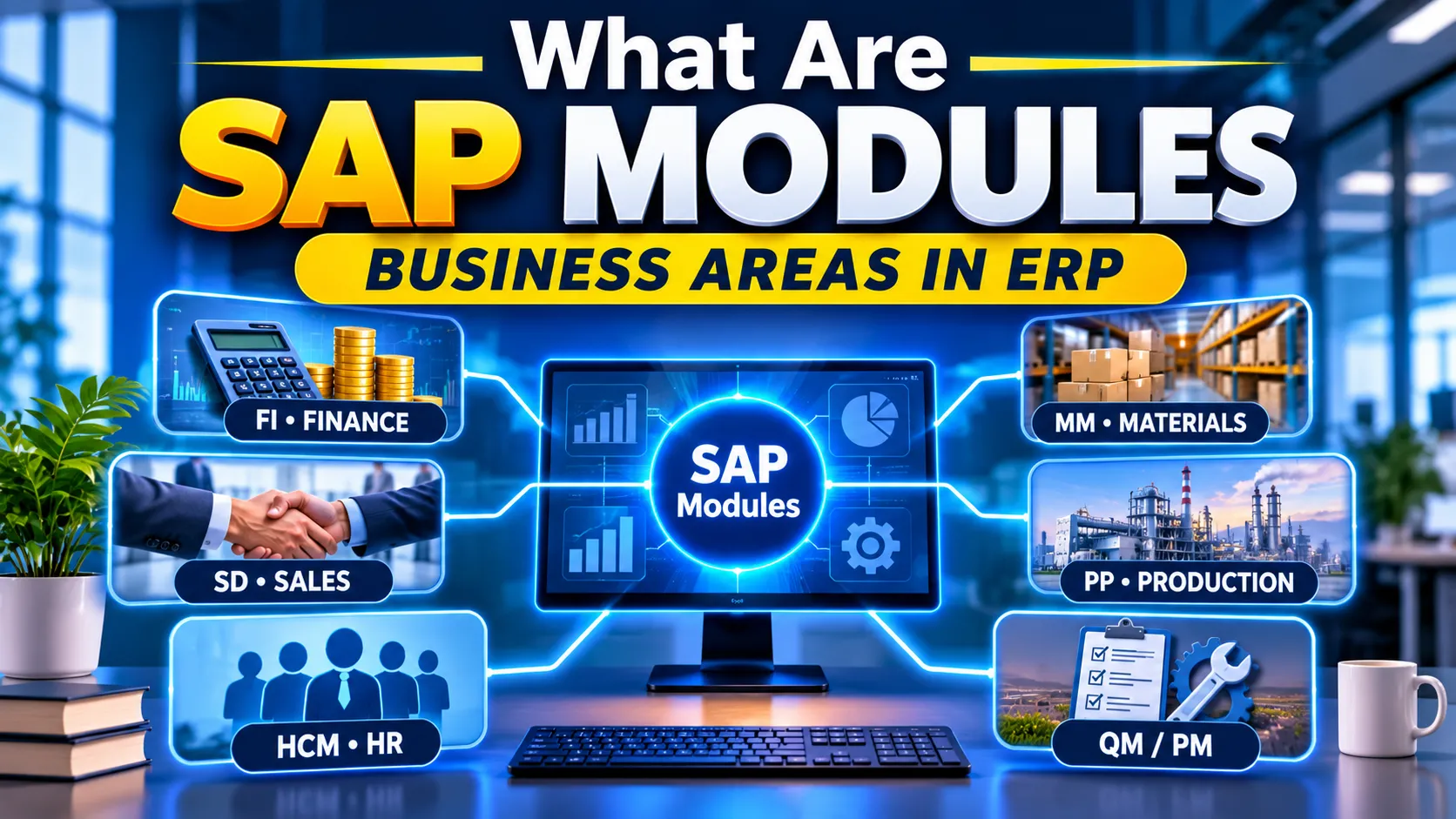
SAP software is divided into different areas, often called modules or applications.
Each area focuses on specific business functions.
Some commonly known SAP areas include:
SAP FI
FI stands for Financial Accounting.
It focuses on financial transactions and accounting information.
SAP CO
CO stands for Controlling.
It helps businesses monitor costs, profitability, and internal financial performance.
SAP MM
MM stands for Materials Management.
It is associated with purchasing, inventory, and materials-related processes.
SAP SD
SD stands for Sales and Distribution.
It supports sales processes, customer orders, shipping, and billing.
SAP PP
PP stands for Production Planning.
It supports manufacturing and production planning activities.
SAP HCM
HCM stands for Human Capital Management.
It focuses on human resources and employee-related processes.
These are only some examples. SAP has many products and applications designed for different business needs.
What Is SAP S/4HANA?
SAP S/4HANA is SAP’s modern ERP platform.
The name S/4HANA is associated with SAP’s newer generation of enterprise resource planning software.
It is designed to run on SAP HANA, SAP’s in-memory database technology.
In simple terms, S/4HANA is a modern SAP ERP platform that can help businesses manage core operations using a connected data environment.
Businesses can use it for areas such as:
- Finance
- Sales
- Procurement
- Manufacturing
- Supply chain
- Asset management
SAP S/4HANA is available in cloud and other deployment models, depending on the solution and customer requirements.
What Is SAP HANA?
SAP HANA is a database and data platform developed by SAP.
It is designed to process large amounts of data quickly by using in-memory computing.
A simple way to think about it is:
SAP HANA = a database technology
SAP S/4HANA = an ERP platform that uses SAP HANA
These names are related, but they are not the same thing.
Why Do Companies Use SAP?

Companies use SAP because modern businesses often have many connected processes.
A large organization may have thousands of employees, customers, products, suppliers, and transactions.
Managing all of this information can become difficult when every department uses a separate system.
SAP can help connect business processes and data.
Common Benefits
Companies may use SAP to:
- Connect business departments
- Manage large amounts of data
- Automate business processes
- Track financial activity
- Manage inventory
- Support supply chain operations
- Improve reporting
- Standardize business processes
However, SAP is not automatically the best choice for every company. ERP software can be complex, and successful implementation requires planning, training, and proper configuration.
Who Uses SAP?
SAP is used by organizations across many industries.
Examples include:
- Manufacturing
- Retail
- Healthcare
- Technology
- Banking
- Automotive
- Consumer goods
- Energy
- Logistics
- Professional services
Both large companies and smaller organizations can use SAP products, although the type of SAP solution may vary.
Is SAP a Company or Software?
This is a common question.
SAP is both a company name and a name used for its software products.
SAP is the company that develops business software and cloud solutions.
People also commonly say “SAP” when referring to an SAP business system.
For example, someone might say:
“I work with SAP.”
This could mean they work with SAP software, such as an ERP system.
Is SAP an ERP?
Yes, SAP offers ERP software.
However, SAP and ERP are not exactly the same thing.
ERP is a type of business software.
SAP is a company that develops ERP and other business software.
Think of it this way:
- ERP = category of software
- SAP = software company and its products
- SAP ERP = SAP’s ERP software
What Does SAP Stand for in Business?
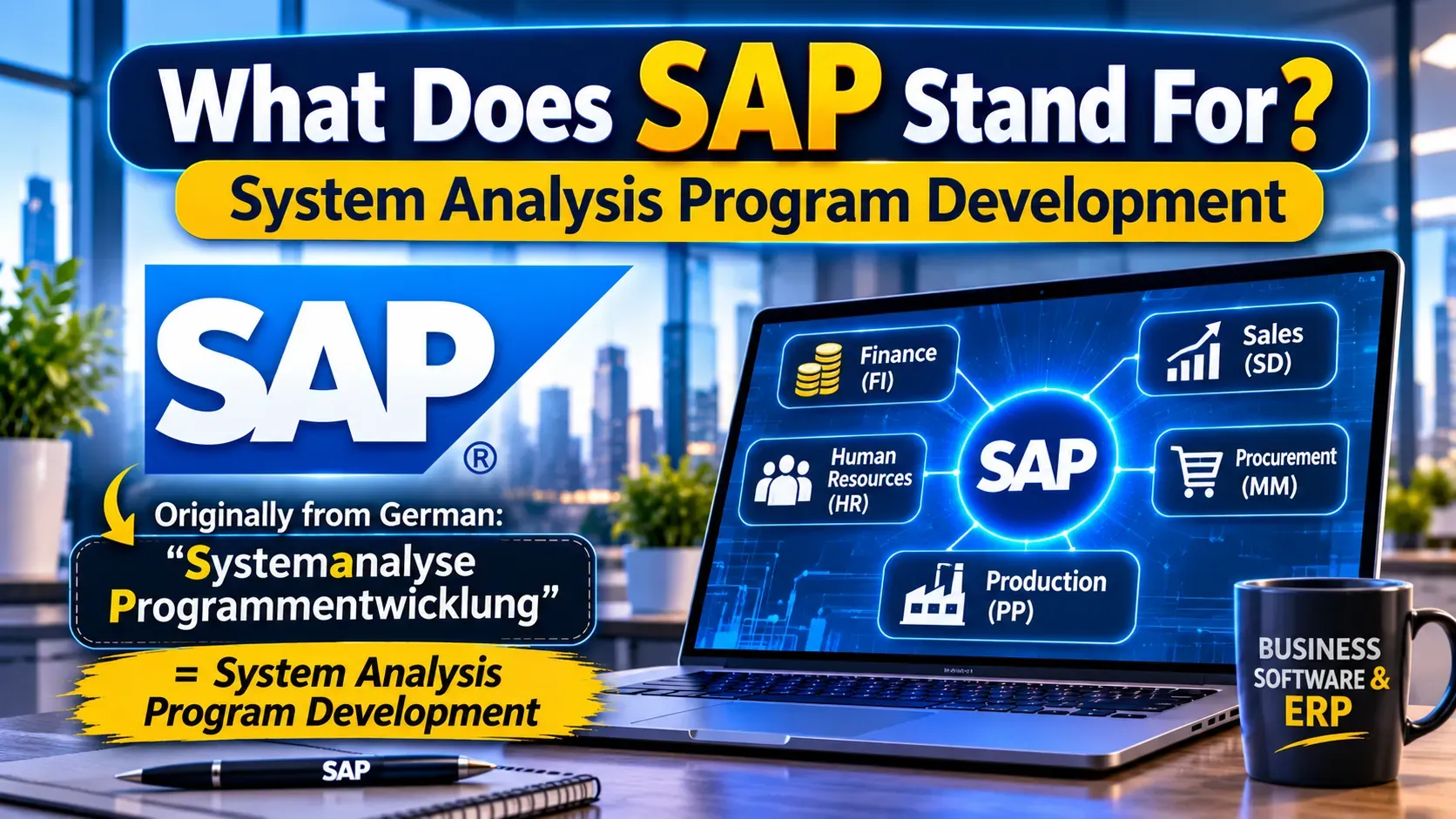
In a business context, SAP usually refers to Systems, Applications, and Products in Data Processing.
However, people may use “SAP” simply to describe the company’s software ecosystem.
For example, a job posting might say:
“SAP experience required.”
This usually means the employer wants someone who has worked with one or more SAP applications or systems.
The specific skills required may depend on the job.
What Does SAP Stand for in a Job?
When SAP appears in a job description, it usually refers to SAP business software.
For example:
- SAP Consultant
- SAP Analyst
- SAP Developer
- SAP Administrator
- SAP Finance Specialist
- SAP Supply Chain Specialist
The exact role depends on the SAP products and business functions involved.
Someone working with SAP Finance may need different skills from someone working with SAP supply chain software.
Is SAP Hard to Learn?
SAP can be challenging because it covers many business processes and software tools.
However, you do not need to learn everything in SAP.
Most people focus on a specific area.
For example, someone interested in accounting might learn SAP Finance, while someone interested in supply chains might focus on procurement or supply chain applications.
A Simple SAP Learning Path
If you are new to SAP, you can start with:
- Learn basic ERP concepts.
- Understand how businesses use SAP.
- Choose one SAP area.
- Learn common terms and processes.
- Practice with examples.
- Learn how transactions move through the system.
- Build practical experience.
Choosing one area first can make learning easier.
What Does an SAP Consultant Do?
An SAP consultant helps organizations use SAP software to support business processes.
Depending on the role, a consultant may:
- Study business requirements
- Configure SAP software
- Help with implementation
- Test business processes
- Train users
- Solve system problems
- Improve existing processes
Some consultants focus on business functions, while others focus more on technical development and system integration.
SAP vs. ERP: What Is the Difference?
The terms SAP and ERP are sometimes confused.
| Term | Meaning |
| SAP | A software company and its products |
| ERP | Enterprise Resource Planning |
| SAP ERP | ERP software from SAP |
| SAP HANA | SAP database and data platform |
| SAP S/4HANA | Modern SAP ERP platform |
The easiest way to remember it is:
ERP is the type of system. SAP is one of the major companies that provides ERP software.What Does SAP Stand For in Simple Words?
If you need a very simple definition:
SAP stands for Systems, Applications, and Products in Data Processing. It is also the name of a major business software company.
SAP software helps organizations manage business activities such as finance, sales, purchasing, inventory, manufacturing, and supply chains.
Frequently Asked Questions
What does SAP stand for?
SAP stands for Systems, Applications, and Products in Data Processing.
What is SAP software?
SAP software helps businesses manage and connect different business processes, such as finance, sales, purchasing, inventory, and supply chain operations.
What does SAP mean in business?
In business, SAP usually refers to SAP’s enterprise business software and solutions. The acronym originally stands for Systems, Applications, and Products in Data Processing.
Is SAP an ERP system?
Yes. SAP provides ERP software. ERP means Enterprise Resource Planning, which connects key business processes in one system.
What does SAP ERP stand for?
SAP ERP refers to enterprise resource planning software from SAP. ERP stands for Enterprise Resource Planning.
What is SAP S/4HANA?
SAP S/4HANA is a modern ERP platform from SAP that uses SAP HANA technology.
What is SAP HANA?
SAP HANA is a database and data platform developed by SAP. It is used by several SAP applications and solutions.
Is SAP only used by large companies?
No. SAP offers different solutions for organizations of different sizes. The appropriate solution depends on a company’s needs.
Is SAP a programming language?
No. SAP is not a programming language. It is a company and a large ecosystem of business software products. SAP also provides technologies and tools that developers can use.
Is SAP a good career?
SAP can offer career opportunities in areas such as consulting, finance, supply chain, development, analytics, and system administration. The best path depends on your skills and career goals.
What should I learn first in SAP?
Start with basic ERP concepts and then choose a specific area, such as finance, sales, procurement, supply chain, or development.
Article Summary
SAP stands for “Systems, Applications, and Products in Data Processing.” It is also the name of a major software company that develops enterprise business solutions.
SAP is best known for ERP software, which helps organizations connect business processes such as finance, sales, purchasing, inventory, manufacturing, and supply chain management.
Important SAP terms include SAP ERP, SAP S/4HANA, SAP HANA, SAP FI, SAP CO, SAP MM, SAP SD, and SAP PP. While SAP can be complex, beginners can learn it by choosing one business area and building their knowledge step by step.
Conclusion
So, what does SAP stand for? SAP stands for Systems, Applications, and Products in Data Processing. Today, the name is strongly associated with business software used to manage and connect important company processes.
SAP helps organizations work with business data, manage operations, and connect areas such as finance, sales, purchasing, inventory, manufacturing, and supply chains.
If you are learning SAP for work or considering an SAP career, start by understanding basic ERP concepts and then focus on one specific SAP area. This makes the large SAP ecosystem much easier to understand.
Read More Posts
What Does SWAT Stand For? Meaning, Full Form, and Uses
What Does APY Stand For? Meaning, Full Form, and Examples
What Does ADU Stand For? Meaning, Types, and Uses

Emma Wilson is a writer at MeaningVibz who enjoys exploring emoji meanings, texting expressions, and online communication trends. She helps readers understand how emojis and slang are used in different situations by providing clear explanations and relatable examples for everyday messaging.