
Introduction
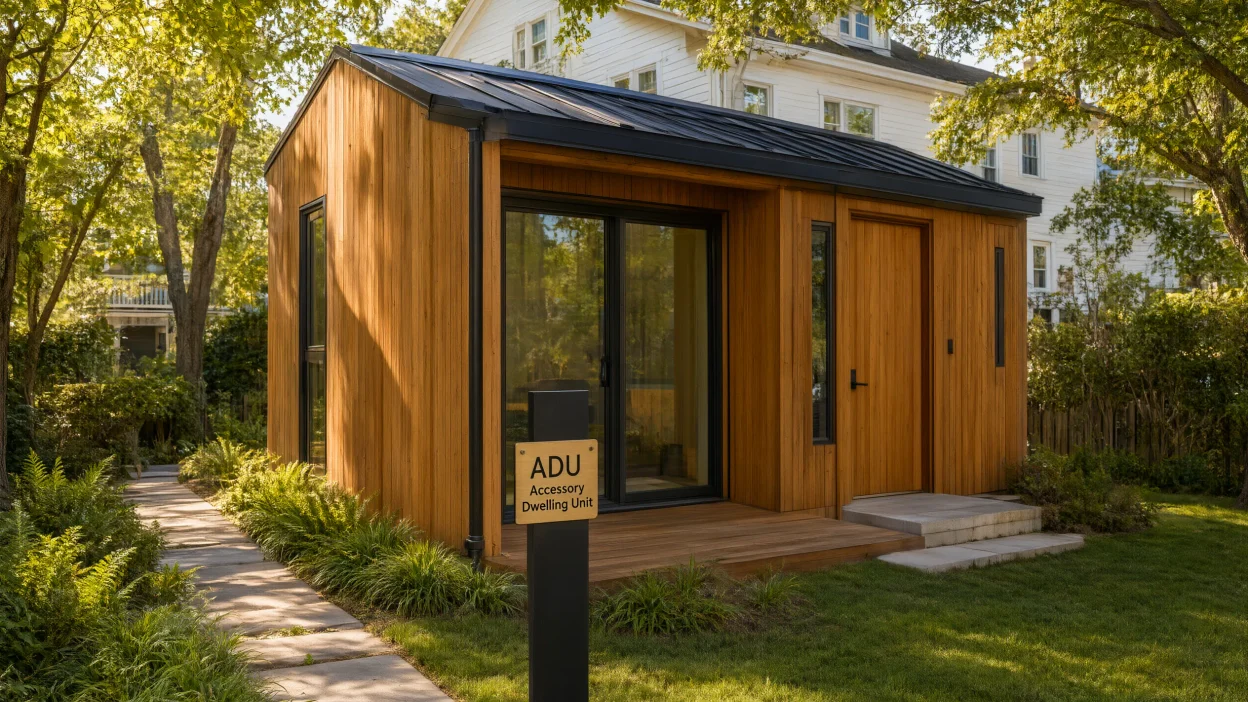
If you have seen ADU in a real estate listing, home renovation plan, or city zoning document, you may be wondering, what does ADU stand for? The answer is Accessory Dwelling Unit.
In simple terms, an ADU is a separate living space on the same property as a main home.
It can be a small backyard house, a converted garage, an apartment above a garage, or a living space attached to the main house.
An ADU is designed to work as an independent home, usually with its own kitchen, bathroom, living space, and entrance.
ADUs are useful for many reasons. A homeowner may use one for family, guests, rental income, aging parents, adult children, or extra private space.
However, the exact rules for building and using an ADU depend on local zoning and building laws.
ADU stands for Accessory Dwelling Unit.
An accessory dwelling unit is a secondary residential unit located on the same property as a primary home.
It is a complete living space rather than simply an extra bedroom or finished room.
An ADU may have:
- A private entrance
- A kitchen or cooking area
- A bathroom
- Sleeping space
- Living space
- Utility connections
- Its own address or entrance, depending on local rules
The basic idea is simple: one property can have a main home and an additional independent living unit.
The word “accessory” means the unit is secondary to the primary residence. “Dwelling unit” means it is designed for people to live in.
ADU Meaning in Simple Words
Think of an ADU as a small second home on the same lot as a main home.
For example, imagine you own a house with a large backyard. You could build a small one-bedroom home behind your main house.
If it meets your local requirements, that backyard home could be an ADU.
An ADU does not always need to be a separate building. It can also be created inside an existing home or structure.
What Is an Accessory Dwelling Unit?
An accessory dwelling unit is a self-contained residential space that shares a property with a primary residence.
This is an important distinction. A spare bedroom is usually not an ADU. A home office is not automatically an ADU.
A shed is not an ADU simply because someone puts furniture inside it.
An ADU is intended to provide independent living space.
For example, a garage conversion may become an ADU when it is legally converted into a livable unit with the required facilities and approvals.
Different jurisdictions use slightly different definitions and requirements, so homeowners should check local rules before starting a project.
What Are the Main Types of ADUs?
ADUs can look very different depending on the property, available space, budget, and local zoning rules.
1. Detached ADU
A detached ADU is a separate building from the main house.
Common examples include:
- Backyard cottages
- Small guest houses
- Standalone rental units
- Small residential buildings behind a main house
A detached ADU can provide more privacy because it does not share interior walls with the primary home.
A detached accessory dwelling unit is sometimes called a DADU, or detached accessory dwelling unit.
2. Attached ADU
An attached ADU is connected to the main house.
It may have its own entrance while sharing one or more walls with the primary residence.
This type can work well when a property does not have enough room for a separate backyard building.
3. Garage Conversion ADU
A garage can sometimes be converted into an ADU.
Instead of using the garage for parking or storage, the space can be redesigned as a small apartment.
A garage conversion may include:
- A bedroom
- Bathroom
- Kitchen
- Living area
- Private entrance
Whether a garage can legally become an ADU depends on local building and zoning requirements.
4. Basement ADU
A basement can sometimes be converted into an independent living unit.
A basement ADU may be useful because the basic structure of the building already exists.
However, requirements involving windows, ceiling height, fire safety, entrances, plumbing, and emergency exits may apply.
5. Above-Garage ADU
Another option is an apartment built above an existing garage.
This arrangement can provide living space without taking up as much additional yard space.
It is often useful when the property already has a detached garage and local rules allow an additional dwelling unit.
What Is an ADU Used For?
One reason ADUs have become popular is their flexibility.
Housing for Family Members
An ADU can give parents, adult children, or other family members a nearby place to live while maintaining more privacy than sharing the main house.
For example, an older parent could live in an ADU while remaining close to family.
Rental Housing
Depending on local laws, an ADU may be rented to a tenant.
This can provide an additional housing option while potentially creating rental income for the homeowner.
However, homeowners should check local rental rules before assuming an ADU can be used as a short-term or long-term rental.
Guest Space
An ADU can provide private space for visitors.
Instead of giving guests a bedroom inside the main house, homeowners can offer a separate living area.
Space for Adult Children
An ADU can also provide a middle ground for adult children who want their own space while staying close to their family.
Home Office or Studio
Some homeowners may use an ADU for work, creative activities, or other purposes.
Whether a particular use is permitted depends on local rules and how the space is legally classified.
What Makes an ADU Different From a Guest House?
The terms ADU and guest house are sometimes used in similar ways, but they are not always legally identical.
An ADU is generally designed as an independent dwelling with facilities for living, cooking, sleeping, and sanitation.
A guest house may be a less formal term for a building used by visitors.
The legal definition matters more than the name. A structure that looks like a small house does not automatically qualify as an ADU.
Local zoning and building regulations determine what is legally permitted.
ADU vs. In-Law Suite
You may also hear terms such as:
- In-law suite
- Mother-in-law apartment
- Granny flat
- Backyard cottage
- Casita
- Secondary dwelling
- Accessory apartment
- Second unit
These terms can describe spaces similar to an ADU.
However, terminology varies by state, city, and local zoning code.
An ADU is the more common planning and real estate term for a secondary dwelling unit on the same property as a primary residence.
What Is the Difference Between an ADU and a Tiny House?
An ADU and a tiny house are not necessarily the same thing.
A tiny house generally describes a small home based on its size or design.
An ADU describes its relationship to another dwelling and the property it occupies.
For example, a small backyard building may qualify as an ADU if it meets local requirements and shares a property with the primary residence.
A tiny house may not qualify as an ADU if it does not meet local requirements for a legal dwelling.
This is why homeowners should not assume that any small house, shed, or prefabricated building can automatically be used as an ADU.
How Big Is an ADU?
There is no single nationwide ADU size that applies everywhere.
ADU size limits can vary based on:
- State law
- City zoning
- Lot size
- Primary home size
- ADU type
- Setback rules
- Building codes
- Local development standards
Some ADUs are very small studio units, while others are large enough for multiple bedrooms.
For example, U.S. Bank notes that ADUs commonly range from about 400 to 1,200 square feet, but that should not be treated as a universal legal size range.
Local regulations control what can actually be built.
Does an ADU Need Its Own Kitchen and Bathroom?
In many jurisdictions, an ADU is expected to have facilities that allow someone to live independently.
These commonly include:
- Cooking facilities
- Bathroom and sanitation facilities
- Sleeping space
- Living space
- An entrance or access arrangement that meets local requirements
This is one of the major differences between an ADU and an ordinary extra room.
However, exact legal requirements vary by location. Always check the local definition before designing an ADU.
Do You Need a Permit to Build an ADU?
In many places, building an ADU requires permits and approval.
The exact process depends on the city, county, and state.
Possible requirements may involve:
- Zoning approval
- Building permits
- Electrical permits
- Plumbing permits
- Mechanical permits
- Site plans
- Building plans
- Fire safety requirements
- Setbacks
- Utility connections
- Inspections
Do not assume that an ADU can be built simply because you have enough space on your property.
Before spending money on plans or construction, contact the appropriate local planning or building department.
How Much Does an ADU Cost?
There is no single price for building an ADU.
The total cost can change based on:
- ADU size
- Location
- Construction type
- Labor
- Materials
- Site conditions
- Utility work
- Foundation work
- Permits
- Design fees
- Plumbing and electrical work
- Interior finishes
A detached unit may have different costs from a garage conversion. A basement conversion may also have different requirements from a new backyard structure.
Because construction prices vary widely by location and project, homeowners should get local estimates instead of relying on one national average.
What Are the Benefits of an ADU?
ADUs can offer several benefits for homeowners.
More Living Space
An ADU adds a separate living area without requiring the homeowner to purchase another property.
Flexible Family Housing
It can provide nearby housing for family members who want more privacy.
Potential Rental Income
Where permitted, an ADU can potentially be rented to a tenant.
Better Use of Existing Property
An ADU can make use of unused backyard, garage, basement, or other suitable space.
Multigenerational Living
Families can live close together while maintaining separate living spaces.
Potential Property Value Benefits
An ADU may add useful housing space to a property, but the effect on property value depends on the local real estate market, the quality and legality of the unit, and buyer demand.
It is better to view increased property value as a possibility rather than a guaranteed result.
What Are the Downsides of an ADU?
ADUs also come with challenges.
Construction Costs
Building a legal living unit can be expensive, especially when major utility, foundation, or structural work is required.
Permits and Regulations
The approval process can take time and may involve several requirements.
Limited Space
Not every property has enough usable space for an ADU.
Privacy Concerns
Adding another household to a property can affect privacy for both the main house and ADU occupants.
Maintenance
An additional dwelling means more space to maintain and repair.
Utility Requirements
Water, sewer, electricity, heating, cooling, and other services may need to be added or upgraded.
Is an ADU a Separate Property?
Usually, an ADU is located on the same lot as the primary residence.
That means it is generally not the same as owning two completely separate houses on two separate lots.
The exact ownership and sale rules depend on local law.
For example, California has specific laws governing ADUs, and some limited circumstances allow separate sale under state law.
That does not mean separate ADU ownership is allowed everywhere.
Can You Rent Out an ADU?
An ADU may be rentable, but rental rules vary by location.
Before renting one, homeowners should check:
- Local zoning rules
- Rental regulations
- Occupancy rules
- Lease requirements
- Short-term rental laws
- Licensing requirements
- HOA rules, if applicable
- State and local tax requirements
A legal ADU is not automatically approved for every type of rental use.
For example, rules for a long-term tenant may differ from rules for a short-term vacation rental.
Can an ADU Be Used as an Airbnb?
Sometimes, but not everywhere.
Short-term rental rules can be much stricter than long-term rental rules.
A city may allow an ADU but limit or prohibit short-term rentals. Other locations may require a permit or license.
If your goal is to operate a short-term rental, check the local rules before building the ADU around that plan.
Why Are ADUs Becoming More Popular?
ADUs offer a way to add housing within an already developed property.
Instead of buying another lot, a homeowner may be able to create an additional dwelling on land they already own.
ADUs can also support different household needs. One property may provide a main home for one household and a smaller independent home for another.
This flexibility has helped make ADUs an important topic in housing, planning, and real estate discussions.
What Does ADU Mean in Real Estate?
In real estate, ADU means Accessory Dwelling Unit.
When you see ADU mentioned in a property listing, it usually refers to an additional residential unit on the same property as the main home.
For buyers, an ADU can be important because it may offer:
- Additional living space
- Family housing
- Rental potential
- Guest accommodation
- A private workspace
However, buyers should verify whether the ADU is legally permitted.
A listing description alone does not prove that every structure on a property is a legal dwelling.
What Does ADU Mean in Zoning?
In zoning, an ADU is generally a secondary dwelling that is allowed under specific local development rules.
Those rules can determine:
- Where an ADU can be located
- How large it can be
- How close it can be to property lines
- How many units are allowed
- Parking requirements
- Building height
- Utility connections
- Occupancy
- Rental use
Because zoning laws are local, an ADU that is allowed in one city may face different requirements in another.
What Does ADU Stand for in Other Contexts?
Although Accessory Dwelling Unit is the common meaning of ADU in U.S. real estate, housing, construction, and zoning, the abbreviation can have other meanings in different fields.
For example, ADU can refer to organizations, universities, scientific terms, and other concepts.
So context matters.
If you see ADU in a real estate listing or home improvement article, Accessory Dwelling Unit is almost certainly the intended meaning.
If you see ADU in another field, the meaning may be different.
Common ADU Terms to Know
If you are researching accessory dwelling units, you may encounter these terms:
ADU: Accessory Dwelling Unit.
DADU: Detached Accessory Dwelling Unit.
JADU: Junior Accessory Dwelling Unit, a special smaller-unit category used in some jurisdictions, including California.
Granny flat: A common informal term for an ADU.
In-law suite: Another informal term for a separate living area intended for family or guests.
Backyard cottage: Usually describes a detached small dwelling located behind a primary home.
Secondary dwelling unit: A term that may be used by local governments for a dwelling that is secondary to the primary home.
The exact definitions of these terms can vary by location.
Questions to Ask Before Building an ADU
If you are thinking about building an ADU, start with these questions:
- Is an ADU allowed on my property?
- What is the maximum permitted size?
- Are there setback requirements?
- Can I build a detached ADU?
- Can I convert my garage?
- What permits are required?
- Are there parking requirements?
- Can the ADU be rented?
- Are short-term rentals allowed?
- How will water, sewer, and electricity be handled?
- Will the property need utility upgrades?
- How much will the complete project cost?
- Will the ADU affect my property taxes or insurance?
- Does my HOA have additional restrictions?
Getting answers to these questions early can prevent expensive surprises later.
Article Summary
ADU stands for Accessory Dwelling Unit. It is a secondary, self-contained living space located on the same property as a primary residence.
An ADU can be:
- Detached in a backyard
- Attached to the main house
- Converted from a garage
- Built inside a basement
- Located above a garage
ADUs are commonly used for family members, guests, rental housing, or additional private living space.
The most important thing to remember is that ADU rules are local. Size limits, permits, rental rules, parking, setbacks, utilities, and other requirements can vary significantly by city, county, and state.
If you are considering an ADU, check your local zoning and building rules before beginning construction.
FAQs
What does ADU stand for?
ADU stands for Accessory Dwelling Unit. It is a secondary residential unit located on the same property as a primary home.
What is an ADU in simple terms?
An ADU is basically a small, independent home on the same property as a main home. It may have its own kitchen, bathroom, living space, sleeping area, and entrance.
Is an ADU the same as a guest house?
Not always. A guest house is a general term, while an ADU is a specific type of residential unit subject to local rules.
A structure must meet local requirements to legally qualify as an ADU.
What are other names for an ADU?
Common terms include granny flat, in-law suite, mother-in-law apartment, backyard cottage, casita, secondary dwelling, and accessory apartment.
Can an ADU have a kitchen?
Yes. An ADU is generally designed to support independent living, so cooking facilities are commonly part of the unit. Exact requirements depend on local regulations.
Can an ADU have a bathroom?
Yes. A legal ADU generally needs sanitation facilities that allow people to live independently.
Can an ADU be detached from the house?
Yes. A detached ADU is a separate building located on the same property as the primary residence.
Can a garage become an ADU?
A garage can sometimes be converted into an ADU if local zoning and building requirements allow it and the conversion meets the required standards.
Can I rent out my ADU?
Possibly. Rental use depends on local laws, zoning, permits, and other regulations. Short-term rental rules may be different from long-term rental rules.
Does an ADU increase home value?
It can, but there is no universal guarantee. The effect depends on factors such as location, legality, construction quality, local demand, and how buyers value additional living space.
How much does an ADU cost?
There is no single nationwide price. Costs depend on size, location, design, construction method, site conditions, utilities, permits, labor, and materials.
Do I need a permit to build an ADU?
In many locations, yes. The exact permits and approval process depend on your city, county, and state.
What is a DADU?
DADU commonly means Detached Accessory Dwelling Unit. It is an ADU that is physically separate from the primary home.
What is a JADU?
JADU means Junior Accessory Dwelling Unit. It is a special type of smaller unit recognized under certain local or state laws, including California.
Is an ADU the same as a tiny house?
No. A tiny house describes a small home, while an ADU describes a secondary dwelling associated with a primary residence. A tiny house does not automatically qualify as an ADU.
Conclusion
So, what does ADU stand for? ADU stands for Accessory Dwelling Unit.
In simple terms, it is a secondary, independent living space on the same property as a primary home.
It can be a detached backyard cottage, garage conversion, basement apartment, attached unit, or another approved residential space.
ADUs can provide flexible housing for family members, guests, tenants, or homeowners who need additional private space.
They may also offer rental opportunities where local laws allow them.
The key point is that ADU laws are not the same everywhere. Before building, buying, or renting an ADU, check your local zoning, building, permit, and rental requirements.
That is the best way to understand what is legally possible on your property.

Emma Wilson is a writer at MeaningVibz who enjoys exploring emoji meanings, texting expressions, and online communication trends. She helps readers understand how emojis and slang are used in different situations by providing clear explanations and relatable examples for everyday messaging.