
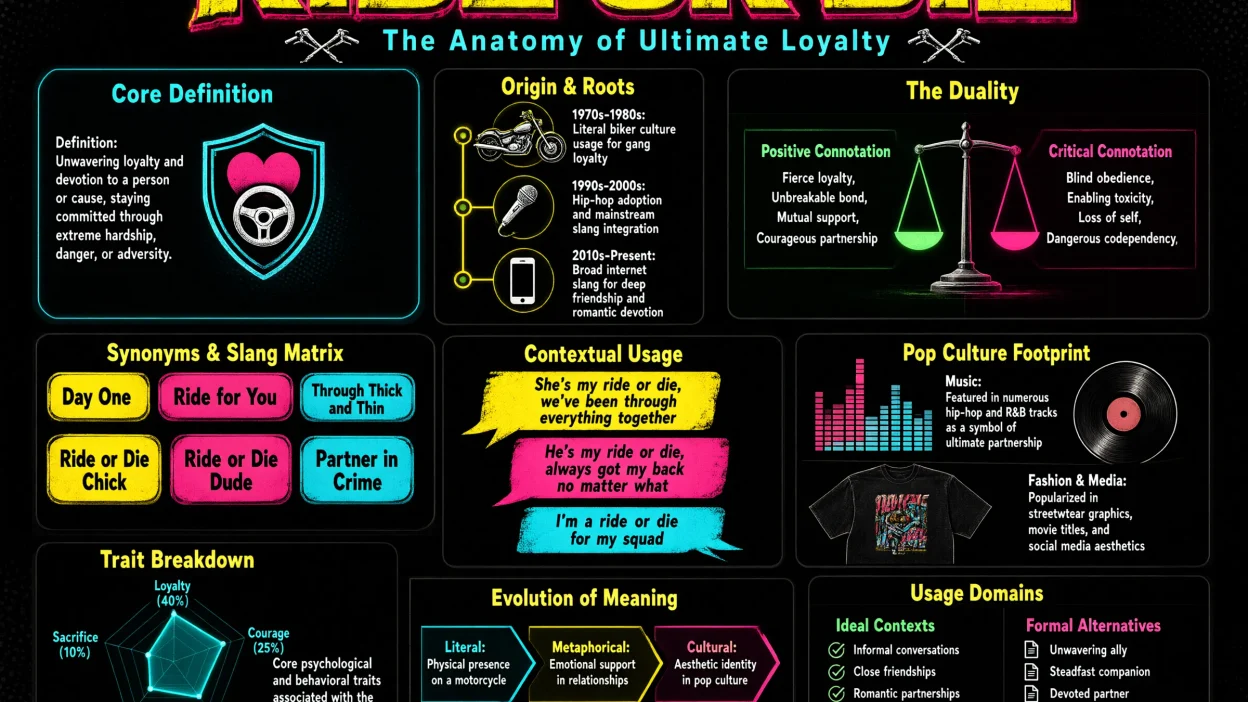
Ride or die means someone who is extremely loyal and supportive and will stick with you through difficult times.
In simple words:
Ride or die = someone who always has your back.
For example:
“Jessica is my ride or die.”
This means Jessica is a person the speaker trusts deeply and can count on.
The phrase can describe:
- A best friend
- A romantic partner
- A sibling
- A family member
- A close teammate
- A longtime companion
It usually shows a strong bond based on loyalty, trust, support, and commitment.
Dictionary.com describes the expression as a colloquial term for extreme loyalty. (Dictionary.com)
Does “Ride or Die” Have a Literal Meaning?
Usually, no.
The phrase is generally figurative. The word “ride” suggests staying on the journey with someone, while “die” adds the idea of staying loyal even when things become very difficult.
So when someone says:
“I’ll ride or die with you.”
They normally mean:
“I’ll stay by your side and support you through the hard times.”
It is often an exaggerated way to show how strong a relationship or friendship is.
What Is the Meaning of “Ride or Die” in Slang?
In slang, ride or die describes a person who is deeply loyal to someone else.
It can mean:
- “I’m always here for you.”
- “You can count on me.”
- “I won’t leave you when things get hard.”
- “I have your back.”
- “We’re in this together.”
The phrase is informal, so it fits better in casual conversations, texts, captions, music, and social media than in formal writing.
For example:
“That girl is my ride or die.”
The speaker is saying that the girl is a very close and trusted person.
Wiktionary similarly defines the slang noun as someone who is wholeheartedly committed and supportive. (Wiktionary)
What Does “My Ride or Die” Mean?
“My ride or die” means my most loyal person or trusted companion.
For example:
“My sister is my ride or die.”
This means the speaker trusts their sister and believes she will support them through good and bad times.
Another example:
“He has been my ride or die since high school.”
This suggests that the person has remained loyal and supportive for many years.
The phrase can sound affectionate, emotional, funny, or playful depending on the situation.
Ride or Die Meaning in a Relationship
In a romantic relationship, ride or die usually describes a partner who is deeply loyal and committed.
For example:
“She’s my ride or die.”
This can mean:
- She supports me.
- She stays with me during hard times.
- I trust her completely.
- We face problems together.
- She is committed to our relationship.
It does not necessarily mean that the couple agrees on everything.
A healthy version of being “ride or die” can mean supporting your partner while still having boundaries and making good choices.
For example, you can support someone emotionally without supporting harmful or illegal behavior.
That distinction is important because extreme loyalty should not mean accepting abuse, dishonesty, or dangerous actions.
Ride or Die Meaning in Friendship
The phrase is also very common between close friends.
If someone says:
“You’re my ride or die.”
They may mean:
“You’re one of my closest friends, and I know I can depend on you.”
A ride-or-die friend might:
- Listen when you have a bad day
- Help you during a difficult situation
- Celebrate your success
- Give honest advice
- Keep your private matters private
- Stay supportive when life gets stressful
For example:
“We’ve been friends for 15 years. She’s definitely my ride or die.”
Here, the phrase highlights long-term trust and friendship.
Ride or Die Meaning in Texting
When someone uses ride or die in a text, it usually has the same meaning as in spoken slang.
Examples include:
“You’re my ride or die ❤️”
Meaning:
“You’re one of the people I trust and love most.”
Or:
“Thanks for being my ride or die.”
Meaning:
“Thank you for always supporting me.”
Because texting is informal, the phrase can be used in a playful way too.
For example:
“Pizza and Netflix tonight. You’re my ride or die 😂”
Here, the speaker is joking about spending time together.
Ride or Die Meaning on Social Media
On Instagram, TikTok, Facebook, and other social platforms, ride or die often appears in captions about friendship, love, or loyalty.
Common examples include:
“My ride or die forever.”
“Best friend and ride or die.”
“Forever grateful for my ride or die.”
“My partner in crime and my ride or die.”
On social media, the phrase is often affectionate rather than serious. It can simply mean that two people have a very close relationship.
Where Did “Ride or Die” Come From?
The history of ride or die is more complex than its modern casual use suggests.
Sources commonly connect the expression to American biker culture, where the idea involved a strong commitment to riding.
Over time, the expression developed into a broader idea of staying loyal through danger or hardship.
It later became associated strongly with hip-hop and popular culture. (Dictionary.com)
Dictionary.com notes that the expression became prominent through hip-hop culture and later expanded into mainstream use. (Dictionary.com)
The phrase was once used in a more intense context, especially when describing a partner who would remain loyal to someone involved in a dangerous lifestyle.
Its meaning later became much broader.
Today, you do not need to be talking about motorcycles, danger, or crime to use ride or die.
You can simply use it to describe a loyal friend or partner.
How the Meaning Has Changed
The modern meaning is much softer than some of the phrase’s earlier cultural uses.
Originally, the expression could carry a strong sense of danger and total commitment.
As it entered mainstream American English, people began using it for everyday relationships.
Today, someone might call their:
- Best friend a ride or die
- Husband or wife a ride or die
- Sister a ride or die
- Brother a ride or die
- Favorite celebrity a ride or die
- Favorite sports team a ride or die
So the phrase has moved from a more specific cultural expression to a general way of talking about strong loyalty.
What Does a Ride-or-Die Person Act Like?
A ride-or-die person is usually someone you can depend on.
They may show loyalty by:
1. Being There During Hard Times
A loyal person does not disappear as soon as you face a problem.
They may listen, help, or simply stay close when you need support.
2. Celebrating Your Wins
Loyalty is not only about difficult moments.
A good friend also celebrates your achievements and wants to see you succeed.
3. Giving Honest Advice
Being loyal does not mean agreeing with everything you do.
A true friend can tell you when you are making a bad choice while still caring about you.
4. Showing Trust
A close relationship often involves trust.
You may feel comfortable sharing personal thoughts, problems, or plans with a ride-or-die friend.
5. Staying Consistent
One reason the phrase feels powerful is that it suggests consistency.
The person is not supportive only when things are easy.
Does “Ride or Die” Mean Unconditional Love?
It can suggest very strong or unconditional loyalty, but the exact meaning depends on context.
When people use the phrase casually, they may simply mean:
“I will always support you.”
However, it should not be understood as a promise to accept every action someone takes.
For example, being someone’s ride or die does not require you to support abuse, violence, cheating, fraud, or other harmful behavior.
Healthy loyalty includes boundaries.
You can care about someone deeply and still say:
“I love you, but I can’t support that decision.”
That can actually be a stronger form of loyalty because it combines care with honesty.
Is “Ride or Die” Only for Romantic Partners?
No.
This is one of the most common misunderstandings.
A ride or die can be anyone with whom you share a strong bond.
For example:
Friend:
“Mark is my ride or die.”
Partner:
“My wife is my ride or die.”
Sibling:
“My brother has always been my ride or die.”
Family member:
“My mom is my ride or die.”
The phrase is not limited to dating or marriage.
Is “Ride or Die” a Compliment?
Yes, in most casual situations, calling someone your ride or die is a compliment.
It tells the person that you see them as:
- Loyal
- Trustworthy
- Dependable
- Supportive
- Important
- Close to you
For example:
“You are seriously my ride or die.”
This normally expresses appreciation and affection.
Ride or Die vs. Ride-or-Die
You may see the phrase written in two ways:
- ride or die
- ride-or-die
Both forms appear in modern English, but they can be used differently depending on grammar.
When the phrase stands alone as a noun, you might write:
“She is my ride or die.”
When it works as an adjective before another noun, the hyphenated form is common:
“She is my ride-or-die friend.”
The hyphens connect the words because the whole phrase is describing friend.
Wiktionary lists ride-or-die as an alternative form. (Wiktionary)
Ride or Die Examples
Here are some simple examples of how Americans may use the phrase.
Example 1: Best Friend
“You have been there for me through everything. You’re my ride or die.”
Meaning:
You are my most loyal and trusted friend.
Example 2: Romantic Partner
“I know my husband is my ride or die.”
Meaning:
The speaker believes her husband will stay supportive through difficult times.
Example 3: Text Message
“Thanks for picking me up. You’re a ride or die 😂”
Meaning:
The speaker is jokingly thanking a loyal friend.
Example 4: Social Media Caption
“Forever with my ride or die.”
Meaning:
The person is expressing strong loyalty and affection toward someone close.
Example 5: Family
“My sister is my ride or die.”
Meaning:
The speaker sees her sister as a deeply trusted and supportive person.
Synonyms for Ride or Die
Depending on the situation, similar expressions include:
- Loyal friend
- Trusted friend
- Best friend
- Loyal partner
- Devoted partner
- Trusted companion
- Reliable person
- Someone who has your back
- Partner in crime
- Faithful supporter
- True friend
- Someone you can count on
The exact synonym depends on the tone.
For casual American slang, “has your back” is especially close in meaning.
For example:
“She always has my back.”
This communicates a similar idea of loyalty and support.
What Is the Opposite of a Ride or Die?
There is no single perfect opposite, but some expressions are:
- Disloyal person
- Unreliable friend
- Fair-weather friend
- Backstabber
- Someone who abandons you
- Untrustworthy person
A fair-weather friend is especially useful as a contrast.
A fair-weather friend may be around when everything is fun and easy but disappear when you need help.
A ride or die, by contrast, is associated with staying supportive during difficult times.
Is “Ride or Die” Formal or Informal?
Ride or die is informal slang.
It is suitable for:
- Text messages
- Social media
- Casual conversations
- Songs
- Movies
- Friendly conversations
- Personal captions
It is usually not the best choice for:
- Academic essays
- Formal business reports
- Legal writing
- Professional documents
In formal writing, use words such as loyal, committed, supportive, dependable, or devoted instead.
Common Mistakes About “Ride or Die”
Mistake 1: Taking It Literally
The phrase usually does not mean someone will literally die.
It is an exaggerated expression of loyalty.
Mistake 2: Thinking It Is Only Romantic
A ride or die can be a friend, sibling, parent, or another trusted person.
Mistake 3: Thinking Loyalty Means Agreeing With Everything
Being loyal does not mean supporting every decision.
A good friend can offer honest advice.
Mistake 4: Using It in Formal Writing
The phrase is casual slang, so it may sound inappropriate in professional or academic writing.
Mistake 5: Assuming It Always Has a Serious Meaning
People often use ride or die playfully.
For example, two friends might call each other ride or dies because they always go out together.
How to Use “Ride or Die” in a Sentence
Here are several natural sentence patterns:
As a noun:
“She is my ride or die.”
As a compound adjective:
“She is my ride-or-die friend.”
With “for”:
“I’ll ride or die for my best friend.”
In a relationship:
“I want a partner who will be my ride or die.”
In a friendship:
“We’ve been ride or die since college.”
The exact grammar can change depending on whether the phrase is being used as a noun, adjective, or informal verb phrase. (Wiktionary)
FAQs
What does “ride or die” mean in simple words?
Ride or die means a person who is extremely loyal and will support you through good times and bad times.
In simple terms, it means someone who always has your back.
What does “my ride or die” mean?
“My ride or die” means a person I deeply trust and who I believe will stay loyal to me.
It can refer to a best friend, romantic partner, sibling, or family member.
Is ride or die a slang term?
Yes. Ride or die is informal slang commonly used in casual speech, texting, social media, music, and popular culture.
What does ride or die mean in a relationship?
In a relationship, it usually means a partner who is deeply loyal, committed, supportive, and willing to stay together through difficult times.
What does ride or die mean in friendship?
In friendship, it means someone you trust and can depend on.
A ride-or-die friend is someone who stays supportive when life becomes difficult.
Is calling someone “ride or die” a compliment?
Yes. In most situations, it is a strong compliment. It suggests that the person is loyal, dependable, trusted, and important to you.
Can a family member be your ride or die?
Yes. A parent, sibling, cousin, or another family member can be your ride or die if you have a strong and loyal bond.
What is another word for ride or die?
Similar terms include loyal friend, trusted companion, devoted partner, true friend, dependable person, and someone who has your back.
What is the difference between ride or die and best friend?
A best friend is a very close friend. Ride or die adds a stronger idea of loyalty and standing by someone through difficult situations. A best friend can be a ride or die, but the terms are not always identical.
Where did the phrase ride or die come from?
The phrase is commonly linked to American biker culture and later became strongly associated with hip-hop and popular culture.
Its meaning gradually broadened into the modern idea of extreme loyalty. (Dictionary.com)
Does ride or die mean unconditional support?
It can express very strong loyalty, but it should not mean supporting harmful or abusive behavior. Healthy loyalty can include honest advice and personal boundaries.
Is “ride or die” the same as “partner in crime”?
Not exactly. Both can describe a close companion, but partner in crime is often playful and can refer to someone you do fun or mischievous things with.
Ride or die focuses more strongly on loyalty and support.
Article Summary
The ride or die meaning is simple: it describes someone who is extremely loyal, supportive, and dependable.
When you call someone your ride or die, you are saying that you trust them and believe they will stay by your side through difficult times.
The phrase can describe a romantic partner, best friend, sibling, family member, or another close person. It is common in texting, social media, music, and casual American English.
Although ride or die has roots connected to biker culture and later became prominent through hip-hop and popular culture, its modern meaning is usually much less literal.
Today, it mainly expresses strong loyalty and commitment. (Dictionary.com)
Conclusion
The ride or die meaning is essentially a deeply loyal person who sticks with you through good times and bad.
It is a casual slang expression that can describe a best friend, romantic partner, sibling, or another person you trust.
When someone says, “You’re my ride or die,” they are usually saying, “I trust you, I value you, and I know you have my back.”
The phrase is not normally meant literally. Instead, it is a strong and often affectionate way to describe loyalty, friendship, love, and commitment.
Just remember that healthy loyalty does not require supporting every choice someone makes.
You can be someone’s ride or die while still being honest, setting boundaries, and encouraging good decisions.

Ryan Mitchell creates informative content about word definitions, acronyms, online slang, and modern communication. He enjoys exploring how people use language in text messages, on social media, and in daily life. Ryan focuses on delivering simple explanations and practical examples that help readers quickly understand the meaning of unfamiliar words and phrases.