
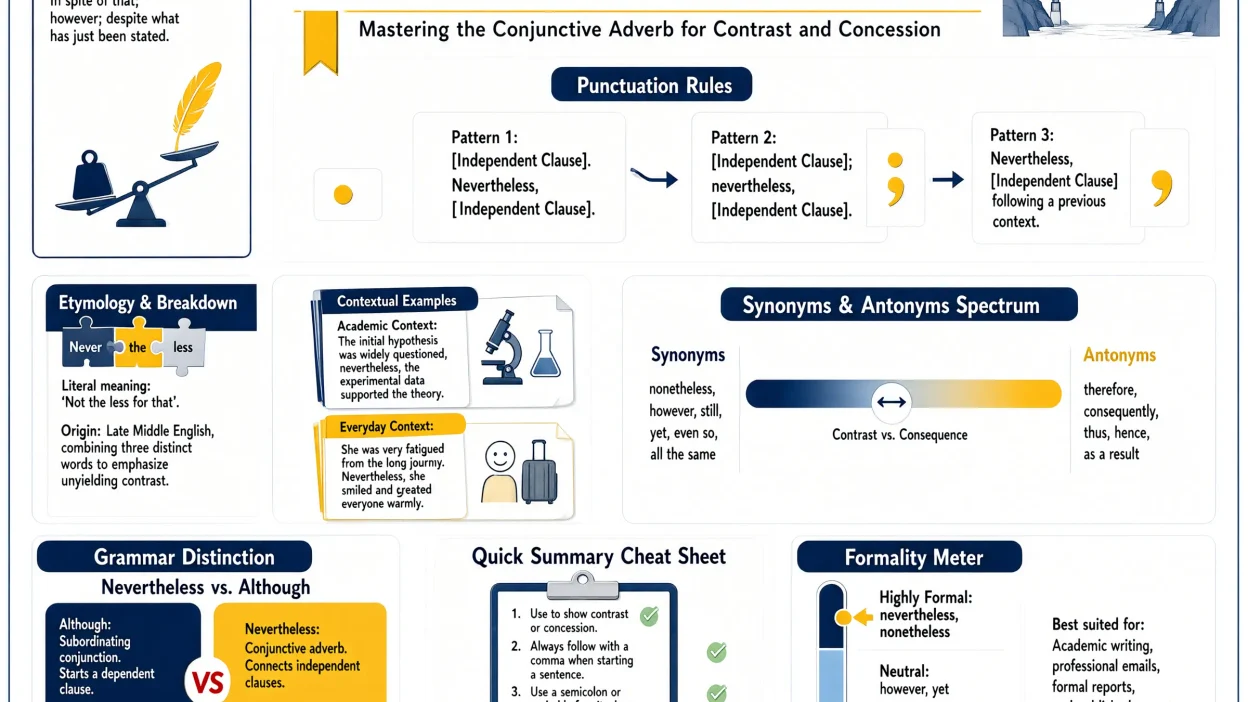
Nevertheless means despite that, even so, or in spite of what was just mentioned.
It connects two ideas that seem to contrast with each other.
The first idea may suggest one result, but the second idea shows that the result is different.
Simple definition
Nevertheless = despite that; even so; still; however.
For example:
- The weather was cold. Nevertheless, we went outside.
- She was tired. She nevertheless finished her work.
- The job is difficult. Nevertheless, I want to try it.
- He made several mistakes. Nevertheless, he learned from them.
The word does not erase the first fact. Instead, it says that the first fact does not stop the second fact from being true.
Nevertheless Meaning in Simple English
If you want the easiest possible explanation, think of nevertheless as:
“That is true, but this is also true.”
For example:
The movie was very long. Nevertheless, I enjoyed it.
This means:
The movie was very long, but I enjoyed it anyway.
Another example:
He was nervous. Nevertheless, he gave the speech.
This means:
He was nervous, but he gave the speech anyway.
So, when you see nevertheless, look for a contrast.
What Part of Speech Is Nevertheless?
Nevertheless is an adverb. More specifically, it is commonly used as a conjunctive adverb to connect ideas and show contrast.
Cambridge also identifies nevertheless as an adverb.
It can appear at the beginning, middle, or end of a sentence.
At the beginning
Nevertheless, we decided to continue.
In the middle
We nevertheless decided to continue.
At the end
We decided to continue nevertheless.
All three forms can express the idea of “even so” or “despite that.”
How to Pronounce Nevertheless
The American English pronunciation of nevertheless is approximately:
nev-er-thuh-LESS
The stress is commonly placed on the final part, “less.”
A simple pronunciation guide is:
/ˌnev.ɚ.ðəˈles/
Cambridge lists this American pronunciation and also provides a British pronunciation.
Try saying it in four parts:
nev – er – the – less
Is Nevertheless One Word?
Yes. Nevertheless is written as one word.
Correct:
Nevertheless, I went.
Incorrect:
Never the less, I went.
The form “never the less” is not the normal modern spelling when you mean the contrast word.
Nevertheless Examples in Sentences
The easiest way to understand this word is to see it in real sentences.
Everyday examples
- It was raining. Nevertheless, we went for a walk.
- I was tired. Nevertheless, I finished my homework.
- The restaurant was crowded. Nevertheless, the service was fast.
- She was nervous. Nevertheless, she performed well.
- The road was difficult. Nevertheless, they reached the town.
- He did not agree with me. Nevertheless, we remained friends.
- The price was high. Nevertheless, I bought the product.
- The plan had problems. Nevertheless, we decided to continue.
- The task was challenging. Nevertheless, the team completed it.
- I knew it would be difficult. Nevertheless, I wanted to try.
In each example, the second statement happens despite the first statement.
Examples of Nevertheless in Different Situations
At school
The assignment was difficult. Nevertheless, Maya completed it on time.
The assignment was difficult, but that did not prevent Maya from finishing it.
At work
The project had a tight deadline. Nevertheless, the team finished it early.
The short deadline could have caused a delay, but the team still finished early.
In daily conversation
I was tired, but I nevertheless went to the gym.
Here, nevertheless means “even so” or “anyway.”
In writing
The evidence was limited. Nevertheless, the researchers continued their work.
This use is more formal and works well in essays, reports, and professional writing.
How to Use Nevertheless Correctly
There are several common ways to use nevertheless.
1. At the beginning of a sentence
This is one of the easiest patterns:
Nevertheless, + sentence
Example:
The trip was expensive. Nevertheless, we had a great time.
A comma usually follows nevertheless when it begins the sentence.
2. Between two commas
You can place it inside a sentence as an interrupting adverb.
The trip was, nevertheless, worth the cost.
This style is grammatically possible but may sound more formal.
3. Before the main verb
You can also put nevertheless before the main verb.
She nevertheless continued working.
Here, the meaning is:
She continued working despite the difficulty.
4. At the end of a sentence
You can use it at the end to mean “anyway” or “even so.”
The plan was risky, but we tried it nevertheless.
This position is natural and useful in both speech and writing.
Nevertheless vs. However
Nevertheless and however are very close in meaning. Both can show contrast.
For example:
The task was difficult. Nevertheless, we finished it.
The task was difficult. However, we finished it.
Both sentences communicate a similar idea.
There can be a small difference in tone. Nevertheless often strongly emphasizes that the second fact remains true despite the first fact.
However is a more general contrast word.
Cambridge lists however, still, and yet as synonyms of nevertheless.
Simple rule
Use nevertheless when you want the idea:
“Despite that, this is still true.”
Use however when you simply want to introduce a contrasting idea.
Nevertheless vs. Nonetheless
Nevertheless and nonetheless have almost the same meaning.
For example:
The weather was bad. Nevertheless, we went outside.
The weather was bad. Nonetheless, we went outside.
Both mean:
The weather was bad, but we went outside anyway.
Cambridge lists nevertheless as another word for nonetheless, while its definition of nonetheless also gives nevertheless as the equivalent.
Which one should you use?
You can usually use either.
Nevertheless is very common and easy to understand.
Nonetheless has the same basic function and can be used in many of the same sentences.
Nevertheless vs. But
The words but and nevertheless both show contrast, but they do not work in exactly the same way.
But
But is a conjunction.
I was tired, but I went to work.
Nevertheless
Nevertheless is an adverb.
I was tired. Nevertheless, I went to work.
You can also say:
I was tired, but I went to work nevertheless.
A useful point is that you should not normally join two complete sentences with only nevertheless in the same way you would with but.
Easy comparison
But: connects contrasting ideas directly.
Nevertheless: emphasizes that the second idea is true despite the first.
Nevertheless vs. Still
Still can sometimes replace nevertheless.
Compare:
It was raining. Still, we went outside.
It was raining. Nevertheless, we went outside.
Both mean that the rain did not stop the action.
However, still is more common in casual speech, while nevertheless can sound more formal or polished.
Nevertheless vs. Yet
Yet can also show contrast.
The instructions were confusing, yet he completed the task.
This is similar to:
The instructions were confusing. Nevertheless, he completed the task.
The main difference is grammar and style.
Yet can work directly as a conjunction between two clauses, while nevertheless is an adverb.
Nevertheless vs. Anyway
In some sentences, anyway has a similar meaning.
It was late, but we went anyway.
It was late. Nevertheless, we went.
Both can suggest that the action happened despite the situation.
However, anyway is more casual. Nevertheless is often better for formal writing.
Is Nevertheless Formal or Casual?
Nevertheless is not extremely formal, but it is more common in careful or formal writing than in casual conversation.
You may see it in:
- Essays
- Reports
- Articles
- Academic writing
- Business writing
- Speeches
- News writing
- Formal emails
In casual conversation, people often use:
- But
- Still
- Yet
- Even so
- Anyway
- However
For example, instead of saying:
The plan was difficult. Nevertheless, we tried it.
A friend might say:
The plan was difficult, but we tried it anyway.
Both are correct.
Can You Start a Sentence With Nevertheless?
Yes.
Starting a sentence with nevertheless is completely normal.
Example:
The instructions looked complicated. Nevertheless, I understood them quickly.
When nevertheless begins a sentence, it is commonly followed by a comma.
Pattern
Nevertheless, + independent clause.
Example:
Nevertheless, she decided to go.
This is one of the most common ways to use the word.
Can Nevertheless Be Used With “But”?
Yes, you may sometimes see but nevertheless, especially when nevertheless adds extra emphasis.
Example:
The plan was risky, but nevertheless, they accepted it.
However, using both can sometimes be unnecessary because but and nevertheless already perform similar contrast functions.
A cleaner sentence may be:
The plan was risky. Nevertheless, they accepted it.
Or:
The plan was risky, but they accepted it anyway.
For simple writing, avoid adding extra words when one clear contrast word is enough.
Common Synonyms for Nevertheless
The most useful synonyms and near-synonyms include:
- However
- Nonetheless
- Still
- Yet
- Even so
- All the same
- In spite of that
- Despite that
- Anyway
- Notwithstanding
Dictionary.com also defines nevertheless using ideas such as nonetheless, notwithstanding, however, and in spite of that.
Not every synonym works in exactly the same grammatical position, so choose one based on the sentence.
Nevertheless Meaning in a Sentence
Here are some simple sentence patterns you can copy when learning the word.
Pattern 1
Fact. Nevertheless, result.
The weather was terrible. Nevertheless, we enjoyed the trip.
Pattern 2
Subject + nevertheless + verb.
She nevertheless accepted the offer.
Pattern 3
Fact, but + result + nevertheless.
The task was hard, but we finished it nevertheless.
Pattern 4
Despite the problem, result.
Despite the problem, we continued.
This last example does not use nevertheless, but it shows the same basic contrast.
Common Mistakes With Nevertheless
Mistake 1: Spelling it as three words
Incorrect:
Never the less, I continued.
Correct:
Nevertheless, I continued.
Mistake 2: Using it without a contrast
Nevertheless normally introduces an idea that contrasts with something already mentioned.
Weak:
I ate breakfast. Nevertheless, I drank coffee.
There is no strong contrast between the two ideas.
Better:
I was not hungry. Nevertheless, I ate breakfast.
Now the contrast is clear.
Mistake 3: Using too many contrast words
You usually do not need several contrast words together.
Awkward:
However, nevertheless, we decided to continue.
Better:
Nevertheless, we decided to continue.
Or:
However, we decided to continue.
Mistake 4: Thinking it means “therefore”
Nevertheless does not mean therefore, so, or because of that.
Compare:
The road was closed. Therefore, we went home.
This shows a result.
The road was closed. Nevertheless, we continued.
This shows contrast.
What Is the Opposite of Nevertheless?
There is no single perfect opposite, but words such as therefore, thus, and consequently can express a different relationship.
Compare:
The weather was bad. Nevertheless, we went hiking.
This means the bad weather did not stop us.
Now:
The weather was bad. Therefore, we stayed home.
This means the bad weather caused or supported the decision to stay home.
So:
- Nevertheless → contrast
- Therefore → result
Is Nevertheless the Same as “Despite”?
They can express a similar idea, but they are used differently.
Despite is normally followed by a noun, noun phrase, or gerund.
Despite the rain, we went outside.
Despite being tired, she continued.
Nevertheless usually connects ideas or refers back to something already mentioned.
It was raining. Nevertheless, we went outside.
So you cannot always replace one directly with the other.
Compare
Despite the rain, we went outside.
It was raining. Nevertheless, we went outside.
The meaning is similar, but the grammar is different.
Is Nevertheless the Same as “In Spite Of”?
It has a similar meaning, but the grammar is different.
In spite of the problem, we continued.
There was a problem. Nevertheless, we continued.
Both express the idea that the problem did not stop the action.
Nevertheless in Academic and Professional Writing
Because nevertheless clearly shows contrast, it can be useful in essays, reports, and professional writing.
For example:
The study had several limitations. Nevertheless, the results provide useful information.
The sentence first admits a weakness and then explains why the work is still valuable.
Another example:
The first approach was expensive. Nevertheless, it produced better results.
This makes the relationship between the two ideas easy to understand.
When writing, do not use nevertheless simply to make your writing sound more advanced. Use it when there is a real contrast.
Nevertheless Meaning for English Learners
If English is not your first language, remember this simple formula:
NEVERTHELESS = DESPITE THAT + STILL TRUE
For example:
I was sick. Nevertheless, I went to class.
Think:
I was sick → this could have stopped me → it did not → I went to class.
That is the basic idea behind the word.
Easy memory trick
Break the meaning into:
“That happened. Even so, this happened.”
Whenever you can use “even so”, you can often use “nevertheless.”
Example:
The test was hard. Even so, I passed.
→
The test was hard. Nevertheless, I passed.
20 Simple Nevertheless Examples
- The car was old. Nevertheless, it ran well.
- She was busy. Nevertheless, she helped me.
- The food was expensive. Nevertheless, it was delicious.
- He was tired. Nevertheless, he kept working.
- It was cold. Nevertheless, we went swimming.
- The road was long. Nevertheless, we enjoyed the drive.
- The book was difficult. Nevertheless, I finished it.
- They disagreed. Nevertheless, they worked together.
- The room was small. Nevertheless, it was comfortable.
- The project was challenging. Nevertheless, we completed it.
- He was afraid. Nevertheless, he moved forward.
- The plan had risks. Nevertheless, they approved it.
- She had little experience. Nevertheless, she did a great job.
- The store was busy. Nevertheless, we found what we needed.
- The instructions were unclear. Nevertheless, I completed the task.
- The team was young. Nevertheless, they played well.
- The journey was tiring. Nevertheless, it was worth it.
- I disagreed with his idea. Nevertheless, I respected his opinion.
- The results were unexpected. Nevertheless, they were useful.
- The situation was difficult. Nevertheless, we remained hopeful.
PAA: Common Questions About Nevertheless
What does nevertheless mean?
Nevertheless means “despite that,” “even so,” “still,” or “however.”
It is used to show that something remains true even though the previous statement might suggest otherwise.
What is an easy synonym for nevertheless?
Easy synonyms include however, still, yet, nonetheless, and even so.
The best choice depends on the sentence and the level of formality.
Does nevertheless mean but?
Not exactly. Both can show contrast, but but is a conjunction, while nevertheless is an adverb. For example: “I was tired, but I worked.”
You can also say, “I was tired. Nevertheless, I worked.”
Is nevertheless a positive word?
No. Nevertheless is not positive or negative by itself. It simply shows contrast between ideas.
Can nevertheless start a sentence?
Yes. This is a common use.
Nevertheless, we decided to continue.
Is nevertheless formal?
It is somewhat more formal than but or anyway, and it is common in careful writing, academic writing, and professional communication.
What is the difference between nevertheless and nonetheless?
There is very little difference. Nevertheless and nonetheless generally mean the same thing and can often be used interchangeably.
What is the difference between nevertheless and however?
Both can express contrast. Nevertheless often has the stronger sense of “despite that” or “even so,” while however is a broad contrast marker.
Can I use nevertheless in casual conversation?
Yes. It is grammatically correct, but it may sound a little more polished or formal than words such as but, still, or anyway.
What is the opposite of nevertheless?
There is no exact opposite. However, therefore, thus, and consequently express a result rather than a contrast.
Article Summary
The nevertheless meaning is “despite that,” “even so,” “still,” or “however.” It is an adverb used to show contrast.
The word tells the reader that the second idea remains true even though the first idea might suggest a different result.
For example:
“The weather was bad. Nevertheless, we went outside.”
This means:
“The weather was bad, but we went outside anyway.”
Nevertheless is similar to nonetheless, however, still, yet, and even so. It can appear at the beginning, middle, or end of a sentence.
It is especially useful in clear, careful, academic, and professional writing.
Conclusion
Understanding nevertheless is easy once you connect it with the phrase “even so.”
The word shows that something is true despite another fact or situation.
The simplest definition is:
Nevertheless = despite that; even so; still.
For example:
“The assignment was difficult. Nevertheless, I finished it.”
You can use nevertheless at the beginning, middle, or end of a sentence.
It is similar to nonetheless and however, but its strongest idea is often “despite what was just said.”
When you are unsure whether to use it, try replacing it with “even so.” If the sentence still makes sense, nevertheless may be a good choice.

Ryan Mitchell creates informative content about word definitions, acronyms, online slang, and modern communication. He enjoys exploring how people use language in text messages, on social media, and in daily life. Ryan focuses on delivering simple explanations and practical examples that help readers quickly understand the meaning of unfamiliar words and phrases.