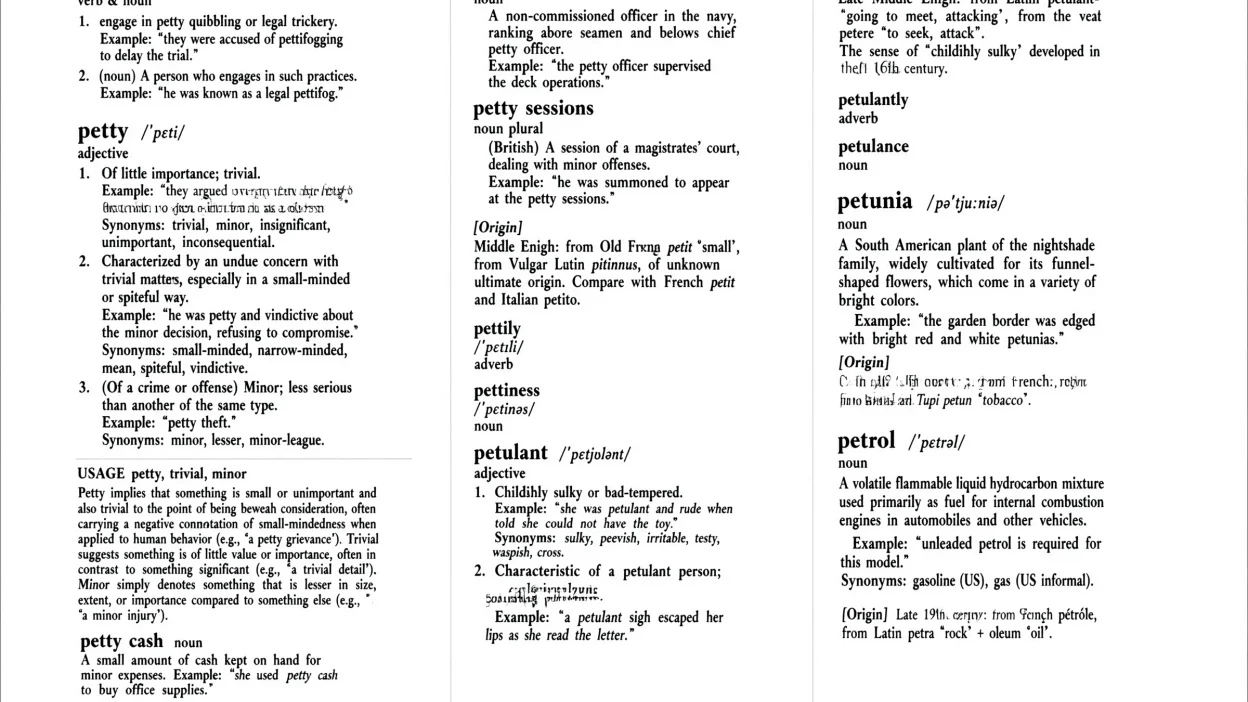
The most common petty meaning is small, minor, or unimportant.
When used to describe a person’s behavior, petty usually means caring too much about a small matter or reacting to it in an unnecessarily mean, childish, or narrow-minded way.
Cambridge defines petty as something unimportant or not serious and also uses it for someone who complains too much about unimportant things. (Cambridge Dictionary)
Simple Definition of Petty
Petty means:
- Small or unimportant
- Minor or trivial
- Small-minded
- Overly concerned with little problems
- Sometimes spiteful or childish
Example
“They had a petty argument about who should sit in the front seat.”
The argument is called petty because the issue is small and not very important.
Another example:
“He was being petty by refusing to help her because she forgot his birthday.”
Here, petty describes behavior that seems unnecessarily upset or spiteful over a small issue.
Petty Meaning in Simple English
In very simple words, petty means making too much of something small.
Imagine two friends have a tiny disagreement.
One friend could simply move on, but instead, they ignore the other person, complain about them, or try to get revenge.
That behavior may be called petty.
The word does not always describe a person as a whole.
It can describe an action, argument, complaint, disagreement, comment, rule, or problem.
For example:
- A petty complaint = a complaint about something very small.
- A petty argument = an argument over an unimportant issue.
- A petty person = someone who makes too much of small issues.
- Petty revenge = a small or spiteful attempt to get back at someone.
Collins also notes that petty can describe problems, rules, or arguments that are unimportant, as well as behavior that is overly concerned with small things. (Collins Dictionary)
What Does It Mean to Call Someone Petty?
Calling someone petty usually means you think they are reacting badly to a small situation.
It can suggest that the person is:
- Immature
- Small-minded
- Unnecessarily angry
- Spiteful
- Too focused on minor details
- Trying to get even over something small
For example:
“She is being petty because he didn’t invite her to lunch.”
The speaker believes her reaction is too strong for the situation.
However, petty can sometimes be used in a playful way between friends.
Someone may jokingly admit:
“I know I’m being petty, but I’m going to watch the movie without him.”
In this case, the speaker knows the reaction is a little childish and is making fun of themselves.
Petty Meaning in Slang
In modern informal speech and social media, petty often has a more playful meaning.
In slang, being petty can mean doing something small or dramatic because you feel annoyed, ignored, embarrassed, or wronged. It may involve a minor revenge move or an exaggerated reaction.
For example:
“He unfollowed her because she didn’t reply to his message. That’s petty.”
Another example:
“She knew I liked that seat, so she took it first. So petty!”
In online conversations, petty is often used humorously. The person may not have done anything seriously harmful.
Instead, their behavior is simply unnecessarily dramatic over a small issue.
Still, the traditional meaning remains important. The word can be negative when the behavior is mean or unreasonable.
Is Being Petty Always Bad?
Not always.
The word petty usually has a negative meaning, especially when describing someone’s character or behavior.
But in casual conversation, people sometimes use it in a funny or self-aware way.
Negative Use
“His petty behavior caused a bigger problem.”
This means his behavior was unreasonable or mean.
Playful Use
“I was being petty and took the last cookie.”
This may simply be a joke about doing something slightly annoying.
The context and tone matter. If someone says “Don’t be petty,” they usually mean:
“Stop making such a big deal out of this small issue.”
Examples of Petty Behavior
Understanding examples can make the petty meaning much easier to remember.
1. Ignoring Someone Over a Small Issue
Someone forgets to say hello, and you refuse to speak to them all day.
That could be considered petty.
2. Getting Revenge Over Something Minor
A friend makes a small joke about you, so you deliberately make an annoying comment about them later.
That may be petty revenge.
3. Arguing About Tiny Details
Two coworkers spend 20 minutes arguing about which font size should be used in a simple note.
Someone might describe this as a petty argument.
4. Holding a Small Grudge
Someone accidentally takes your parking spot once, and you stay angry for months.
That can be described as petty.
5. Making a Small Problem Bigger
A person receives a drink that is slightly different from what they ordered and becomes extremely angry.
Their reaction could be called petty if the situation does not justify it.
Petty vs. Mean
These words are related, but they are not exactly the same.
Mean usually describes behavior that is unkind or hurtful.
Petty focuses more on the small or unimportant reason behind the behavior.
For example:
“He was mean to his coworker.”
This simply says he behaved unkindly.
“He was petty because he refused to help his coworker after a tiny disagreement.”
This tells us that his reaction was connected to a small issue.
A person can be mean without being petty, and a person can sometimes be petty without seriously hurting anyone.
Petty vs. Immature
Immature means behaving in a way that is not emotionally mature.
Petty often describes a specific reaction to a small problem.
For example:
“He was immature during the meeting.”
This is a broad statement about his behavior.
“He was petty because he refused to share the report after a minor disagreement.”
This points to a specific small-minded reaction.
The two words can overlap, but they are not perfect synonyms.
Petty vs. Trivial
Trivial usually means something has little importance.
Petty can mean the same thing, but it can also describe someone’s attitude or behavior.
For example:
“It was a trivial problem.”
The problem itself was not important.
“She was petty about the trivial problem.”
Her behavior toward that unimportant problem was unreasonable.
Vocabulary.com explains that petty commonly refers to things that are trivial or should not matter much, while it can also have more neutral uses in phrases such as petty cash. (Vocabulary.com)
Common Phrases With “Petty”
The word petty appears in many common English phrases.
Petty Argument
A petty argument is a disagreement about something small or unimportant.
Example:
“They had a petty argument about whose turn it was to choose the restaurant.”
Petty Revenge
Petty revenge means doing something small or spiteful to get back at someone.
Example:
“Deleting the shared playlist was just petty revenge.”
Petty Crime
A petty crime is a relatively minor crime.
The exact legal meaning of a crime can vary by jurisdiction, so petty crime should not be treated as one universal legal category.
Petty Theft
Petty theft generally refers to theft involving property below a value threshold set by applicable law.
The legal threshold differs by location. (WebDictionary.co.uk)
Petty Cash
Petty cash has a different and more neutral meaning.
It refers to a small amount of money kept available for minor business or everyday expenses.
For example:
“I used petty cash to buy office supplies.”
Here, petty does not mean childish or spiteful.
Petty Officer
A petty officer is a military or naval rank. In this context, petty relates to rank or status rather than childish behavior.
This is an important reminder that you should always consider the context when interpreting the word.
Petty Synonyms
The best synonym depends on how petty is being used.
When Petty Means Small or Unimportant
- Minor
- Trivial
- Insignificant
- Unimportant
- Small
- Little
- Negligible
- Slight
When Petty Describes Behavior
- Small-minded
- Spiteful
- Childish
- Mean
- Narrow-minded
- Niggling
- Unreasonable
For example, minor works well for “a petty offense,” while small-minded may work better for “a petty person.”
No single synonym works perfectly in every sentence.
Opposite of Petty
The opposite of petty depends on the context.
When petty means small or unimportant, possible opposites include:
- Important
- Major
- Significant
- Serious
- Important
When petty describes someone’s behavior, possible opposites include:
- Mature
- Reasonable
- Understanding
- Generous
- Forgiving
- Big-hearted
- Magnanimous
For example:
“Instead of being petty, she was mature and forgave him.”
How to Use “Petty” in a Sentence
Here are some natural examples:
- “That was a petty argument.”
- “Don’t be petty about such a small mistake.”
- “He is acting petty because he didn’t get his way.”
- “They got into a petty disagreement.”
- “She admitted that her reaction was petty.”
- “His petty comments annoyed everyone.”
- “I don’t want to get involved in their petty drama.”
- “They were fighting over a petty issue.”
- “That seems like a petty reason to end the friendship.”
- “She made a petty attempt to get revenge.”
What Does “Don’t Be Petty” Mean?
“Don’t be petty” means:
“Don’t make a big deal out of something small.”
It can also mean:
“Don’t act childish, spiteful, or unnecessarily difficult because of a minor problem.”
For example:
“He forgot to text you back. Don’t be petty.”
The speaker is telling the person not to overreact.
The phrase can sound serious, teasing, or humorous depending on the tone.
What Does “So Petty” Mean?
When someone says “so petty,” they usually mean that a person has reacted to a small issue in an unnecessarily dramatic, childish, or spiteful way.
Example:
“She blocked him because he liked someone else’s picture. So petty!”
In casual social media language, the phrase may be used as a joke rather than a serious insult.
Can “Petty” Be a Compliment?
Usually, petty is not a true compliment because it normally points to a negative quality.
However, friends sometimes use it playfully.
For example:
“That was petty, but I have to admit it was funny.”
Here, the speaker is not praising the behavior as mature or kind. They are simply finding the small act amusing.
So, whether petty sounds harsh or playful depends heavily on context, relationship, and tone.
Petty Meaning in Texting
In texting, petty usually keeps the same informal meaning.
If someone texts:
“You’re being petty.”
They probably mean:
“You’re making too much of a small issue.”
If someone texts:
“I’m about to be petty 😂”
They may be joking that they are planning a small act of revenge or a playful response.
The emoji, conversation, and relationship between the people can change how serious the word sounds.
Is “Petty” a Bad Word?
No. Petty is not a swear word or profanity.
It is a normal English adjective. However, calling someone petty can be insulting because it suggests that the person is childish, small-minded, or unreasonable.
For example:
“That was a petty decision.”
This criticizes the decision.
“You’re a petty person.”
This is more personal and may sound rude.
If you want to be polite, you could say:
“I think you’re putting too much focus on a small issue.”
That communicates a similar idea in a softer way.
PAA: Common Questions About Petty
What does petty mean in simple terms?
Petty means small, unimportant, or trivial. When describing a person, it often means they make too much of small problems or act in a childish or spiteful way.
What does it mean when someone calls you petty?
It means they think you are reacting too strongly to a minor issue or behaving in a small-minded or unnecessarily difficult way.
Is petty the same as childish?
Not exactly. Childish means immature, while petty often focuses on an unnecessary reaction to a small issue. The two words can overlap.
What is an example of a petty person?
Someone who gets very upset over a tiny mistake, holds a grudge, or takes unnecessary revenge over a small issue could be described as petty.
What does petty mean in slang?
In slang, petty often means reacting to a small problem with unnecessary drama, attitude, or minor revenge. It can be serious or playful depending on context.
What does “petty revenge” mean?
Petty revenge means taking a small or spiteful action to get back at someone, usually because of a minor disagreement or slight.
What is the opposite of petty?
Depending on the context, opposites include important, significant, mature, reasonable, generous, forgiving, and understanding.
Is petty always negative?
Usually, yes, but people often use it playfully or jokingly in casual conversation.
What does “don’t be petty” mean?
It means “don’t overreact to a small issue” or “don’t act childish or spiteful about something minor.”
What is another word for petty?
Depending on the meaning, alternatives include minor, trivial, insignificant, small-minded, childish, spiteful, and niggling.
Article Summary
The petty meaning is mainly connected to something small, minor, or unimportant.
When the word describes a person’s behavior, it usually means they are making too much of a small issue or acting in a childish, spiteful, or small-minded way.
For example, a person who starts a major argument over a tiny mistake may be called petty.
The word can also appear in phrases such as petty argument, petty revenge, petty crime, petty theft, and petty cash.
The meaning changes slightly with context. Petty cash, for example, refers to a small amount of money and does not describe bad behavior.
Understanding the surrounding words is therefore important.
Conclusion
The simplest way to remember the petty meaning is: making too much of something small.
The word can describe something minor or unimportant, such as a petty complaint or petty issue.
It can also describe a person’s behavior when they react to a small problem in an unnecessarily childish, spiteful, or small-minded way.
In everyday American English, you may hear phrases such as “Don’t be petty,” “That’s petty,” and “He’s being petty.”
These expressions usually suggest that someone is giving too much attention to a minor issue.
At the same time, petty is not always about behavior. Phrases such as petty cash and petty officer have different meanings.
The best way to understand the word is to look at the context in which it appears. (Collins Dictionary)

Ryan Mitchell creates informative content about word definitions, acronyms, online slang, and modern communication. He enjoys exploring how people use language in text messages, on social media, and in daily life. Ryan focuses on delivering simple explanations and practical examples that help readers quickly understand the meaning of unfamiliar words and phrases.