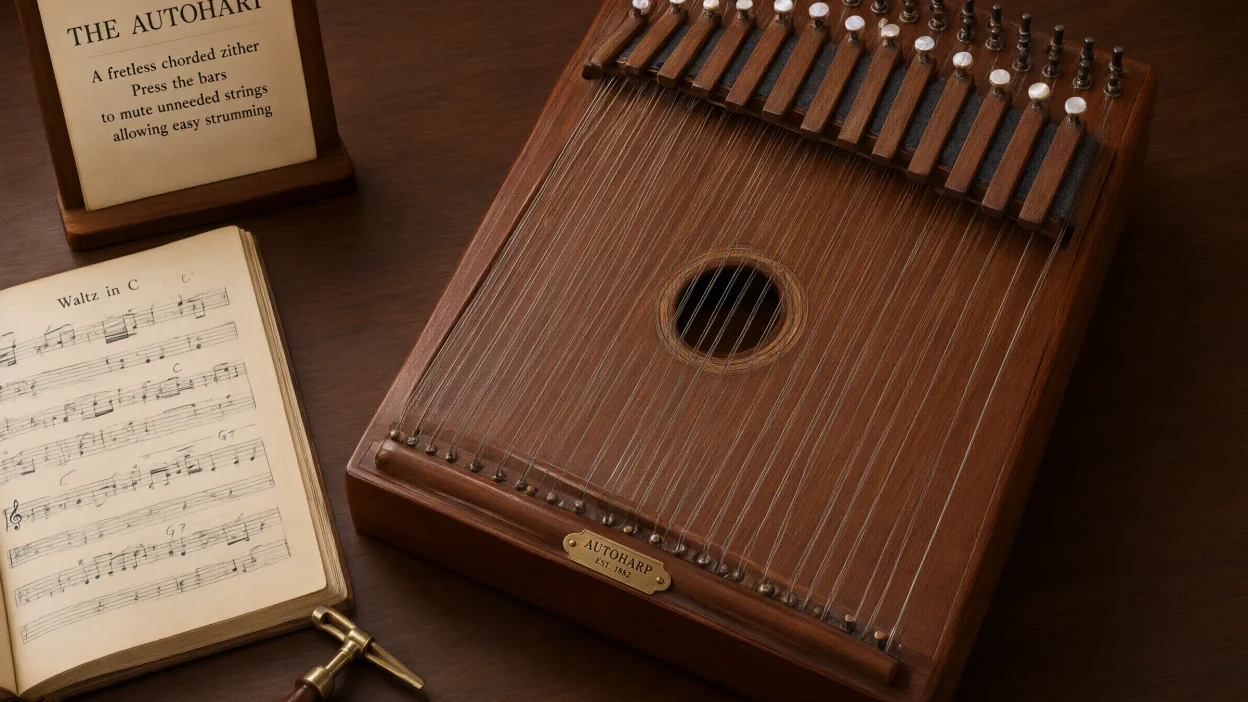
Autoharp means a stringed musical instrument that uses chord bars or buttons to help a player produce chords.
An autoharp belongs to the zither family. It has a flat wooden body with many strings stretched across it.
Above the strings are chord bars fitted with felt or similar dampening material.
When a player presses one of these bars, some strings are muted while others are allowed to ring.
The result is a chord that can be played with a simple strum.
In very simple terms:
Autoharp = strings + chord buttons/bars + strumming.
The word may sound like the instrument plays by itself, but that is not what “auto” means here.
The player still has to press the correct chord bar and strum or pluck the strings.
Simple Autoharp Definition
An easy definition is:
An autoharp is a string instrument with chord bars that mute unwanted strings so the player can easily produce chords.
It is often used for chordal accompaniment and has strong connections to folk, country, bluegrass, and traditional music.
Is an Autoharp Actually a Harp?
No. Despite its name, an autoharp is not a member of the harp family.
It is a type of zither. A zither is a string instrument in which the strings are stretched across a body rather than attached to a tall frame like those found on traditional harps.
This is one of the most important things to understand about the autoharp meaning.
A traditional harp has strings that the player usually plucks individually. An autoharp, on the other hand, uses chord bars to select groups of strings.
The player can then strum across several strings at once.
So:
- Harp: Usually played by plucking individual strings.
- Autoharp: Uses chord bars to select strings and is commonly strummed.
- Zither: A broad family of instruments with strings stretched across a body.
- Autoharp: A chorded zither with a special damping system.
How Does an Autoharp Work?
The basic mechanism is surprisingly simple.
An autoharp has many strings. When you strum across all of them without using a chord bar, many different notes may sound together.
That would not always create a useful chord.
The chord bars solve this problem.
When you press a chord bar, its felt or padded dampers move against the strings.
The dampers stop certain strings from vibrating. The strings that are not muted remain free to ring.
Those remaining strings form the selected chord.
For example, if you press a C major chord bar, the mechanism allows the strings needed for the C major chord to ring while muting other strings.
You can then strum the strings and hear the chord.
The Basic Playing Process
Playing a simple chord on an autoharp can be broken into three steps:
- Choose a chord.
- Press the matching chord bar.
- Strum the strings.
Changing chords is mainly a matter of releasing one bar and pressing another.
That is why the instrument can be attractive to beginners who want to accompany singing without first learning complicated guitar-style chord shapes.
What Are the Main Parts of an Autoharp?
Understanding the parts can make the autoharp much easier to understand.
1. Strings
The strings are the part that creates the sound.
Modern autoharps commonly have many metal strings.
Different models can have different numbers of strings, and some instruments use chromatic or diatonic arrangements.
2. Chord Bars
Chord bars sit above the strings.
Each bar is labeled for a particular chord, such as:
- C
- G
- F
- Am
- Dm
- G7
When you press a bar, its dampers mute the strings that should not sound.
3. Dampers
Dampers are usually made with felt or another soft material.
Their job is to stop selected strings from vibrating.
This is the key feature that makes the autoharp different from a basic zither.
4. Soundboard
The soundboard helps the vibrations from the strings become an audible musical sound.
5. Body
The body holds the strings, tuning hardware, chord-bar system, and other parts together. It is often made from wood.
6. Tuning Pins
Tuning pins hold the strings and allow the player to adjust their pitch.
7. Sound Hole
Many autoharps have a sound hole that helps project the sound from the instrument.
How Do You Play an Autoharp?
The traditional technique is fairly straightforward.
The player uses one hand to control the chord bars and the other hand to strum the strings.
The exact position can vary. An autoharp may be placed on a table or held against the body.
Historical and modern playing styles include both positions.
A beginner might start with three simple chords.
For example, in the key of C, C, F, and G or G7 are common basic chords. These chords can support many simple songs.
Basic Example
Imagine a song with this chord pattern:
C → F → C → G7 → C
You could:
- Press the C chord bar.
- Strum.
- Press F.
- Strum again.
- Return to C.
- Press G7 when needed.
- Finish on C.
The exact technique depends on the song and the instrument.
Is the Autoharp Easy to Play?
The autoharp can be easier to start than some other string instruments because the chord-bar system reduces the need to learn traditional chord fingerings.
A beginner does not need to form a C major or G major shape with several fingers in the same way a guitar player does.
Instead, the player presses the labeled chord bar.
However, “easy to start” does not mean “easy to master.”
Good autoharp playing can involve:
- Accurate rhythm
- Smooth chord changes
- Controlled strumming
- Melody playing
- Finger picking
- Muting
- Dynamics
- Advanced chord techniques
Experienced players can go well beyond basic strumming.
Modern techniques can allow players to combine melody, chords, bass notes, and rhythmic patterns.
What Does an Autoharp Sound Like?
An autoharp typically produces a bright, ringing, acoustic sound.
Because several strings can sound together, chords can have a full and resonant quality.
Its sound can fit especially well with:
- Folk music
- Country music
- Bluegrass
- Americana
- Traditional music
- Singer-songwriter performances
The exact sound depends on the instrument, strings, tuning, playing technique, and recording or amplification setup.
Some autoharps can also be fitted with pickups for amplification.
What Is the History of the Autoharp?
The history of the autoharp is more complicated than its simple design may suggest.
The term Autoharp appeared in connection with a U.S. patent granted to Charles F. Zimmermann in 1882.
The patent described a zither-like instrument with a mechanism for selectively damping strings to create chords.
Another important patent was granted in Germany to Hermann Lindemann and Karl August Gütter in 1885 for a related damping mechanism.
Over time, instruments using this general design became known as autoharps or chord zithers.
The name was originally associated with a trademark, but “autoharp” later became widely used as a general name for instruments of this type.
Why Is the Autoharp Important in Folk Music?
The autoharp became closely connected with American folk and country music because it could provide chordal accompaniment without requiring complex chord shapes.
It was especially useful for singers who wanted to accompany themselves.
The instrument also became strongly associated with the Carter Family and performers such as Maybelle Carter.
The autoharp was not limited to background accompaniment, though. Players eventually developed techniques that allowed it to take a more active melodic role.
Today, the instrument continues to appear in folk, country, bluegrass, Americana, and other musical settings.
What Is an Autoharp Used For?
An autoharp can be used for several musical purposes.
Chord Accompaniment
This is one of its most common uses.
A singer can press chord bars and strum while singing.
Folk Music
Its warm acoustic sound works well with traditional folk songs.
Country Music
The autoharp has a long history in American country and traditional music.
Bluegrass
Some players use the instrument to add rhythm and harmony to bluegrass arrangements.
Teaching Music
Because the chord system is easy to understand, autoharps can also be useful for introducing beginners to chords and harmony.
Solo Performance
Advanced players can use finger-style methods and other techniques to play more than simple accompaniment.
Autoharp vs. Harp
The names are similar, but the instruments work differently.
| Feature | Autoharp | Harp |
| Instrument family | Zither | Harp family |
| Main method | Strumming and plucking | Mostly plucking |
| Chord system | Chord bars | Individual strings |
| Shape | Flat or trapezoidal | Tall frame |
| Strings | Stretched across the body | Attached to a frame |
| Beginner chords | Chord bars make them accessible | Requires learning string patterns |
The biggest difference is the way the player selects notes.
An autoharp uses its chord-bar system to mute unwanted strings. A traditional harp player normally chooses individual strings directly.
Autoharp vs. Zither
The relationship is much closer here.
An autoharp is essentially a chorded zither.
A basic zither may have strings stretched across its body, but it does not necessarily have the autoharp’s chord-bar system.
So “zither” describes a broader family, while “autoharp” describes a specific type of chorded string instrument.
Autoharp vs. Guitar
An autoharp and guitar can both provide chords for a singer, but they use different techniques.
On guitar, the player normally presses strings against frets to create chord shapes.
On an autoharp, the player presses a chord bar that automatically selects the appropriate strings.
This can make basic chord accompaniment feel more direct on an autoharp.
However, the guitar offers a very large range of chord shapes, notes, techniques, and playing styles.
An autoharp has its own strengths but is not simply a replacement for a guitar.
What Does “Auto” Mean in Autoharp?
The “auto” part of autoharp does not mean the instrument is automatic or plays without a person.
It refers to the way the mechanism helps select the notes needed for a chord.
When a player presses a chord bar, the bar’s dampers mute unwanted strings.
This lets the player strum across the strings without manually choosing every individual note.
That mechanical chord-selection system is the key idea behind the name.
Is Autoharp One Word or Two?
The standard spelling is autoharp, written as one word.
You may also see variations such as:
- auto harp
- auto-harp
- chorded zither
- chord zither
However, autoharp is the common modern spelling.
What Is a Chorded Zither?
A chorded zither is a zither designed to make chords easier to play.
The autoharp is a well-known example.
Instead of requiring the player to select every note of a chord separately, the instrument uses a mechanical system to mute unwanted strings.
This gives the player a simple way to produce a group of notes together.
Can an Autoharp Play a Melody?
Yes.
Although many people think of an autoharp mainly as a chord instrument, skilled players can use techniques that allow melodies to be played.
Traditional chordal playing involves pressing a chord bar and strumming across the strings.
More advanced players can pluck individual strings, use different picking patterns, and combine melody with chords.
Diatonic instruments can be particularly useful for certain melodic approaches, while chromatic instruments provide access to a wider range of notes.
How Many Strings Does an Autoharp Have?
The number of strings depends on the model.
Many modern autoharps have 36 strings, while other designs can have more or fewer.
Some historical and specialized instruments differ considerably in their string count.
The number of chord bars also varies.
Common models may have:
- 12 chord bars
- 15 chord bars
- 21 chord bars
Specialized instruments can have different configurations.
What Is a Diatonic Autoharp?
A diatonic autoharp is arranged around one key or a limited group of keys.
It does not provide every possible note in the same way as a fully chromatic instrument.
Instead, its strings are selected to work especially well within certain musical keys.
This can give the instrument a strong, full sound within those keys.
Diatonic autoharps are often used by players who want to focus on particular keys and styles.
What Is a Chromatic Autoharp?
A chromatic autoharp provides access to a wider set of notes, including sharps and flats.
This gives the player more flexibility when changing keys or playing melodies.
The trade-off is that the string arrangement and playing technique may be more complex than on a simple diatonic instrument.
The best choice depends on what the player wants to do.
Is an Autoharp Good for Beginners?
For many beginners, an autoharp can be a friendly introduction to string instruments.
Its biggest advantage is the chord-bar system.
Instead of learning complicated finger positions for every chord, the player can use labeled bars.
A beginner can start by learning:
- How to hold the instrument
- How to tune it
- How to press chord bars
- How to strum evenly
- How to change between basic chords
- How to follow a simple chord chart
Once those skills become comfortable, the player can explore more advanced techniques.
Common Questions About Autoharp Meaning
Does an autoharp play automatically?
No. The player still controls the instrument. The chord-bar mechanism simply helps select which strings should sound.
Is an autoharp the same as a zither?
Not exactly. An autoharp is a type of zither, more specifically a chorded zither with a damping system.
Is an autoharp a real harp?
No. Despite its name, it belongs to the zither family rather than the harp family.
Is an autoharp easy to learn?
Basic chord accompaniment can be relatively easy to learn because the chord bars simplify chord selection.
Advanced playing can take much more practice.
What music uses an autoharp?
Autoharps are strongly associated with folk, country, bluegrass, traditional music, and Americana.
Can you play songs on an autoharp?
Yes. An autoharp can accompany many songs using chord changes. Advanced players can also play melodies and more complex arrangements.
What is another name for an autoharp?
A common descriptive name is chorded zither.
How is an autoharp different from a guitar?
A guitar player normally creates chords by pressing strings against frets.
An autoharp player selects chords with chord bars and then strums the strings.
FAQs
What is the simple meaning of autoharp?
The simple meaning of autoharp is a stringed instrument that uses chord bars to mute unwanted strings, allowing the player to strum and produce chords.
Why is it called an autoharp?
The name comes from the instrument’s chord-selection mechanism.
The system helps select the strings needed for a chord, but the instrument does not play by itself.
Is an autoharp easy to play?
Basic playing can be beginner-friendly because the chord bars make it easier to produce common chords. Becoming an advanced player requires practice and good control.
Is an autoharp a harp or a zither?
An autoharp is a zither, not a traditional harp.
What family does the autoharp belong to?
The autoharp belongs to the zither family of string instruments.
Who invented the autoharp?
The history includes several inventors and patents. Charles F. Zimmermann received a U.S. patent in 1882 for an instrument using a mechanism to selectively damp strings.
How does an autoharp make chords?
When a chord bar is pressed, its dampers mute strings that are not needed.
The remaining strings can then be strummed to produce the selected chord.
What are autoharps used for?
They are commonly used for chord accompaniment and can be heard in folk, country, bluegrass, traditional, and Americana music.
Can an autoharp play individual notes?
Yes. While chord strumming is its best-known use, skilled players can pluck individual strings and use advanced techniques to play melodies and more complex parts.
How many chord bars does an autoharp have?
The number varies by model. Common instruments may have 12, 15, or 21 chord bars, while specialized models can have different arrangements.
Article Summary
The autoharp meaning is simple: it is a stringed instrument from the zither family that uses chord bars to mute unwanted strings.
When a player presses a chord bar and strums the strings, the strings left ringing produce the selected chord.
Although its name contains “harp,” an autoharp is not a traditional harp. It is a chorded zither.
The instrument is closely linked with American folk and country music and has also been used in bluegrass, Americana, education, and solo performance.
Its chord-bar system makes basic chord playing approachable, while advanced techniques allow experienced musicians to play melodies, bass lines, and more complex musical parts.
Conclusion
Understanding the autoharp meaning is much easier once you know how the instrument works. An autoharp is a stringed zither, not a traditional harp.
Its special chord bars use dampers to mute unwanted strings, allowing the player to press a chord and strum the instrument.
This simple design makes the autoharp useful for beginners and experienced musicians alike.
It has a long connection with American folk and country music and can also be used for bluegrass, Americana, teaching, accompaniment, and advanced solo playing.
In short, an autoharp is best understood as a chord-playing string instrument that combines many strings with an easy-to-use mechanical chord system.

Emma Wilson is a writer at MeaningVibz who enjoys exploring emoji meanings, texting expressions, and online communication trends. She helps readers understand how emojis and slang are used in different situations by providing clear explanations and relatable examples for everyday messaging.