Introduction
Have you ever tapped your phone on a payment terminal and wondered what makes it work so fast? The answer is NFC.
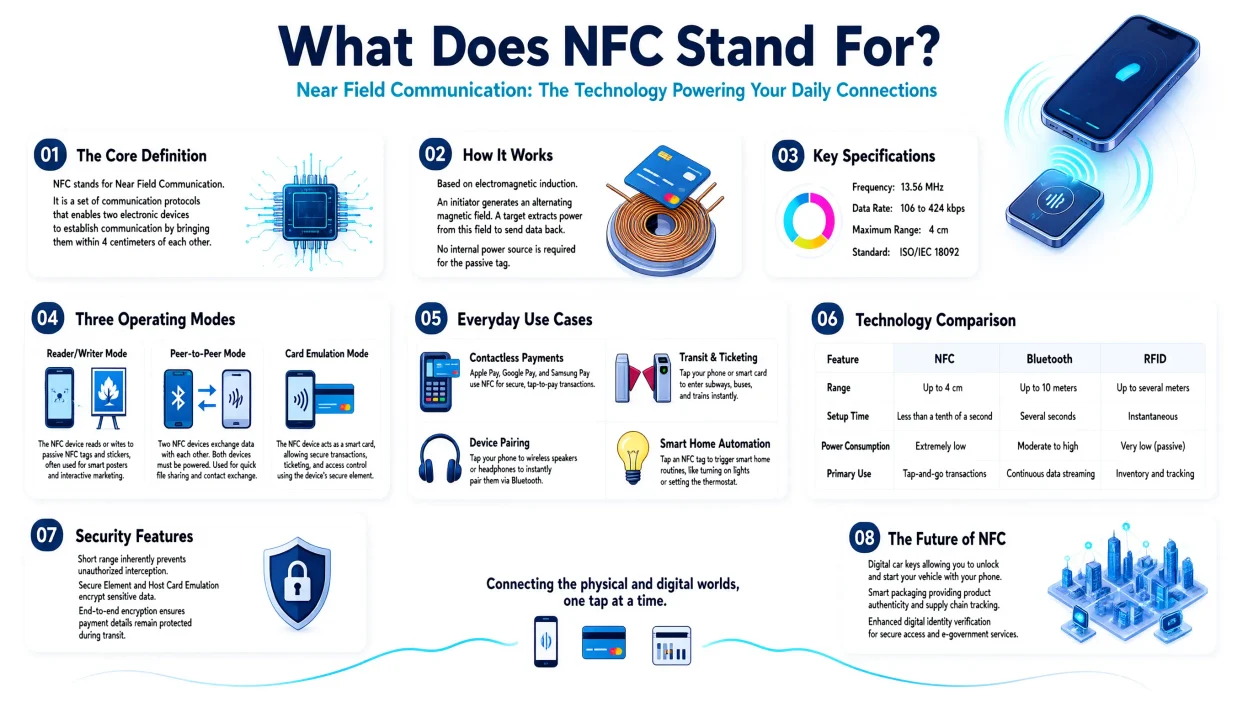
So, what does NFC stand for? NFC stands for Near Field Communication.
It is a short-range wireless technology that lets compatible devices exchange small amounts of information when they are very close to each other.
Apple describes NFC as communication between devices within a few centimeters, while Android documentation says an NFC connection typically starts at about 4 centimeters or less. (Apple Developer)
You may already use NFC every day without thinking about it. It can power contactless payments, transit passes, access cards, NFC tags, and quick device connections.
In this guide, you will learn what NFC means, how it works, what NFC does on a phone, where it is used, how safe it is, and how it compares with Bluetooth and RFID.
NFC stands for Near Field Communication.
It is a short-range wireless communication technology designed to exchange information between compatible devices or between a device and an NFC tag.
The name tells you a lot:
- Near means the devices must be very close.
- Field refers to the electromagnetic field used for communication.
- Communication means information can be exchanged between compatible devices.
NFC usually works within only a few centimeters.
Android’s official documentation describes NFC as a group of short-range wireless technologies that typically require a distance of 4 cm or less to start a connection. (Android Developers)
This very short range is one of NFC’s main features. Unlike Wi-Fi or Bluetooth, you normally need to bring the phone, card, tag, or reader very close together.
NFC Full Form
The NFC full form is:
N = Near
F = Field
C = Communication
So, when someone asks, “What does NFC stand for?”, the simple answer is Near Field Communication.
What Is NFC?
NFC is a wireless technology that allows two compatible devices to exchange information over a very short distance.
For example, you can hold an NFC-enabled phone near a contactless payment terminal.
The devices communicate wirelessly, allowing the payment process to begin.
NFC can also work with small chips called NFC tags. These tags can store information such as a web address or other small data.
A compatible phone can read the information when it is brought close to the tag. Apple and Android both provide support for reading NFC tags on compatible devices. (Apple Developer)
NFC is not designed for sending large files or maintaining a long-distance connection. Its strength is quick, close-range interactions.
How Does NFC Work?
NFC works by using short-range radio communication and electromagnetic fields.
The basic process is simple:
- An NFC reader creates a small electromagnetic field.
- Another NFC device or tag comes close to the reader.
- The devices communicate through the NFC connection.
- Small amounts of information are exchanged.
- The connection ends when the devices move away from each other.
Some NFC tags do not need their own battery. A nearby NFC reader can provide the energy needed for the tag to respond.
This is one reason NFC tags can be small and inexpensive. (Shopify)
For example, an NFC tag on a poster might contain a website address.
When you hold a compatible phone near the tag, the phone can read the stored information and open the related content.
Does NFC Need the Internet?
NFC itself does not require an internet connection to communicate locally.
The NFC connection happens between nearby devices. However, the action you start with NFC may need the internet.
For example, reading basic information from an NFC tag can happen locally. But if the tag sends your phone to a website, your phone needs an internet connection to load that website.
The same idea applies to payments. NFC provides the short-range connection, while the payment system may need a network connection to complete authorization.
What Is NFC Used For?
NFC has many everyday uses. The most common include:
- Contactless payments
- Digital wallets
- Transit cards
- Access cards
- NFC tags
- Product information
- Quick device connections
- Digital tickets
- Identity and access systems
- Smart posters and signs
Let’s look at some of these uses in more detail.
1. Contactless Payments
One of the most familiar uses of NFC is tap-to-pay.
You can hold an NFC-enabled smartphone, smartwatch, or contactless card near a compatible payment terminal. The devices communicate at close range.
Services such as mobile wallets use NFC for contactless transactions.
Google, for example, requires NFC to be enabled when using Google Wallet for tap-to-pay on supported Android devices. (Google Help)
This is why you may see people simply tap their phone against a payment terminal instead of inserting a card.
2. NFC Tags
An NFC tag is a small chip that can store information.
The tag may be placed inside:
- Posters
- Business cards
- Product packaging
- Signs
- Stickers
- Event materials
- Smart labels
A phone can read the tag when it is brought close enough.
For example, a restaurant could place an NFC tag on a table. A customer could scan it with a phone to open a menu.
3. Public Transit
NFC can also be used for transit systems.
A phone, card, or wearable can communicate with a compatible transit reader. The reader checks the information and processes the trip according to the system’s rules.
This creates a fast “tap and go” experience.
4. Access Control
NFC can be used for access systems.
For example, an NFC-enabled card, phone, or other device can communicate with a reader near a door.
If the credential is accepted, the system can allow access.
This can be useful in offices, hotels, buildings, and other controlled areas.
5. Sharing Information
NFC can be used to exchange small amounts of data.
It is useful when two devices need a quick, close-range interaction rather than a long wireless connection.
Android documentation notes that NFC can exchange small data payloads between an NFC tag and an Android device or between compatible Android devices. (Android Developers)
What Does NFC Do on a Phone?
If your phone has NFC, the feature allows it to communicate with nearby NFC devices and tags.
Depending on the phone and software, NFC can be used for:
- Tap-to-pay
- Reading NFC tags
- Digital passes
- Transit systems
- Access credentials
- Device interactions
- Other supported NFC services
On Android phones, NFC can be enabled through the device settings.
Google Wallet’s support instructions say users can search for “NFC” in Android Settings and turn the feature on when required for tap-to-pay. (Google Help)
On compatible iPhones, NFC can also be used to read NFC tags. Apple’s developer documentation describes NFC tag reading for real-world objects such as products and signs. (Apple Developer)
The exact NFC features available depend on your phone model, operating system, apps, and region.
What Is an NFC Tag?
An NFC tag is a small electronic chip with an antenna and memory.
Many NFC tags are passive, which means they do not need a separate battery for basic tag communication.
When a compatible reader comes close, the electromagnetic field can provide the energy needed for the tag to respond. (Shopify)
An NFC tag can contain different types of information.
For example, it could contain:
- A website URL
- Contact information
- Plain text
- Product information
- A digital action
- Other supported NFC data
Android commonly uses NDEF, or NFC Data Exchange Format, for NFC data.
Apple’s Core NFC documentation also supports reading NDEF messages from compatible NFC tags. (Apple Developer)
NFC vs. Bluetooth
NFC and Bluetooth are both wireless technologies, but they are designed for different jobs.
| Feature | NFC | Bluetooth |
| Range | Very short | Much longer |
| Typical interaction | Very close | Can work across a room |
| Setup | Often very quick | Usually requires pairing |
| Best for | Taps and small exchanges | Ongoing connections |
| Common examples | Payments, tags, access | Headphones, speakers, keyboards |
NFC is designed for extremely short-range communication. Bluetooth is better when two devices need to stay connected while separated by a larger distance.
For example, NFC may help start an interaction, while Bluetooth can handle a longer connection between a phone and wireless headphones.
NFC vs. RFID
NFC and RFID are closely related, but they are not exactly the same.
RFID stands for Radio-Frequency Identification. It is a broad family of technologies used to identify or track objects using radio waves.
NFC is a short-range wireless technology that grew from RFID-related technology and standards.
One important difference is range and use.
NFC is specifically designed for very close interactions, while RFID systems can be designed for different ranges and applications.
For example:
- NFC can be used for phone payments.
- RFID can be used for inventory tracking.
- NFC tags can be scanned with compatible smartphones.
- RFID systems can be used in warehouses and supply chains.
So, it is better to think of NFC as a specialized short-range technology rather than treating NFC and RFID as identical terms.
What Are the Three NFC Modes?
NFC can support different types of communication.
Three commonly discussed modes are reader/writer mode, peer-to-peer mode, and card emulation mode.
Android documentation describes NFC operation around these types of interactions, while industry explanations commonly use the same three-mode model. (Shopify)
Reader/Writer Mode
In this mode, an NFC device reads information from or writes information to a compatible NFC tag.
A smartphone scanning an NFC tag is a simple example.
Peer-to-Peer Mode
Peer-to-peer NFC allows compatible devices to communicate with each other.
It is intended for small amounts of information rather than high-volume data transfer.
Card Emulation Mode
In card emulation mode, a compatible phone or other device can act like a contactless card.
This is important for uses such as mobile payments and some access systems.
Is NFC Safe?
NFC has a very short operating range, which can make accidental communication harder than with longer-range wireless technologies.
However, short range does not mean automatically risk-free.
Security depends on the device, application, payment system, NFC tag, and how the technology is configured.
For payments, modern mobile wallet systems can use additional security measures such as tokenization and device authentication.
The NFC connection itself is only one part of the overall payment system.
You should still be careful when scanning unknown NFC tags.
An unfamiliar tag could potentially direct your phone to an unwanted website or action.
Treat an unknown NFC tag much like an unfamiliar QR code or link: do not follow it if you do not trust the source.Can NFC Work Without Wi-Fi?
Yes. NFC can work without Wi-Fi.
NFC creates a local wireless connection between nearby compatible devices.
However, the action performed after an NFC interaction may require Wi-Fi or mobile data.
For example:
NFC tag → website link → internet connection
The phone can read the NFC tag locally, but it needs an internet connection to load an online website.
This distinction is important because NFC and internet access are separate technologies.
Does NFC Need Bluetooth?
No. NFC does not require Bluetooth.
NFC is its own wireless technology.
A phone can communicate with an NFC tag without first connecting through Bluetooth. However, some products may use NFC to make it easier to start or configure another wireless connection.
So, NFC and Bluetooth can work together, but one does not require the other.
How Close Does NFC Need to Be?
NFC is designed for very close-range communication.
Android describes NFC as typically requiring 4 centimeters or less to initiate a connection. (Android Developers)
In real use, the exact distance can vary based on the device, tag, antenna, reader, and surrounding conditions.
This is why you usually need to hold your phone very close to a payment terminal or NFC tag.
It is also why NFC is different from technologies such as Bluetooth, which are designed to work over a much greater distance.
How Do You Know If Your Phone Has NFC?
The easiest way is to check your phone’s settings or technical specifications.
On many Android phones, you can search the Settings app for NFC. Google provides this method for checking and enabling NFC when setting up Google Wallet. (Google Help)
You can also check your phone manufacturer’s specifications.
Keep in mind that NFC availability can vary by phone model and market.
If your phone does not have NFC hardware, changing a software setting will not add the feature.
Common Examples of NFC in Everyday Life
You may encounter NFC more often than you realize.
Here are some simple examples:
Paying at a Store
You hold your phone or contactless card near a payment terminal.
Using Public Transit
You tap a supported phone, card, or pass on a transit reader.
Opening a Website
You hold your phone near an NFC tag, and it provides a website address.
Entering a Building
An NFC-enabled credential can communicate with an access reader.
Connecting Devices
Some products use NFC to make the initial connection or setup process easier.
Product Information
A product can contain an NFC tag that provides additional digital information when scanned.
Apple gives examples such as scanning products, toys, and signs to connect physical objects with digital experiences. (Apple Developer)
What Does NFC Stand For in Other Contexts?
Although Near Field Communication is the main technology meaning, NFC can stand for other things in different contexts.
For example, in American football, NFC stands for National Football Conference, one of the two conferences in the NFL. (Abbreviations)
So the meaning depends on where you see the acronym.
If you see NFC in:
- Phone settings → Near Field Communication
- Mobile payments → Near Field Communication
- NFC tags → Near Field Communication
- NFL discussions → National Football Conference
When someone asks, “What does NFC stand for?” in a technology or smartphone context, the answer is almost always Near Field Communication.
People Also Ask About NFC
What does NFC mean on a phone?
NFC on a phone means Near Field Communication. It allows the phone to communicate wirelessly with compatible devices and NFC tags over a very short distance.
What does NFC stand for in simple words?
NFC stands for Near Field Communication. In simple terms, it is a way for nearby devices to communicate when they are very close together.
Is NFC the same as Bluetooth?
No. NFC is designed for very short-range interactions, while Bluetooth is designed for longer-range wireless connections.
Is NFC the same as RFID?
No. They are related technologies, but NFC is designed for close-range communication and specific interactions such as payments, tags, and access.
Does NFC work without Wi-Fi?
Yes. NFC itself can communicate locally without Wi-Fi. However, some actions started through NFC may require an internet connection.
Does NFC use the internet?
Not for the NFC connection itself. NFC communicates locally between compatible devices.
An internet connection may be needed for a website, online service, or payment authorization.
Can NFC work without Bluetooth?
Yes. NFC works independently of Bluetooth.
How far does NFC work?
NFC is designed for a very short distance. Android documentation describes a typical connection distance of about 4 centimeters or less. (Android Developers)
What is an NFC tag used for?
An NFC tag can store small amounts of information that a compatible phone or reader can access at close range.
Common examples include website links, product information, and digital actions.
Is NFC available on every phone?
No. NFC hardware is not included in every phone. Availability depends on the specific device and market.
Article Summary
NFC stands for Near Field Communication. It is a short-range wireless technology that allows compatible devices to exchange small amounts of information when they are very close together.
NFC is commonly used for:
- Contactless payments
- Mobile wallets
- NFC tags
- Public transit
- Access control
- Digital passes
- Product information
- Quick device interactions
NFC typically works within a few centimeters and is different from Bluetooth because it is designed for much shorter-range interactions. It is also related to, but not identical to, RFID.
If you see NFC in your smartphone settings, it generally refers to Near Field Communication.
Conclusion
So, what does NFC stand for? NFC stands for Near Field Communication.
It is a short-range wireless technology that lets compatible phones, cards, tags, readers, and other devices communicate when they are brought close together.
You may already use it when paying with your phone, using a transit pass, scanning a tag, or accessing a building.
NFC is simple because it does not need a long-distance wireless connection. Its short range makes it useful for quick, intentional interactions.
In short, NFC is the technology behind many of the “tap” experiences we use every day.

Emma Wilson is a writer at MeaningVibz who enjoys exploring emoji meanings, texting expressions, and online communication trends. She helps readers understand how emojis and slang are used in different situations by providing clear explanations and relatable examples for everyday messaging.