
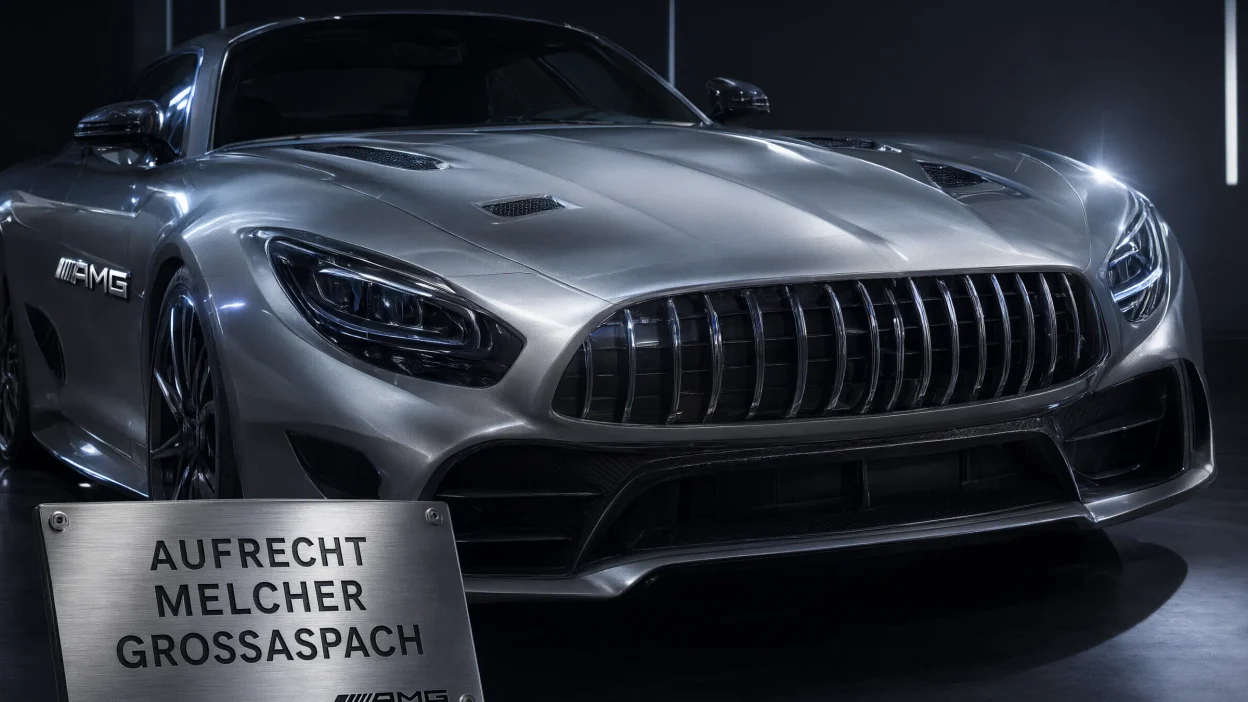
AMG stands for Aufrecht, Melcher, Großaspach.
Each letter has a specific meaning:
- A = Aufrecht — Hans Werner Aufrecht, one of AMG’s founders
- M = Melcher — Erhard Melcher, the other founder
- G = Großaspach — the town where Aufrecht was born and where the company’s early story began
Mercedes-AMG itself confirms that the three letters come from Aufrecht, Melcher, and Großaspach.
The company was founded in 1967 by Aufrecht and Melcher, who shared a strong interest in motorsport and engine performance.
So, AMG is not simply an abbreviation for “advanced motor group” or another technical phrase.
Its name comes from the people and place behind the company’s beginnings.
What Is AMG?
AMG is Mercedes-Benz’s high-performance brand.
Today, Mercedes-AMG develops and produces performance-focused vehicles that combine Mercedes-Benz design and technology with a stronger focus on speed, power, handling, and motorsport-inspired engineering.
But AMG did not begin as a major luxury-car division. Its roots were much smaller.
Hans Werner Aufrecht and Erhard Melcher were engineers working at Daimler-Benz. T
hey became known for their work on racing engines and continued developing performance engines even after the company’s motorsport activities changed. In 1967, they started their own business focused on racing-engine development.
That small operation eventually became a globally recognized performance brand.
What Do the Letters A, M, and G Mean?
A Means Aufrecht
The A comes from Hans Werner Aufrecht.
Aufrecht was one of the two founders of AMG. He had a strong passion for motorsport and wanted to improve engine performance.
Mercedes-AMG describes Aufrecht as the visionary behind the company and identifies him as the “A” in AMG.
M Means Melcher
The M comes from Erhard Melcher.
Melcher worked with Aufrecht on engine development and was known for his technical skills.
Together, the two engineers worked to make Mercedes-Benz engines more competitive in racing.
Mercedes-AMG identifies Melcher as the “M” in the name.
G Means Großaspach
The G comes from Großaspach, a town in Germany.
It is important to note that Großaspach is not another founder’s last name. It is the place associated with Hans Werner Aufrecht and the company’s early history.
The original name therefore combines two people’s names and a place name.
When Was AMG Founded?
AMG was founded in 1967 by Hans Werner Aufrecht and Erhard Melcher.
The two founders wanted to continue their work with high-performance racing engines.
Their early business was focused on engineering, testing, and developing racing engines.
The company originally had a much longer German name:
Aufrecht Melcher Großaspach Ingenieurbüro, Konstruktion und Versuch zur Entwicklung von Rennmotoren.
In simple terms, it was an engineering company focused on designing, testing, and developing racing engines.
The short name AMG was much easier to remember—and it eventually became famous around the world.
How Did AMG Become Famous?
AMG’s early success came from motorsport.
One of the most important moments in the company’s history came in 1971, when the AMG 300 SEL 6.8 achieved a class victory at the 24 Hours of Spa.
Mercedes-AMG says this result helped make the three letters AMG known around the world.
The car became famous as the “Red Pig”, or “Rote Sau.”
This racing success helped establish AMG as a serious name in performance engineering.
The company later became known for modifying Mercedes-Benz vehicles and creating increasingly powerful road cars.
Its racing roots still influence the AMG brand today.
Is AMG the Same as Mercedes-Benz?
Not exactly.
Mercedes-Benz is the larger automotive brand, while Mercedes-AMG is its performance-focused brand.
An easy way to think about it is:
- Mercedes-Benz — luxury vehicles, SUVs, sedans, coupes, and other passenger vehicles
- Mercedes-AMG — performance-focused Mercedes vehicles and engineering
- AMG Line — an appearance/equipment package that can give some Mercedes-Benz models a sportier look
A true Mercedes-AMG model is designed around higher performance.
An AMG Line vehicle, on the other hand, may mainly have sporty styling and equipment rather than being a full AMG performance model.
This distinction is important because seeing the letters “AMG” on a Mercedes does not always mean the vehicle is a full Mercedes-AMG performance model.
Kelley Blue Book also highlights the difference between Mercedes-AMG models and AMG Line packages.
What Is an AMG Car?
An AMG car is a Mercedes-Benz vehicle developed with a strong focus on performance.
Depending on the model, AMG vehicles can feature changes to areas such as:
- Engine performance
- Acceleration
- Suspension
- Steering
- Braking
- Exhaust sound
- Transmission tuning
- Aerodynamics
- Wheels and tires
- Interior design
The exact equipment varies by model.
The goal is not simply to make a Mercedes look sporty. AMG’s identity is based on combining luxury with performance engineering.
What Makes Mercedes-AMG Cars Different?
One of the biggest reasons people choose AMG is performance.
A regular Mercedes-Benz model may be designed mainly for comfort, efficiency, luxury, or everyday driving.
A Mercedes-AMG model puts more emphasis on driving performance while still keeping many of the features expected from a Mercedes.
AMG describes its philosophy around “Driving Performance,” connecting engineering skill with a performance-focused mindset.
More Performance
AMG vehicles are generally built or tuned for stronger performance than comparable standard models.
Depending on the vehicle, this can include a more powerful powertrain, sportier suspension, stronger brakes, and performance-oriented driving settings.
Sportier Handling
AMG models can use performance-focused chassis and suspension technology to give the driver a more responsive feel.
The goal is to make the vehicle feel more controlled and engaging when driven quickly.
Stronger Braking
Performance requires the ability to slow down as well as accelerate.
AMG models can use upgraded braking systems designed to handle the demands of higher-performance driving.
Distinctive Sound
AMG vehicles are also known for their strong engine and exhaust character.
The exact sound depends on the engine, exhaust system, model, and driving mode.
Motorsport Influence
Motorsport has been part of AMG’s identity since its beginning.
Today, Mercedes-AMG continues to have a major motorsport presence.
Mercedes-AMG also provides official Formula 1 safety and medical cars and competes through the Mercedes-AMG PETRONAS F1 Team.
What Is the Difference Between AMG and AMG Line?
This is one of the most common points of confusion.
AMG and AMG Line are not necessarily the same thing.
Mercedes-AMG
A Mercedes-AMG model is a genuine performance vehicle from the Mercedes-AMG brand.
It is engineered with performance as a major part of the vehicle’s purpose.
AMG Line
An AMG Line package can give a regular Mercedes-Benz model a sportier appearance and equipment.
It may include features such as:
- Sportier exterior styling
- AMG-inspired wheels
- Sport seats
- AMG-style interior details
- Different trim pieces
- Sportier body elements
However, an AMG Line vehicle should not automatically be treated as a full Mercedes-AMG model.
For shoppers, this is an important difference.
A car with an AMG Line badge or package may look similar to an AMG vehicle without having the same performance hardware.
Why Is AMG So Popular?
AMG has become popular because it combines several things that car buyers value.
Performance
Many drivers want a car that feels fast and exciting.
AMG gives Mercedes-Benz buyers a way to get stronger performance without giving up the luxury features associated with the brand.
Luxury
AMG vehicles still belong to the Mercedes-Benz family.
This means buyers can get a performance-focused vehicle with a premium interior, advanced technology, and luxury-oriented features.
Design
AMG models often have aggressive styling that helps them stand out from standard versions.
Performance wheels, larger brakes, sporty bodywork, distinctive grilles, and AMG badging can all contribute to the look.
Brand Heritage
AMG has a long history that started with racing and engine development.
That history gives the three-letter badge meaning beyond simple decoration.
What Does AMG Mean on a Mercedes?
When you see AMG on a Mercedes, it generally points to Mercedes-Benz’s performance brand.
However, you should check the exact model because AMG Line and genuine Mercedes-AMG vehicles are different.
For example, a Mercedes may have an AMG-inspired styling package without being a full AMG performance model.
The best way to tell is to look at the vehicle’s complete model name and specifications rather than relying only on the badge.
Does AMG Stand for a Type of Engine?
No.
AMG is not the name of one specific engine type.
The term refers to the Mercedes-AMG performance brand and its history.
AMG vehicles can use different powertrain technologies depending on the model and generation.
The important point is that AMG does not mean one particular engine configuration.
Instead, it represents a performance-oriented approach to vehicle engineering.
Are All AMG Cars Fast?
AMG models are designed with performance in mind, but not every AMG vehicle has the same level of performance.
AMG offers different models and configurations, so power, acceleration, handling, and other performance features can vary.
Some are built as powerful everyday vehicles, while others are much more focused on high-performance driving.
This is why it is better to compare the specific AMG model rather than assume every AMG vehicle performs exactly the same way.
What Does AMG Mean in Mercedes Model Names?
You may see names such as:
- Mercedes-AMG GT
- Mercedes-AMG C-Class
- Mercedes-AMG E-Class
- Mercedes-AMG G-Class
- Mercedes-AMG GLE
The exact naming system has changed over time, so modern AMG badges and numbers should be understood as part of the model’s current naming structure rather than assuming every number directly represents engine size.
Older AMG naming conventions often used numbers related to engine displacement, but that approach does not always apply to newer vehicles.
AMG History in Simple Terms
Here is the AMG story in a quick timeline:
1967: AMG Begins
Hans Werner Aufrecht and Erhard Melcher founded AMG as an engineering business focused on racing engines.
1971: Major Racing Success
The AMG 300 SEL 6.8 won its class at the 24 Hours of Spa, helping bring international attention to AMG.
Later Years: Performance Mercedes Vehicles
AMG became increasingly known for modifying and improving Mercedes-Benz vehicles.
Today: Mercedes-AMG
AMG is now a globally recognized Mercedes performance brand, with road cars and a strong connection to motorsport.
What Is the AMG “Red Pig”?
The AMG 300 SEL 6.8 is often called the “Red Pig” because of its famous red appearance and large, imposing shape.
It became a major part of AMG history after its class victory at the 24 Hours of Spa in 1971.
Mercedes-AMG identifies the car’s racing success as an important moment that helped make the AMG name known internationally.
The car is important because it showed that AMG could take a large Mercedes-Benz vehicle and turn it into a serious racing machine.
Is AMG Only About Speed?
No.
Although speed and power are major parts of the AMG identity, the brand is also about engineering, handling, motorsport, design, and the overall driving experience.
AMG’s official history connects its origins to the pursuit of better engine performance and motorsport success.
That is why an AMG vehicle can focus on more than horsepower. Suspension tuning, brakes, steering, aerodynamics, transmission behavior, and driver controls can all affect the experience.
Why Does AMG Cost More?
AMG models can cost more than comparable standard Mercedes-Benz vehicles because they may include additional performance hardware, engineering, technology, braking systems, chassis components, and specialized equipment.
The price difference depends heavily on the specific model.
A full AMG performance vehicle should also not be compared directly with an AMG Line package.
An AMG Line package may primarily change styling and equipment, while a true Mercedes-AMG model is built around a broader performance package.
What Does AMG Stand For in Simple Words?
In the simplest possible terms:
AMG stands for Aufrecht, Melcher, and Großaspach.
- Aufrecht = Hans Werner Aufrecht
- Melcher = Erhard Melcher
- Großaspach = the German town connected to Aufrecht and AMG’s early history
AMG began in 1967 as a small racing-engine business and later became Mercedes-Benz’s famous performance brand.
Related Questions People Ask About AMG
What does AMG stand for in a car?
AMG stands for Aufrecht, Melcher, Großaspach. It is the name of Mercedes-Benz’s performance brand.
What does AMG mean on a Mercedes-Benz?
It identifies a Mercedes-AMG performance model or, depending on the vehicle, may appear as part of an AMG Line package.
These should not be confused with each other.
Is AMG better than Mercedes-Benz?
AMG is part of the Mercedes-Benz family and focuses more heavily on performance. “Better” depends on what you want.
A standard Mercedes may be better for comfort or efficiency, while an AMG may be better for performance-focused driving.
Is AMG made by Mercedes?
Yes. Mercedes-AMG is Mercedes-Benz’s performance brand.
Who founded AMG?
Hans Werner Aufrecht and Erhard Melcher founded AMG in 1967.
What does the G in AMG stand for?
The G stands for Großaspach, the town associated with Hans Werner Aufrecht and the company’s early history.
What does the M in AMG stand for?
The M stands for Melcher, referring to AMG co-founder Erhard Melcher.
What does the A in AMG stand for?
The A stands for Aufrecht, referring to AMG co-founder Hans Werner Aufrecht.
Is AMG a luxury brand?
AMG is best described as Mercedes-Benz’s high-performance brand.
It combines performance engineering with the luxury and technology associated with MercedesBenz.
Is AMG the same as AMG Line?
No. A Mercedes-AMG vehicle is a performance model, while AMG Line generally refers to a styling or equipment package for a Mercedes-Benz vehicle.
FAQs
What does AMG stand for?
AMG stands for Aufrecht, Melcher, Großaspach.
The name comes from founders Hans Werner Aufrecht and Erhard Melcher and the town of Großaspach.
When was AMG founded?
AMG was founded in 1967 by Hans Werner Aufrecht and Erhard Melcher as an engineering business focused on racing-engine development.
What does AMG mean on a Mercedes?
AMG identifies Mercedes-Benz’s performance brand.
However, AMG Line vehicles are different from full Mercedes-AMG performance models.
Is AMG a Mercedes-Benz?
Yes. Mercedes-AMG is part of the Mercedes-Benz family and specializes in high-performance vehicles.
What does the G in AMG stand for?
The G stands for Großaspach, a town in Germany associated with Hans Werner Aufrecht and the early AMG story.
Who created AMG?
Hans Werner Aufrecht and Erhard Melcher created AMG in 1967.
Is an AMG Line car a real AMG?
An AMG Line vehicle can have AMG-inspired styling and equipment, but it is not necessarily a full Mercedes-AMG performance model.
Always check the exact vehicle specification.
Why are AMG cars special?
AMG cars combine Mercedes-Benz luxury with performance-focused engineering.
Their roots in motorsport and racing-engine development are a major part of the brand’s identity.
Article Summary
AMG stands for Aufrecht, Melcher, Großaspach.
The name comes from Hans Werner Aufrecht, Erhard Melcher, and Großaspach, the German town connected to Aufrecht and AMG’s beginnings.
AMG was founded in 1967 as a small engineering company focused on racing engines.
Its success in motorsport, especially the 1971 class victory of the AMG 300 SEL 6.8 at the 24 Hours of Spa, helped turn AMG into a well-known performance name.
Today, Mercedes-AMG represents the performance side of Mercedes-Benz.
AMG vehicles focus on power, handling, braking, engineering, and driving performance while keeping the luxury and technology associated with Mercedes-Benz.
One key point to remember is that Mercedes-AMG and AMG Line are not the same.
A true AMG model is a performance vehicle, while AMG Line can refer to a sportier styling or equipment package.
Conclusion
So, what does AMG stand for? It stands for Aufrecht, Melcher, Großaspach—the names and place behind one of the world’s best-known performance-car brands.
What began in 1967 with two engineers and a passion for racing engines grew into Mercedes-AMG, a brand closely connected with high-performance road cars and motorsport.
The next time you see an AMG badge on a Mercedes, you will know that those three letters are more than a performance label.
They represent the names of AMG’s founders, its German roots, and decades of engineering and motorsport history.

Emma Wilson is a writer at MeaningVibz who enjoys exploring emoji meanings, texting expressions, and online communication trends. She helps readers understand how emojis and slang are used in different situations by providing clear explanations and relatable examples for everyday messaging.