Penn is most often used as a surname, a place name, or a shortened name for an organization or institution. It does not have one single meaning in every situation.
Here are the main ways people use the word:
- As a surname: Penn is a family name found in English-speaking countries.
- As a university name: Penn often refers to the University of Pennsylvania in Philadelphia.
- As a place name: Several places in the United States and the United Kingdom use Penn in their names.
- As a historical name: Penn is linked to William Penn, the founder of Pennsylvania.
- As a short name: Some people or groups may use Penn as a nickname or abbreviation.
The context is the best way to tell which meaning applies. If you see Penn on a college website, it may refer to the university. If you see it after someone’s first name, it is more likely a last name.
Penn Meaning in Simple Words
In simple words, Penn is usually a name rather than a common word with one fixed definition.
For example:
- “I study at Penn” may mean the person attends the University of Pennsylvania.
- “William Penn helped shape Pennsylvania’s history” refers to a historical person.
- “Mr. Penn called this morning” uses Penn as a surname.
- “Penn is a quiet village” may refer to a place.
These examples show why it is important to read the full sentence before deciding what Penn means.
Is Penn an Acronym?
Penn is not always an acronym. It is often a name that stands on its own.
However, people commonly use “Penn” as a short name for the University of Pennsylvania. The university is also known as Penn or UPenn.
In this case, Penn is a nickname, not a word formed from the first letters of a longer phrase.
In other settings, Penn may be part of a business name, school name, or group name. The meaning depends on the organization using it.
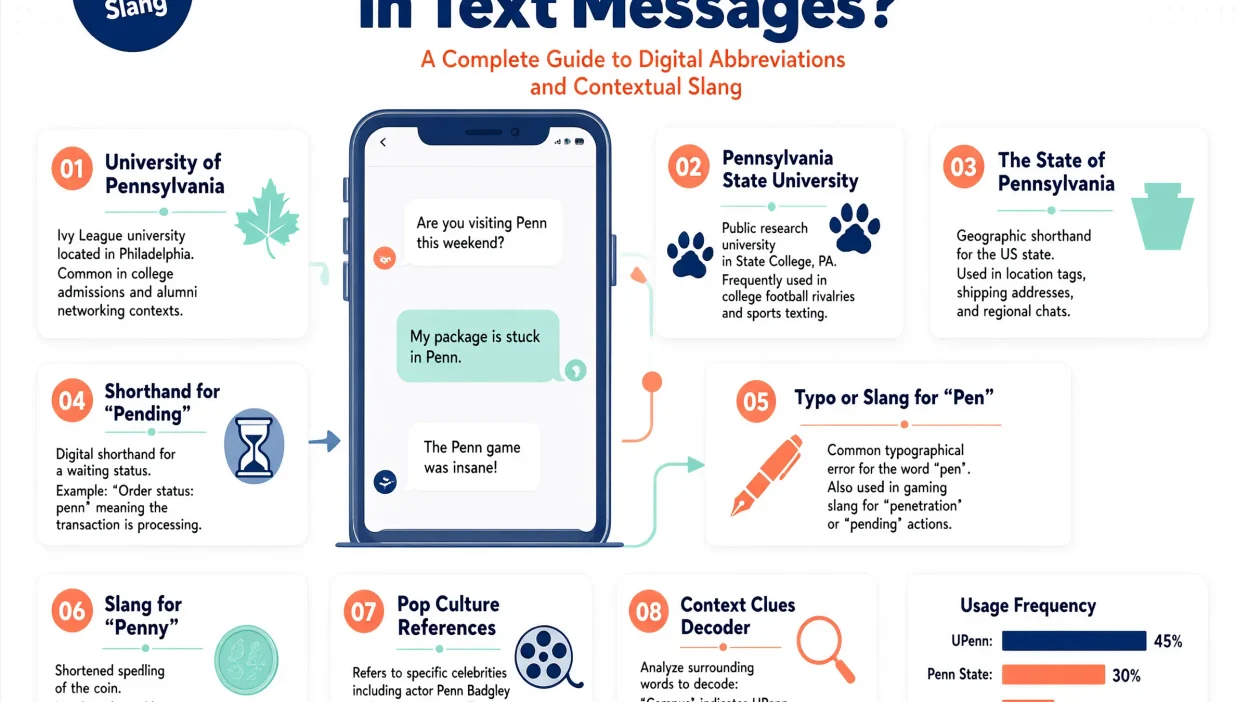
What Does Penn Mean in Text Messages?

Penn does not have one widely accepted meaning in everyday texting.
Unlike common texting shortcuts such as LOL, BRB, or IDK, Penn is not a standard abbreviation used by most people in text messages.
If someone sends you “Penn,” they may be talking about a person, school, place, or topic that you both know.
Examples of Penn in Text
Example 1
Person A: “Where are you applying for college?”
Person B: “Penn and a few other schools.”
Here, Penn likely means the University of Pennsylvania.
What Does Penn Mean as a Name?
Penn is used as both a surname and, less often, a given name. It has a long history as an English name.
As a last name, Penn may have developed from a place name or an older word used to describe a location.
The exact origin can differ between families, so it is not possible to give every person named Penn the same family history.
As a first name, Penn may be chosen because it is short, easy to spell, and has a simple sound. Some parents may also choose it because of a family connection or a link to a well-known person.
Penn as a Last Name
Penn is an English surname. One commonly discussed origin links it to an old British word for a hill or high place.
It may also have developed from the names of places called Penn.
Surnames often began as a way to identify where a person lived, what work they did, or which family they belonged to.
Over time, these names passed from parents to children.
For example, a person whose family came from a place called Penn may have taken that place name as a surname.
However, not every Penn family shares the same origin. Family records are needed to learn the history of a particular family.
Penn as a First Name
Penn is sometimes used as a first name. It is short and easy to remember, which may appeal to parents looking for a simple name.
A person named Penn may have received the name because it was a family surname, because the family liked its sound, or because of a personal connection to a place or public figure.
The name does not have one universal meaning that applies to every person who uses it.
What Is the Origin of the Name Penn?
The name Penn has English and place-name connections. Some explanations trace it to an old Celtic or Brittonic word associated with a head, hill, or high place.
The exact history depends on the place or family being discussed.
Penn is also connected with several English place names. People who lived in or came from those places may have used Penn as a surname.
When studying a name’s origin, it helps to separate three things:
- Word origin: The older word from which a name may have developed.
- Place origin: A town, village, or other location connected to the name.
- Family history: The particular story of how a family came to use the name.
These three types of history may overlap, but they are not always the same.
What Does Penn Stand for in Education?

In education, Penn commonly refers to the University of Pennsylvania, a private university in Philadelphia, Pennsylvania.
The university is often called Penn or UPenn. Its name is sometimes confused with Penn State, but these are different institutions.
Penn vs. UPenn
Penn and UPenn are commonly used names for the University of Pennsylvania.
Both can point to the same school, depending on the setting.
Students, alumni, and university staff may use Penn in casual conversation.
UPenn is also widely used to make the university’s identity clear, especially when people could confuse it with other schools.
For example:
- “She studies at Penn” means she attends the University of Pennsylvania in the right context.
- “He graduated from UPenn” refers to the same university.
- “Penn has a campus in Philadelphia” refers to the institution’s location.
Penn vs. Penn State
Penn and Penn State are not the same school.
The University of Pennsylvania is a private university in Philadelphia.
Pennsylvania State University, often called Penn State, is a separate university system with its main campus in University Park, Pennsylvania.
The names sound similar, but they refer to different institutions.
If someone says they attend Penn, it is best not to assume they mean Penn State.
The full school name or the surrounding conversation can help you tell the difference.
Who Was William Penn?
William Penn was an English Quaker who founded the Province of Pennsylvania in the late 1600s.
He is an important figure in the history of Pennsylvania and the early American colonies.
Penn received the land grant that became Pennsylvania from King Charles II of England in 1681.
He helped develop the colony and supported religious freedom for people with different beliefs.
His ideas about government and religious tolerance influenced the development of Pennsylvania. The colony also became home to many different groups of settlers.
Why Is William Penn Important?
William Penn is important for several reasons:
- He helped establish Pennsylvania as an English colony.
- He supported religious freedom.
- He promoted a form of government with written rules.
- His name became part of the name of Pennsylvania.
The state name is commonly understood as a combination of “Penn” and “sylvania,” a Latin-based term associated with woodland.
The name was chosen in honor of William Penn’s family, even though William Penn himself did not choose the name.
What Does Penn Mean in History?

In history, Penn most often refers to William Penn, the Penn family, or places and institutions named after them.
The word may appear in books about early American settlement, colonial government, religious freedom, and the founding of Pennsylvania.
For example, a history lesson may discuss Penn’s role in creating a colony where different religious groups could live.
A book about the state may explain how Pennsylvania received its name.
Penn can also appear in family history research. Old records may list Penn as a surname, while maps and local documents may use it as a place name.
The meaning is not always the same, so it helps to look at the date, location, and topic of the source.
Different Uses of the Word Penn
Penn can appear in several settings. The following table gives a simple overview.
| Context | Likely meaning |
| Text message | A person, school, place, or name |
| Last name | An English surname |
| First name | A personal name |
| College conversation | Often the University of Pennsylvania |
| American history | Often William Penn or the Penn family |
| Place name | A town, village, or local area |
| Organization name | A shortened name or part of a formal name |
These meanings are related in some cases, but not all uses have the same origin.
How Context Changes the Meaning
Imagine you see the word Penn in three different places.
On a college website, it may refer to the University of Pennsylvania. On a family tree, it may be someone’s surname. In a history book, it may refer to William Penn.
The spelling stays the same, but the meaning changes based on the topic.
This is common with names. A single word can identify a person, place, school, or organization without being an abbreviation or slang term.
Common Questions About Penn
Does Penn Mean a Hill?
Some explanations of the name connect Penn with an old Celtic or Brittonic word associated with a hill, head, or high place. This is often discussed when explaining certain British place names and surnames.
However, the meaning should not be applied automatically to every person or location named Penn. The origin of a specific name depends on its history.
Is Penn a Common Name?
Penn is used as a surname and, less often, as a first name. It is also widely recognized as part of the names of places and institutions.
Its popularity depends on the country and whether you are looking at first names or surnames. It is not one of the most common first names in the United States.
Does Penn Mean University of Pennsylvania?
In many educational settings, yes. Penn is a common short name for the University of Pennsylvania.
Still, the word can refer to other people, places, or organizations. The context helps identify the correct meaning.
What Is the Difference Between Penn and UPenn?
Penn and UPenn are both used to refer to the University of Pennsylvania. UPenn can help make the school’s identity clearer when there is a chance of confusion.
Neither name should be confused with Penn State, which is a different university.
What Does Penn Mean on Social Media?
On social media, Penn may refer to a person, college, location, or organization. It is not a widely recognized universal texting abbreviation.
For example, a post about college applications may use Penn to mean the University of Pennsylvania. A post about a celebrity may use Penn as a surname.
Always check the post or conversation before deciding what the word means.
How Do You Pronounce Penn?
Penn is pronounced like “pen,” the word used for a writing tool. It has one syllable and a short “e” sound.
For example, Penn and pen sound the same in common American English pronunciation.
Penn Meaning: Examples in Everyday Life

The easiest way to understand Penn is to look at how it is used in a sentence. Here are a few more examples.
Example 1: College
“I hope I get accepted to Penn this year.”
Meaning: The speaker is likely talking about applying to the University of Pennsylvania.
Example 2: Family Name
“Dr. Penn will see you at 2 p.m.”
Meaning: Penn is the doctor’s last name.
These examples show that Penn does not need a special or hidden meaning. In most cases, it is simply a name whose meaning depends on the situation.
How to Find the Correct Meaning of Penn
If you are unsure what Penn means, you can usually find the answer by checking a few details.
- Look at the topic. A conversation about college may point to the University of Pennsylvania, while a history lesson may refer to William Penn.
- Read the whole sentence. The words before and after Penn can provide useful clues.
- Check capitalization. Penn is usually capitalized when it is used as a proper name.
- Consider the source. A university website, family record, and text message may use the word in different ways.
- Ask for clarification. If someone uses Penn without enough context, asking what they mean is often the simplest solution.
These steps can help you understand Penn without guessing or treating it as slang when it is not.
Article Summary: Penn Meaning
Here are the main points to remember:
- Penn is commonly used as a surname, given name, or place name.
- In college conversations, Penn often means the University of Pennsylvania.
- Penn is connected to William Penn and the history of Pennsylvania.
- Some explanations link the name’s older roots to a hill or high place.
- Penn is not a standard texting abbreviation with one widely accepted meaning.
- Penn and Penn State refer to two different universities.
- The correct meaning depends on the context in which the word appears.
Conclusion
The meaning of Penn depends on where you see or hear it. Most often, it is a surname, a place name, or a short name for the University of Pennsylvania.
It is also closely linked to William Penn and the history of Pennsylvania.
Although some explanations connect Penn to an old word for a hill or high place, the exact origin can vary by family and location.
In text messages and on social media, Penn usually refers to a person, school, or place rather than a common slang term.
The simplest way to understand Penn is to look at the full sentence and the topic being discussed. Once you know the context, it is much easier to identify the intended meaning.

Emma Wilson is a writer at MeaningVibz who enjoys exploring emoji meanings, texting expressions, and online communication trends. She helps readers understand how emojis and slang are used in different situations by providing clear explanations and relatable examples for everyday messaging.