GPT stands for Generative Pre-trained Transformer.
It is a type of artificial intelligence (AI) model designed to work with language and other forms of data.
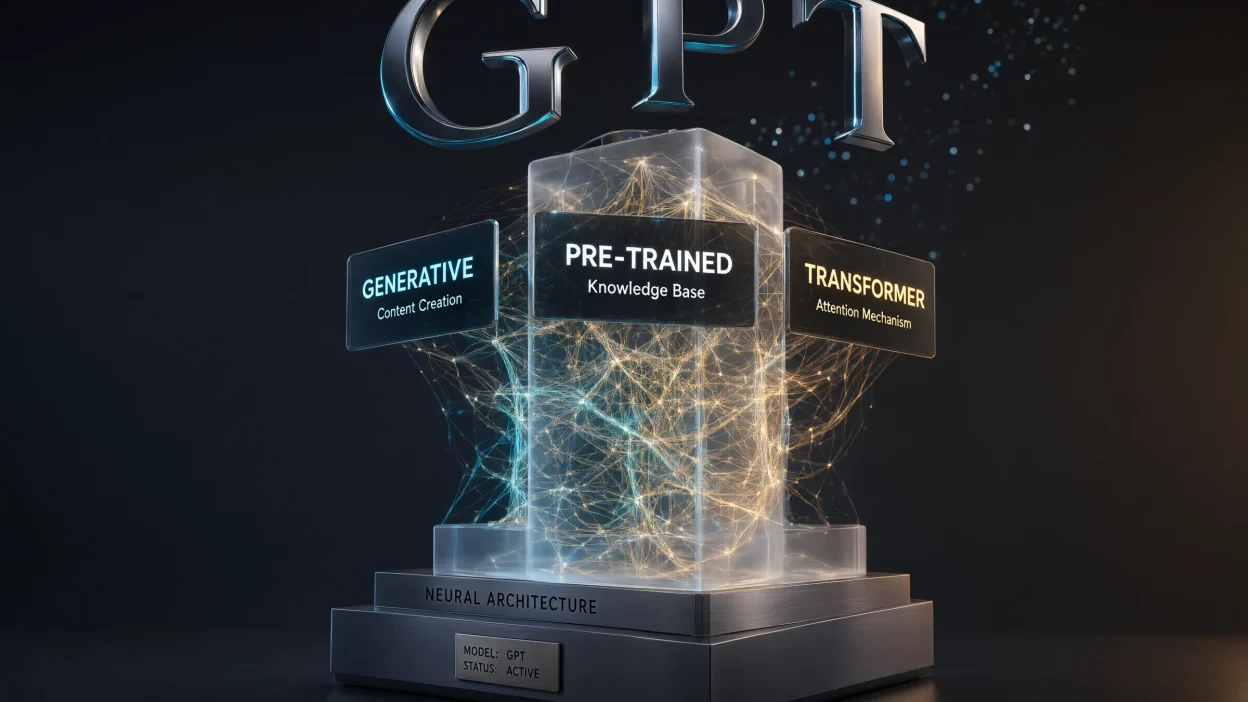
Each letter in GPT points to a key part of the technology:
- G — Generative: The model can create new text, such as answers, stories, summaries, and ideas.
- P — Pre-trained: The model is trained on large amounts of data before it is used to answer people’s questions.
- T — Transformer: This is the type of neural network design that helps the model process language and understand how words relate to one another.
Together, these three ideas explain how GPT models can respond to prompts and create text that sounds natural.
What Does Each Letter in GPT Stand For?
To understand GPT, it helps to look at each word separately.
1. What Does Generative Mean?
The word “generative” means that the model can produce new content.
A GPT model can generate many types of text, including:
- Answers to questions
- Emails and letters
- Blog posts and articles
- Stories and poems
- Study notes
- Computer code
- Lists and summaries
For example, you can type, “Write a short story about a lost puppy.” ChatGPT can create a story based on your instructions.
2. What Does Pre-Trained Mean?
“Pre-trained” means the model receives training before it is used for everyday tasks.
During training, a GPT model learns patterns from large collections of data.
These patterns help it work with grammar, facts, writing styles, and relationships between words.
Think of it like learning a language before writing an essay.
You first learn words and sentence patterns. Later, you use that knowledge to write about many different topics.
3. What Does Transformer Mean?
A “transformer” is a type of neural network used in modern AI systems.
It helps a model process words based on their relationship to other words in a sentence or passage. One important feature is called attention.
Attention helps the model focus on useful parts of the input when working out what a word or phrase means in context.
For example, consider this sentence:
“The boy put the book on the table because it was heavy.”
Depending on the surrounding words and the wider context, a language model uses relationships between words to work out how the sentence fits together.
What Is ChatGPT?
ChatGPT is an AI assistant created by OpenAI.
You can use it to ask questions, write content, learn new topics, brainstorm ideas, and complete many other tasks.
The name combines two ideas:
- Chat: The tool is designed for conversation.
- GPT: This refers to Generative Pre-trained Transformer, a type of AI model.
ChatGPT is the product you interact with, while GPT refers to the model technology associated with generating responses.
Depending on the version and features available, ChatGPT may also use tools that help it work with images, files, voice, web information, and other types of input.
What Is the Difference Between GPT and ChatGPT?
GPT and ChatGPT are closely related, but they do not mean the same thing.
| Feature | GPT | ChatGPT |
| Meaning | Generative Pre-trained Transformer | OpenAI’s conversational AI assistant |
| What it is | A type of AI model | A product people can use |
| Main role | Processes input and generates output | Helps users complete tasks through conversation |
| Example | A GPT model that generates text | ChatGPT answering a question |
| How people use it | Through products, tools, or integrations | Through the ChatGPT app or website and supported interfaces |
A Simple Example
Imagine a car and its engine.
The engine provides power, while the car is the product you use to travel.
In a similar way, a GPT model can provide important AI capabilities, while ChatGPT gives people a convenient way to use AI.
This comparison is not exact, because ChatGPT can include more than a single model.
Still, it is a useful way to understand the basic difference.
Also, not every GPT model is ChatGPT, and not every feature in ChatGPT is explained by the letters GPT alone.
How Does GPT Work in ChatGPT?
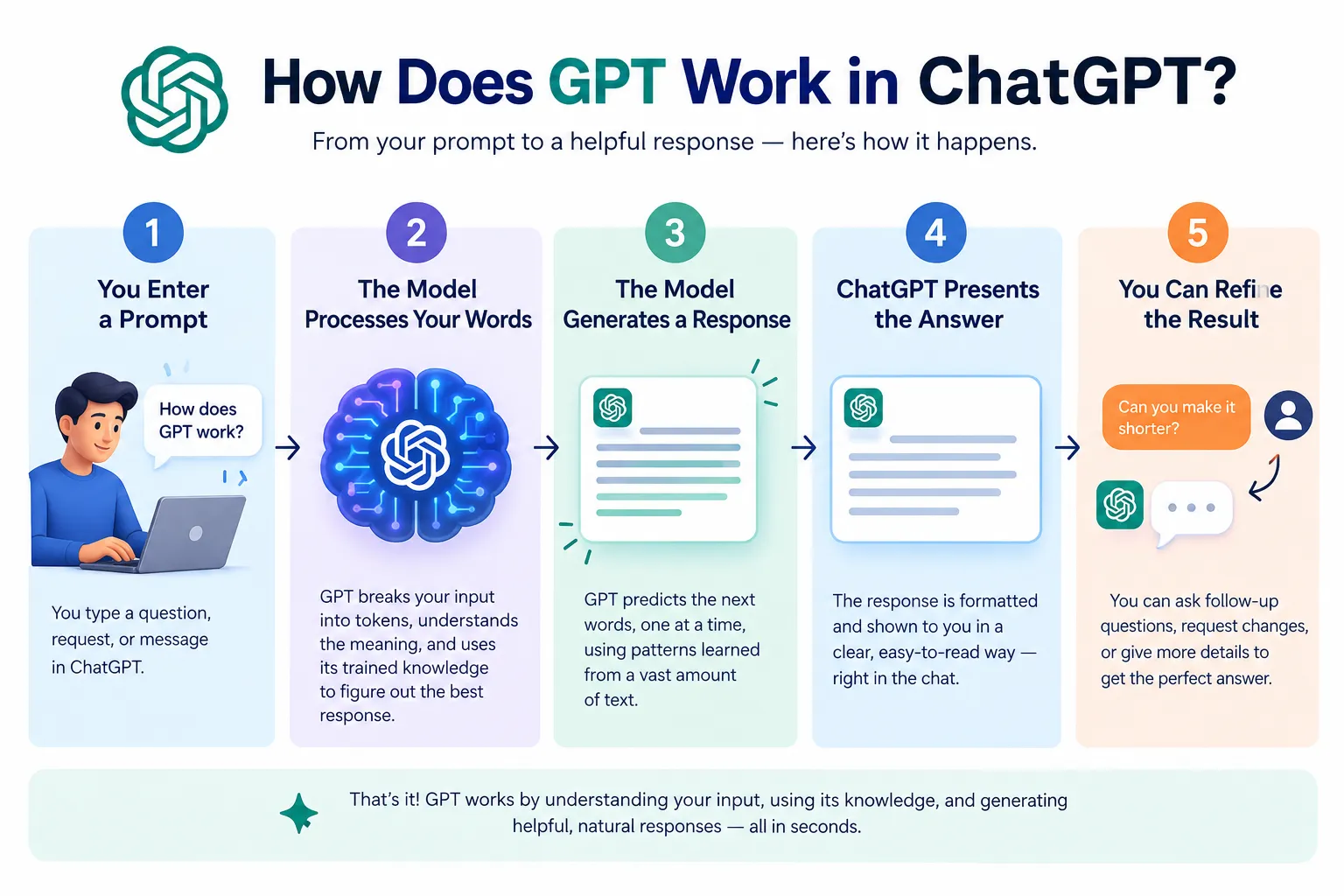
GPT works through several stages.
You do not need to understand the math behind AI to understand the basic process.
You Enter a Prompt
A prompt is the question, command, or information you give the AI.
For example:
“Explain climate change in simple words.”
A clear prompt gives the model a better idea of what kind of answer you want.
The Model Processes Your Words
The model processes your input as smaller units called tokens.
A token may represent a whole word, part of a word, or another piece of text.
The model uses patterns and context to process these tokens and determine what response fits the prompt.
The Model Generates a Response
The model predicts what token should come next, then continues generating more tokens until it forms a response or reaches a stopping point.
This process can create sentences, paragraphs, lists, and other types of text.
ChatGPT Presents the Answer
ChatGPT displays the generated response so you can read it and ask follow-up questions.
For example, after receiving an explanation of climate change, you could ask, “Can you explain it with an example for a child?”
The assistant can use the conversation’s context to create a more suitable answer.
You Can Refine the Result
If the answer is too long, too complex, or not quite right, you can give another instruction.
You might say:
- “Make it shorter.”
- “Use easier words.”
- “Give me three examples.”
- “Explain it step by step.”
This back-and-forth process makes ChatGPT useful for many everyday tasks.
What Can GPT Do in ChatGPT?
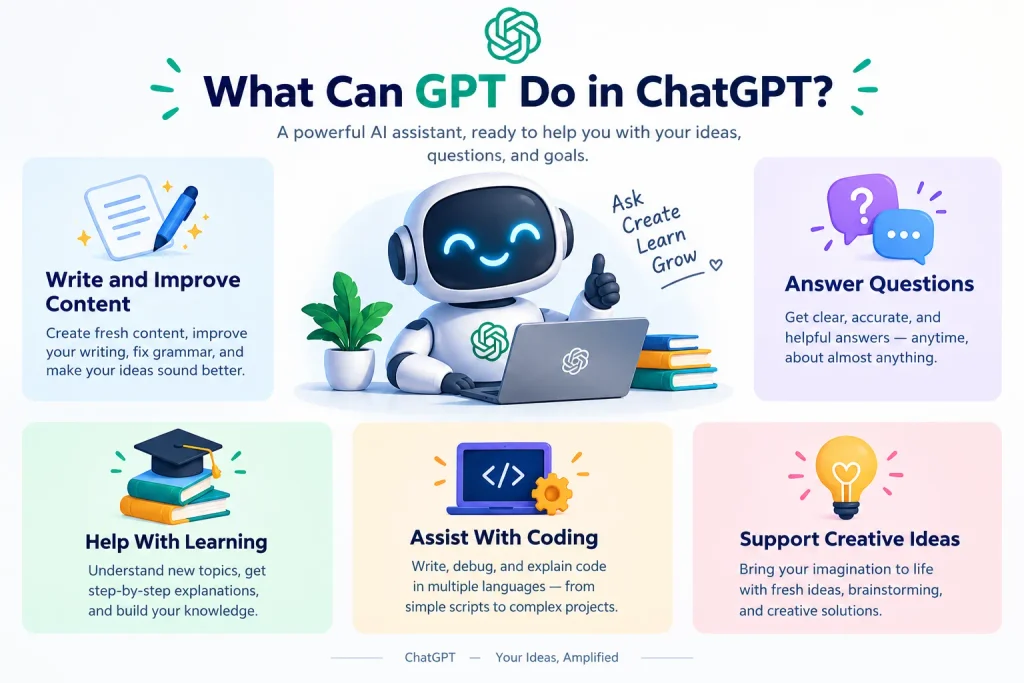
GPT models can support a wide range of language-based tasks.
The exact abilities depend on the model, the tools available, and the features enabled in ChatGPT.
Write and Improve Content
GPT can help you draft emails, social media posts, stories, reports, and blog articles.
For example, you can ask it to turn a rough idea into a clear paragraph or rewrite a message in a friendly tone.
You should still review the result for accuracy, originality, and the right tone before using it.
Answer Questions
You can ask GPT to explain words, describe ideas, or break down complex subjects.
For example:
“What is the difference between weather and climate?”
The model can provide a simple explanation based on patterns learned during training and the context of your question.
For current facts or important decisions, check reliable sources rather than assuming every answer is correct.
Help With Learning
Students and independent learners can use ChatGPT to understand difficult topics, practice languages, or prepare study notes.
For example, you could ask:
“Explain fractions using pizza as an example.”
The model can adjust its explanation based on your age, skill level, and learning goals.
Assist With Coding
GPT models can generate, explain, and help debug computer code.
You might ask for a simple Python program or request an explanation of an error message.
However, generated code can contain bugs or security problems. Test it carefully before using it in a real project.
Support Creative Ideas
GPT can help brainstorm business names, video topics, fictional characters, slogans, and other creative ideas.
For example, if you want to start a food blog, you could ask for 20 name ideas and then narrow the list based on your preferred style.
The final choice should still reflect your own goals and judgment.
Does GPT Understand Language Like a Human?
GPT can produce language that seems natural and thoughtful. It can also use context to give relevant answers.
However, this does not mean it understands language in exactly the same way a human does.
People draw on personal experiences, emotions, senses, and real-world knowledge.
A GPT model works by processing data and applying patterns learned during training.
This difference matters because an answer can sound confident even when it is wrong.
For example, if you ask for a fact that is not well represented in its training or available context, the model may produce an incorrect answer.
This type of error is often called an AI hallucination.
To use ChatGPT wisely:
- Check important facts against trusted sources.
- Ask for clarification when an answer is unclear.
- Review names, dates, figures, and quotations.
- Do not share private information unless you understand the relevant privacy settings and risks.
- Use expert advice for high-stakes medical, legal, or financial decisions.
GPT is a useful tool, but it should not replace careful judgment.
Is GPT the Same as Artificial Intelligence?
No. GPT is one type of AI technology, while artificial intelligence is a much broader field.
AI includes systems designed to recognize images, understand speech, make predictions, recommend products, control machines, and perform many other tasks.
GPT models belong to a family of AI models focused on generating and processing content.
They can also be part of systems that support other tasks.
For example, a photo-recognition system may use a different type of model to identify objects in an image.
A GPT-based system may help explain the image in words if it has the required visual capabilities.
In short, GPT is a part of AI, not another name for all artificial intelligence.
Are All GPT Models the Same?
No. Different GPT models can vary in size, design, speed, cost, and ability.
Some models may be better suited to quick everyday questions. Others may be designed for more complex reasoning, coding, or work with different types of input.
The available models and their features can also change over time.
This means that two products using GPT technology may not give exactly the same answers.
Even the same model can produce different responses to the same question because of changes in wording, context, settings, or the generation process.
If you use ChatGPT, the model options available to you may depend on your account, plan, and the current product features.
Why Is GPT Important?
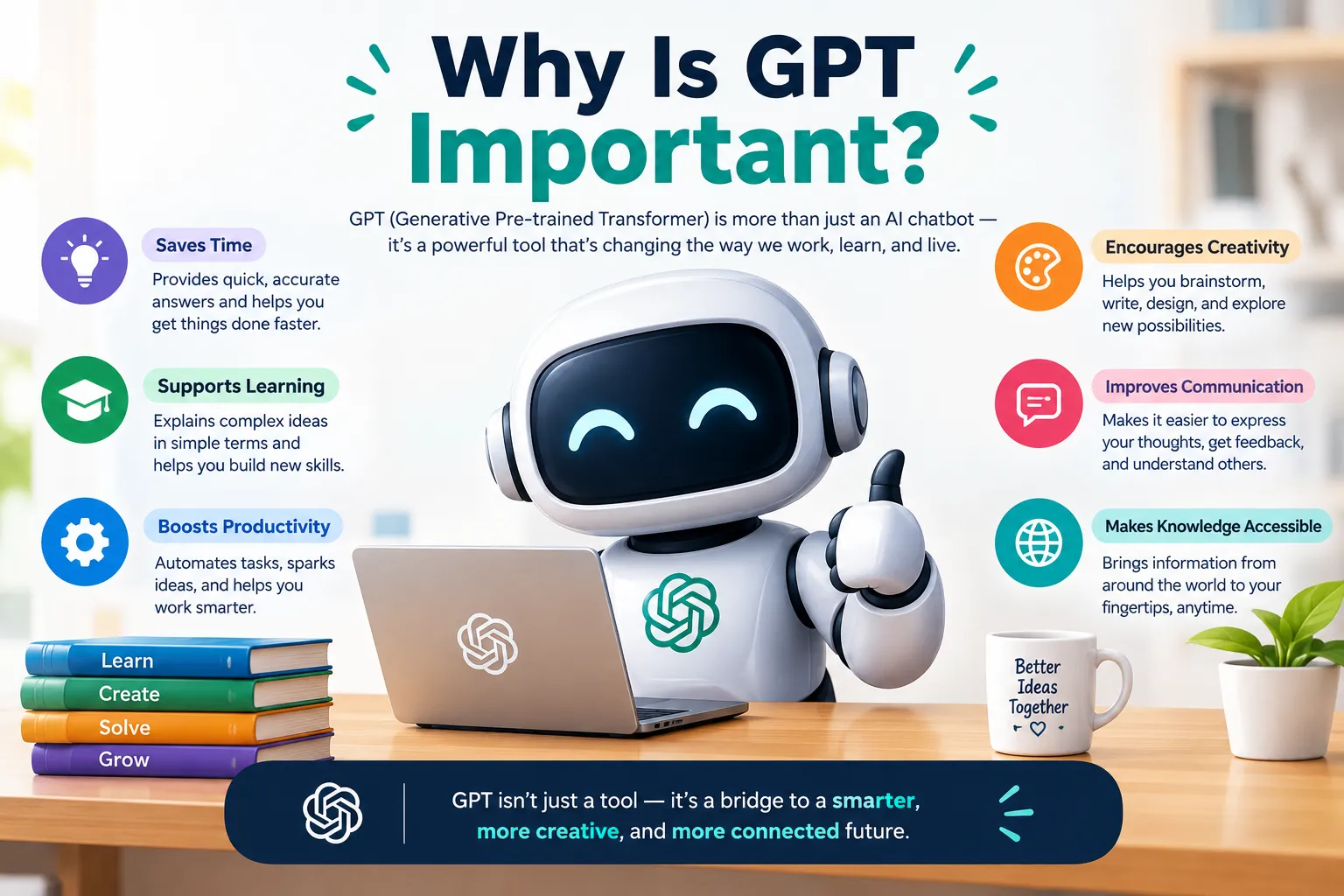
GPT matters because it makes many language tasks easier to access.
People no longer need to know how to write perfect prompts or understand advanced computer science to get help with a basic question.
They can describe what they need in everyday language and refine the result through conversation.
For individuals, this can save time when drafting text, learning new topics, or organizing ideas.
For businesses, GPT-based tools can help with tasks such as preparing drafts, summarizing documents, and supporting customer service.
Human review remains important, especially when accuracy, privacy, or safety matters.
GPT also helps researchers and developers build new AI-powered tools. Its flexible language abilities can be used in different products and workflows.
However, its usefulness comes with limits.
Models can make mistakes, reflect problems in their training data, and produce content that needs review. Good results depend on how the tool is designed and used.
FAQ
What does GPT stand for in ChatGPT?
GPT stands for Generative Pre-trained Transformer. It describes a type of AI model that learns patterns from data and uses them to generate respon
ses.
What does the G in GPT mean?
The G stands for “Generative.” It means the model can create content, such as text, answers, summaries, and other outputs.
What does the P in GPT mean?
The P stands for “Pre-trained.” It means the model is trained on data before it is used for everyday tasks.
What does the T in GPT mean?
The T stands for “Transformer.” It refers to the neural network architecture that helps the model process language and relationships between words.
Who created GPT?
OpenAI developed the GPT family of AI models.
ChatGPT is an OpenAI product that lets people interact with AI through conversation.
Is ChatGPT the same as GPT?
No. GPT refers to a type of AI model, while ChatGPT is a conversational AI assistant.
ChatGPT uses AI models and may include additional tools and features.
Is GPT a chatbot?
GPT is not necessarily a chatbot by itself. It is a type of AI model that can power a chatbot or other applications.
ChatGPT is an example of a conversational product that uses GPT technology.
How does GPT generate answers?
A GPT model processes the input and predicts likely next tokens based on learned patterns and context. It repeats this process to generate a response.
Does GPT always give correct answers?
No. GPT models can make mistakes, provide outdated information, or generate claims that sound correct but are false.
Important information should be checked against reliable sources.
Can GPT understand images and voice?
Some GPT-based models and ChatGPT features can work with images, audio, or other types of input. These abilities depend on the specific model and features available.
Is GPT free to use?
Access depends on the product and plan. ChatGPT may offer free access with limits, as well as paid plans with different features or usage limits.
Check the current ChatGPT plan details for the latest information.
What is the difference between GPT and generative AI?
Generative AI is a broad category of systems that create content, including text, images, audio, and video.
GPT is a type of generative AI model focused on processing and generating sequences of data, especially language.
Article Summary
GPT stands for Generative Pre-trained Transformer.
Each word explains an important part of the technology: it generates content, learns from data before use, and relies on a transformer architecture to process context and language.
ChatGPT is the conversational AI product that lets people use AI models to ask questions, write content, learn, and complete other tasks.
GPT and ChatGPT are related, but they are not the same thing.
GPT models can be useful for many everyday activities, but they are not perfect.
They can make mistakes, so users should check important information and review AI-generated work before relying on it.
Conclusion
GPT means Generative Pre-trained Transformer, a type of AI model that helps power language-based tools such as ChatGPT. “Generative” means it can create content, “pre-trained” describes training before use, and “transformer” refers to the model architecture that helps it process context.
The easiest way to remember the difference is that GPT is a type of AI model, while ChatGPT is the assistant you use to interact with AI.
Together, these technologies make it easier to ask questions, write content, learn new skills, and explore ideas.
Although GPT can be helpful, it does not always produce correct information.
Use it as a tool, check important facts, and apply your own judgment to its answers.
Once you understand what GPT means in ChatGPT, the technology behind everyday AI conversations becomes much easier to understand.

Emma Wilson is a writer at MeaningVibz who enjoys exploring emoji meanings, texting expressions, and online communication trends. She helps readers understand how emojis and slang are used in different situations by providing clear explanations and relatable examples for everyday messaging.