
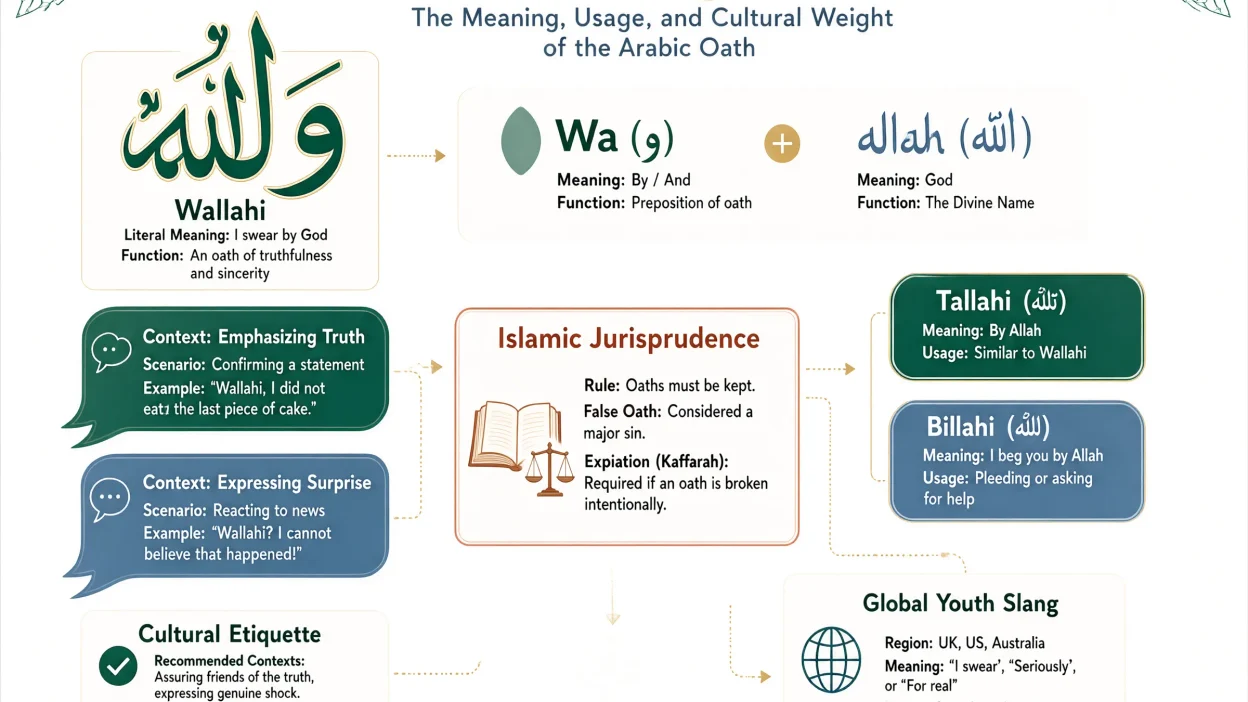
Wallahi means “By Allah” or “I swear by Allah.” It is an Arabic phrase used to make an oath.
When someone says Wallahi, they are calling on Allah as a witness to their words.
For example:
- “Wallahi, I did not take your phone.”
- “Wallahi, I will help you tomorrow.”
- “Wallahi, I am telling the truth.”
In these examples, the speaker uses Wallahi to show that they want to be believed.
The word is common among Muslims because Allah is the Arabic word for God.
It is also heard in communities where Arabic and Islamic culture have a strong influence.
Wallahi can be used in serious talks, family discussions, and casual conversations.
The exact tone depends on the person and the situation.
Wallahi Meaning in Simple English
In simple English, Wallahi means:
- By Allah
- I swear by Allah
- I promise before Allah
The closest meaning depends on how the word is used. Still, “I swear by Allah” is often the clearest translation.
What Is the Origin of Wallahi?
Wallahi comes from the Arabic language. It is made from parts that express an oath by Allah.
The word is linked to the Arabic name “Allah,” which means God.
The full expression is used to call upon Allah when a person makes a statement or oath.
Arabic has many words and phrases used in daily speech.
Wallahi is one of the expressions that has spread across many countries and cultures.
It is used by Arabic speakers and by many Muslims who speak other languages, including English, Urdu, Somali, Turkish, and Swahili. Its pronunciation and spelling may vary slightly from place to place.
How Do You Pronounce Wallahi?
Wallahi is commonly pronounced:
wah-LAH-hee
The first part sounds like “wa,” the middle part sounds like “lah,” and the final part sounds like “hee.”
Pronunciation can vary by accent and language. You may also see the word written as “wallah” in casual messages.
However, Wallahi is a common spelling for the Arabic oath meaning “By Allah.”
What Does the Word Allah Mean?
Allah is the Arabic word for God. Arabic-speaking Muslims use it to refer to God, and Arabic-speaking Christians also use the word in religious speech.
Since Wallahi includes the name Allah, it is tied to a religious oath rather than being only a casual expression.
What Does Wallahi Mean in Islam?
In Islam, Wallahi is an oath made by Allah. It is used when a person wants to stress that a statement is true or make a serious promise.
An oath is not something to use carelessly. Muslims are taught to speak truthfully and to treat oaths with care.
For example, if someone says, “Wallahi, I did not lie to you,” they are making a serious claim about their honesty.
If the statement is false, the oath becomes a serious religious matter.
The exact religious rules around oaths can depend on the words used, the person’s intention, and the situation.
For a specific question about a broken oath or its religious consequences, it is best to ask a trusted Islamic scholar.
Is Saying Wallahi a Sin?
No. Saying Wallahi is not automatically a sin.
A person may use it for a truthful and proper reason.
However, using it to lie, trick someone, or make a false claim is wrong in Islam.
Using Allah’s name carelessly is also something Muslims are encouraged to avoid.
For example, saying “Wallahi, I was at home” when you know you were somewhere else is a false oath.
That is very different from using the word to tell the truth.
The best rule is simple: speak honestly, and do not use Wallahi unless you mean what you say.
Can Non-Muslims Say Wallahi?
People from different backgrounds may use words from Arabic or other languages.
However, Wallahi has a clear religious meaning because it refers to Allah.
A non-Muslim who understands the meaning may choose to use it in the right context, but should avoid treating it as a joke or using it without respect.
If you are unsure, a simple phrase such as “I promise” may be a better choice.
How Is Wallahi Used in Everyday Conversation?
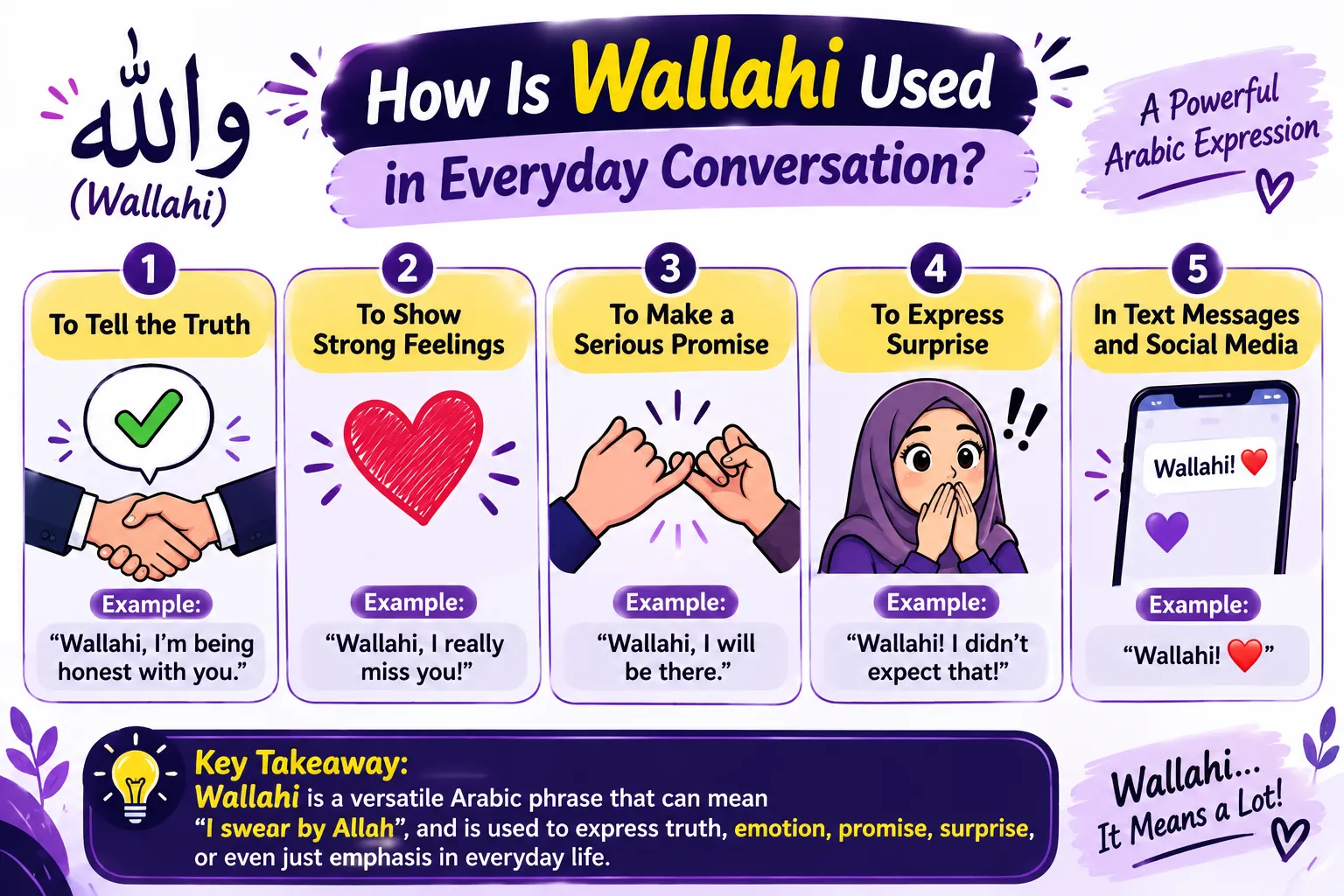
Wallahi can be used in several ways. The meaning depends on what the speaker wants to express.
To Tell the Truth
People may say Wallahi when they want someone to believe that a statement is true.
Example:
“Wallahi, I did not see your message.”
Meaning: “I swear by Allah that I did not see your message.”
To Show Strong Feelings
Some people use Wallahi to show how strongly they feel about something.
Example:
“Wallahi, that movie was amazing!”
Meaning: The speaker is strongly expressing how much they liked the movie.
In casual speech, the word may be used with less formal intent. Still, its original meaning is an oath by Allah, so it should not be treated as a meaningless filler word.
To Make a Serious Promise
Wallahi may be used when someone wants to show that a promise matters to them.
Example:
“Wallahi, I will return your book tomorrow.”
Meaning: “I swear by Allah that I will return your book tomorrow.”
A person should only make this kind of oath when they are serious and intend to keep their word.
To Express Surprise
In some communities, people use Wallahi when they are surprised by news or an unexpected event.
Example:
“Wallahi? You got the job?”
Here, the speaker may be asking for confirmation.
The exact meaning depends on tone and context.
In Text Messages and Social Media
Wallahi is also used in online chats, comments, and short videos.
Examples include:
- “Wallahi, that was funny.”
- “Wallahi, I forgot.”
- “Wallahi, I had no idea.”
Online, it may sound casual. However, its religious meaning remains important.
Wallahi Meaning in Text and Slang
On social media, Wallahi is sometimes used as slang to add emphasis to a message.
People may use it when they want to sound serious, surprised, excited, or honest.
For example:
“Wallahi, this song is so good.”
The speaker means they really like the song and wants to stress that feeling.
Another example is:
“Wallahi, I didn’t know that.”
The speaker is stressing that they were not aware of something.
The word is common in some online communities, including Muslim youth groups and people who speak Arabic or other languages influenced by Arabic. Still, it does not mean exactly the same thing in every situation.
Important: A slang use does not remove the original meaning. Wallahi refers to Allah, so it should be used with care and respect.
Wallahi vs. Wallah: What Is the Difference?
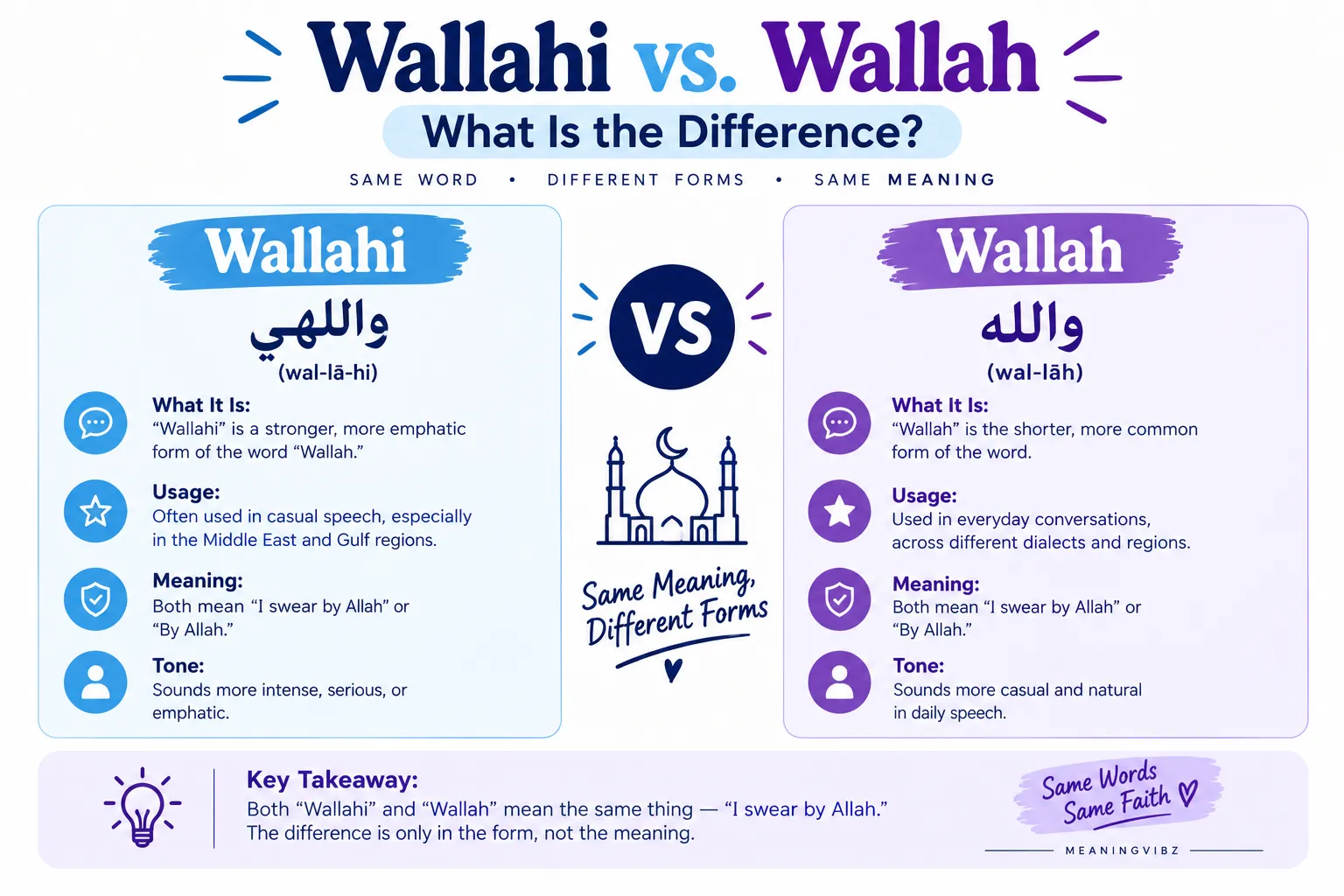
Wallahi and Wallah are often used in similar ways, but their spelling and meaning can differ.
| Word | Common meaning | Typical use |
| Wallahi | By Allah; I swear by Allah | Making an oath |
| Wallah | Often used as a shortened or informal form of Wallahi | Casual speech and messages |
In everyday conversation, people may use these spellings interchangeably. The exact use can vary by dialect, region, and online community.
If you want to express the Arabic oath clearly in writing, Wallahi is a common choice.
Is Wallah the Same as Wallahi?
They are closely related. Wallah is often used informally with a similar meaning, while Wallahi is a common form for “I swear by Allah.”
However, the way people use these words can differ across Arabic dialects and communities.
It is best to look at the context instead of assuming that every use has exactly the same meaning.
Wallahi vs. Inshallah vs. Mashallah
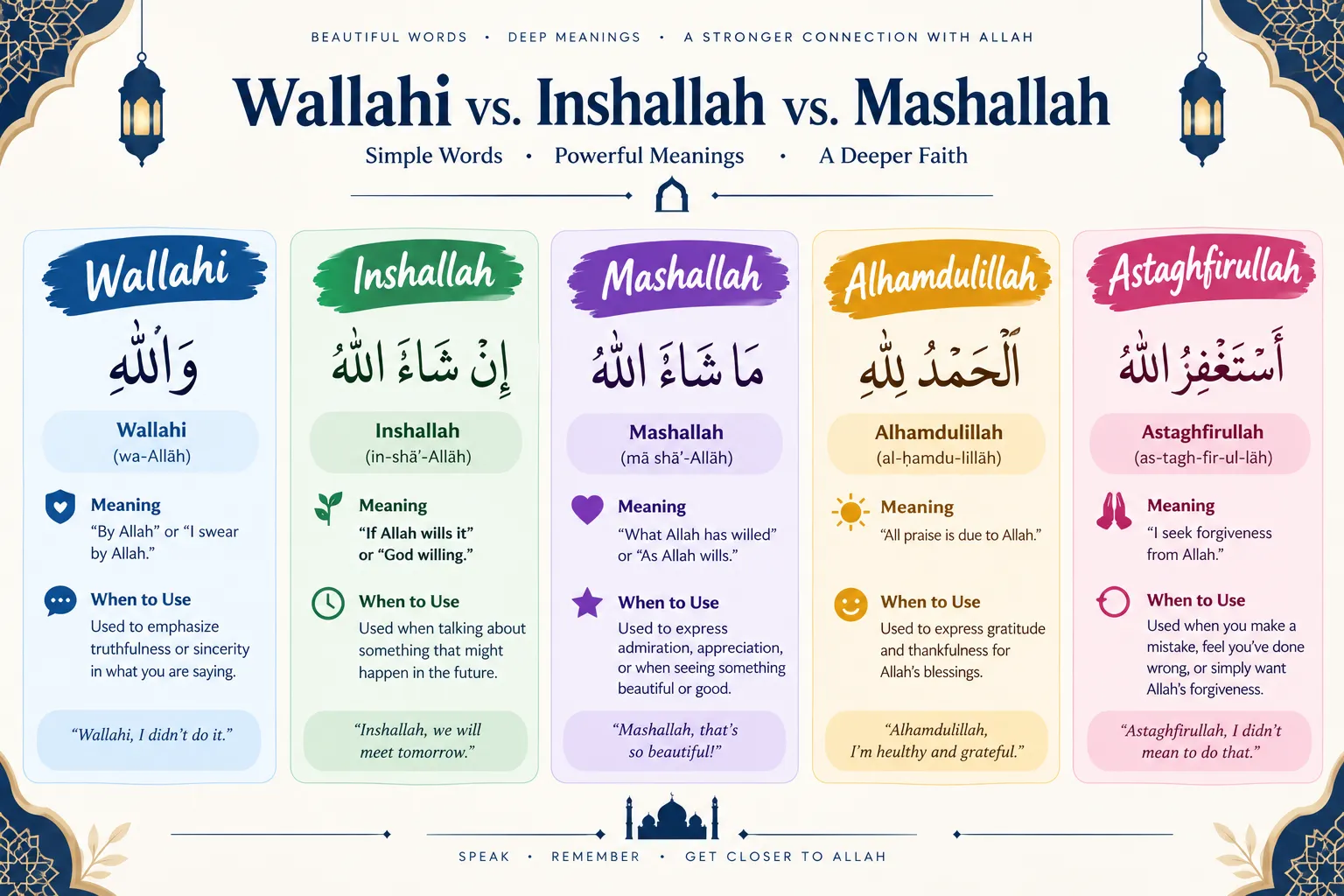
Wallahi, Inshallah, and Mashallah are Arabic expressions used by many Muslims. They all refer to Allah, but they have different meanings.
| Expression | Meaning in English | When it is used |
| Wallahi | By Allah; I swear by Allah | To make an oath |
| Inshallah | If Allah wills | When talking about a future plan or hope |
| Mashallah | What Allah has willed | To express admiration or acknowledge something good |
| Alhamdulillah | Praise be to Allah | To express thanks or praise |
| Astaghfirullah | I seek forgiveness from Allah | To seek forgiveness or express disapproval, depending on context |
These expressions are not interchangeable.
For example, “Wallahi, I will come tomorrow” is an oath. “Inshallah, I will come tomorrow” means the person hopes to come if Allah wills.
Understanding the difference helps you use each expression correctly.
Examples of Wallahi in Sentences
Here are simple examples of how Wallahi may appear in daily speech.
Everyday Examples
Example 1: “Wallahi, I left my keys on the table.”
Meaning: The speaker swears by Allah that the keys were left on the table.
Example 2: “Wallahi, I will call you tonight.”
Meaning: The speaker makes a serious promise to call.
Example 3: “Wallahi, I did not tell anyone your secret.”
Meaning: The speaker swears that they kept the secret.
Example 4: “Wallahi, this food tastes great.”
Meaning: The speaker strongly expresses that they like the food.
Examples in Text Messages
Friend 1: “Did you finish the project?”
Friend 2: “Wallahi, I finished it last night.”
Here, Wallahi stresses the speaker’s claim.
Friend 1: “Are you really moving next week?”
Friend 2: “Wallahi, yes.”
Here, the speaker uses the word to show that the statement is serious.
Friend 1: “You forgot my birthday!”
Friend 2: “Wallahi, I didn’t mean to.”
Here, the word adds emphasis to the speaker’s response.
Remember that these are examples of common language use. Whether an oath is appropriate depends on the situation and the speaker’s intention.
When Should You Use Wallahi?
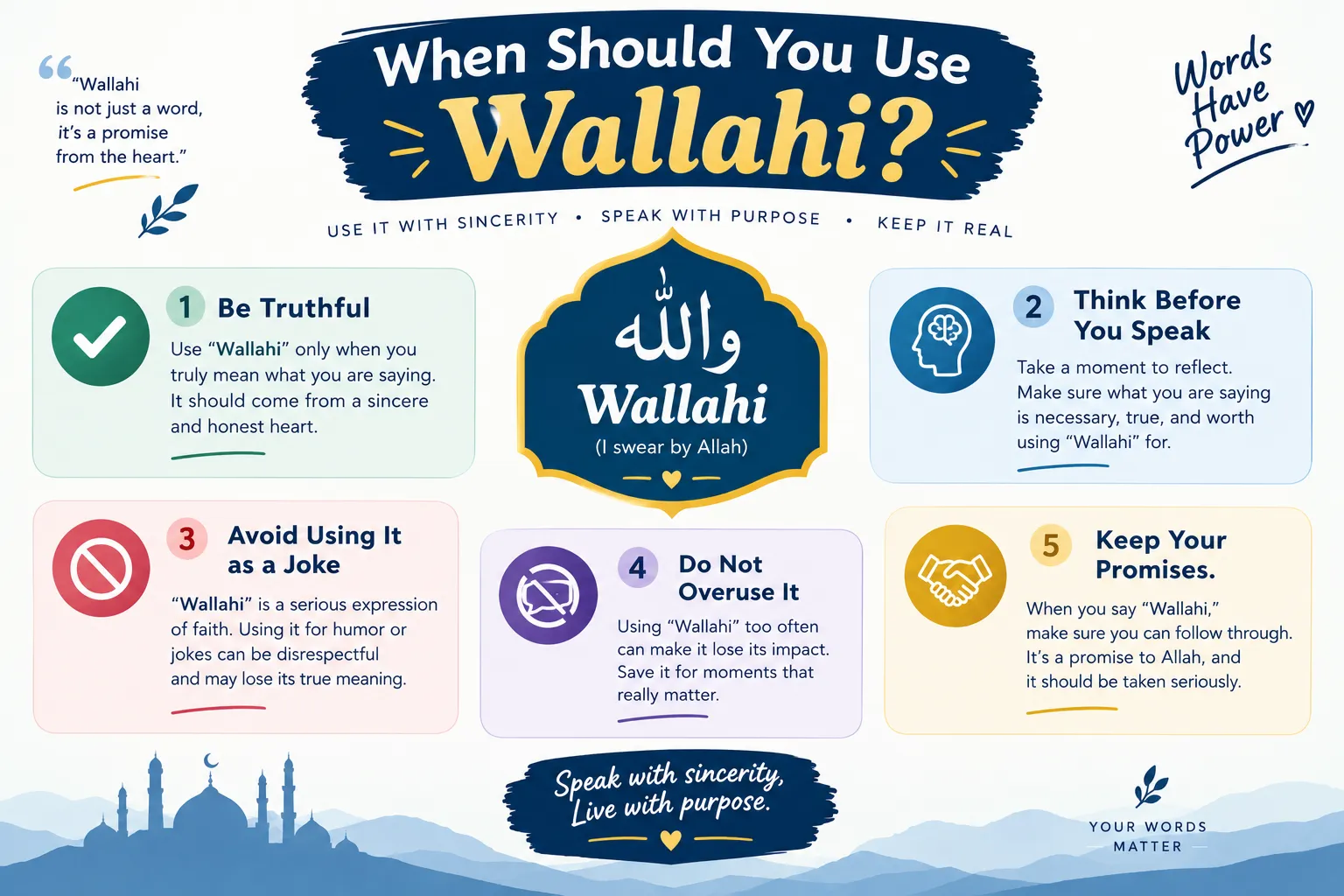
Wallahi should be used with care because it is an oath by Allah.
Here are a few simple guidelines:
- Be truthful. Never use Wallahi to support a lie.
- Think before you speak. Do not make an oath just to win an argument.
- Avoid using it as a joke. Its religious meaning deserves respect.
- Do not overuse it. You can often express yourself without making an oath.
- Keep your promises. If you swear to do something, take your words seriously.
If you simply want to show that you are sure about something, you can say “I am certain,” “I promise,” or “I really mean it.”
These phrases may fit better when you do not intend to make a religious oath.
Common Misunderstandings About Wallahi
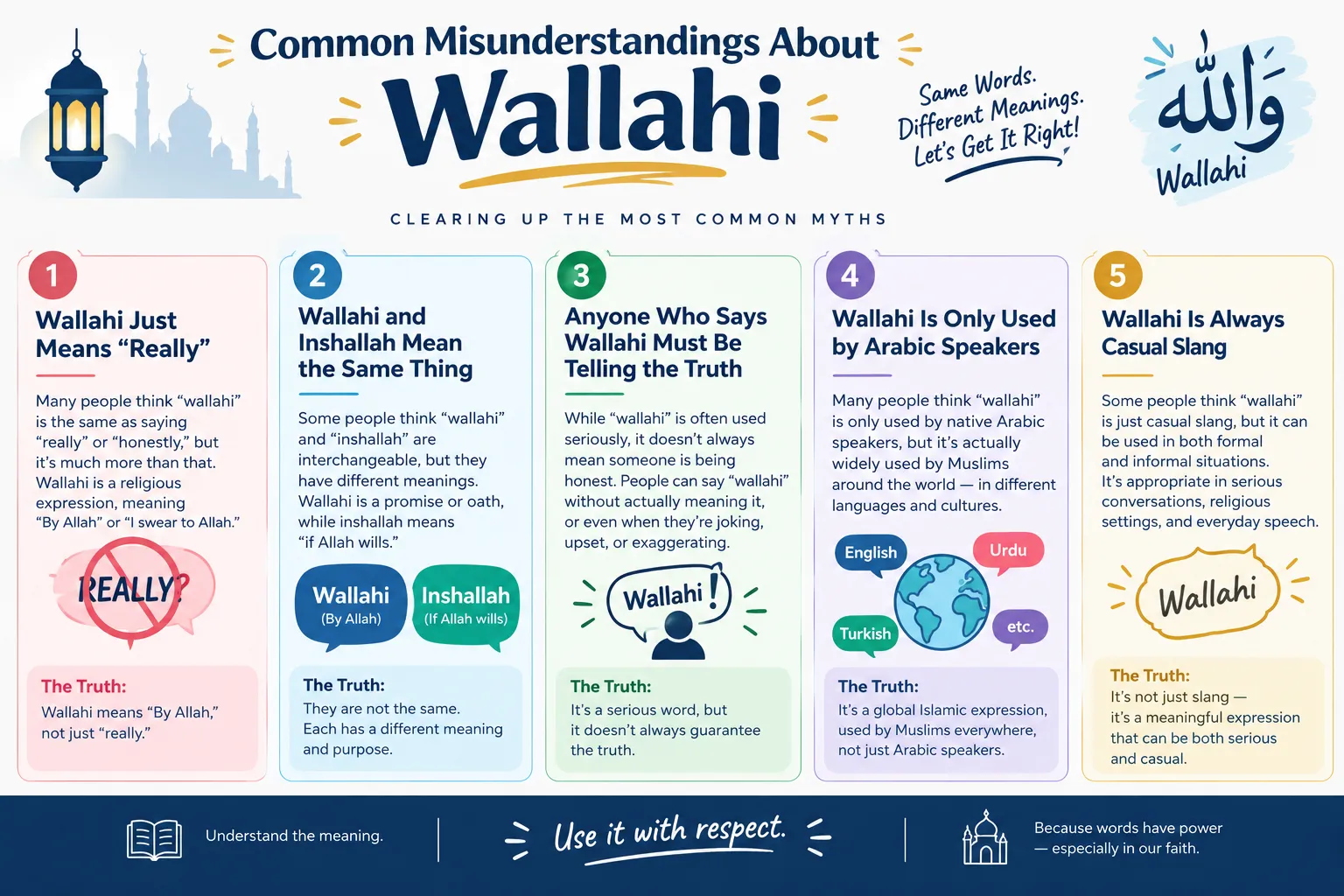
People sometimes misunderstand Wallahi because they hear it in casual conversations or online videos.
Wallahi Just Means “Really”
Wallahi can add emphasis, but its core meaning is “By Allah” or “I swear by Allah.” It is not simply another word for “really.”
Wallahi and Inshallah Mean the Same Thing
They do not. Wallahi is an oath, while Inshallah means “if Allah wills.”
Anyone Who Says Wallahi Must Be Telling the Truth
Using the word does not prove that a statement is true. People can still lie when making an oath.
The truth depends on the facts, not just the words used.
Wallahi Is Only Used by Arabic Speakers
The word comes from Arabic, but it is also used by many Muslims and other people in different countries and language communities.
Wallahi Is Always Casual Slang
Some people use it casually, but it has a serious religious meaning.
Its use should reflect an understanding of that meaning.
How to Reply When Someone Says Wallahi
Your reply depends on what the person is saying.
- If someone says, “Wallahi, I am telling the truth,” you can listen and consider what they say.
- If someone says, “Wallahi, I will help you,” you can reply, “Thank you. I appreciate that.”
- If someone asks, “Wallahi?” to show surprise, you can answer, “Yes, really,” if that is what you mean.
- If someone uses Wallahi to make a serious claim, you do not need to repeat the word in your response.
You can respond in a natural way without making an oath yourself. For example, “I understand,” “Thanks for telling me,” or “I hope that is true” may fit the situation.
FAQs
1. What does Wallahi mean in English?
Wallahi means “By Allah” or “I swear by Allah.” It is an Arabic expression used to make an oath or stress that a statement is true.
2. Is Wallahi an Arabic word?
Yes. Wallahi comes from Arabic and refers to making an oath by Allah.
3. What does Wallahi mean in Islam?
In Islam, Wallahi is an oath by Allah. Muslims are encouraged to be truthful and avoid making false or careless oaths.
4. Does Wallahi mean I promise?
It can express a serious promise, but its direct meaning is “By Allah” or “I swear by Allah.” The meaning depends on the sentence and context.
5. Is Wallahi the same as Wallah?
The terms are closely related and may be used in similar ways. Wallahi is a common form of the Arabic oath meaning “By Allah,” while Wallah is often used as an informal or shortened form.
6. Can I say Wallahi if I am not Muslim?
People from different backgrounds may use Arabic expressions, but Wallahi has a religious meaning.
Anyone considering using it should understand what it means and treat it with respect.
7. Is it haram to say Wallahi?
Saying Wallahi is not automatically forbidden. However, making a false oath or using Allah’s name carelessly is a serious matter in Islam. For a personal religious ruling, ask a trusted Islamic scholar.
8. What is the difference between Wallahi and Inshallah?
Wallahi means “By Allah” or “I swear by Allah.” Inshallah means “if Allah wills” and is often used when speaking about future plans.
9. How do you pronounce Wallahi?
Wallahi is commonly pronounced “wah-LAH-hee.”
Pronunciation may vary slightly by accent and dialect.
10. Why do people say Wallahi so often?
Some people use it to stress that they are telling the truth, making a promise, or expressing strong feelings.
In some communities, it is also part of casual speech, though its religious meaning remains important.
Article Summary
- Wallahi meaning: “By Allah” or “I swear by Allah.”
- Language: Arabic.
- Main purpose: To make an oath or stress that a statement is true.
- Religious meaning: It is an oath by Allah in Islamic usage.
- Common uses: Honest statements, serious promises, and expressions of strong feelings.
- Wallahi vs. Inshallah: Wallahi is an oath; Inshallah means “if Allah wills.”
- Important reminder: Use Wallahi truthfully and respectfully, and avoid making false or careless oaths.
Conclusion
Wallahi is an Arabic expression that means “By Allah” or “I swear by Allah.”
It is used in daily conversations, text messages, and serious discussions to stress that a statement is true or that a promise matters.
Although some people use Wallahi casually, it has a deep religious meaning in Islam. It should not be used to lie, mislead others, or make careless promises.
Understanding its meaning helps you recognize the phrase when you hear it and use it properly if you choose to do so.
The main thing to remember is simple:
Wallahi is more than slang. It is an oath by Allah, so honesty and respect matter whenever it is used.

Ryan Mitchell creates informative content about word definitions, acronyms, online slang, and modern communication. He enjoys exploring how people use language in text messages, on social media, and in daily life. Ryan focuses on delivering simple explanations and practical examples that help readers quickly understand the meaning of unfamiliar words and phrases.