
Introduction
Have you ever heard someone say something that sounded innocent, but you felt they were hinting at something else? That may be innuendo.
The word can describe a subtle remark that suggests an idea without saying it directly. It is often used for humor, criticism, romance, or sexual suggestions.
Understanding innuendo meaning can make everyday conversations much easier to follow.
You may see the word in movies, jokes, social media posts, books, news stories, or casual conversations.
The tricky part is that an innuendo depends heavily on context. The same words can sound normal in one situation but carry a hidden message in another.
In simple terms, innuendo means an indirect hint or suggestion, often about something rude, unpleasant, or sexual.
This guide explains what innuendo means, how to recognize it, common examples, related words, and the difference between innuendo and similar terms.
What Does Innuendo Mean?
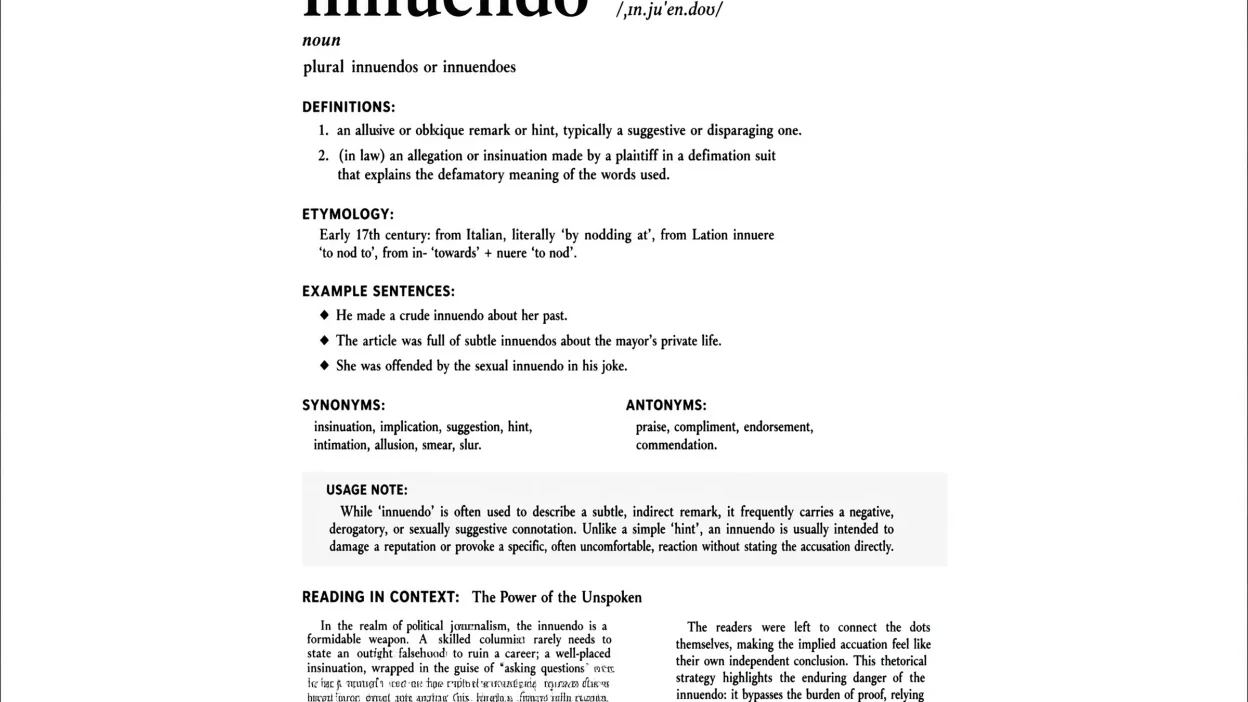
Innuendo is a noun that means an indirect remark or suggestion.
Instead of clearly saying what someone means, the speaker hints at it and lets the listener figure it out.
For example:
“He seems to spend a lot of time with his coworker.”
On its own, this sounds like a simple statement. But depending on the tone and situation, the speaker may be suggesting that something romantic is happening between them.
That hidden suggestion is the innuendo.
Dictionary definitions commonly describe innuendo as an indirect reference or remark, often suggesting something negative, rude, or sexual.
Simple innuendo definition
Innuendo = a subtle or indirect hint about something without saying it openly.
It can be:
- Funny
- Suggestive
- Critical
- Insulting
- Romantic
- Sexual
- Sarcastic
- Sometimes completely innocent
The meaning depends on the words, tone, context, and relationship between the people speaking.
Innuendo Meaning in Simple English
If you want the easiest possible explanation, think of an innuendo as “saying something without really saying it.”
Imagine someone says:
“Wow, you two are getting pretty close.”
The sentence does not directly accuse the two people of dating or having a romantic relationship. However, the speaker may be hinting at exactly that.
So, an innuendo allows someone to communicate an idea indirectly.
It is similar to giving someone a nudge or hint instead of making a direct statement.
Another simple example
Someone says:
“I wonder why she got the job so quickly.”
The speaker has not directly accused anyone of favoritism. But the comment may suggest that the person received special treatment.
That implied accusation can be an innuendo.
What Is an Innuendo Used For?
People use innuendo for many reasons. It is not always meant to be offensive.
1. To make people laugh
Comedians often use innuendo because a hidden meaning can make a joke more entertaining.
Instead of directly stating something inappropriate, the speaker creates a sentence with an innocent surface meaning and a second implied meaning.
The listener then discovers the joke.
2. To criticize someone indirectly
Innuendo can allow someone to make a negative suggestion without making a direct accusation.
For example:
“Some people seem to get special treatment around here.”
The speaker may be talking about a particular person without naming them.
3. To suggest something romantic
A person might use innuendo when flirting.
For example:
“You look really good tonight. I hope you’re not planning to leave early.”
Depending on the situation, this could simply be friendly—or it could carry a romantic suggestion.
4. To make a sexual joke
Sexual innuendo is especially common in comedy, movies, advertisements, and adult humor. It suggests a sexual idea without directly describing it.
Cambridge specifically defines this common use as a remark that suggests something about sex without saying it directly.
5. To avoid saying something directly
Sometimes people use indirect language because a direct statement may feel rude, embarrassing, or uncomfortable.
This can make innuendo useful, but it can also create confusion.
Examples of Innuendo
Here are several simple examples.
Example 1: Romantic innuendo
“You two seem to enjoy spending a lot of time together.”
This may suggest that the two people have romantic feelings for each other.
Example 2: Workplace innuendo
“Interesting that he got promoted so quickly.”
The speaker may be implying that the promotion was not based only on ability.
Example 3: Social innuendo
“I heard they had a very long dinner together.”
Depending on the context, this could suggest that something romantic happened.
Example 4: Humorous innuendo
“That’s a very big banana.”
The literal sentence is innocent. But depending on the situation and tone, it could be intended as a sexual joke.
Example 5: Critical innuendo
“She certainly knows how to get what she wants.”
This could simply be praise, but it might also imply that she uses questionable methods to get what she wants.
Example 6: Sarcastic innuendo
“Well, that was certainly a brilliant decision.”
The speaker may actually mean the opposite and imply that the decision was foolish.
These examples show why context matters. An innuendo is often not obvious from the words alone.
What Is Sexual Innuendo?
Sexual innuendo is an indirect suggestion or joke that hints at sex or sexual activity without saying it openly.
For example:
“That’s not the way I expected you to handle that.”
If the surrounding situation gives the sentence a sexual meaning, it may be sexual innuendo.
Sexual innuendo is common in:
- Comedy
- Movies
- Television
- Advertising
- Music
- Social media
- Casual conversation
- Flirting
The important point is that the statement itself does not have to be explicitly sexual.
The sexual meaning comes from the suggestion, context, or double interpretation.
This is why some jokes can sound completely innocent to one person while another person immediately notices the hidden meaning.
Innuendo vs. Double Entendre
Innuendo and double entendre are closely related, but they are not exactly the same.
A double entendre is a phrase that can have two meanings, often with one meaning being humorous or suggestive.
An innuendo, on the other hand, is more about indirectly suggesting something.
For example, a phrase may have a normal literal meaning but be delivered in a way that suggests something sexual or insulting. That is an innuendo.
The terms can overlap, especially in comedy and entertainment.
Some explanations treat sexual innuendo and double entendre as closely connected, but the focus is different: double entendre emphasizes multiple meanings, while innuendo emphasizes an indirect suggestion.
Simple difference
| Term | Simple meaning |
| Innuendo | An indirect hint or suggestion |
| Double entendre | A phrase with two possible meanings |
| Hint | A small clue or suggestion |
| Insinuation | An indirect suggestion, often negative |
| Implication | An idea suggested without being directly stated |
Innuendo vs. Insinuation
These words are also very similar.
An insinuation is an indirect suggestion, often one that is negative or harmful.
An innuendo can also be negative, but it is commonly associated with suggestive, humorous, or sexual remarks.
For example:
“Are you sure you can trust him?”
This could be an insinuation that the person is dishonest.
By contrast:
“They seem to be spending a lot of time alone together.”
This could be an innuendo suggesting a romantic relationship.
The difference is not always strict because the two words can overlap.
Innuendo vs. Hint
A hint is usually more neutral.
For example:
“Your gift is somewhere in the kitchen.”
That is a hint. It gives you useful information without directly telling you where the gift is.
An innuendo is more likely to contain a hidden or suggestive idea.
So:
Hint: “Look near the place where we keep the snacks.”
Innuendo: “I wonder why you two always disappear into the kitchen together.”
The second statement suggests something beyond its literal words.
How to Recognize an Innuendo
Sometimes an innuendo is easy to spot. Other times, you need to pay attention to context.
Here are some signs.
1. The statement seems unusual
If someone says something that feels strange for the situation, there may be another meaning.
2. The tone sounds different
A raised eyebrow, pause, smile, or sarcastic tone can change the meaning of ordinary words.
3. The speaker emphasizes certain words
Extra emphasis may signal that the speaker wants you to notice a hidden meaning.
4. The sentence has an obvious second interpretation
Some phrases can be understood in both an innocent and suggestive way.
5. Other people react
If people laugh, look at each other, or make a knowing expression, there may be an implied meaning.
6. Context changes the meaning
This is perhaps the most important point.
A sentence cannot always be labeled an innuendo by looking at the words alone. You need to consider what was happening when the sentence was said.
Can Innuendo Be Innocent?
Yes.
Not every possible hidden meaning is sexual or offensive.
Innuendo can simply involve an indirect suggestion.
However, dictionaries often highlight negative, rude, or sexual uses because those are common meanings of the word.
For example:
“I wouldn’t ask him to organize the party again.”
This might imply that he did a poor job, even though the speaker does not directly say so.
That is an indirect suggestion rather than a sexual remark.
Why Do Writers Use Innuendo?
Writers, comedians, and filmmakers often use innuendo because it lets audiences discover a meaning for themselves.
It creates humor
A hidden joke can be more amusing than a direct statement.
It adds personality
A character who constantly uses subtle remarks may appear clever, sarcastic, mysterious, or playful.
It creates tension
A character might hint at something without revealing the entire truth.
It lets audiences participate
Readers and viewers get to interpret what the speaker really means.
It makes dialogue more natural
Real conversations often contain hints and indirect statements. Writers can use this to make characters feel more realistic.
Innuendo is also common in comedy because the audience gets satisfaction from noticing the meaning behind the words.
Innuendo in Movies and TV Shows
Innuendo is common in entertainment.
A writer may create dialogue that sounds harmless to children but has another meaning that adults understand.
This technique has been used in many forms of comedy and animation. The hidden joke works because different viewers may understand the same sentence at different levels.
For example, a character might make an ordinary comment about food, work, or an object while the camera angle, facial expression, or surrounding dialogue creates another interpretation.
That second interpretation is what makes the line an innuendo.
Innuendo in Social Media and Texting
You may also see innuendo in texts, comments, memes, and social media posts.
Because written messages do not always include voice tone or facial expressions, innuendo can sometimes be harder to understand.
For example:
“Oh, so that’s what you two were doing.”
Without context, this could mean almost anything.
But if the sender adds a laughing emoji or uses a particular situation as the background, the intended meaning may become clear.
This is why context is especially important when identifying innuendo in text messages.
Common Synonyms for Innuendo
Depending on the situation, these words may have similar meanings:
- Insinuation
- Hint
- Suggestion
- Implication
- Allusion
- Reference
- Intimation
- Suggestion
- Indirect remark
However, they are not perfect replacements in every sentence.
For example, hint is usually neutral, while innuendo often suggests something more pointed, suggestive, negative, or inappropriate.
What Is the Plural of Innuendo?
There are two commonly accepted plural forms:
- Innuendos
- Innuendoes
For example:
“The comedian’s jokes were full of innuendos.”
You may also see:
“The movie contains several innuendoes.”
Both forms are used in English.
How Do You Pronounce Innuendo?
In American English, innuendo is commonly pronounced:
in-yoo-EN-doh
The American English pronunciation is represented as /ˌɪnjuˈɛndoʊ/.
It has four syllables:
in – nu – en – do
The stress is mainly on “en.”
Is Innuendo Always Sexual?
No.
This is a common misunderstanding.
While sexual innuendo is a very common type, the word has a broader meaning.
An innuendo can suggest something negative, insulting, romantic, suspicious, or otherwise implied.
For example:
“He must have had a good reason for arriving three hours late.”
The speaker may be implying that the person has a poor excuse.
No sexual meaning is necessary.
So the best general definition is:
An innuendo is an indirect suggestion or remark that carries an implied meaning.
Is Innuendo the Same as Sarcasm?
No.
Sarcasm usually involves saying something that means the opposite of the literal words, often to mock or criticize.
Innuendo involves suggesting something indirectly.
For example:
“Great job!” said after someone makes a major mistake.
That is sarcasm.
But:
“I guess some people have their own way of getting promoted.”
That may be innuendo because it suggests something without directly stating it.
A sentence can sometimes contain both sarcasm and innuendo.
Is Innuendo the Same as a Metaphor?
No.
A metaphor compares one thing to another to create an image or explain an idea.
For example:
“Time is a thief.”
This is a metaphor.
An innuendo does not require a comparison. It is about indirectly suggesting an idea.
How to Use “Innuendo” in a Sentence
Here are natural examples:
- The comedian is known for using sexual innuendo.
- Her comment contained an obvious innuendo.
- I didn’t understand the innuendo at first.
- The movie uses humor and innuendo.
- His remarks were filled with innuendo.
- The advertisement was criticized for its sexual innuendo.
- She made an innuendo about his relationship.
- The joke went over my head because I missed the innuendo.
These examples show how the noun innuendo is commonly used in everyday English.
Common Phrases With Innuendo
You may encounter several phrases containing the word.
Sexual innuendo
A hidden or indirect sexual suggestion.
Full of innuendo
Used when something contains many indirect or suggestive remarks.
“The comedy was full of innuendo.”
An obvious innuendo
A suggestion that is easy to recognize.
“That was an obvious innuendo.”
A subtle innuendo
A hidden suggestion that requires more thought or context.
“The writer included a subtle innuendo.”
Political innuendo
An indirect suggestion or accusation involving politics or public figures.
Article Summary
Innuendo means an indirect hint, remark, or suggestion that communicates an idea without stating it openly.
It is often associated with rude, negative, humorous, romantic, or sexual meanings, but it is not always sexual.
The key to understanding innuendo is context. Tone, facial expressions, surrounding words, and the relationship between speakers can reveal what someone really means.
Innuendo is common in everyday conversation, comedy, movies, television, advertising, books, and social media.
It is closely related to terms such as insinuation, implication, hint, suggestion, and double entendre, but each word has a slightly different use.
The simplest way to remember the meaning is:
Innuendo = an indirect suggestion or hidden hint.
FAQs
What does innuendo mean in simple words?
Innuendo means hinting at something without saying it directly.
The hidden meaning may be funny, negative, romantic, or sexual, depending on the context.
What is an example of an innuendo?
An example is:
“You two seem to spend a lot of time together.”
The speaker may simply be making an observation, but they could also be hinting that the two people have a romantic relationship.
Does innuendo always mean something sexual?
No. Sexual innuendo is common, but innuendo can also suggest something negative, critical, romantic, suspicious, or insulting.
What is a synonym for innuendo?
Common synonyms include insinuation, implication, hint, suggestion, allusion, and indirect remark. The best synonym depends on the context.
What is the difference between innuendo and insinuation?
Both involve indirect suggestions. Innuendo is often used for suggestive, humorous, or sexual remarks, while insinuation often refers to an indirect negative suggestion or accusation.
What is the difference between innuendo and double entendre?
An innuendo indirectly suggests an idea. A double entendre is a phrase that can have two meanings, often with one being humorous or suggestive. The two concepts can overlap.
How do you pronounce innuendo?
In American English, innuendo is commonly pronounced in-yoo-EN-doh, with the pronunciation represented as /ˌɪnjuˈɛndoʊ/.
What is sexual innuendo?
Sexual innuendo is an indirect remark, joke, or suggestion that hints at a sexual idea without saying it openly.
Can an innuendo be negative?
Yes. An innuendo can indirectly suggest something unpleasant, critical, or insulting about a person or situation.
What is the plural of innuendo?
Both innuendos and innuendoes are used as plural forms.
Is sarcasm an innuendo?
Not necessarily. Sarcasm usually involves saying something in a way that means the opposite, often to mock or criticize.
Innuendo focuses on an indirect or hidden suggestion. One statement can sometimes use both.
Conclusion
The innuendo meaning is simple once you understand the idea of an indirect message. An innuendo is a remark that suggests something without clearly saying it.
It can be funny, critical, romantic, suggestive, or sexual.
The most important thing to remember is that context determines the hidden meaning.
The same sentence may be completely innocent in one situation and an obvious innuendo in another.
If you notice a statement that seems to have a meaning beyond its literal words, ask yourself what the speaker is trying to suggest.
That is often the key to recognizing an innuendo.

Emma Wilson is a writer at MeaningVibz who enjoys exploring emoji meanings, texting expressions, and online communication trends. She helps readers understand how emojis and slang are used in different situations by providing clear explanations and relatable examples for everyday messaging.