
“Good riddance” is an English phrase that means you are glad to be rid of someone or something.
It is used when a person, problem, bad habit, or unwanted situation goes away.
In simple words, it means, “I am glad that is gone.”
The phrase often shows a mix of relief and dislike.
You may feel better because something that made you upset is no longer part of your life.
Simple Example of Good Riddance
- “My rude neighbor moved away. Good riddance!” This means the speaker is glad the neighbor is gone.
The phrase can be used for people, things, habits, and situations. However, when you use it about a person, it may sound cold or mean.
What Does Good Riddance Mean in Simple Words?
In simple words, good riddance means being glad that something unwanted is gone.
Imagine you have a problem that causes you stress every day. One day, the problem ends.
You feel happy and free. You might say, “Good riddance!”
Here are a few easy ways to understand it:
- I am glad it is over.
- I am happy that person is gone.
- I do not want that thing back.
- I feel better without it.
The exact meaning depends on the situation. It may show joy, relief, anger, or even a little sarcasm.
For example, if someone says, “Good riddance to my old phone,” the words may sound playful.
But if someone says, “Good riddance to you,” during an argument, it can sound rude and hurtful.
Is Good Riddance Positive or Negative?
“Good riddance” can sound positive or negative, depending on what is being discussed.
The feeling behind it is often positive for the speaker, but the words can sound negative toward the person or thing being discussed.
When It Has a Positive Meaning
The phrase can show relief when a bad situation ends.
Examples:
- “Good riddance to that awful storm!”
- “Good riddance to my old debt!”
- “Good riddance to the bad habits I left behind!”
In these cases, the speaker feels happy because something unwanted is gone.
When It Has a Negative Meaning
When you use the phrase about a person, it can show anger, dislike, or disrespect.
Examples:
- “He left the team? Good riddance!”
- “Good riddance to that selfish friend.”
- “She said good riddance after their fight.”
These examples suggest that the speaker does not care that the person is gone. They may even feel happy about it.
How to Use Good Riddance in a Sentence
You can use “good riddance” on its own or as part of a longer sentence. It is common in casual speech, texts, online comments, and informal writing.
1. Use Good Riddance on Its Own
You can say the phrase after someone or something leaves.
Examples:
- “He is gone? Good riddance!”
- “The old rules are over. Good riddance!”
- “That problem is finally solved. Good riddance!”
This form is short and direct. It often shows a strong feeling.
2. Use Good Riddance To
The phrase often appears with “to” when you name the person or thing you are glad to lose.
Examples:
- “Good riddance to bad rubbish.”
- “Good riddance to my old, broken shoes.”
- “Good riddance to all that stress.”
The words after “to” tell the reader what the speaker wants to leave behind.
4. Use Good Riddance in Text Messages
Friends may use the phrase in casual messages.
Example:
Friend 1: “I finally blocked that person who kept bothering me.”
Friend 2: “Good riddance! You deserve peace.”
This use can show support. Still, the phrase may sound unkind if the other person does not know the full story.
Good Riddance Meaning in Different Situations
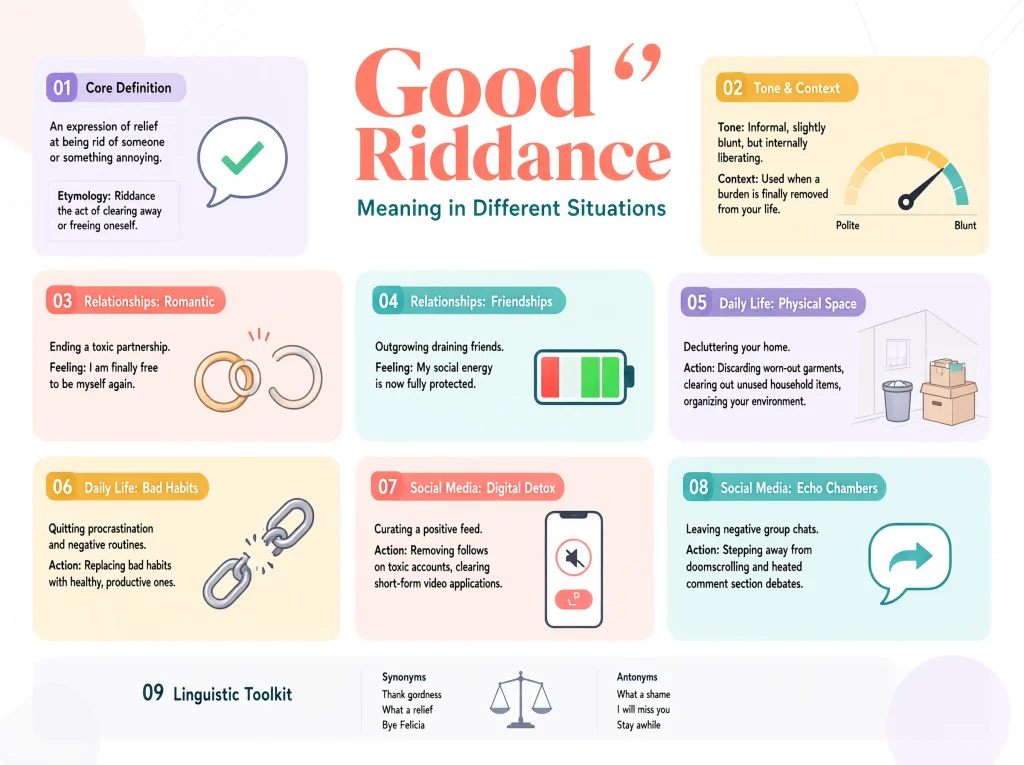
The meaning of “good riddance” can change a little based on the situation. The main idea stays the same: the speaker is glad something is gone.
Good Riddance in Relationships
In relationships, the phrase often shows relief after a breakup or the end of a bad friendship.
Example: “After months of fighting, they broke up. She said, ‘Good riddance!’”
This means she feels better now that the relationship has ended.
However, saying “good riddance” about an ex-partner can sound bitter or angry. If you want to sound calm and kind, you could say, “I am ready to move on.”
Good Riddance in Daily Life
People also use it for unwanted items, bad habits, and annoying problems.
Examples:
- “Good riddance to these old clothes!”
- “I stopped wasting money on things I do not need. Good riddance to that habit.”
- “The noisy machine is finally fixed. Good riddance to that awful sound!”
In these cases, the phrase can sound lighthearted or funny rather than angry.
Good Riddance on Social Media
On social media, “good riddance” may appear in posts about breakups, bad experiences, public events, or the end of a difficult time.
Example: “The worst year of my life is over. Good riddance!”
Here, the person is glad to leave a painful time behind.
The phrase can also be used in memes or jokes. Its strong tone makes it useful for showing a clear opinion in just two words.
What Does “Good Riddance to Bad Rubbish” Mean?
“Good riddance to bad rubbish” is a longer version of the phrase. It means that getting rid of an unwanted person or thing is a good result.
The words “bad rubbish” make the statement stronger. When used about a person, they suggest that the speaker thinks the person is worthless or harmful.
Example: “He treated everyone badly, so when he left, his coworkers said, ‘Good riddance to bad rubbish.’”
This saying can sound insulting. It is usually used in informal speech, jokes, or angry comments rather than polite conversation.
When talking about an object or a problem, the phrase can sound less personal.
For example, “Good riddance to bad rubbish” may be used while throwing away broken items.
Good Riddance vs. Goodbye
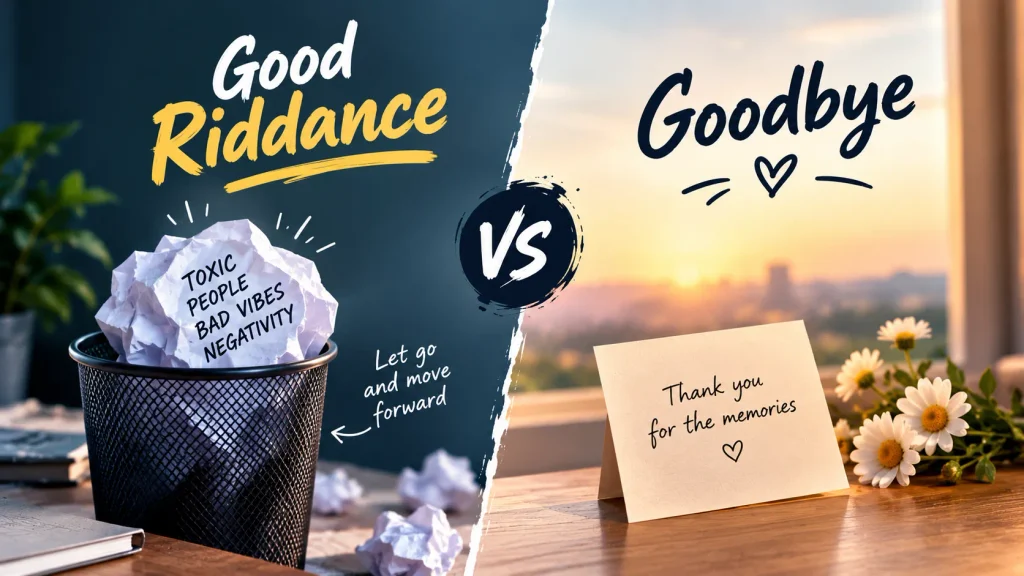
“Good riddance” and “goodbye” are not the same. Both can be said when someone leaves, but they express different feelings.
| Phrase | Meaning | Tone |
| Good riddance | I am glad you or it is gone. | Often harsh or sarcastic |
| Goodbye | I am leaving or we are parting. | Neutral or polite |
| Farewell | A formal or lasting goodbye. | Respectful or emotional |
| See you later | I expect to see you again. | Friendly |
| Take care | I wish you well. | Kind or polite |
For example, if a friend moves to another city, you might say, “Goodbye! I will miss you.”
If a person who often treats you badly leaves your life, you might say, “Good riddance!”
The key difference is the feeling behind the words. “Goodbye” marks a parting, while “good riddance” says you are glad the person or thing is gone.
Good Riddance Synonyms and Similar Phrases
If you want to express relief without using “good riddance,” several phrases may fit.
1. Glad to Be Rid of It
This phrase means you are happy that something is no longer part of your life.
Example: “I am glad to be rid of that old car.”
2. Good to See It Go
This is a simple way to show that you welcome a change.
Example: “Those unfair rules are gone. Good to see them go!”
3. Finally Free
This phrase focuses on relief and freedom.
Example: “I left that stressful job. I am finally free!”
4. Thank Goodness It Is Over
This phrase shows relief after a hard or annoying experience.
Example: “The long exam is over. Thank goodness!”
Which Phrase Should You Choose?
Use “good riddance” when you want to show a strong feeling that something unwanted is gone.
Use “glad that’s over” or “thank goodness it’s over” when you want to sound less harsh.
If you want to be polite, say, “I am ready to move on” or “I wish them well.”
When Is It Okay to Say Good Riddance?
It may be fine in casual talks with friends when everyone understands the context.
It can also be used about objects, bad habits, or difficult situations.
Examples:
- “Good riddance to my old, slow computer!”
- “Good riddance to that bad habit.”
- “Good riddance to the stress of moving.”
Common Mistakes When Using Good Riddance
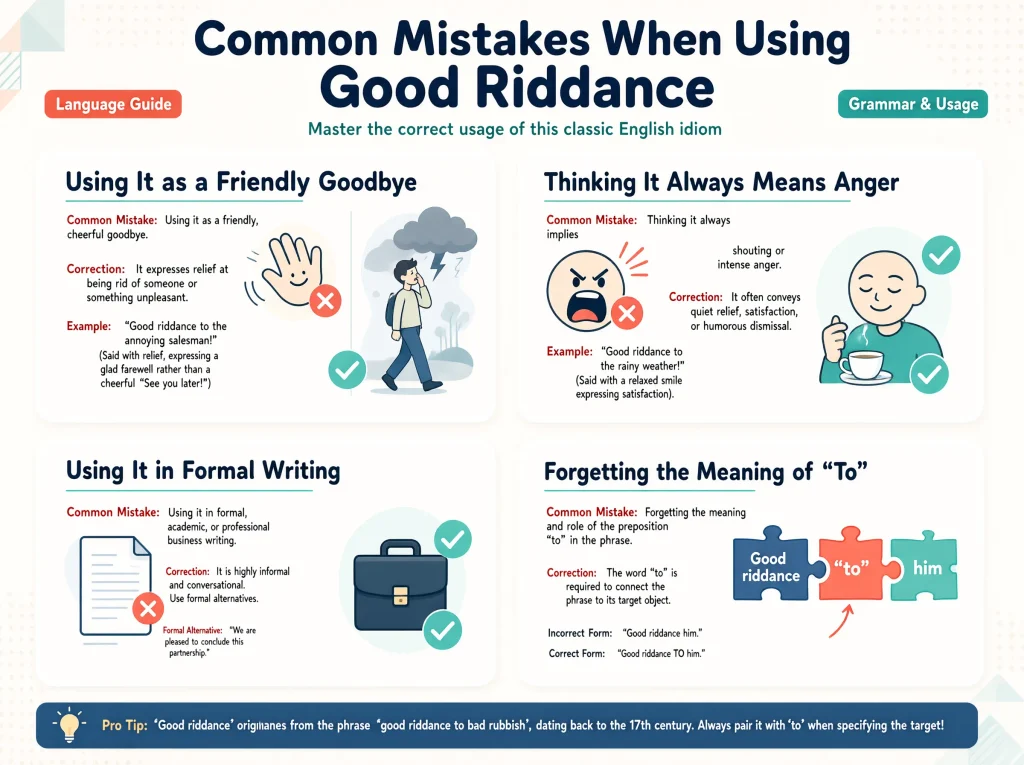
Even though the phrase is simple, some learners use it in the wrong way.
Using It as a Friendly Goodbye
“Good riddance” usually does not mean a warm or kind goodbye.
Incorrect for a friendly farewell: “Good riddance! Have a great trip!”
Better: “Goodbye! Have a great trip!”
Thinking It Always Means Anger
The phrase does not always show anger. It can express relief, humor, or satisfaction.
Example: “Good riddance to my old, broken phone!”
The speaker may simply be happy to replace an item that no longer works.
Using It in Formal Writing
The phrase is usually informal and can sound harsh.
Instead of writing, “Good riddance to the old policy,” in a business report, write, “The removal of the old policy is a welcome change.”
Forgetting the Meaning of “To”
You can say “Good riddance!” on its own or use “to” before the person or thing you are glad to lose.
Examples:
- “Good riddance!”
- “Good riddance to that problem!”
Both are natural English.
How to Respond When Someone Says Good Riddance
If someone says “good riddance” to you, the best response depends on the situation and your relationship with that person.
If They Are Joking
You can keep the tone light.
Example:
Person: “You finally finished that messy project? Good riddance!”
You: “You can say that again!”
If They Are Angry
Try to stay calm instead of making the conflict worse.
You could say:
- “I understand how you feel.”
- “Let’s leave it there.”
- “I think it is best if we move on.”
You do not have to argue with someone who wants to end a conversation.
FAQs
1. What does good riddance mean in simple words?
Good riddance means you are happy that someone or something you disliked is gone.
It often shows relief or freedom from an unwanted person, problem, or situation.
2. Is good riddance a rude phrase?
Yes, it can be rude, especially when you use it about a person. It may suggest that you are happy the person is no longer part of your life.
When used about an unwanted object or problem, it can sound harmless or playful.
3. What is an example of good riddance?
An example is, “My old boss made work stressful. Good riddance!” This means the speaker is glad the boss is gone and expects life to be better without them.
4. What does good riddance mean in a relationship?
In a relationship, good riddance often means someone feels relieved that a breakup or bad friendship has ended.
It may show anger, disappointment, or happiness about moving on.
5. Does good riddance mean goodbye?
No. Goodbye is a general way to say farewell, while good riddance means you are glad someone or something is gone.
The second phrase often sounds more negative.
6. What is another word for good riddance?
Similar phrases include “glad that’s over,” “I won’t miss it,” “finally free,” and “thank goodness it’s over.”
The best choice depends on whether you want to sound angry, relieved, playful, or polite.
7. What does good riddance to bad rubbish mean?
It means that getting rid of an unwanted person or thing is a good result.
When used about a person, it is a strong insult because it compares them to rubbish.
8. Can I use good riddance in a positive way?
Yes. You can use it to show happiness when a bad habit, stressful task, or unwanted problem ends.
Article Summary
- Good riddance meaning: Being glad that an unwanted person, thing, or situation is gone.
- Main feeling: Relief, dislike, freedom, or sometimes sarcasm.
- Common use: Casual conversations, texts, jokes, and informal posts.
- Tone: Often harsh when used about a person, but lighter when used about an object or problem.
- Similar phrases: “Glad that’s over,” “I won’t miss it,” and “thank goodness it’s over.”
- Polite alternative: “I am ready to move on.”
- Example: “I finally left that stressful job. Good riddance!”
Conclusion
The phrase “good riddance” means you are glad to be free of someone or something you did not want.
It can express relief after a hard time, happiness when a bad habit ends, or anger when a person leaves.
The meaning depends on the situation and the speaker’s tone.
Now that you understand the good riddance meaning, you can use it more naturally in everyday English.
Remember that it is an informal phrase and may sound rude when used about a person. If you want to express relief in a kinder way, try saying “glad that’s over” or “I am ready to move on.”
FAQs About Good Riddance Meaning

Ryan Mitchell creates informative content about word definitions, acronyms, online slang, and modern communication. He enjoys exploring how people use language in text messages, on social media, and in daily life. Ryan focuses on delivering simple explanations and practical examples that help readers quickly understand the meaning of unfamiliar words and phrases.