
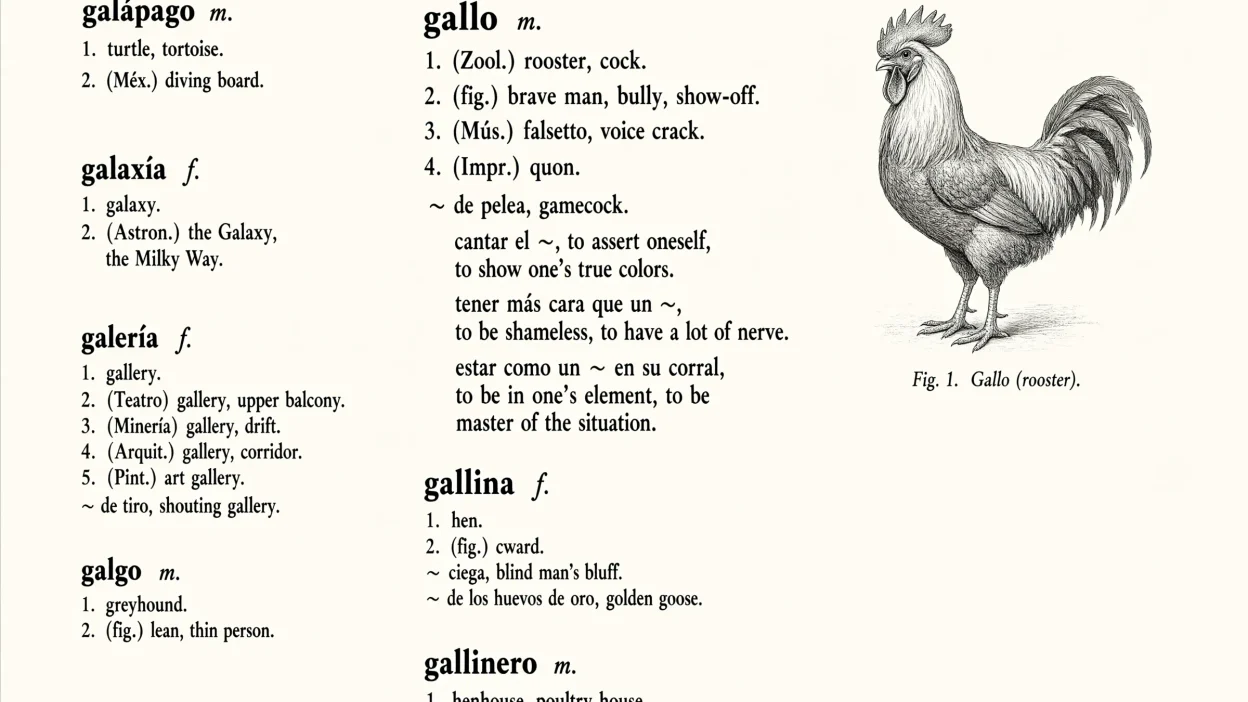
El gallo literally means “the rooster” in English.
The phrase has two parts:
- El = “the”
- Gallo = “rooster”
So:
El gallo = The rooster
A gallo is a male chicken. In normal Spanish, you can use el gallo when talking about an actual rooster.
For example:
El gallo canta por la mañana.
English: The rooster crows in the morning.
Spanish dictionaries list rooster as the main meaning of gallo. (SpanishDictionary.com)
However, gallo has several other meanings in Spanish.
In informal speech, it can describe a tough guy, and in some regional uses it can refer to things such as a wrong note in singing, a voice squeak, a serenade, or a wad of spit. (SpanishDictionary.com)
That is why you should always look at the sentence and situation before deciding what el gallo means.
El Gallo Meaning in Simple Words
If you want the shortest answer:
El gallo means “the rooster” in Spanish.
But depending on context, gallo can also have informal or regional meanings.
| Meaning | Use |
| The rooster | Literal meaning |
| A tough guy | Informal use |
| A strong or important man | Context-dependent use |
| A wrong note | Singing or music |
| A voice squeak | Speaking |
| A serenade | Some Mexican usage |
| A wad of spit | Some regional Mexican usage |
These additional meanings are documented in Spanish-English dictionaries, although they are not interchangeable. (SpanishDictionary.com)
What Does “El” Mean in El Gallo?
The word el is the Spanish masculine singular definite article.
In English, it normally translates to “the.”
For example:
- el perro = the dog
- el libro = the book
- el hombre = the man
- el gallo = the rooster
The word gallo is a masculine noun, which is why it takes el.
So the phrase is not a special compound word. It is simply the Spanish phrase “the rooster.”
How Do You Pronounce El Gallo?
El gallo is commonly pronounced approximately:
“el GAH-yoh”
The ll in gallo is pronounced differently depending on the Spanish-speaking region.
In many varieties of Spanish, it sounds similar to a y sound, while some regions use other pronunciations.
If you are an English speaker, saying:
el GAH-yoh
will give you a reasonable approximation.
Is El Gallo a Slang Term?
Sometimes, yes—but context matters.
The word gallo has informal meanings beyond “rooster.”
SpanishDictionary lists a colloquial meaning of “tough guy.”
Collins also lists informal meanings connected with a tough or expert person. (SpanishDictionary.com)
For example, if someone uses gallo to describe a person, it may suggest that the person is:
- Tough
- Confident
- Strong
- Competitive
- Assertive
But you should not assume that every use of “el gallo” means “the tough guy.”
If someone says:
El gallo está en el patio.
they are most likely talking about an actual rooster.
If someone describes a person as el gallo, the meaning may be figurative.
El Gallo as a Symbol of Strength
The rooster can be associated with confidence, pride, toughness, and dominance in figurative language.
This connection helps explain why gallo can sometimes be used to describe a strong or tough person.
Spanish dictionaries specifically record the informal sense of “tough guy.” (SpanishDictionary.com)
For example:
Él es el gallo.
Depending on context, this could literally mean:
He is the rooster.
But in a figurative setting, it could suggest:
He is the tough guy.
or:
He is the one who stands out.
The exact English translation should come from the surrounding conversation rather than from the phrase alone.
El Gallo in Nicknames
El Gallo is also used as a nickname or title.
A person may receive a nickname involving gallo because of personality, reputation, sports, music, or other cultural reasons.
The phrase is also found in the nicknames of public figures and performers. (Wikipedia)
For example, you may see names such as:
- El Gallo
- El Gallo Negro
- El Gallo de Oro
In these cases, translating the phrase word-for-word may not fully explain why the person has that nickname.
A nickname can carry ideas about identity, reputation, personality, or image.
What Does El Gallo Mean in Mexican Spanish?
In Mexican Spanish, gallo can have several informal and regional meanings.
The literal meaning remains rooster, but dictionaries also record other Mexican uses.
For example, un gallo can refer to a serenade in Mexican usage. (SpanishDictionary.com)
There are also Mexican colloquial uses in which gallo refers to a wad of spit or a loogie. (SpanishDictionary.com)
This is an important point:
The meaning of “gallo” is not always the same across Spanish-speaking countries.
Spanish is spoken across many countries, and slang can change from one region to another.
Therefore, if you hear el gallo in Mexico, Spain, Central America, South America, or another Spanish-speaking community, the intended meaning may depend on local usage.
El Gallo and a Wrong Note in Music
One lesser-known meaning of gallo is connected to music and the human voice.
Spanish dictionaries use gallo for a wrong note or a voice squeak/crack. (SpanishDictionary.com)
For example, if a singer accidentally produces an unpleasant or incorrect note, Spanish speakers may describe it as un gallo.
Similarly, a sudden squeak or crack in someone’s voice can be described with this word.
So if you see gallo in a discussion about singing, it may have nothing to do with an actual rooster.
Common Examples of El Gallo
Here are some simple examples that show how context changes the meaning.
1. Talking About a Bird
El gallo canta temprano.
Meaning:
The rooster crows early.
Here, gallo has its literal meaning.
2. Talking About a Tough Person
Él se cree el gallo.
Depending on context, this can suggest:
He thinks he is the tough guy.
Here, gallo is figurative.
3. Talking About Singing
El cantante dio un gallo.
Depending on context, this can mean that the singer hit a wrong note or produced a voice crack. (SpanishDictionary.com)
4. Talking About a Serenade
In Mexican usage, gallo can refer to a serenade. (SpanishDictionary.com)
5. Talking About a Nickname
El Gallo may be someone’s nickname rather than a literal reference to a bird.
El Gallo vs. La Gallina
A common question for Spanish learners is the difference between gallo and gallina.
- Gallo = rooster
- Gallina = hen
A rooster is the male chicken, while a hen is the female chicken.
Examples:
El gallo canta.
The rooster crows.
La gallina pone huevos.
The hen lays eggs.
This is one reason the phrase el gallo is easy to understand when it appears in a basic Spanish sentence.
What Is the Difference Between Gallo and Pollo?
Another useful distinction is:
- Gallo = rooster
- Gallina = hen
- Pollo = chicken, especially a young chicken or chicken as food
The exact use of pollo can vary by context, and Spanish speakers may use it in informal ways too.
If you are specifically talking about an adult male chicken, gallo is the normal word.
What Does “El Gallo” Mean in a Song?
If you see el gallo in a Spanish song, do not automatically translate it as “the rooster” without checking the lyrics around it.
It may be:
- A literal rooster
- A nickname
- A symbol
- A description of a person
- A regional expression
- Part of a larger phrase
Songs often use words figuratively, so the surrounding lines are important.
For example, if the song describes someone as powerful or fearless, gallo may be connected to the informal idea of a tough or strong person.
If the song describes a farm or morning, it is much more likely to mean an actual rooster.
What Does “El Gallo” Mean on Social Media?
On social media, el gallo may be used literally, humorously, as a nickname, or as part of a Spanish-language meme or caption.
The safest approach is to look at:
- Who posted it
- What language they normally use
- What the surrounding text says
- Whether a person or animal is being discussed
- Whether the phrase is part of a nickname
For example, a picture of a rooster with the caption “El gallo” almost certainly uses the literal meaning.
A post calling a person “El Gallo” may instead be using a nickname or figurative meaning.
Is El Gallo a Compliment?
It can be, but not always.
If gallo is being used to describe a strong, capable, or respected person, it may have a positive meaning.
But context and tone matter.
Someone who acts overly aggressive or tries too hard to appear tough could also be described negatively.
So you should not treat el gallo as automatically meaning:
“the best guy”
or
“the boss.”
Those are possible interpretations in some contexts, but they are not the basic dictionary translation.
The safest literal translation remains “the rooster.”
Can El Gallo Be Negative?
Yes, depending on how it is used.
The literal phrase is not negative. A rooster is simply an animal.
However, figurative language can carry a negative tone.
Calling someone a gallo in an informal context might suggest that the person is acting tough, aggressive, proud, or overly confident.
The surrounding sentence and speaker’s tone are important.
For example:
Se cree el gallo del barrio.
A natural interpretation could be:
He thinks he’s the tough guy in the neighborhood.
That could be said with admiration, humor, or criticism.
Common Spanish Phrases With Gallo
The word gallo appears in several Spanish expressions.
“En menos de lo que canta un gallo”
This expression refers to something happening very quickly.
Collins gives the phrase as meaning “in an instant.” (Collins Dictionary)
The literal idea is connected to the short time it takes for a rooster to crow.
“Mamar gallo”
This is a regional informal expression. Spanish dictionaries list it as an expression meaning to pull someone’s leg. (SpanishDictionary.com)
Because this is an idiom, you should not translate it word for word.
“Pico de gallo”
You may already know this phrase from Mexican food.
Pico de gallo is the name of a popular fresh salsa or chopped topping.
Here, gallo is part of a fixed food name. It does not simply mean that someone is talking about a rooster.
“Misa de gallo”
Misa de gallo means Midnight Mass and is associated with Christmas Eve/Christmas traditions.
The phrase is listed among common expressions containing gallo. (SpanishDictionary.com)
Again, this shows why translating every Spanish phrase word by word can cause confusion.
El Gallo Meaning in Different Contexts
The easiest way to understand the phrase is to compare the context.
| Context | Likely Meaning |
| Farm | The rooster |
| Animal description | The rooster |
| Nickname | A personal nickname |
| Informal conversation about a man | Tough guy or strong person |
| Singing | Wrong note or voice crack |
| Mexican cultural context | May refer to a serenade |
| Mexican slang | May have other regional meanings |
| Food | May be part of a fixed phrase such as pico de gallo |
| Religious phrase | May appear in misa de gallo |
This is why there is no single figurative definition that works in every situation.
Why Does Gallo Have So Many Meanings?
Words naturally develop additional meanings over time.
The basic word gallo refers to a rooster. But language also uses animals to describe people, behavior, sounds, and cultural ideas.
A rooster is loud and noticeable, so it can become a useful comparison for a person who is bold or tough.
Likewise, the sound of a rooster can be connected with the human voice, which helps explain the use of gallo for an incorrect note or voice crack.
Regional culture also creates new expressions.
Collins lists multiple regional meanings for gallo across Latin America and Spain. (Collins Dictionary)
People Also Ask About El Gallo
What does el gallo mean literally?
El gallo literally means “the rooster” in Spanish.
El means “the,” and gallo means “rooster.” (SpanishDictionary.com)
Does el gallo mean a tough guy?
It can. Gallo has a documented colloquial meaning of “tough guy.”
The exact interpretation depends on the sentence and region. (SpanishDictionary.com)
Is el gallo Spanish slang?
It can be used informally, but el gallo itself is not only slang.
Its basic meaning is simply “the rooster.” Other meanings are regional or colloquial.
What does gallo mean in Mexican Spanish?
In Mexican Spanish, gallo can mean rooster, and some regional or informal uses include tough guy, serenade, and a wad of spit. (SpanishDictionary.com)
How do you pronounce el gallo?
A simple English approximation is “el GAH-yoh.”
Pronunciation of the ll varies by Spanish-speaking region.
Is el gallo a nickname?
Yes. El Gallo can be used as a nickname or title for a person.
Many public figures have used El Gallo or related names. (Wikipedia)
Does el gallo mean “the boss”?
Not literally. The direct translation is “the rooster.”
In some figurative contexts, gallo can describe a tough, strong, or important person, but “the boss” is an interpretation rather than the basic translation.
What is the female version of gallo?
The female chicken is la gallina, meaning “the hen.”
What is the difference between gallo and pollo?
Gallo means rooster, while pollo commonly means chicken or young chicken.
The words are not interchangeable in every situation.
What does pico de gallo mean?
Pico de gallo is a common Mexican food name for a fresh chopped salsa or topping.
It is a fixed phrase, so it should not be understood simply by translating gallo as “rooster.”
Related Searches for El Gallo Meaning
People searching for el gallo meaning may also be interested in:
- el gallo meaning in English
- gallo meaning in Spanish
- what does gallo mean in Spanish
- el gallo translation
- el gallo slang meaning
- el gallo meaning in Mexican Spanish
- gallo Spanish slang
- what does el mean in Spanish
- what does gallo mean
- el gallo pronunciation
- gallo meaning in English
- el gallo nickname
- gallo meaning Mexican
- Spanish word for rooster
- gallo vs gallina
- what does pico de gallo mean
- what does mamar gallo mean
Article Summary
El gallo is a Spanish phrase that literally means “the rooster.”
The word el means “the,” while gallo means “rooster.”
However, gallo has several additional meanings depending on context and region.
Informally, it can describe a tough guy, while in music it can refer to a wrong note or voice squeak.
In Mexican usage, it can also refer to a serenade, and dictionaries record other regional meanings as well. (SpanishDictionary.com)
The phrase can also appear in nicknames, songs, cultural expressions, and fixed phrases such as pico de gallo, misa de gallo, and mamar gallo. (SpanishDictionary.com)
The key lesson is simple: “el gallo” normally means “the rooster,” but the context tells you whether a figurative or regional meaning is intended.
Conclusion
The el gallo meaning is simple at its core: “the rooster.” In everyday Spanish, that is the normal literal translation.
But gallo can mean more when the context changes. It may describe a tough guy, a wrong musical note, a voice squeak, a serenade, or other regional ideas.
It can also appear in nicknames and common Spanish expressions. (SpanishDictionary.com)
So, if you see el gallo in a Spanish sentence, do not assume it always has a slang meaning. First look at what the speaker is talking about.
If the sentence is about an animal, it means the rooster.
If it describes a person, music, or a regional expression, the meaning may be different.
In short: El gallo = “the rooster,” but context determines the deeper meaning.

Ryan Mitchell creates informative content about word definitions, acronyms, online slang, and modern communication. He enjoys exploring how people use language in text messages, on social media, and in daily life. Ryan focuses on delivering simple explanations and practical examples that help readers quickly understand the meaning of unfamiliar words and phrases.