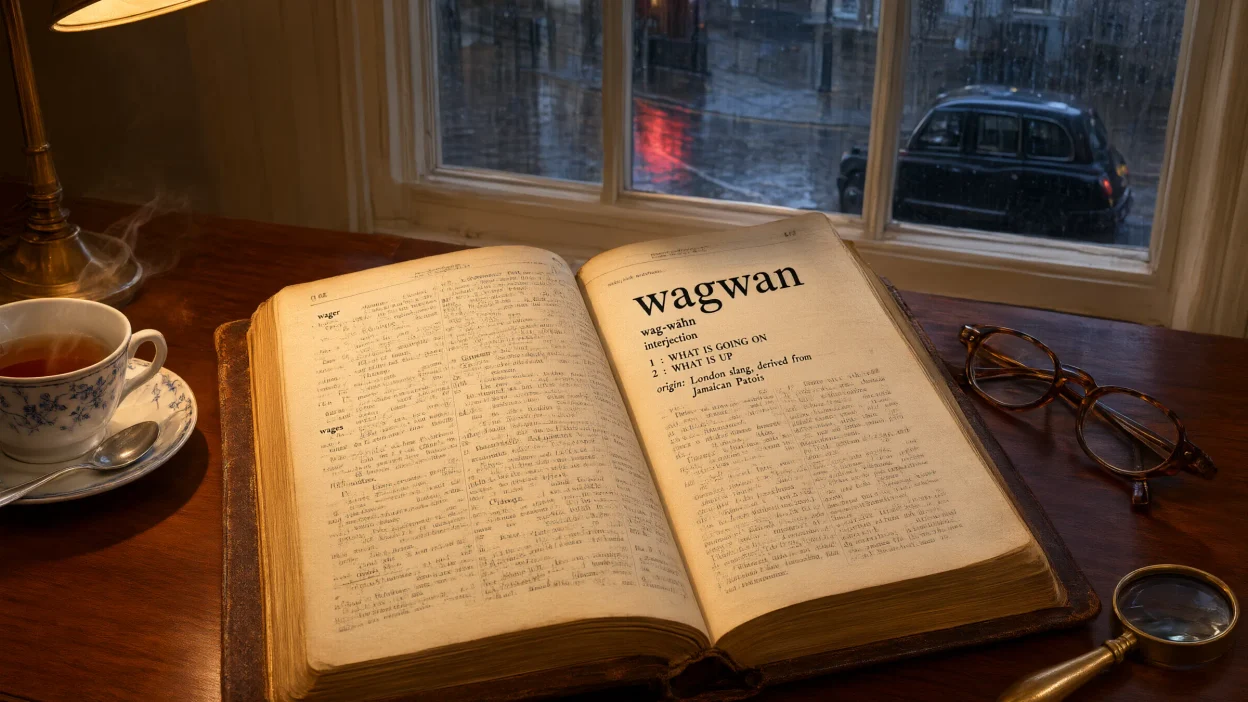
Wagwan is an informal slang greeting that means:
- What’s going on?
- What’s up?
- What’s happening?
- How are you doing?
- What are you up to?
In most everyday conversations, wagwan works much like “What’s up?” in American English.
For example:
“Wagwan, bro?”
This could simply mean:
“What’s up, bro?”
It can be used to start a conversation, check on a friend, or ask what is happening.
Collins Dictionary defines wagwan as British slang meaning “what is happening,” while Dictionary.com describes it as a way of saying “What’s going on?” in Jamaican English. (Collins Dictionary)
Simple Definition
Wagwan = What’s going on? / What’s up?
It is usually casual, friendly, and informal.
Where Does Wagwan Come From?
The word wagwan has roots in Jamaican Patois, also called Jamaican Creole or Jamaican Patwa.
It is linked to the phrase “Wah gwaan?”, which expresses the idea of “What’s going on?” or “What is happening?”
Dictionary.com explains that the phrase Wat a gwaan? was shortened into forms such as wah gwan and wagwan, particularly within the Jamaican diaspora. (Dictionary.com)
The expression later became strongly associated with Jamaican communities outside Jamaica, especially in South London.
Jamaican immigration and Caribbean cultural influence helped bring the expression into British urban speech. (Dictionary.com)
Today, you may hear or see it far beyond Jamaica and London.
It has spread through:
- Jamaican and Caribbean communities
- British slang
- Reggae and dancehall
- Grime and UK music
- Movies and television
- Social media
- Text messaging
- Online communities
So while wagwan is often described as British slang today, its linguistic roots are Jamaican.
What Does Wagwan Mean in Jamaican Patois?
In Jamaican Patois, “Wah gwaan?” is a common informal way to ask what is happening or how things are going.
In standard American English, the closest natural translations are:
- “What’s up?”
- “What’s going on?”
- “How are things?”
- “What’s happening?”
The word is not normally meant to be translated word for word in everyday conversation.
Its practical meaning depends on how it is used.
For example:
“Wagwan?”
usually sounds more like:
“What’s up?”
than a serious request for a detailed report about everything happening around you.
Is Wagwan a Greeting?
Yes. Wagwan is commonly used as a greeting.
It can be used when you meet someone, message a friend, or enter a casual conversation.
For example:
“Wagwan, Mike?”
The speaker is likely saying:
“What’s up, Mike?”
You can also use it without adding a person’s name:
“Wagwan?”
This can simply mean:
“What’s going on?”
Because it is informal, it fits best in relaxed conversations rather than formal settings.
How Do You Pronounce Wagwan?
Wagwan is commonly pronounced roughly like:
“wag-wahn” or “wah-gwan.”
The exact pronunciation can vary depending on the speaker, region, and accent.
You may also hear the original phrase “wah gwaan.”
The spelling does not always tell you exactly how someone will pronounce it because slang words often reflect spoken language.
If you are learning the word from text, listening to native or experienced speakers can help you understand its natural rhythm
What Are the Different Spellings of Wagwan?
You may see several spellings of the same expression.
Common forms include:
- wagwan
- wah gwaan
- wah gwan
- wha gwan
- wa gwan
These forms are related to the same Jamaican expression.
Dictionary.com specifically notes forms such as “wah gwan” and “wat a gwaan.” (Dictionary.com)
Online slang can have many spellings because people often write words the way they hear them.
So if someone writes “wah gwaan?” instead of “wagwan?”, the meaning is generally still:
“What’s going on?”
What Does Wagwan Mean in Text?
When someone sends “wagwan” in a text message, it usually means “What’s up?” or “What’s going on?”
For example:
Person A: “Wagwan?”
Person B: “Not much. Just relaxing.”
Here, wagwan is simply a casual way to begin a conversation.
You might also see:
“Wagwan bro?”
This means:
“What’s up, bro?”
Or:
“Wagwan tonight?”
This could mean:
“What’s happening tonight?”
The surrounding words help determine the exact meaning.
What Does Wagwan Mean on Social Media?
On social media, wagwan is often used as a quick greeting.
You might see it in:
- TikTok comments
- Instagram DMs
- Snapchat
- X posts
- Facebook messages
- YouTube comments
- Discord
- Gaming chats
For example:
“Wagwan 😂”
The person may simply be saying:
“What’s up?”
It does not automatically have a special hidden meaning.
The tone can change based on emojis, punctuation, and the rest of the conversation.
What Does Wagwan Mean in British Slang?
In British slang, wagwan is an informal greeting meaning “What’s going on?” or “What’s up?”
It is closely connected to Multicultural London English (MLE) and Jamaican influence on British urban speech.
Dictionary sources describe the expression as Jamaican in origin and established in British slang. (Dictionary.com)
You might hear:
“Wagwan, bruv?”
This is roughly:
“What’s up, bro?”
The expression is especially associated with casual speech and should not be treated as formal British English.
How Do You Reply to Wagwan?
If someone says “wagwan?”, you do not need a special answer.
You can reply naturally, just as you would reply to “What’s up?”
Common Replies
You can say:
- “Not much.”
- “I’m good.”
- “All good.”
- “Doing good, you?”
- “Nothing much, how about you?”
- “Just chilling.”
- “I’m fine. What about you?”
For example:
Person A: “Wagwan?”
Person B: “All good, you?”
That is a natural response.
Can You Reply “Wagwan” Back?
Yes. In a casual conversation, someone may respond with “wagwan” as another greeting.
For example:
A: “Wagwan!”
B: “Wagwan, bro!”
The meaning depends on the context and relationship between the speakers.
What Does “Nagwan” Mean?
You may sometimes see “nagwan” in discussions about Jamaican slang.
It is associated with the idea of “nothing’s going on.”
For example:
A: “Wagwan?”
B: “Nagwan.”
The basic idea is:
Wagwan? → “What’s going on?”
Nagwan. → “Nothing’s going on.”
However, this is more specific slang usage, so you should not assume every person who says “wagwan” expects “nagwan” as a reply.
A simple response such as “I’m good” or “Not much” works well.
Examples of Wagwan in a Sentence
Here are some simple examples.
Example 1: Greeting a Friend
“Wagwan, bro?”
Meaning:
“What’s up, bro?”
Example 2: Starting a Text
“Wagwan? How have you been?”
Meaning:
“What’s up? How have you been?”
Example 3: Asking About Plans
“Wagwan tonight?”
Depending on context, this can mean:
“What’s happening tonight?”
Example 4: Casual Group Greeting
“Wagwan, everyone?”
This is a relaxed way to greet a group.
Example 5: Checking on Someone
“Wagwan with you?”
This can mean:
“What’s going on with you?”
The exact tone depends on the speaker and situation.
Is Wagwan Formal or Informal?
Wagwan is informal.
It is best suited for:
- Friends
- Casual conversations
- Text messages
- Social media
- Online chats
- Informal groups
It would usually not be the right choice for:
- Job interviews
- Formal emails
- Business letters
- Academic writing
- Official documents
- Professional presentations
For a formal setting, use phrases such as:
“How are you?”
or
“How are things going?”
instead.
Is Wagwan the Same as “What’s Up?”
Not exactly, but they are very close in everyday use.
| Expression | Basic Meaning | Style |
| Wagwan | What’s going on? | Very casual |
| What’s up? | What’s happening? | Casual |
| How are you? | How are you doing? | Neutral |
| How’s it going? | How are things? | Casual |
| Hello | Greeting | Neutral |
| What’s happening? | What is going on? | Casual |
The main difference is cultural and linguistic background.
“What’s up?” is common across American English, while wagwan has Jamaican roots and strong links to Caribbean and British urban speech.
Is Wagwan Offensive?
The word itself is not inherently offensive. It is generally a casual greeting.
However, context matters.
Because wagwan comes from Jamaican language and culture, using it in a forced accent or mocking way can be disrespectful.
The issue is not simply the word itself but how and why someone uses it.
For example, there is a big difference between:
“Wagwan, how are you?”
and deliberately copying someone’s accent to make fun of them.
A good rule is to understand the cultural background and use the expression naturally rather than treating it like a costume or joke.
Who Uses the Word Wagwan?
Wagwan is associated with Jamaican speakers and the wider Jamaican and Caribbean diaspora. It is also found in British urban speech and online slang.
Its use can vary greatly from person to person.
Some people use it as part of their everyday speech. Others may recognize it mainly from:
- Music
- TV shows
- Social media
- Friends
- Internet culture
- British slang
Because slang spreads quickly, you may encounter it outside the communities where it originated.
Why Is Wagwan So Popular Online?
One reason is that slang travels easily through digital communication.
A short word such as wagwan is easy to use in a text, comment, or chat. Music, entertainment, and social media have also helped Jamaican and British slang reach audiences around the world.
When people encounter the word repeatedly online, they may start using it themselves.
This is why someone in a different country may recognize wagwan even if they have never visited Jamaica or the UK.
Still, knowing where the word comes from is important. Its popularity does not erase its Jamaican linguistic and cultural roots. (Dictionary.com)
Wagwan vs. “Wah Gwaan”
Wagwan and wah gwaan are closely related spellings.
The form “wah gwaan” more clearly shows the phrase behind the expression.
Wagwan is often written as one word, especially in slang and online communication.
For example:
“Wah gwaan?”
and
“Wagwan?”
can both be understood as:
“What’s going on?”
The spelling can change, but the basic greeting remains similar.
Can Wagwan Mean “What Are You Doing?”
Sometimes, yes.
The expression is flexible in casual speech.
For example:
“Wagwan later?”
could be asking what is happening later or what someone is doing later.
But “wagwan” does not have one strict English translation for every situation.
Depending on context, it can be closer to:
- “What’s up?”
- “What’s going on?”
- “What’s happening?”
- “How are you?”
- “What are you doing?”
Context gives the word its exact conversational meaning.
Does Wagwan Mean “Hello”?
It can function like hello, but it is more than a simple greeting.
When someone says:
“Wagwan?”
they are often greeting you while also asking how things are going.
That makes it similar to saying:
“Hey, what’s up?”
rather than simply:
“Hello.”
Is Wagwan Still Used Today?
Yes. Wagwan remains recognizable and in use in modern informal speech and online communication.
It appears in slang dictionaries and contemporary discussions of Jamaican and British slang, and recent online usage continues to show it in texting and social media contexts. (SlangDex)
However, slang changes over time. How common the word feels can depend on a person’s age, location, social group, and exposure to Jamaican or British culture.
FAQsWhat is the wagwan meaning?
Wagwan means “What’s going on?”, “What’s up?”, or “What’s happening?” It is a casual greeting with roots in Jamaican Patois.
What does wagwan mean in text?
In a text message, wagwan usually means “What’s up?” or “What’s going on?” It is normally a friendly, informal way to start a conversation.
Is wagwan Jamaican slang?
Yes. Wagwan has Jamaican Patois roots and is strongly associated with Jamaican and Caribbean speech.
It also became established in British urban slang. (Dictionary.com)
What do you reply when someone says wagwan?
You can reply with “I’m good,” “Not much,” “All good,” “Just chilling,” or “Doing good, you?” A natural response is similar to how you would answer “What’s up?”
Does wagwan mean hello?
It can work as an informal hello, but it usually carries the added sense of “What’s going on?” or “What’s up?”
Is wagwan British slang?
It is used in British slang, especially in Multicultural London English, but its roots are Jamaican. (LanGeek Dictionary)
What is the difference between wagwan and wah gwaan?
They are closely related forms. “Wah gwaan” reflects the Jamaican phrase behind “wagwan,” while wagwan is commonly written as one word in slang and online conversations.
Is wagwan rude?
No. Wagwan is generally a friendly, informal greeting. However, using Jamaican speech in a mocking or forced way can be disrespectful because of its cultural roots.
What does “wagwan bro” mean?
“Wagwan bro” usually means “What’s up, bro?” or “What’s going on, bro?”
What does wagwan mean on TikTok?
On TikTok, wagwan usually works as a casual greeting or way to ask what is happening. The exact tone depends on the video, comment, and surrounding text.
Can I use wagwan with my friends?
Yes, if it fits your normal casual speech and the context. It is an informal expression, so it is better suited to friends and casual conversations than professional settings.
Article Summary
Wagwan is a casual greeting that generally means “What’s going on?”, “What’s up?”, or “What’s happening?”
The expression has roots in Jamaican Patois, particularly the phrase “wah gwaan.”
It later became widely recognized in British urban speech, including Multicultural London English, and has spread through music, television, social media, and online communication. (Dictionary.com)
In a text, someone saying “wagwan?” is usually just checking in or starting a conversation.
You can answer with “Not much,” “I’m good,” “All good,” or another normal response.
The word is informal, so it works best in relaxed conversations rather than formal or professional writing.
While the word itself is generally friendly, understanding its Jamaican cultural roots helps you use it naturally and respectfully.
Conclusion
The wagwan meaning is simple: “What’s up?”, “What’s going on?”, or “What’s happening?”
Although the word is now familiar in British slang and online conversations, its roots are in Jamaican Patois.
You may see it written as wagwan, wah gwaan, wah gwan, or wha gwan.
If someone texts you “wagwan?”, there is usually no need to overthink it. A simple “I’m good, you?” or “Not much!” is a perfectly natural reply.

Emma Wilson is a writer at MeaningVibz who enjoys exploring emoji meanings, texting expressions, and online communication trends. She helps readers understand how emojis and slang are used in different situations by providing clear explanations and relatable examples for everyday messaging.