Introduction
Have you ever seen someone agree with a person just to win their support? Or watched a politician,
brand, or celebrity say exactly what an audience wants to hear? That behavior may be called pandering.
The pandering meaning is usually connected to trying to please someone by giving them what they want, especially when the effort seems excessive, calculated, or dishonest.
The word often has a negative tone because it can suggest that a person is seeking approval, votes, money, attention, or another benefit instead of acting from genuine beliefs.
Dictionary definitions describe pandering as catering to or profiting from the weaknesses, desires, or interests of others. (Dictionary.com)
In this guide, you will learn what pandering means in simple English, how to use pander to, see clear examples, compare it with words like pleasing and flattering, and understand common questions about the word.
Complete Article
What Does Pandering Mean?
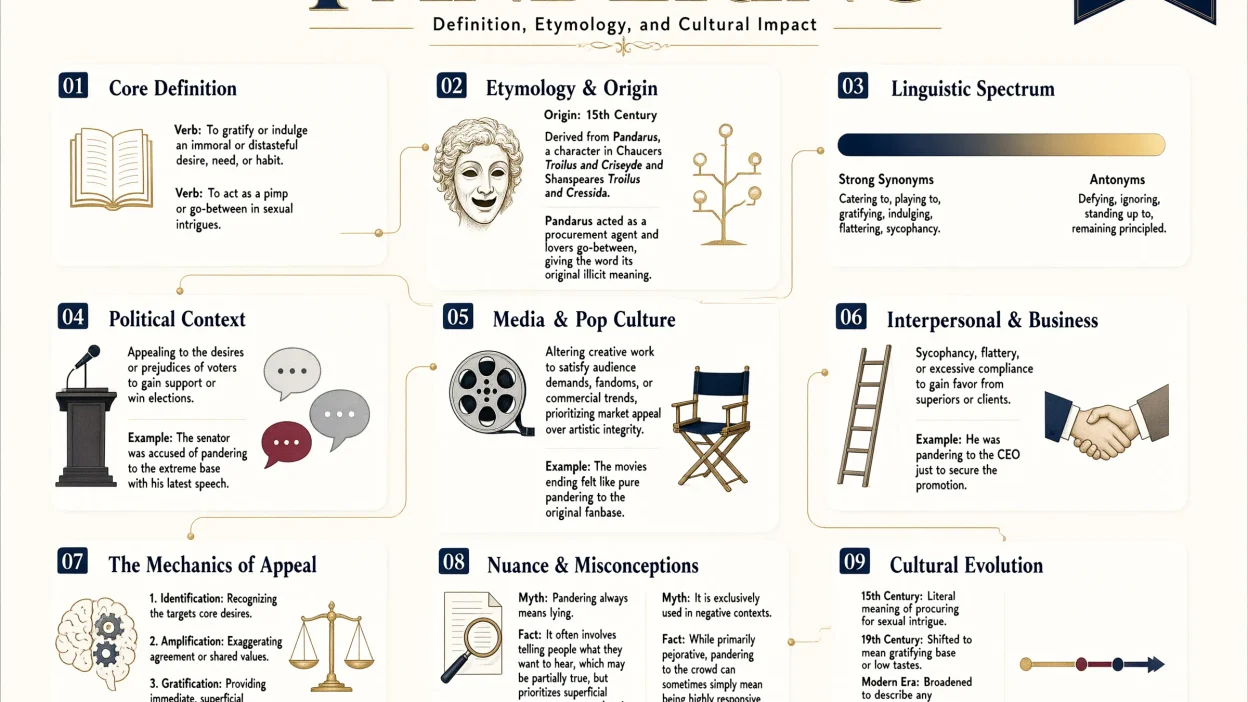
Pandering means trying to please a person or group by giving them what they want, often to gain approval, support, attention, or some other benefit.
It usually suggests that the person is being overly eager to please or is changing what they say or do mainly because they want something in return.
For example:
The politician was accused of pandering to voters.
This means the politician was accused of saying or doing things mainly to gain votes or public support.
The word can appear in many settings, including:
- Politics
- Advertising
- Social media
- Business
- Entertainment
- News and media
- Personal relationships
- Public debates
The important idea is strategic or excessive pleasing.
Pandering is not simply being nice. If someone helps a friend because they genuinely care, that is not normally called pandering.
The word becomes more appropriate when the behavior seems calculated, insincere, or aimed at gaining approval.
Pandering Meaning in Simple English
In very simple English, pandering means trying too hard to give people what they want so they will like you or support you.
Imagine a store owner who normally refuses to sell a certain product. After noticing that customers want it, the owner suddenly promotes it heavily just to increase sales.
Someone might say:
The company is pandering to its customers.
The statement suggests that the company is changing its behavior mainly to satisfy customers and gain something from them.
Another example is a politician who changes a position before an election because a large group of voters dislikes that position.
You could say:
The candidate is pandering to voters.
The criticism is not simply that the candidate is listening to voters. It suggests that the candidate may be saying whatever is popular to gain support.
What Does “Pander To” Mean?
Pander to is the most common expression related to pandering.
To pander to someone or something means to give in to their desires, interests, opinions, or demands, especially when doing so is viewed as excessive or self-serving.
Examples include:
- The candidate panders to voters.
- The company panders to its audience.
- The advertisement panders to people’s fears.
- The website panders to popular trends.
- The movie panders to its biggest fans.
The structure is easy to remember:
pander to + person, group, desire, opinion, interest, or emotion
For example:
The brand panders to younger consumers.
This means the brand is trying very hard to appeal to younger consumers, possibly because it wants their attention or money.
Dictionary sources also use pander to for the idea of catering to desires or weaknesses. (Dictionary.com)
Is Pandering Always Negative?
Usually, yes.
When someone says that a person is pandering, it is normally criticism.
For example:
He’s pandering to the crowd.
This does not usually sound like praise. It suggests that he is saying what the crowd wants to hear rather than expressing a sincere opinion.
Compare:
She listens to her customers.
This sounds neutral or positive.
With:
She panders to her customers.
This sounds negative. It suggests that she may be going too far to win their approval.
However, context matters. Someone can use pandering in a humorous or casual way.
The basic negative idea remains the same: trying to please others in a calculated or excessive way.
Examples of Pandering
Here are several examples that show how the word works in everyday American English.
Example 1: Politics
The candidate was accused of pandering to voters.
The candidate may be making promises or expressing opinions mainly to win votes.
Example 2: Business
The company is pandering to customers who want cheaper products.
The company may be changing its products or message to satisfy customer demand.
Example 3: Advertising
The ad was criticized for pandering to people’s fears.
The advertisement may be using fear because it gets attention or encourages people to buy something.
Example 4: Entertainment
Critics said the movie was pandering to its fans.
The critics believe the movie was designed mainly to give fans exactly what they wanted.
Example 5: Social Media
Some influencers pander to their followers to get more likes.
The meaning is that they may say or do things mainly to gain approval and engagement.
Example 6: Workplace
The manager was accused of pandering to the most popular employees.
The manager may be giving special treatment because they want approval from those employees.
Example 7: Public Opinion
The leader refused to pander to public opinion.
This means the leader refused to change their position simply because many people wanted something different.
Example 8: Personal Conversation
I don’t want to pander to him just because he’s upset.
The speaker does not want to say things merely to make the other person happy.
Pandering in a Sentence
There are several natural ways to use pandering.
As a verb
The politician is pandering to voters.
The company is pandering to young customers.
The website panders to people’s fears.
As a noun
The speech was pure political pandering.
Many viewers saw the statement as pandering.
As an adjective
The advertisement had a pandering tone.
The noun form is especially common when talking about the behavior itself:
Critics accused the brand of pandering.
Pandering vs. Pleasing
Pandering and pleasing are related, but they are not the same.
Pleasing simply means making someone happy or satisfied. It can be completely sincere.
Pandering usually suggests that someone is trying excessively or strategically to please others.
| Word | Basic Meaning | Usual Tone |
| Pleasing | Making someone happy | Neutral or positive |
| Pandering | Trying to satisfy someone to gain approval or benefit | Usually negative |
| Flattering | Giving praise to make someone feel good | Neutral to negative |
| Accommodating | Adjusting to someone’s needs | Usually positive |
For example:
The restaurant changed its menu to please customers.
This is neutral.
The restaurant changed its menu to pander to customers.
This sounds critical. It suggests that the restaurant may be trying too hard to win customer approval.
Pandering vs. Flattering
Flattering means giving someone praise or compliments, often to make them feel good.
Pandering is broader.
A person can pander by:
- Agreeing with someone’s opinions
- Changing a policy
- Giving special treatment
- Appealing to emotions
- Following popular trends
- Making promises
- Giving excessive praise
For example:
She flattered her boss by praising his presentation.
But:
She pandered to her boss by agreeing with everything he said.
The second sentence suggests a stronger lack of sincerity.
Pandering vs. Accommodating
Being accommodating is not normally a bad thing.
If a hotel changes a room arrangement to meet a guest’s reasonable needs, the hotel is being accommodating.
If a business constantly gives in to unreasonable demands just to keep customers happy, someone might describe that behavior as pandering.
So, accommodation can be helpful and reasonable, while pandering usually carries a critical meaning.
Pandering vs. Appeasing
Appeasing means trying to calm someone or stop conflict by giving them what they want.
Pandering can involve appeasement, but it often has a stronger connection to gaining approval or exploiting someone’s desires.
For example:
The manager apologized to appease the angry customer.
The goal is to calm the customer.
The manager was accused of pandering to the customer.
The statement suggests that the manager may be going too far to satisfy the customer.
Common Synonyms for Pandering
The best synonym depends on the sentence and context.
Catering to
This is one of the closest related expressions.
The website caters to young readers.
However, catering to can be completely neutral, while pandering is usually negative.
Indulging
To indulge someone means allowing them to have what they want.
He keeps indulging his children.
Appeasing
To appease someone means trying to calm or satisfy them.
She apologized to appease the customer.
Flattering
To flatter someone means praising them to make them feel good.
He flattered his manager.
Humoring
To humor someone means going along with their wishes or ideas, sometimes even when you do not agree.
She humored her friend during the discussion.
Sycophancy
Sycophancy describes excessive praise or obedience toward someone important or powerful.
It is related to pandering but has a more specific focus on submissive behavior toward another person.
Antonyms of Pandering
There is no single perfect opposite of pandering, but several words can express the opposite idea.
Standing firm
This means keeping your position even when others disagree.
The leader stood firm instead of pandering to the crowd.
Resisting
This means refusing to give in.
She resisted pressure from the audience.
Being honest
A person who states what they truly believe instead of saying what people want to hear may be described as honest rather than pandering.
Challenging
Someone can challenge popular opinions instead of simply agreeing with them.
The journalist challenged popular beliefs instead of pandering to readers.
Where Is Pandering Commonly Used?
The word appears in many areas of American English.
Political Pandering
Politics is one of the most common contexts.
A politician may be accused of pandering when critics believe the politician is saying what voters want to hear mainly to win elections.
For example:
The senator was accused of pandering during the campaign.
The accusation suggests that the senator’s statements were designed to gain votes rather than express a genuine position.
Media Pandering
News sites, websites, and media companies can also be accused of pandering.
For example:
The site was criticized for pandering to readers’ fears.
The criticism suggests that the content is designed to attract attention by appealing strongly to emotions.
Advertising Pandering
Advertisers may appeal to people’s desires, fears, or insecurities.
For example:
The campaign was accused of pandering to people’s insecurities.
The word is negative because the advertiser may be seen as taking advantage of those feelings.
Entertainment Pandering
Movies, TV shows, video games, and music can also be described as pandering.
For example:
Fans loved the new content, but critics called it pandering.
The critics may believe that the creators gave fans what they wanted instead of making choices based on artistic goals.
Social Media Pandering
On social media, people may use popular opinions or emotional topics to gain likes, shares, and followers.
For example:
The post felt like pandering for likes.
This suggests that the post was created mainly to get approval or engagement.
Why Does Pandering Sound Negative?
The negative meaning comes from the idea that someone is putting approval above sincerity.
A person may have their own beliefs, but instead of honestly sharing them, they may change their message because another group can provide a benefit.
That benefit might be:
- Votes
- Money
- Likes
- Followers
- Attention
- Popularity
- Business
- Social approval
This does not mean every attempt to appeal to an audience is pandering.
A writer should understand readers.
A company should listen to customers.
A politician should listen to voters.
A creator should understand fans.
These actions become more likely to be called pandering when the person seems to sacrifice honesty, principles, or quality simply to win approval.
Is Pandering the Same as Lying?
No.
Pandering can involve dishonesty, but lying is not required for something to be called pandering.
Someone may genuinely agree with an audience but still be accused of pandering if they appear to be excessively focused on pleasing that audience.
For example:
The comedian changed the show to match what fans wanted.
That alone does not prove pandering.
But:
Critics accused the comedian of pandering to fans by abandoning original material.
Here, the criticism is about the comedian appearing to prioritize approval over originality.
So, pandering is about the way and reason someone tries to please others, not simply whether the person tells a lie.
Is Pandering the Same as Being Nice?
No.
Being nice means treating people kindly.
Pandering suggests trying to satisfy people because you want their approval or another benefit.
Consider these two examples:
She helped her neighbor because he needed help.
That is kindness.
She agreed with everything her neighbor said because she wanted him to like her.
That could be described as pandering, depending on the situation.
The difference is important: kindness does not automatically equal pandering.
How to Pronounce Pandering
Pandering is commonly pronounced:
PAN-der-ing
It has three syllables:
pan – der – ing
The word comes from the verb pander.
What Is the Origin of Pandering?
The modern word pandering comes from pander, a word with a long history connected to a character named Pandarus.
Over time, pander developed into a term for someone who facilitates or caters to another person’s desires.
The modern sense focuses more broadly on satisfying people’s weaknesses, desires, interests, or preferences, often for personal advantage. (Dictionary.com)
There is also a separate legal use of pandering in some U.S. laws, particularly involving prostitution or sexually explicit material.
That legal meaning depends on the specific law and jurisdiction and is different from the everyday meaning discussed in most conversations. (Justia Legal Dictionary)
Common Mistakes When Using Pandering
Mistake 1: Using it for every kind act
Not every effort to help someone is pandering.
Incorrect idea:
She gave her friend a ride, so she was pandering.
Giving a friend a ride does not automatically involve pandering.
Mistake 2: Thinking pandering always means lying
A person can pander without making a false statement.
The key issue is the excessive or calculated attempt to satisfy others.
Mistake 3: Confusing pandering with pleasing
Pleasing can be positive.
Pandering usually has a negative or critical tone.
Mistake 4: Forgetting “to”
The common expression is:
pander to someone
For example:
The politician panders to voters.
Not:
The politician panders voters.
Mistake 5: Assuming only politicians pander
Politics is a common context, but pandering can happen in business, entertainment, advertising, media, social media, and everyday interactions.
Quick Comparison: Pandering and Similar Words
| Word | Meaning |
| Pandering | Trying excessively or strategically to please someone |
| Pleasing | Making someone happy or satisfied |
| Flattering | Giving praise to make someone feel good |
| Appeasing | Trying to calm or satisfy someone |
| Indulging | Allowing someone to have what they want |
| Accommodating | Adjusting to meet someone’s needs |
| Sycophancy | Excessive praise or obedience toward someone powerful |
| Catering to | Giving special attention to someone’s wants or needs |
The words overlap, but pandering usually has the strongest suggestion of insincerity or self-interest.
PAA: What Does Pandering Mean in Simple Terms?
Pandering means trying very hard to please someone or a group because you want their approval, support, money, attention, or another benefit.
It is usually used in a negative way.
PAA: What Is an Example of Pandering?
A simple example is:
A politician tells voters exactly what they want to hear before an election, even though the politician may not truly support those ideas.
That behavior can be described as political pandering.
PAA: Is Pandering a Negative Word?
Yes. Pandering is usually negative.
Calling someone a panderer or saying someone is pandering often suggests that the person is trying too hard to please others for personal gain.
PAA: What Does It Mean to Pander to Someone?
To pander to someone means to give that person what they want, especially when you are doing so to gain their approval or support.
Example:
He panders to his audience by agreeing with every popular opinion.
PAA: What Is Another Word for Pandering?
Possible alternatives include:
- Catering to
- Appeasing
- Indulging
- Flattering
- Humoring
- Satisfying
- Trying to please
- Curry favor with
The best choice depends on the context.
PAA: Is Pandering the Same as Flattery?
No.
Flattery focuses mainly on praise or compliments.
Pandering is broader and can involve agreeing with people, changing behavior, giving them what they want, or appealing to their emotions.
PAA: What Does Political Pandering Mean?
Political pandering means trying to gain voters’ support by saying or doing things that appeal strongly to them, especially when the behavior seems motivated more by winning support than by genuine political beliefs.
Related Searches for Pandering Meaning
People searching for pandering meaning may also look for:
- pandering definition
- what does pandering mean
- pandering meaning in simple English
- pander meaning
- pander to meaning
- what does pander to mean
- pandering examples
- pandering synonym
- pandering vs pleasing
- pandering vs flattering
- political pandering meaning
- pandering meaning in a sentence
- is pandering a bad word
- what does it mean to pander to someone
- pandering meaning in text
These searches all connect to the same main idea: understanding when someone is trying to please another person or group for approval or advantage.
Article Summary
Pandering means trying to please a person or group by giving them what they want, usually because you want approval, support, attention, money, or another benefit.
The word normally has a negative meaning because it can suggest excessive, calculated, or insincere behavior.
The common phrase “pander to” means to give in to someone’s desires, opinions, interests, or demands.
For example, a politician may pander to voters, while a company may pander to customers.
Pandering is different from simply being nice, helpful, accommodating, or pleasing. Those actions can be sincere and positive.
Pandering usually suggests that the desire to please others is excessive or self-serving.
FAQs
What does pandering mean?
Pandering means trying to please someone or a group by giving them what they want, often to gain approval, support, attention, or another benefit.
Is pandering a bad thing?
Usually, yes. The word normally has a negative meaning because it suggests excessive, calculated, or insincere attempts to please others.
What does “pander to” mean?
“Pander to” means to give someone what they want, especially when doing so is considered excessive or done to gain approval.
What is a simple example of pandering?
“The politician was pandering to voters.” This means the politician was accused of saying or doing things mainly to gain voters’ support.
What is the difference between pandering and pleasing?
Pleasing simply means making someone happy. Pandering usually means trying to please someone excessively or strategically for approval or personal benefit.
What is a synonym for pandering?
Depending on the context, related words include catering to, appeasing, indulging, flattering, and humoring.
Is pandering the same as lying?
No. Pandering does not require someone to lie. A person can be accused of pandering simply because they appear to be excessively changing their behavior or message to gain approval.
Can a business pander to customers?
Yes. For example, a company may be accused of pandering if it changes its message or products mainly to win customer approval in a way that seems excessive or insincere.
Can someone pander to their friends?
Yes. A person might pander to a friend by agreeing with everything the friend says or constantly giving in to the friend’s demands simply to stay on good terms.
What is political pandering?
Political pandering is an attempt to gain voters’ support by appealing strongly to what they want to hear, especially when the behavior appears motivated by votes rather than genuine beliefs.
Conclusion
The pandering meaning is easier to understand when you remember one simple idea: trying to please people because you want their approval or another benefit, especially in an excessive or insincere way.
The word is usually negative. It is often used when discussing politicians, businesses, advertisements, media, entertainers, and social media creators.
The phrase “pander to” is especially common, as in pander to voters, pander to customers, or pander to an audience.
Pandering is not the same as being kind or accommodating. Someone can genuinely listen to others and meet their needs without pandering.
The word becomes more appropriate when the effort to please appears calculated, excessive, or self-serving.
Once you understand that difference, you can use pandering, pander, and pander to naturally and correctly in American English.

Emma Wilson is a writer at MeaningVibz who enjoys exploring emoji meanings, texting expressions, and online communication trends. She helps readers understand how emojis and slang are used in different situations by providing clear explanations and relatable examples for everyday messaging.